Beer Prices in Switzerland: What You Actually Pay in 2026
133 beer deals at 6 chains for the canton of Zurich. Lowest price per litre: CHF 1.83/l. Updated 28 Sept 2026.
Lowest prices per litre
See all 133- deals
- 133
- chains
- 6

Kronenbourg 1664 Original Lager Beer 24x500ml
 Coopuntil Wed 30 Sept
CHF 1.83 per litre
CHF 21.90

 Denneruntil Wed 30 Sept
CHF 2.01 per litre
CHF 15.95
 AldiCERVEJA SAGRES · 330 ml
CHF 2.03 per litre
CHF 0.67
Promotions only, not regular shelf prices. Price per litre: deal price divided by the volume in litres, checked against the chain’s own figure where there is one. Source: deals published by the chains.
All beer deals
For the canton of Zurich
133 deals
- −50%Lowest per litre
Kronenbourg 1664 Original Lager Beer 24x500ml
CoopCHF 1.83 per litre
CHF 21.90was
43.80until Wed 30 Sept
- −42%
- Deal
- −50%
- −45%
- −50%
- −50%
- −38%
- Deal
- −40%
- −40%
Feldschlösschen Alcohol-Free Lager 24x500ml
CoopCHF 2.30 per litre
CHF 27.60was
46.00until Wed 30 Sept
- −50%
- Deal
- −39%
- −40%Online only
- −27%
- −36%
- −32%
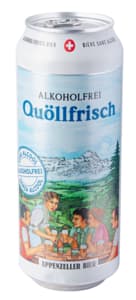
Appenzeller Bier Quöllfrisch Pale Can 24x500ml
CoopCHF 2.50 per litre
CHF 29.95was
43.80until Wed 30 Sept
- −48%
Desperados Original Tequila Flavored Beer 24x500ml
DennerCHF 2.50 per litre
CHF 29.95was
57.60until Wed 30 Sept
- −49%
- −30%
- −44%
- −28%
Appenzeller Quöllfrisch alcohol-free 4x6x500ml
 Aligro
CHF 2.58 per litre
CHF 31.00was
42.80until Sat 3 Oct
- −40%



 Lidl
LidlGuide
How Swiss beer prices work: brand tiers, a dated May 2026 shelf-price sample per retailer, promo timing, beer tax and cross-border limits.
In our May 2026 shelf-price sample, a beer in Swiss supermarkets cost from CHF 0.69 (a single 50cl can at Denner) to CHF 3.92 per bottle (Feldschlösschen Eve specialty 33cl), with restaurants charging CHF 6 to CHF 9 per glass. This guide puts the shelf prices for Feldschlösschen, Calanda, Eichhof, Cardinal, Quöllfrisch, and the discounter own-brands at all 7 major Swiss retailers in context, broken down by pack size, format, and region, so you can pick the beer that actually fits your budget. The current deals are at the top of this page.
Shelf prices sampled in May 2026 at coop.ch, aldi-suisse.ch, sortiment.lidl.ch, denner.ch, aligro.ch, ottos.ch. Current deals are at the top of this page and in the Rappn app. Migros does not sell alcohol in its main supermarkets; its beer channel is Denner.
Rappn is an independent grocery price comparison app in Switzerland, with no commercial agreements with any retailer.
Note: this article is an informational price comparison. Drinking guidelines and Swiss legal age limits (16 for beer and wine, 18 for spirits) apply.
How beer prices work in Switzerland
Three things drive what you pay for a beer in Swiss retail: format, brand tier, and region. Format is the biggest lever. A 50cl can typically costs 30 to 40 percent less per centilitre than a 33cl bottle. 6-pack and 10-pack multibuys cut another 15 to 25 percent versus single-bottle prices. Specialty bottles (33cl Eve, IPA, Weizen) carry a 50 to 80 percent premium over standard lager.
Brand tier matters next. The Heineken-owned Swiss portfolio (Feldschlösschen, Calanda, Cardinal, Eichhof, Haldengut) sits at the mainstream-premium tier, generally CHF 1.10 to CHF 1.40 per 33cl bottle in 6-pack format. Independent regional brands (Quöllfrisch from Appenzell, Müller Bräu from Baden, Schützengarten from St. Gallen) sit slightly above. Discounter own-brands and economy imports (Karlsbräu, Tell, Müller Bräu Lager) anchor the bottom at CHF 0.69 to CHF 0.95 per 50cl can.
Region matters too. Eastern and central Switzerland sees more Quöllfrisch and Eichhof on shelves; Romandie has more Cardinal and Boxer; Ticino sees more Italian imports (Moretti, Menabrea, Nastro Azzurro). Pricing is largely uniform nationally for the chains, but regional own-brand presence varies.
The Swiss Brewers Association (SBV) reports that in brewing year 2024/25 the total Swiss beer market including alcohol-free beer fell 1.8 percent to 4.72 million hectolitres, with Swiss breweries producing 3,688,146 hectolitres. Imports hold roughly a fifth of the market. Alcohol-free beer continues its rise: volume up about 13 percent and its share up to 7.5 percent, after 7.0 percent the year before (SBV press release, 26 November 2025).
Compare current offers and their supplied unit prices. Check the pack size, canton and validity dates. Preset search: «beer».
Spot the next beer Aktion. Rappn is freeFree, no account required · iOS & Android
"beer" · Feldschlösschen · Calanda · Quöllfrisch
Offers
Reference, May 2026: beer shelf prices per retailer (sample)
Prices as of May 2026, not current. Current deals are at the top of this page.
| Retailer | Cheapest beer (regular price) | Pack | Per litre |
|---|---|---|---|
| Denner | Karlsbräu Lager 50cl can, single | 50cl | CHF 1.38 |
| Aldi Suisse | Karlsbräu Lager / Tell Lager 6 x 50cl | 6 x 50cl | CHF 1.65 to CHF 1.95 |
| Lidl Schweiz | Argus / Perlenbacher Lager 6 x 50cl | 6 x 50cl | CHF 1.79 to CHF 2.10 |
| Aligro | Müller Bräu Lager 24-pack 33cl | 24 x 33cl | CHF 1.95 to CHF 2.30 |
| Coop | Eichhof Lager 10 x 33cl multipack | 10 x 33cl | CHF 3.30 |
| Otto's | Limited and rotating beer assortment | Varies | Varies |
| Migros | No alcoholic beer in main supermarkets (alcohol-free only) | n/a | n/a |
In that May 2026 sample, the Denner Karlsbräu single 50cl can at CHF 0.69 (CHF 1.38 per litre) had the lowest price per litre. Aldi and Lidl multipacks came close on per-litre but required buying 6 cans at once. For Swiss-brewed beer, Coop's Eichhof 10-pack at CHF 3.30 per litre was the usual reference point. This Denner vs Migros vs Coop comparison shapes most regular beer-shopping decisions.
Beer by brand tier: where the money actually goes
| Tier | Brands | Per 33cl bottle (regular) | Per litre |
|---|---|---|---|
| Discounter / economy | Karlsbräu, Tell, Argus, Perlenbacher | CHF 0.69 to CHF 0.95 | CHF 1.38 to CHF 2.10 |
| Swiss mainstream Heineken portfolio | Feldschlösschen, Calanda, Cardinal, Eichhof, Haldengut | CHF 1.09 to CHF 1.40 | CHF 3.30 to CHF 3.61 |
| Independent regional Swiss | Quöllfrisch (Appenzell), Müller Bräu (Baden), Schützengarten (St. Gallen), Boxer (Romandie), Valaisanne | CHF 1.10 to CHF 1.50 | CHF 3.30 to CHF 4.50 |
| Specialty Swiss craft | BFM (Jura), WhiteFrontier (Valais), Doppelleu, Erusbacher Bräu, Felsenau | CHF 2.50 to CHF 4.50 | CHF 7.50 to CHF 13.50 |
| Imported premium | Heineken, Erdinger, Leffe, Chimay, Kona | CHF 1.50 to CHF 3.50 | CHF 4.50 to CHF 10.50 |
Quick read: if you don't care about brand, discounter own-brands save you roughly 60 percent versus mainstream Swiss lagers. If you want a Swiss brand without paying a premium, Eichhof and Cardinal at Coop in 10-pack had the lowest shelf prices in May 2026, at CHF 3.30 to CHF 3.32 per litre. Craft beer triples the cost per litre but is reserved for occasions, not daily drinking. For broader context on how beverages fit into the wider grocery picture, see our food prices in Switzerland hub.
Beer goes on Aktion 30% off. Track once, get pinged automatically.
Watch Feldschlösschen, Eichhof, Calanda, Cardinal, or your favourite craft brand in the Rappn app, and it tells you when that beer goes on offer.
When beer goes on offer: the deal-mechanic patterns
Beer promotions follow predictable patterns. Knowing them turns a CHF 11.90 10-pack into a CHF 8.30 10-pack, which is a 30 percent saving on a recurring product.
The four reliable patterns in 2026:
1. Major football tournament run-ups. Euro and World Cup years see Coop, Denner, Aldi, and Lidl all run aggressive multipack promotions on Feldschlösschen, Calanda, and Cardinal in the 4 to 6 weeks before kickoff. Discounts of 25 to 35 percent are standard.
2. Summer terraces (May to August). All 7 retailers cycle promotions on 6-packs and 10-packs through the warm months. Coop typically pushes the Feldschlösschen and Calanda multipacks; Denner pushes its house lager 50cl cans; Aldi and Lidl rotate own-brands.
3. Christmas and New Year (mid-November to early January). Specialty seasonal beers (Calanda Glüh-Bier, festive lagers) appear at premium pricing. Standard lager multipacks see 20 to 30 percent off in the same window for parties and gatherings.
4. Cantonal festivals (Fasnacht, August 1, Oktoberfest weekends). Region-specific promotions in cantons hosting the events. Basel Fasnacht prompts Cardinal/Feldschlösschen pushes; Lucerne Fasnacht does the same for Eichhof; Zurich's Streetparade aligns with Calanda and craft beer push.
If you drink beer regularly, two simple habits cut your annual spend by roughly CHF 200 to CHF 400 per household: stock up on 10-packs during football and Christmas weeks, and switch the daily lager to a discounter own-brand 50cl can multipack. For a deeper look at how to stack these patterns across your weekly shop, see our save money on groceries in Switzerland guide.
Why Swiss beer prices are so high (and what's changing)
Swiss beer is structurally more expensive than German or Belgian equivalents on a per-litre basis at retail. Three reasons:
Smaller production runs. Switzerland had 1,149 registered breweries as at 16 January 2025, and 1,091 reported a beer-tax-liable output in calendar year 2025 (SBV), so the count is past its peak of about 1,200 and falling. Most are small craft producers without economies of scale. Even the mainstream chains (Feldschlösschen, Calanda) run smaller volumes than German national brands.
Alcohol tax (Biersteuer). Switzerland levies a federal beer tax of CHF 16.88 per hectolitre at standard alcohol content (4 to 4.5 percent ABV), with progressive rates above. Combined with the 8.1 percent standard VAT (since 2024), the tax stack adds roughly CHF 0.10 to CHF 0.15 per 50cl can compared to untaxed retail.
Swiss agricultural and labour costs. Hops, malt, and packaging are more expensive in Switzerland than in EU producer countries. Combined with Swiss labour rates, the structural floor on Swiss-brewed beer is roughly 30 to 40 percent above German equivalents.
Two competitive forces are pushing prices down at the discounter level. Aldi Suisse's Karlsbräu and Tell lines and Lidl Schweiz's Argus / Perlenbacher own-brands have anchored the per-litre floor at CHF 1.65 to CHF 2.10 in multipack format. And Denner's single-can pricing (CHF 0.69 for a 50cl Karlsbräu in May 2026) kept the spot price low for buyers who don't want a 6-pack commitment.
For comparison shopping across the cheapest stores in your area, the cheapest supermarket in Switzerland hub breaks down where the math actually lands, and the Aligro Switzerland page covers cash-and-carry beer crate pricing for higher-volume buyers.
Cross-border beer: how much can you save?
Since January 1, 2025, Swiss customs allows up to CHF 150 of goods per person per day duty-free, per the Federal Office for Customs and Border Security (BAZG). For beer specifically, Switzerland allows up to 5 litres per person per day duty-free under the personal allowance for beverages with up to 18 percent alcohol. Above that, the agricultural and alcohol tariff applies (around CHF 0.25 per litre for beer above the personal allowance).
A 6-pack of Krombacher or Bitburger at Edeka Konstanz, Lidl Lörrach, or Carrefour Annemasse typically costs EUR 4.50 to EUR 6.50, roughly CHF 4.25 to CHF 6.10. That is 30 to 50 percent below Swiss equivalents at Coop. Five litres per person per day (10 cans of 50cl) makes beer one of the categories where cross-border genuinely pays.
The catch: a single trip to Konstanz typically costs CHF 15 to CHF 30 in fuel and tolls (vignette excluded), so the trip pays back only if you bundle beer with other heavy or high-tariff items (meat, butter, cheese). For occasional bulk runs, especially before parties or gatherings, the math works.
Beer is one of the most reliable promo categories in Swiss retail.
Pin Feldschlösschen, Eichhof, Calanda, Cardinal, or your favourite Swiss craft brand. Track up to 50 products at once. Get Rappn free.
Updated: .
Why Rappn?
Rappn is an independent grocery price comparison app in Switzerland, with no commercial agreements with any retailer. Our comparisons are truly independent.
- 100% free: no subscription, no hidden costs
- Neutral: no commercial agreements with Migros, Coop, Aldi, Lidl, Denner, Aligro, or Otto’s
- Updated daily, as soon as the chains publish their deals
- The chains’ deals in one place: search, filter, compare, no account needed
Ready to save on groceries?
Install Rappn and compare for yourself this week. No account required.Scan the code, install Rappn and compare current offers. No account needed.
Built in Switzerland, for Switzerland
Frequently Asked Questions
How much does beer cost in Switzerland in 2026?
A standard Swiss lager (Feldschlösschen, Calanda, Cardinal, or Eichhof) in a 10-pack at Coop cost CHF 10.90 to CHF 12.95 in May 2026, or CHF 1.09 to CHF 1.30 per 33cl bottle. In that sample, the lowest-priced single beer was the Denner Karlsbräu 50cl can at around CHF 0.69 (CHF 1.38 per litre), and discounter 6-packs at Aldi or Lidl sat at CHF 5.50 to CHF 7.20 (CHF 1.65 to CHF 2.40 per litre). Restaurant beers run CHF 6 to CHF 9 per glass. The current deals, sorted by price per litre, are at the top of this page.
Where is beer cheapest in Switzerland?
It changes every week: the list at the top of this page ranks the current deals of all retailers by price per litre. In the May 2026 shelf-price sample, Denner had the lowest single 50cl cans at CHF 0.69 to CHF 0.95 (Karlsbräu and similar), Aldi Suisse and Lidl Schweiz came close in 6-pack format, and for Swiss-brewed beer Coop's Eichhof 10x33cl at CHF 10.90 (CHF 3.30 per litre) was the usual low. Aligro is competitive on cases of 24 but oriented to professional buyers. Migros does not sell alcoholic beer in its main supermarkets.
Why doesn't Migros sell alcoholic beer?
Since 1928, Migros has had a self-imposed ban on selling alcohol and tobacco in its main supermarkets. The policy was confirmed by member vote in 2022. Migros's alcohol channel is Denner, which Migros owns. If you want beer in the orange-M ecosystem, the answer is to walk to a Denner.
What are the best Swiss beer brands?
Mainstream: Feldschlösschen (Switzerland's largest, brewed in Rheinfelden since 1876), Calanda (Chur, since 1902), Cardinal (Romandie favourite), Eichhof (Lucerne, since 1834). Independent regional: Quöllfrisch by Brauerei Locher (Appenzell), Schützengarten (St. Gallen, Switzerland's oldest brewery, 1779), Müller Bräu (Baden), Boxer (Romandie). Specialty craft: BFM, WhiteFrontier, Doppelleu.
When is beer on offer in Switzerland?
The reliable peak-promo windows are the 4 to 6 weeks before major football tournaments (Euro, World Cup), the summer terrace season (May to August), the 6 weeks before Christmas and New Year, and around major cantonal festivals (Fasnacht, August 1). Discount depths of 20 to 35 percent are standard at all 7 retailers.
Is alcohol-free beer cheaper than regular beer?
Not at regular prices: in May 2026, alcohol-free Feldschlösschen, Eichhof, and Calanda at Coop ran CHF 1.20 to CHF 1.45 per 33cl bottle in 6-pack format, versus CHF 1.10 to CHF 1.30 for the alcoholic version. The category is growing fast: up about 13 percent per the Swiss Brewers Association (SBV) for brewing year 2024/25, and now 7.5 percent of the total Swiss beer market, after 7.0 percent the year before.