
Grocery guide for expats in Switzerland: shopping in English, in four languages
4 chain families decide what a newcomer pays in Switzerland, and the order matters (updated September 2026): Aldi and Lidl set your floor, Denner covers a fast city shop, Migros adds M-Budget and Coop adds Prix Garantie. Most shops close on Sunday, so the fallback is a station or airport branch. Below: the 30 day routine for month one, the 5 tips that keep the bill down, and the customs rules to check before any cross-border trip.
Rappn compares the current promotions of 7 Swiss retailers, updated daily: free, no subscription.
Find your local prices. Rappn is free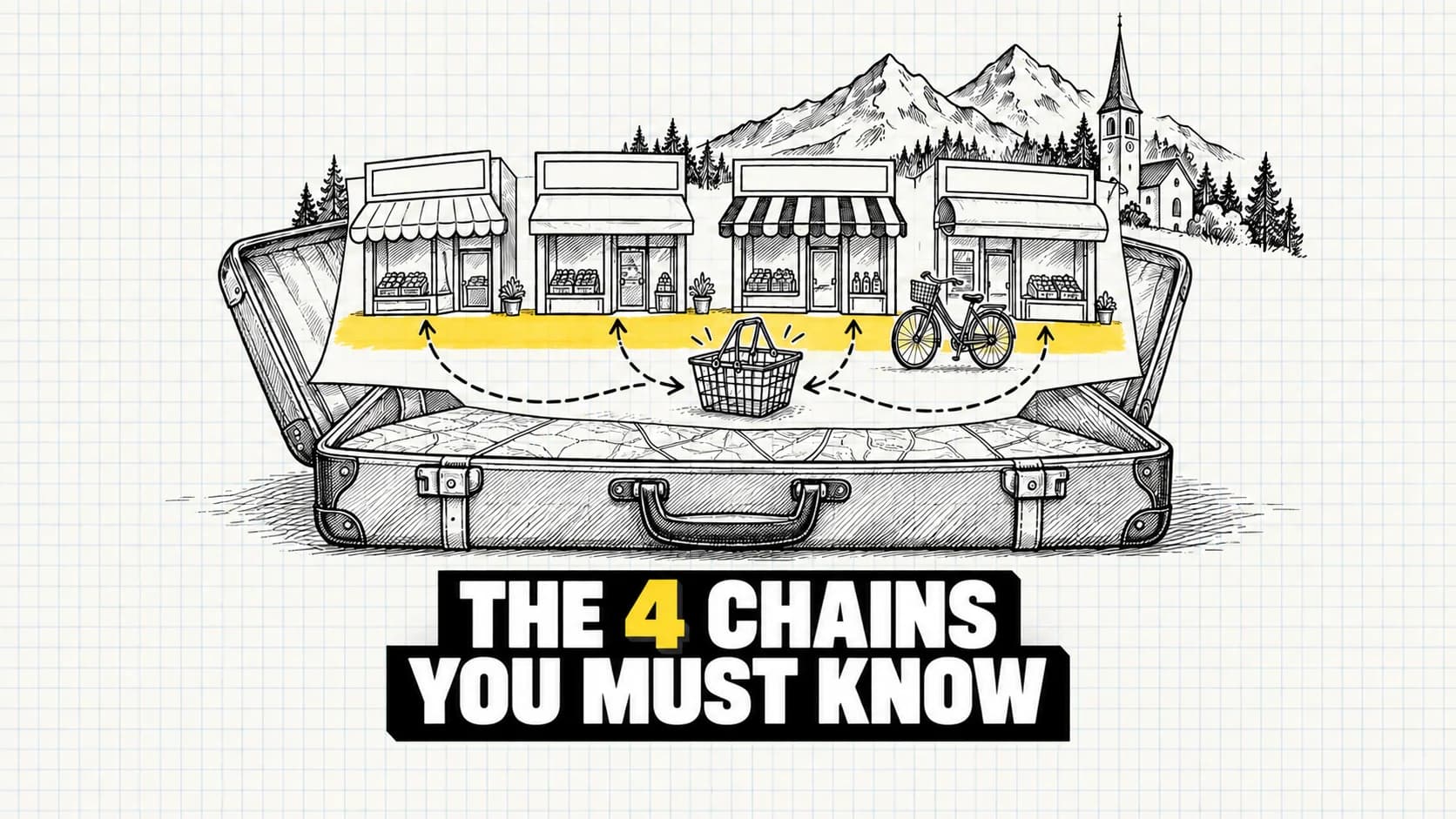
Let's start with reality, not clichés. In Switzerland, grocery prices are among the highest in Europe, and expats feel that difference immediately. That does not mean every single product costs "two or three times more," but it does mean the overall price level is clearly above what many newcomers are used to.
The good news is that Switzerland is not chaotic. The grocery market is highly structured. If you quickly understand the difference between discount chains, premium chains, budget ranges, loyalty cards and opening hours, you can avoid the classic mistakes of the first few months. Most importantly, you stop shopping "randomly," which in Switzerland is the fastest way to spend too much.
Can you use a grocery app in English without an account?
“The app defaults to German and does not let me change the language.” If that is the problem you encounter, start with a service whose information you can understand. Rappn is available in German, French, Italian and English, free and with no account needed. Search for a product across the offers from the seven covered chains, then use the canton filter to narrow the area. Prices per kilogram, litre or piece help you compare different pack sizes. For your first shopping trip, use a short list of familiar staples and check which offers fit your location. This guide does not assume a particular language-switching control. The practical aim is to understand the product, quantity, price and validity before you choose a store or add a journey.
New to Switzerland? Five chains run the grocery scene: Migros and Coop for the broad assortment, Aldi and Lidl for discount, Denner for Swiss-style discount. Rappn shows all five in one feed, start on the home view, switch tabs to compare.
Find your local prices. Rappn is freeFree, no subscription · iOS & Android
New here? · Migros · Coop · Aldi · Lidl · Denner
Welcome
The first thing to understand: shopping in Switzerland is different from the rest of Europe
The general rule is simple: normal retail is heavily restricted on Sundays. The real exceptions, the ones that actually change daily life for expats, are shops in train stations and airports. If you live near a major station or airport, you have an emergency plan. If you live in a normal residential area, you need to organise ahead.
The second difference is opening hours. Outside stations and airports, many branches close in the late afternoon or early evening. If you come from a country where grocery shopping at 9:30 pm or on Sunday afternoon is normal, this is probably the habit you will need to change first.
The third difference is small but symbolic: do not assume bags are free. In Switzerland, paying for a bag is normal. The practical rule for newcomers is simple: always keep a reusable bag in your pocket, backpack or car.
The 4 supermarket chains you really need to know
1. Aldi and Lidl
Positioning: The cheapest
Why they matter: If you have just arrived and want to lower your grocery bill quickly, Aldi and Lidl are the most logical place to start. They offer a simpler assortment, plenty of weekly deals, international products and fewer premium temptations.
For expats, the advantage of Aldi and Lidl is not just price. It is also simplicity: less choice, less distraction, fewer unnecessary purchases. In the first few months, when you still do not know which products are genuinely expensive in Switzerland and which are still reasonably priced, discounters are the best place to build your mental price benchmark.
2. Denner
Positioning: Strong value for money
Why it matters: Denner is the chain many newcomers underestimate. In practice, it combines small city-centre stores with weekly promotions, especially on wine and featured offers.
In expat terms, that means Denner is often the chain to use when you do not have an Aldi or Lidl nearby but still want to stay disciplined on budget. It is not the place for a gourmet experience; it is the place where you can often do a practical, fast and sensible shop.
3. Migros
Positioning: The biggest chain, strong on private label
Why it matters: Migros is one of the pillars of everyday Swiss life. Its logic is clear: strong chain identity, broad national presence and a major focus on own brands. For years it was also famous for not carrying many classic international brands, and even today private label plays a much bigger role here than in many other supermarket systems.
For expats, Migros is often the right choice if you want a reliable, widespread and easy-to-understand chain. The M-Budget range is crucial: it is the simplest way to keep spending under control without giving up the convenience of Switzerland's most established supermarket chain.
4. Coop
Positioning: Wider choice, more premium
Why it matters: Coop is the chain where you will often find "almost everything" more easily: more brands, more categories, more organic products, and more range overall. For many expats, it is the most intuitive supermarket because it feels closest to a large, full-range European supermarket.
The trade-off is that if you walk in without a list or a plan, you can spend more than you intended very quickly. The right move is to use Coop deliberately: Prix Garantie for basics, weekly promotions for known brands, and organic products when that really matters to you. In general, Coop is often the best for choice, but rarely the cheapest.
The key differences that surprise almost every expat
The first: emergency shopping almost always costs more, or forces you to shop somewhere you did not really want to go. If you realise on Sunday evening that you are missing something, in Switzerland you are usually simply too late. Grocery shopping here needs a bit more planning.
The second: budget ranges are not a detail, they are the system. In many countries, expats walk into a supermarket and buy "the brand they know." In Switzerland, that approach gets expensive. You need to quickly learn the signals: M-Budget at Migros, Prix Garantie at Coop, weekly promotions at Denner, and deals plus apps at Aldi and Lidl.
The third: loyalty cards really matter. Cumulus, Supercard and discount apps are not marginal extras. If you stay in Switzerland for more than a few weeks and do not activate them, you are leaving money on the table.
Cross-border shopping: yes for some, no for others
Many expats arrive with the same idea: "I'll just shop in France, Germany or Italy and save a fortune." Sometimes that is true. But not always.
If you live near the border, for example in Basel, Geneva, Lugano or Schaffhausen, shopping abroad can make a lot of sense, especially for large purchases, toiletries, wine, drinks or household products. If you live in Zurich, Bern, Lucerne or Lausanne instead, travel time and transport costs often eat up much of the benefit.
The honest answer is this: shopping abroad is not a universal solution for all expats in Switzerland. It works very well in some regions, much less in others. Before you go, you should always check customs rules, the allowance per person and quantity limits on certain products.
The simple strategy for your first 30 days
In your first month in Switzerland, the best strategy is not to find "the perfect supermarket" right away. It is to build a system.
First: do one benchmark shop at Aldi or Lidl. This helps you understand your realistic floor.
Second: do one benchmark shop at Migros or Coop, but buy mostly budget lines and promotions. This shows you how much more you are paying for convenience, selection and perceived quality.
Third: activate Cumulus, Supercard and at least one discount app immediately. In Switzerland, saving money does not start "later"; it starts on day one.
Fourth: identify your Sunday plan immediately. Find out which station or store can save you in an emergency, or organise your weekly shopping in a more disciplined way from the start.
Fifth: always carry a bag. It sounds trivial, but it is one of those small habits that really helps you adapt to the Swiss way of grocery shopping.
Specific tips for expats
- Do not start blindly with Coop or Migros. Start with Aldi or Lidl to set your mental baseline, then go back to the bigger chains with more intention.
- Denner is often more useful than you think. Especially if you live in a city and want something between a pure discounter and a traditional supermarket.
- Budget lines are central, not secondary. M-Budget and Prix Garantie are not "lesser" products; they are the grammar of saving money in Switzerland.
- Sundays need planning. Exceptions do exist, but they are real exceptions: stations, airports and a few special locations.
- If you live near the border, learn the rules before you go. For some expats it is absolutely worth it. For others, not at all.
Compare supermarket deals in Switzerland
Rappn collects offers from Migros, Coop, Aldi, Lidl and Denner and helps you compare prices by area and by product. For expats, it is the easiest way to turn grocery shopping from a monthly source of stress into a routine you can control.
Updated: .
Why Rappn?
Rappn is an independent grocery price comparison app in Switzerland, with no commercial agreements with any retailer. Our comparisons are truly independent.
- 100% free: no subscription, no hidden costs
- Neutral: no commercial agreements with Migros, Coop, Aldi, Lidl, Denner, Aligro, or Otto’s
- Updated daily, as soon as the chains publish their deals
- The chains’ deals in one place: search, filter, compare, no subscription
- Meal planner in the Kitchen tab: plan the week, send the ingredients to your list

Ready to save on groceries?
Install Rappn and compare for yourself this week. No account required.Scan the code, install Rappn and compare current offers. No account needed.



Frequently Asked Questions
Which supermarket should I start with when I first move to Switzerland?
If your goal is to understand the lowest realistic grocery budget first, start with Aldi or Lidl. Then compare with Denner, Migros and Coop using promotions and budget lines.
Is it true that you cannot really shop on Sundays in Switzerland?
As a general rule, yes: most shops are closed. The main practical exceptions are train stations and airports.
Does Migros mainly sell private-label products?
Yes, and that is one of the key things to understand early. Private label is central to Migros, and M-Budget is the main range for spending less.
Is Coop the best choice for organic food?
For many people, yes, especially because it has a broader range and a strong organic presence. In general, Coop is often the best for selection, but not for price.
Is cross-border grocery shopping always worth it?
No. It depends on where you live, how much you buy and how many people are in the car. If you live near the border, it can make a lot of sense; in central Switzerland, often much less.
Grocery shopping in Switzerland for expats: where do you actually start?
Start at Aldi or Lidl for one benchmark shop, so you know your realistic floor. Then do a second benchmark at Migros or Coop, buying mostly the budget lines, M-Budget and Prix Garantie, and the weekly promotions: that shows what you pay for choice and convenience. Activate Cumulus and Supercard in the first week. Plan Sundays in advance, because outside train stations and airports most shops are closed, and keep a reusable bag with you, since bags are not free here.
Is there a grocery app in English for Switzerland?
Rappn is available in German, French, Italian and English, free, no account needed. You can search for products across chains, compare unit prices and filter the offers by canton.