Grocery Price Comparison in Switzerland: Which App Really Covers Every Supermarket?
A practical guide for anyone who wants to spend less without dedicating their Saturday morning to flipping through flyers. With real tools and tips that actually work.
Rappn compares the current promotions of 7 Swiss retailers, updated daily: free, no subscription.
Download Rappn, comparing is free
Updated: September 2026. Source: K-Tipp.
Groceries in Switzerland are expensive. We all know this. But what's even more expensive is not knowing that the coffee you just bought at Migros at full price is 40% off at Denner this week. Or that the detergent you paid CHF 25 for at Coop on Friday will be half price at Lidl on Monday.
The problem isn't that deals don't exist. Every week, Migros, Coop, Aldi, Lidl, Denner, Otto's and Aligro publish hundreds of promotions. The problem is that nobody has time to go through seven different flyers to find the ones that matter.
This guide is for anyone who wants to save on groceries in a practical way, without becoming a coupon obsessive and without spending hours planning. We'll explain how the pricing and promotion system works in Swiss supermarkets, and what tools exist to make your life easier.
How prices work in Swiss supermarkets
Before we talk about tools and apps, it helps to understand the system. Once you get the logic, saving money becomes almost automatic.
Basic products cost roughly the same everywhere. Milk, butter, sugar, flour, bread, spaghetti: prices across Migros, Coop, Aldi, Lidl and Denner are virtually identical for these items. K-Tipp confirms this regularly. For your daily shop, the nearest store is fine.
The real difference comes from three things:
First, the budget line. M-Budget at Migros and Prix Garantie at Coop are often much cheaper than the standard lines in the same store; the unit price on the shelf label shows by how much. Buying M-Budget instead of M-Classic at the same Migros saves you more than switching supermarkets. It's the single change with the best effort-to-savings ratio.
Second, weekly promotions. Every supermarket puts different products on promotion each week, with discounts of 20-50%. For items like detergent, coffee, toilet paper and meat, buying on promotion versus full price makes an enormous difference to your monthly budget. Since 5 February 2026 (Coop since January 2025), Migros, Coop and Denner all run the same promotion cycle: Thursday to Wednesday.
Third, the unit price (per kilo or per litre). This is the trick supermarkets hope you won't use. Two packs of the same product can have similar shelf prices but completely different per-kilo prices. The bigger pack isn't always cheaper. Reading the unit price is the habit that separates people who actually save from people who think they save.
This is what comparing prices looks like in Rappn: the live offers of the seven Swiss chains, side by side in one feed. Type a product, switch tabs, dig into your shopping list.
Download Rappn, comparing is freeFree, no subscription · iOS & Android
All retailers · Migros · Coop · Aldi · Lidl · Denner
Offers
The practical method (10 minutes per week)
You don't need a spreadsheet and you don't need to visit five stores. You need a simple method you can follow every week in a few minutes.
Wednesday evening: check the week's deals. Migros, Coop and Denner start Thursday; Aldi and Lidl also on Monday, Aligro on Monday, Otto's on Tuesday. The Migros and Denner flyers are out on Wednesday. In 10 minutes you can see if anything you care about is on offer.
Focus on 3 categories. You don't need to check everything. The categories that go on promotion most reliably are meat, household products (detergent, toilet paper) and coffee/drinks. When one of these is on promotion, buy more and stock up.
Don't switch stores to save 50 centimes. The time and petrol to reach another shop often cost more than you'd save. Only switch stores for genuine bargains: 40-50% off something you buy regularly.
What tools are available?
There are several ways to keep track of deals in Switzerland. Here they are, from simplest to most comprehensive.
Paper and online flyers. Every supermarket publishes its weekly flyer, both in your letterbox and online. The downside: you need to check 5-7 different sites and compare manually.
Flyer aggregator websites. Some websites collect flyers from different supermarkets in one place. Useful for browsing, but you can't search for a specific product or compare prices directly.
Individual supermarket apps. Migros has its app with Cumulus, Coop has theirs with Supercard, Lidl has Lidl Plus. Each shows only its own deals. To compare, you need to open 5 different apps, and each one obviously only shows its own promotions.
Price comparison apps. This is where it gets interesting. A price comparison app collects deals from all supermarkets and shows them in one place. You search for a product and compare its price across the chains, without opening 5 different apps.
Grocery price comparison in Switzerland: what a real check covers
Not all comparison apps are equal. Here are the features that make a real difference for grocery shopping in Switzerland.
Supermarket coverage. The app should include at least the big 5: Migros, Coop, Aldi, Lidl and Denner. If it also covers Otto's and Aligro, even better.
Product search, not just flyer browsing. Being able to type "coffee" and see every active coffee deal across all supermarkets is far more useful than scrolling through flyer pages.
Integrated shopping list. Saving deals directly to a shopping list without having to copy them down is a huge time saver. If the list is shareable with your partner or family, even better: anyone in the household can add items, and everyone sees where to buy them cheapest.
Price alerts. If you buy coffee every two weeks, an alert telling you "Chicco d'Oro is on promotion at Denner this week" saves you money without you having to check anything.
Canton filter. In Switzerland, deals can vary by canton. An app that shows only deals available in your area avoids the frustration of finding a great offer and discovering it doesn't apply where you live.
Visible unit price. The price per kilo or litre should always be shown. It's the only way to truly compare two similar products.
Rappn: how it works
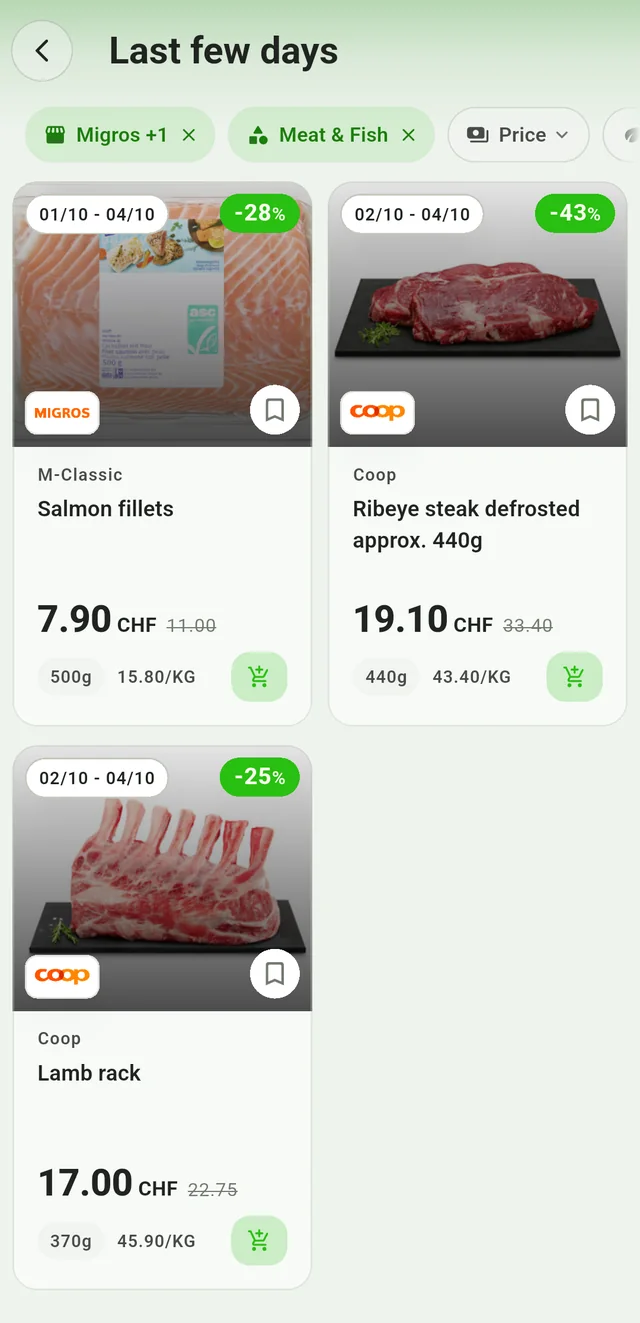
Rappn is the app we built to solve exactly this problem. It collects deals and prices from Migros, Coop, Aldi, Lidl, Denner, Otto's and Aligro in one place. It's not a flyer app. It's a search engine for Swiss supermarket deals.
Here's how it works in practice.
Search a product, see every deal. Open the app, type "coffee" in the search bar. In one second you see every active coffee promotion across all supermarkets, with price, discount percentage and store. No flyer needed.
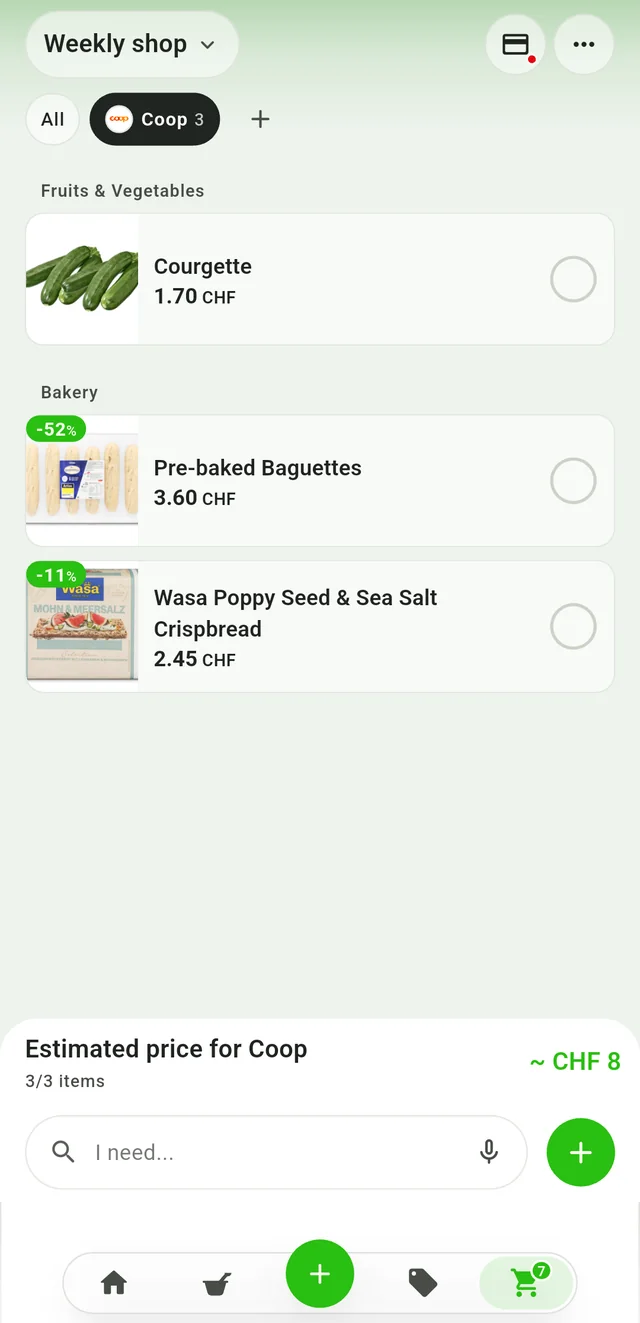
Add to your shopping list with one tap. Found a deal you like? One tap and it goes straight to your shopping list. The list is shareable: your partner, your kids, your flatmates can add items from their app, and everything syncs in real time. When you get to the store, your list is ready with all the deals already in it.
Save your favourite products. If you always buy the same things (coffee, milk, detergent, nappies), you can save the categories you care about. Rappn shows you the relevant deals every week without you having to search.
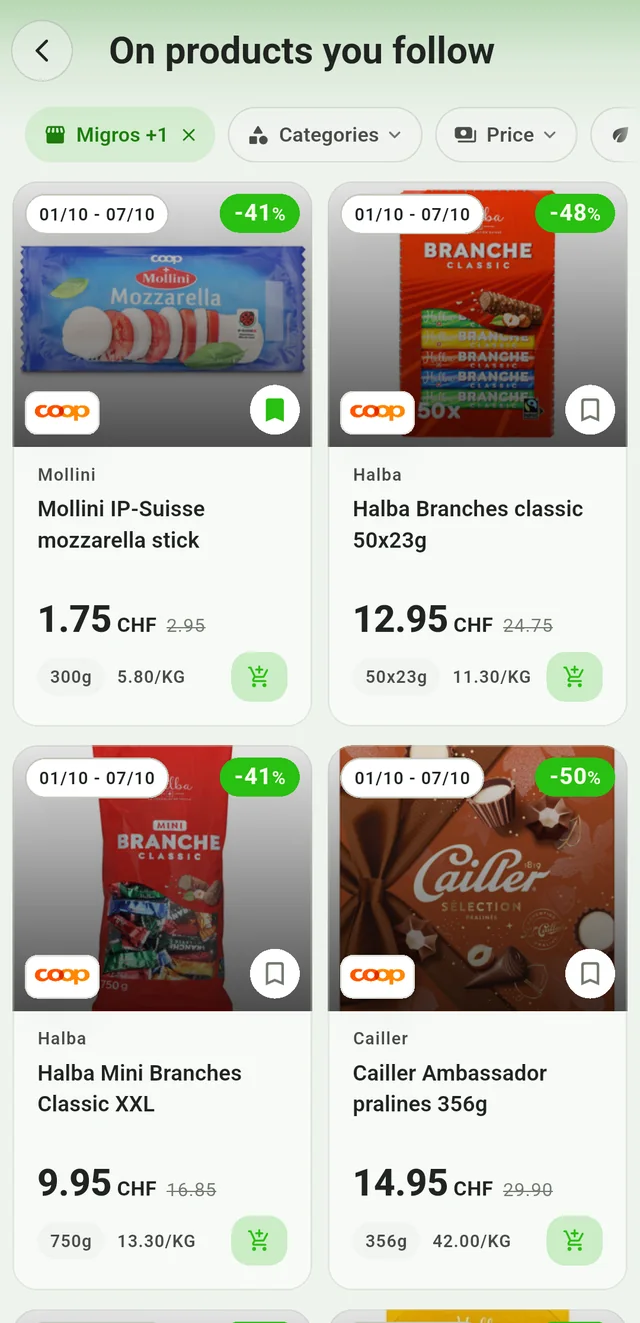
Set up a price alert. Activate an alert for a specific product. When it goes on promotion at any supermarket, you get a notification. No more "I wish I'd known it was on offer last week."
Everything filtered by your canton. You only see deals available in your area.
Unit price always visible. Next to the shelf price, the per-kilo or per-litre price is shown. Comparing becomes instant.
How much can you realistically save?
It depends on what you spend and on how you shop today, so we put no monthly figure on it for you. What exists is a measured spread: in the K-Tipp basket of 100 everyday products (August 2025), Aldi came to CHF 230.94 and Coop to CHF 250.70, about 8.6 per cent apart on that basket.
The three levers are always the same: the budget line instead of the standard line, pantry items only on promotion, and fresh where it pays that week. What they are worth on your own basket only your own basket shows, live and for your canton.
A note on independence
Rappn has no commercial agreements with any retailer. We don't receive money from Migros, Coop, Aldi, Lidl, Denner or anyone else to display their deals more favourably. All deals are shown as they are, with no preferences.
This matters to us. In a market where every supermarket has its own app and its own loyalty programme, all designed to keep you in their ecosystem, having an independent tool is the only way to genuinely compare.
The app is free and will stay that way. Available in English, German, French and Italian.
Updated: .
Why Rappn?
Rappn is an independent grocery price comparison app in Switzerland, with no commercial agreements with any retailer. Our comparisons are truly independent.
- 100% free: no subscription, no hidden costs
- Neutral: no commercial agreements with Migros, Coop, Aldi, Lidl, Denner, Aligro, or Otto’s
- Updated daily, as soon as the chains publish their deals
- The chains’ deals in one place: search, filter, compare, no subscription
- Meal planner in the Kitchen tab: plan the week, send the ingredients to your list

Ready to save on groceries?
Install Rappn and compare for yourself this week. No account required.Scan the code, install Rappn and compare current offers. No account needed.



Frequently Asked Questions
Is there an app to compare Swiss supermarket prices?
Yes, several exist. Each supermarket has its own app (Migros with Cumulus, Coop with Supercard, Lidl Plus), but these only show their own deals. To compare all supermarkets in one place, Rappn collects deals from Migros, Coop, Aldi, Lidl, Denner, Otto's and Aligro, with product search, shared shopping lists and personalised price alerts.
Is Rappn really free?
Yes, completely. No subscriptions, no hidden costs, no premium version. The app has no advertising and no commercial agreements with any retailer.
How does Rappn have up-to-date prices?
The data comes from public sources: flyers, websites and promotional materials from the supermarkets. Rappn collects everything, organises it and displays it clearly. Updated weekly.
Is Rappn useful even if I always shop at the same supermarket?
Absolutely. Even if you always go to Migros, Rappn shows you Migros deals in a cleaner format than the flyer, and you can set alerts for products you buy regularly. And if you notice your favourite coffee is 40% off at Denner this week, you can decide for yourself whether the detour is worth it.