
Volg, Landi & Spar: The Unsung Giants of Rural Swiss Retail (2026)
Volg (~600 village shops, fenaco-owned, record CHF 1.795 bn group revenue 2025) is the most-visited Swiss supermarket city dwellers have never heard of. Landi (~270 stores, hardware-plus-garden-plus-feed, NOT a grocery destination). Spar Schweiz (>350 stores, sold by South African SPAR Group to Tannenwald Holding AG in Sept 2025 for CHF 46.5M, back in Swiss hands). K-Tipp: Volg ~40 % above Migros/Coop on average, <10 % on beverages. The trade-off is convenience, location and local sourcing.
Rappn compares prices across all 7 chains live: free, no account.
Compare the village shop to the nearest big chain. Rappn is free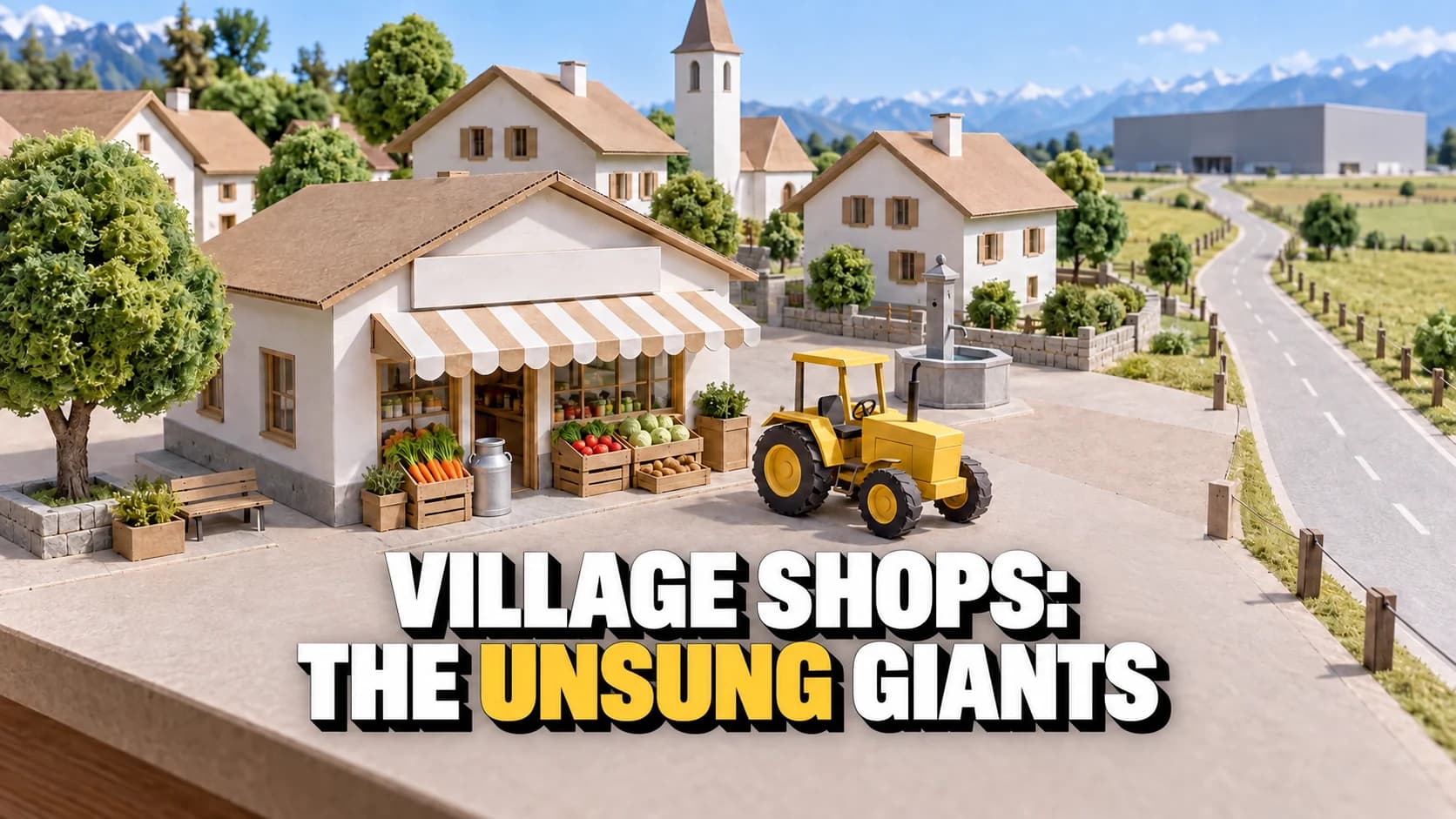
Who owns Volg? Volg is owned by fenaco, the Swiss agricultural cooperative formed in 1993 by the merger of six regional farmer-owned cooperatives. fenaco also owns the Landi retail chain, AGROLA fuel stations, UFA animal feed, Ramseier Suisse beverages, Ernst Sutter AG meat, and roughly 80 other subsidiaries. Volg operates around 600 village shops across German- and French-speaking Switzerland; the Volg group's 2025 revenue was CHF 1.795 billion, the highest in its history (+1.3 percent). Spar Schweiz is separate, with over 350 stores in Switzerland, and changed hands in September 2025: the South African SPAR Group sold it to Tannenwald Holding AG, a Swiss investor group, for CHF 46.5 million.
Sources checked regularly. Volg corporate (volg.ch "Wer wir sind"); fenaco Geschäftsbericht 2025 (Detailhandel CHF 2.30 bn); Volg media release 29 January 2026 (Volg group CHF 1.795 bn, 593 village shops, 121 AGROLA TopShops, 193 Prima retailers); LANDI Schweiz AG corporate (landischweiz.ch, landi.ch); Spar Schweiz corporate (spar.ch "Über uns", "35 Jahre SPAR Schweiz"); Tannenwald Holding AG September 2025 acquisition announcement (CHF 46.5M, Reto Francioni board); K-Tipp 2024 Volg economy-line comparison (~40 % above Coop / Migros); Schweizer Bauer + Handelszeitung CEO Hirsig statements; Tsüri.ch on individual Spar franchisee defections to Migros Voi (late 2025). Verified July 2026.
Rappn is an independent grocery price comparison app in Switzerland, with no commercial agreements with any retailer.
The Swiss rural retail giants nobody talks about
If you draw a map of Switzerland that strips out Migros and Coop, what is left is a country still dotted with shops. Most of those shops are Volg, Landi or Spar. Migros and Coop dominate cities and town centres; Volg, Landi and Spar are how villages still have a grocery option without a 20-minute drive.
The three are very different. Volg is small-format village grocery, owned by fenaco, the farmer-owned agricultural cooperative. Landi is a hardware-plus-garden-plus-feed retailer owned by the same family of cooperatives, with food limited mostly to beverages. Spar is an independent Swiss franchise of the international SPAR network, sold to a Swiss investor group in September 2025. Each fills a gap the big chains cannot or will not.
Explore current offers, shopping lists, price alerts and digital loyalty cards in Rappn. Open the different views to try the app.
Compare the village shop to the nearest big chain. Rappn is freeFree, no account required · iOS & Android
Rural · Volg ~600 + Landi ~270 + Spar >350 (back-Swiss Sep 2025)
Welcome
Volg, the village grocery store (around 600 locations, fenaco-owned)
Volg's name comes from Verband ostschweizerischer landwirtschaftlicher Genossenschaften, the Association of East Swiss Agricultural Cooperatives, founded in the 19th century. Today Volg Konsumwaren AG is headquartered in Oberwinterthur (Zurich), supplies more than 900 small-format outlets in Switzerland, and operated 593 of them under the Volg name in 2025 (595 the year before). The remaining outlets are AGROLA TopShops at petrol stations (121 of them in 2025) and 193 independent retailers running the Volg "Prima" partner concept.
The Volg group reported a revenue record in fiscal year 2025 inside fenaco's Detailhandel division, which posted CHF 2.30 billion in retail revenue (Volg plus Landi combined). The reach is unusual: more than 400 Volg stores host postal services for Swiss Post, and since 2019 every Volg store enables cash withdrawals via the Sonect app. In 2023 Volg removed conventional bananas entirely from its range and now sells only organic; from January 2025, around 40 Alnatura organic products are stocked across its stores.
Pricing is where Volg is honest about its position. CEO Ferdinand Hirsig told Handelszeitung that Volg is, on average, "somewhat more expensive than Coop." A K-Tipp comparison of Volg's economy line against Coop and Migros found Volg customers paying roughly 40 per cent more on average for comparable groceries, with the gap narrowing to under 10 per cent on beverages (coffee, mineral water, orange juice). Volg's defence is consistent: smaller turnover, smaller stores, structurally higher costs, and a service no big chain delivers in those villages.
Landi, the rural megastore where food is a side hustle (around 270 locations)
Landi is not a grocery chain. It is a hardware, garden, agriculture and beverages chain, and labelling it as a "grocery store" misses what it actually does. LANDI Schweiz AG, headquartered in Dotzigen (Bern), supports around 270 LANDI stores across German- and French-speaking Switzerland. The stores are owned by 180-plus local Landi cooperatives whose members are Swiss farmers; fenaco is the majority shareholder of the central service company, with the LAVEBA cooperative in St. Gallen and the Genossenschaftsverband Schaffhausen (GVS) holding minority shares.
The Landi assortment runs to roughly 8'000 items: power tools, garden furniture, plants, fertiliser, animal feed, workwear, motor oil, motor scooters under the in-house Tell brand, plus drinks (Farmer is the in-house beverage line). Around 59 per cent of products are sourced in Switzerland. Strategy is dauertiefpreis: permanent low prices, no Aktion calendar.
For food, Landi's role is narrow: beer, mineral water, juices, wine, occasionally snacks. If you need bread, milk, meat or fresh produce, Landi is not the answer. If you need 12 cases of beer for a village fest, 50 litres of motor oil, garden soil, or three sacks of chicken feed, Landi is the answer. The 2025 milestones illustrate the chain's direction: first city-centre store in Rotkreuz (August 2024), then in July 2025 the largest-ever Landi at over 3'000 square metres opened in Bern Wankdorf, in a former Do it + Garden Migros space.
Spar Schweiz, an independent franchise (over 350 locations)
Spar Schweiz is structurally different from Volg and Landi. It is not part of fenaco; it is the Swiss arm of the international SPAR network. The current company was founded in 1989 by Juan M. Leuthold, who signed a SPAR International franchise contract for Switzerland. Headquarters: Gossau (St. Gallen). Roots reach back to a 1761 specerei (spice and colonial-goods shop) in St. Gallen.
The 2025 ownership change matters. South African SPAR Group (which had held the majority since 2016, after a 2014 acquisition of Irish BWG) sold Spar Schweiz to Tannenwald Holding AG, a Swiss investor group based in Basel, for CHF 46.5 million plus an earn-out of up to CHF 30 million tied to EBITDA milestones through FY2027. The deal was agreed and completed on 8 September 2025, with Reto Francioni (former CEO of Deutsche Börse) on the new board. So Spar Schweiz is now back in Swiss hands at the corporate level, and so is TopCC, the group's cash-and-carry arm.
Spar Schweiz today operates over 350 outlets across multiple formats: classic SPAR neighbourhood markets (around 130 to 143 depending on count method), 5 Eurospar supermarkets, around 100 SPAR Express convenience stores, plus the 11 TopCC cash-and-carry markets for hospitality customers, which changed owner with the rest of the group on 8 September 2025. Roughly three-quarters of the neighbourhood markets are run by independent franchisees, the remaining quarter directly by the group. In late 2025, after Migros announced 140 new Voi convenience stores, individual Spar franchisees in places like Unteriberg and Richterswil announced switches to the Voi format. Migros and Spar both deny a wider deal; the franchisee migration is real but not corporate.
Price comparison vs Migros and Coop
| Product | Volg position | Spar position | Notes |
|---|---|---|---|
| Whole milk 1 L | +15 to +30 % vs Migros / Coop | +5 to +15 % | Volg via fenaco supply chain |
| Sliced bread 500 g | +20 to +35 % | +10 to +20 % | Volg has strong local bakery rotation |
| Plain yoghurt 500 g | +25 to +40 % | +10 to +25 % | Volg own-line ~40 % over Coop / Migros economy |
| Coca-Cola 1.5 L | +5 to +15 % | +2 to +10 % | Branded items, closest spread of all |
| Mineral water 1.5 L | < +10 % | < +10 % | Closest category gap |
| Coffee beans 500 g | < +10 % | < +10 % | Beverages narrow the gap most |
| Pasta 500 g | +25 to +40 % | +15 to +25 % | |
| Bananas 1 kg | +30 to +50 % | +10 to +25 % | Volg sells only organic since 2023 |
| Carrots 1 kg | +20 to +40 % | +10 to +20 % | Swiss origin at all four |
| Chicken breast 250 g | +20 to +35 % | +10 to +20 % |
K-Tipp's 2024 published comparison documented Volg's economy line at roughly 40 per cent above Coop and Migros equivalents on average, with beverages under 10 per cent. The structural reason is simple: smaller turnover per store equals higher unit costs equals higher shelf prices. For the cross-chain weekly-shop view see Migros vs Coop vs Aldi vs Lidl prices and cheapest supermarket in Switzerland.
When village shops actually beat the big chains
Three situations where Volg or Spar is not just acceptable but the right answer:
- Sundays and public holidays. Many Volg stores hold "village shop" exception licences that allow Sunday opening in communes where they function as basic-supply infrastructure. Some Spar Express stores at petrol stations and train stations open seven days. Migros and Coop main branches generally do not. See Sunday grocery shopping in Switzerland and public-holiday grocery shopping.
- Late evenings in villages. Many Volg stores stay open until 18:30 or 19:00, longer than the next Migros 15 kilometres away if that Migros is in a smaller satellite village.
- Local and regional specialities. Volg's "Feins vom Dorf" range sources from the village or neighbouring villages: bread, cheese, eggs, jam, alpine specialities that simply do not exist in a Migros or Coop assortment.
Add the time cost of the drive, the petrol cost, and the time cost of the queue at the big-chain check-out, and the Volg premium often disappears for a small top-up shop. See Swiss supermarket opening hours for the full hours map.
Hidden gems: the products you can only find at the village shop
A weekly Volg run rewards anyone paying attention. The "Feins vom Dorf" label flags products made in the same commune as the shop; in the Bündner mountain valleys this often means alpine cheese from a producer five kilometres away, Bündnerfleisch from a butcher in the same village, or Trockenwurst from a farm whose name is on the package. Spar's franchisee model produces the same effect by accident: local owners stock the regional brands they grew up with. Landi sells direct-from-farm products from the cooperative's own members through its "Hofprodukte" platform.
For an expat or a city visitor, this is the genuine reason to step into a Volg or a regional Spar. For a rural Swiss resident, it is just how groceries work.
Updated: .
Why Rappn?
Rappn is an independent grocery price comparison app in Switzerland, with no commercial agreements with any retailer. Our comparisons are truly independent.
- 100% free: no subscription, no hidden costs
- Neutral: no commercial agreements with Migros, Coop, Aldi, Lidl, Denner, Aligro, or Otto’s
- Updated daily, as soon as the chains publish their deals
- The chains’ deals in one place: search, filter, compare, no account needed
Ready to save on groceries?
Install Rappn and compare for yourself this week. No account required.Scan the code, install Rappn and compare current offers. No account needed.
Built in Switzerland, for Switzerland

Frequently Asked Questions
Who owns Volg?
Volg is owned by fenaco, the Swiss agricultural cooperative formed in 1993 by the merger of six regional farmer-owned cooperatives. fenaco also owns the Landi retail chain, AGROLA fuel stations, UFA animal feed, Ramseier Suisse beverages, Ernst Sutter AG meat, and roughly 80 other subsidiaries.
Is Volg more expensive than Migros and Coop?
Yes. K-Tipp's 2024 comparison found Volg customers paying on average around 40 per cent more than at Coop or Migros for the economy basket, narrowing to under 10 per cent on beverages. Volg's explanation: much smaller turnover per store and structurally higher costs. The trade-off is convenience, location and local sourcing rather than price.
Does Landi sell groceries or just farm supplies?
Landi is primarily a house, garden, agriculture and DIY retailer with around 8'000 items. Food is limited mostly to beverages: beer, wine, mineral water, juices, plus occasional snacks. It is not a grocery destination for milk, bread, fresh produce or meat. For drinks at low prices, especially in bulk for events, it is competitive.
Are Volg shops open on Sundays?
Many of them, yes. Cantonal rules vary, but rural village shops in Switzerland can hold special Sunday licences when they serve as basic-supply infrastructure. Spar Express stores at petrol stations and train stations also often open on Sundays. Always check the specific store on the Volg or Spar locator before driving.
Is Spar in Switzerland the same as Spar in Germany?
No. The SPAR International brand is shared across more than 40 countries, but each national organisation operates independently. Spar Schweiz is a separate company headquartered in Gossau (St. Gallen). It was owned by South African SPAR Group from 2016 until 8 September 2025, when Tannenwald Holding AG, a Basel-based Swiss investor group, bought it for CHF 46.5 million plus an earn-out of up to CHF 30 million.
Why do rural Swiss villages have a Volg rather than a Migros?
Volg's small-format model (often under 200 square metres) can serve villages of a few hundred people. Migros and Coop's economics require larger catchment areas. Volg's ownership by fenaco, which is in turn owned by Swiss farmers via the Landi cooperatives, means the chain has structural reasons to keep village stores open even where pure retail logic would close them.