Avoiding impulse buys in Swiss supermarkets: the list, the checkout and this week's promotions
You avoid impulse buys with three habits: write the list at home, shop after eating, and check the promotions before you go, not in the aisle. Rappn count for 11 Oct 2026, canton of Zurich: 1,038 of the 1,591 food and drink promotions with a price cut running at the five big chains only apply from 2 items (65 percent); for snacks and sweets it is 285 of 367 (78 percent). These multi-buys come from three of the five chains.
Rappn compares the current promotions of 7 Swiss retailers, updated daily: free, no subscription.
Build your shopping list in Rappn, free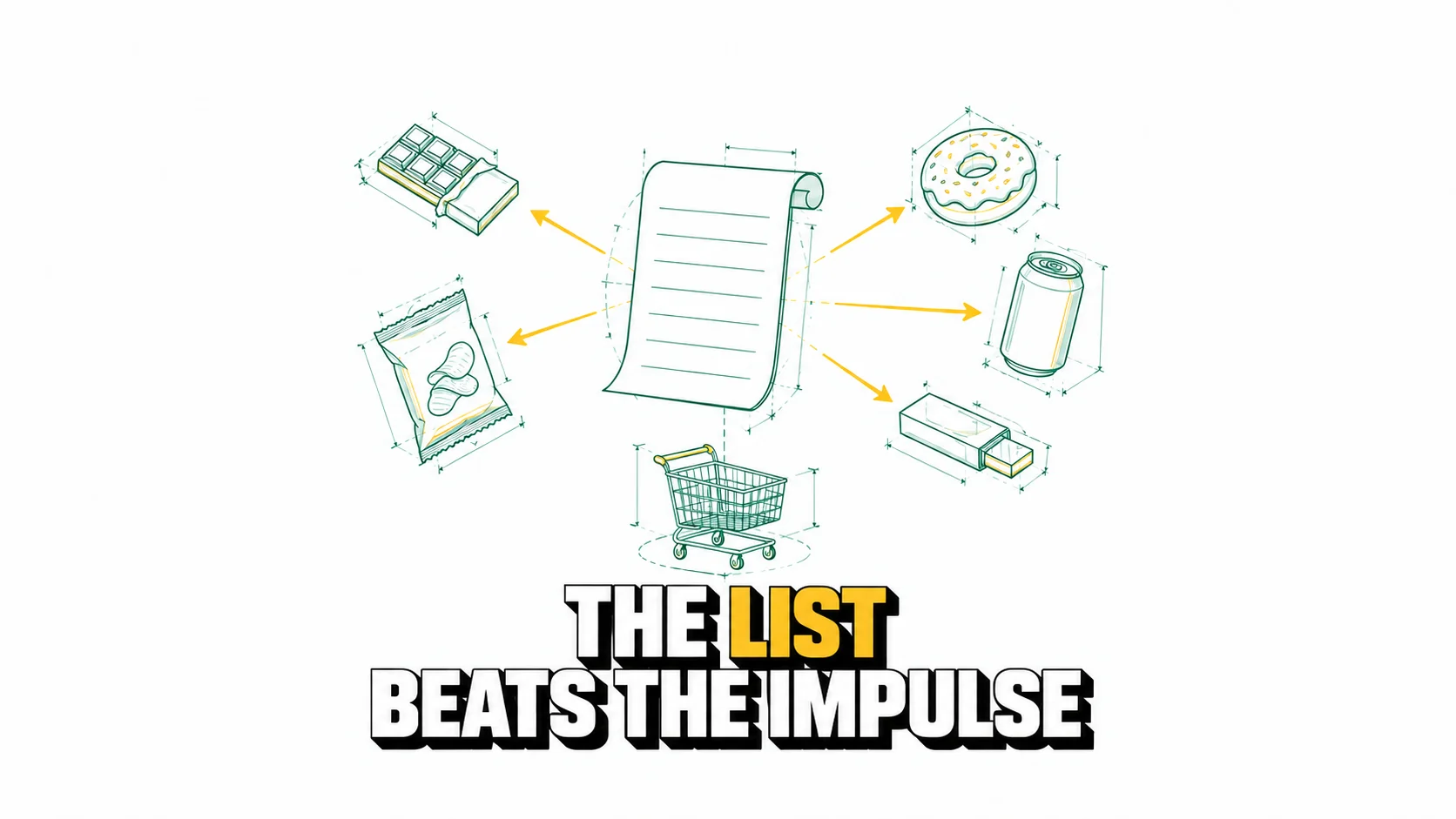
Impulse buys are the quiet leak in a grocery budget: things that were not on the list and still end up in the trolley. The defence is not going without, it is an order of steps: the list first, then a look at the promotions, then the store. Below are the habits the studies support, what happens at the checkout, and a count taken from the promotions running now: how many are snacks and sweets, and how many only apply from 2 items. In Switzerland a supermarket promotion is called an Aktion, and the word is on shelf tags and in the flyers.
Rappn is an independent grocery price comparison app in Switzerland, with no commercial agreement with any retailer. Migros, Coop, Aldi, Lidl, Denner, Aligro and Otto's do not pay us to rank them, and nothing below is sponsored.
How do I avoid impulse buys at the supermarket?
| Habit | What it does | Evidence |
|---|---|---|
| Write the list at home | fewer items in the basket | Davydenko and Peetz, Journal of Consumer Behaviour 2020 (2 experiments, online shopping) |
| Shop after eating | hunger raises purchases, even beyond food | Xu, Schwarz and Wyer, PNAS 2015 (department store, North America, 81 people) |
| Check promotions before you go | the promotion joins the list instead of triggering a grab | Rappn count of the running promotions |
| Add nothing at the checkout | almost every checkout has sweets | FRC, March 2026 (30 stores, French-speaking Switzerland) |
This is Rappn's shopping list: make your list before you go, share it with your household and add what you found in this week's offers, so you buy what you planned instead of what tempts you. Tap around to try it.
Build your shopping list in Rappn, freeFree, no subscription · iOS & Android
Weekly
This week’s promotions: how many sweets, how many need 2 or more
| Figure | Value |
|---|---|
| Food and drink promotions with a price cut, running | 1,591 |
| of which only from 2 items | 1,038 (65%) |
| of which snacks and sweets | 367 (23%) |
| Snacks and sweets only from 2 items | 285 of 367 (78%) |
| Chains with promotions only from 2 items | 3 of 5 |
| Median discount, snacks and sweets | 20% |
| Median discount, other food and drink | 20% |
Method: promotions with a real price cut running on 11 Oct 2026 in the Rappn feed of the five big chains, canton of Zurich; category per the Rappn taxonomy; “only from 2 items” means a minimum quantity of 2 or more. Promotions without a reference price are not counted. The figure rates no chain and no promotion.
The rule: list first, promotion second. If the item is on your list and you will use 2 before they expire, the multi-buy is a good moment. If it is not, the promotion is the impulse.
The checkout: why there are almost always sweets
At the checkout you no longer compare anything, you just wait, and that is exactly where the range for the spontaneous grab sits. The Fédération romande des consommateurs (FRC), the consumer federation of French-speaking Switzerland, measured it in March 2026: it checked more than 2,500 products in the checkout and exit areas of 30 stores in the region. 98 percent of checkouts in Geneva and 100 percent in the other French-speaking cantons were stocked with sweets, and of the children's foods sold there the WHO advises against 99 percent, according to the FRC. The survey covers French-speaking Switzerland only; we found no comparable study for the German-speaking part or Ticino.
The same principle applies to the promotional displays at the end of the aisles: they hold what you were not looking for. If chips or chocolate are on your list, compare them at home, not in the queue. The current promotions on chips and snacks are on chip and snack prices in Switzerland.
What the list in Rappn can do, and what it cannot
The list is the core of beating impulse buys, and it works on paper too. Keep it in Rappn and the promotions come with it. Here is what the app does today:
- the current promotions of seven chains, filtered to your canton;
- product search with the unit price per kilo, litre or piece;
- putting what you found on a list your household reads in real time (see shared shopping list);
- watching a product: the app tells you when it goes on offer;
- free, no account needed.
What Rappn does not show: regular shelf prices without a promotion. The app lists promotions; it does not price a whole shop across every chain. Which list app suits your household is covered in shopping list apps compared.
How big is the share of impulse buys?
Smaller than the often-quoted figures suggest. In a study of 2,945 shoppers in 21 stores in the Netherlands (Bell, Corsten and Knox, data from July 2006), unplanned purchases made up around 20 percent, measured at the level of whole product categories, and slightly more than 60 percent of trips involved no unplanned purchase at all. The popular 60 to 70 percent comes from US surveys by the retail marketing body POPAI and counts every purchase decision made in the store, including switching brands or buying something only loosely planned. There is no Swiss figure. The habits above work whichever number is right for you.
The list works best when it comes out of a short weekly plan: settle a few meals, derive the ingredients, shop once instead of several times. The weekly meal plan on a budget shows how. What 3 for 2 or second item at 40% off really gives you per unit is worked out in stocking up on offers, the tricks on the price tag are explained in supermarket price traps, and more levers are collected in save money on groceries.
Updated: .
Why Rappn?
Rappn is an independent grocery price comparison app in Switzerland, with no commercial agreements with any retailer. Our comparisons are truly independent.
- 100% free: no subscription, no hidden costs
- Neutral: no commercial agreements with Migros, Coop, Aldi, Lidl, Denner, Aligro, or Otto’s
- Updated daily, as soon as the chains publish their deals
- The chains’ deals in one place: search, filter, compare, no subscription
- Meal planner in the Kitchen tab: plan the week, send the ingredients to your list
Ready to save on groceries?
Install Rappn and compare for yourself this week. No account required.Scan the code, install Rappn and compare current offers. No account needed.


Frequently Asked Questions
How do I avoid impulse buys at the supermarket?
With three habits: write the list at home, shop after eating, and check this week's promotions before you leave, not in the aisle. If an item is not on your list, the promotion alone is no reason to take it.
How many supermarket promotions only apply from 2 items?
It changes every week, so Rappn counts it again from the promotions running now: the current figure for your canton is at the top of this page, with the date and the method. A multi-buy only pays if the item is on your list and you will use the whole quantity before it expires.
Why are there almost always sweets at the checkout?
Because the queue is built for the spontaneous grab. In March 2026 the Fédération romande des consommateurs checked more than 2,500 products in 30 stores in French-speaking Switzerland: 98 percent of checkouts in Geneva and 100 percent in the other French-speaking cantons were stocked with sweets.
Does a shopping list really help?
Yes, on quantity. In two online grocery experiments, people who wrote a list first bought fewer items; the effect on the amount spent was weaker (Davydenko and Peetz, 2020). A plain budget estimate without an item list did not work the same way. There is no Swiss study on it.
Do you buy more when you shop hungry?
Research points that way. In a field study in a North American department store, hungrier shoppers bought more non-food items and spent more on them (Xu, Schwarz and Wyer, PNAS, 2015). Shopping after a meal costs nothing.