
Black Friday groceries in Switzerland: real bargains or just hype?
For fresh food, Black Friday is not a big savings event in Switzerland, the margins are too thin. Aldi and Lidl mainly discount non-food around Black Friday and during Black Week (23 to 30 November in 2026). Stocking up only pays off on shelf-stable goods like coffee, oil and tinned food, and only if the unit price genuinely drops.
Rappn compares prices across all 7 chains live: free, no account.
Check real discounts in Rappn, free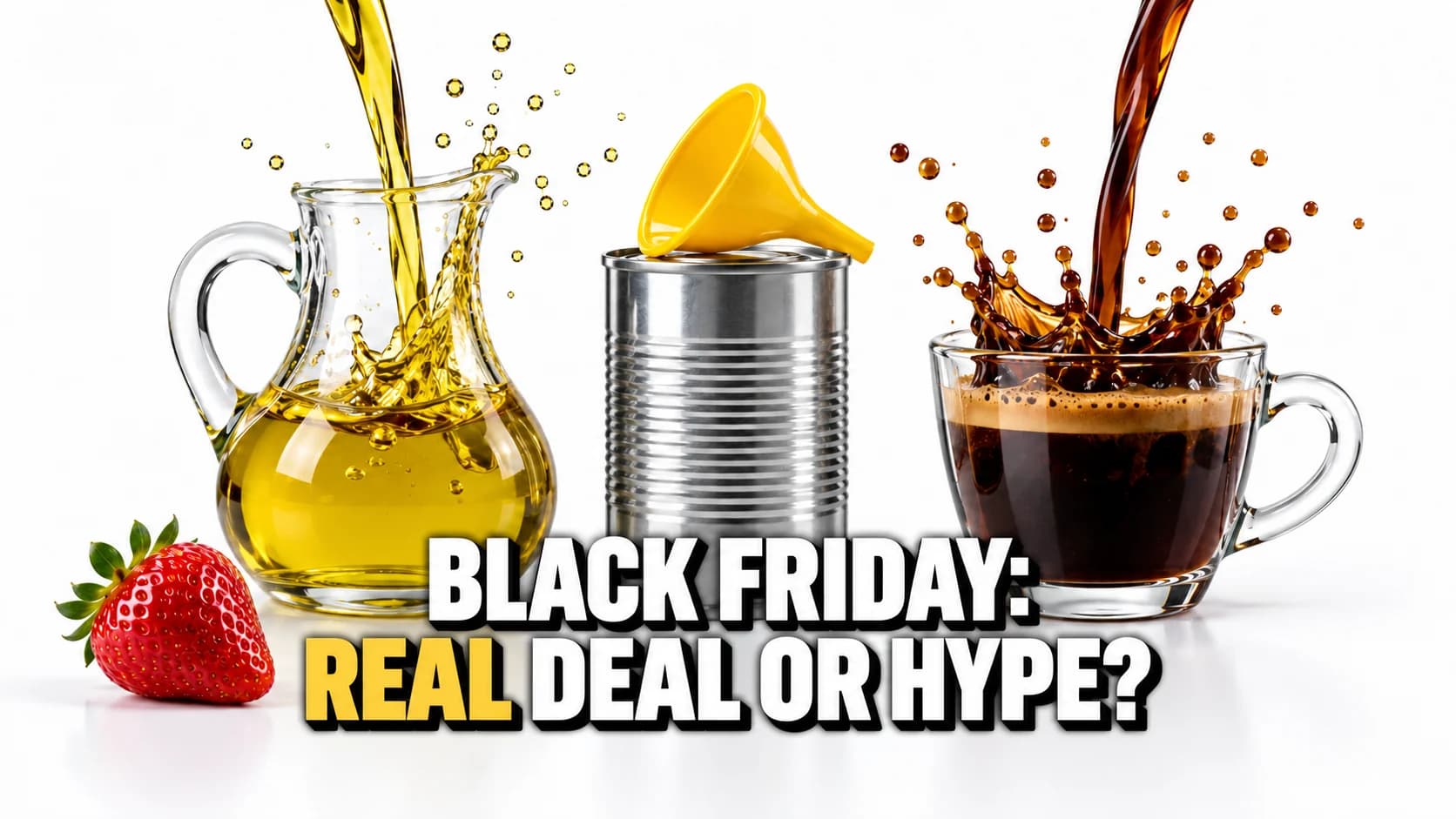
Updated regularly. Sources used in this article: SECO (Price Indication Ordinance, PBV), SRF Kassensturz and the Stiftung für Konsumentenschutz consumer-protection foundation on fake discounts, plus blackfriday.ch and NZZ for the dates. In 2026 Black Friday falls on Friday 27 November, Black Week runs from Monday 23 November to Cyber Monday on 30 November, and Singles Day is on 11 November.
Rappn is an independent grocery price comparison app in Switzerland, with no commercial agreements with any retailer.
The honest headline first: for groceries in the narrow sense, Black Friday in Switzerland is not a big savings event. The reason is structural, margins on fresh food are thin, so you almost never see blanket 20 or 30 percent discounts across whole fresh-food ranges. What the discounters Aldi Suisse and Lidl put on around Black Friday and during their Black Week is mostly non-food: home appliances, kitchen gear, consumer electronics, tools, toys and fashion. Migros traditionally stays cautious on Black Friday because its cooperatives decide regionally, and tends to run targeted promotions such as a discount on toys rather than on your weekly shop. Coop and Denner follow similar logic, with the focus on non-food and gift items.
Which Swiss chains discount food, household and non-food on Black Friday?
| Chain | Black Friday focus | Genuine food deals? |
|---|---|---|
| Aldi Suisse | Black Week with daily-changing deals, mostly appliances, kitchen, leisure | Rare, mainly shelf-stable promo lines |
| Lidl | Tech, fashion and household from the start of the week, time-limited | Rarely a blanket food discount |
| Migros | Cautious, regional per cooperative, often around 30 percent off toys | Targeted, not a weekly-shop discount |
| Coop | Non-food and gift items in focus | Targeted |
| Denner | Promo lines, wine and spirits with volume discounts | Sometimes on drinks and stockpiling |
If you do want to stock up on groceries for Black Friday, it only pays off on genuinely shelf-stable goods: coffee and coffee capsules, cooking oil, tinned food, pasta, rice, cleaning products and toilet paper, plus wine. In these categories the unit price matters over weeks, so a good Black Friday price can amortise across the stockpile. Perishable fresh items such as meat, cheese, dairy and vegetables do not belong in a stockpiling strategy, you keep buying those by weekly promotion and actual consumption.
On Black Friday the unit price tells the truth. This is Rappn's live offers feed: search a product and see whether the deal is really a deal. Type to try it.
Check real discounts in Rappn, freeFree, no account required · iOS & Android
Offers
How do I tell a real Black Friday discount from an inflated reference price?
The single most useful Swiss lever is the unit price, the Grundpreis, the price per kilo, per litre or per 100 grams printed on the shelf label. A big percentage sign is only a deal if the unit price is genuinely lower than at a competitor or than in a normal weekly promotion. This is exactly where SRF Kassensturz and the consumer-protection foundation push back: managing director Sara Stalder warns that prices are artificially inflated before a sale in order to fake a particularly large discount afterwards, the so-called Mondpreise (moon prices). K-Tipp also reported that quite a few products were available more cheaply again a few weeks after Black Friday.
Legally, Switzerland applies SECO's Price Indication Ordinance (PBV). A comparison price used as a self-comparison is only allowed if the retailer genuinely charged it immediately beforehand, for at least twice as long as the discount lasts. The Federal Council amended the PBV on 30 October 2024 and the change entered into force on 1 January 2025: under Art. 16 para. 1 lit. a no. 2 PBV, an open-ended self-comparison is permitted if the goods were actually offered at that higher price for at least 30 consecutive days beforehand. It is open-ended because the two-month duration cap in Art. 16 para. 3 applies only to no. 1 and to lit. b, not to the new no. 2. These rules are meant to curb fake discounts, but they do not guarantee a low price. Your real protection is sober comparison: write the list first, set a budget, and do not let a countdown rush you.
In practice: note the normal unit price of your five to ten favourite products before Black Week starts. If on Black Friday that same unit price merely gets a red tag and a percentage next to it, it is not a bargain. If the unit price is genuinely lower than recent weekly promotions, go ahead, provided the item keeps.
This sober groundwork is precisely what Rappn does for you. Instead of leafing through flyers, you see the current prices and promotions of the seven big chains, Migros, Coop, Aldi, Lidl, Denner, Aligro and Otto's, side by side, including the unit price. There is more on the method on our price comparison page and in the head-to-head Migros vs Coop prices.
What is worth stockpiling, and what is not
In concrete terms, many households stock up around Black Friday on coffee capsules and cooking oil, because both keep for a long time and the unit price counts for months. By contrast, stockpiling barely pays off on sausages and cold cuts or cheese, where freshness matters and the regular weekly shop stays the better strategy. If you are hunting for gifts, compare supermarket gift cards instead.
See it live in Rappn. Download Rappn before Black Week, add your stockpiling products to a watchlist, and observe whether the unit price actually drops on Black Friday or only the tag changes. That way you buy neutrally, fact-based and without falling for moon prices. Rappn is 100 percent free and compares the current deals of the big Swiss supermarkets.
Updated: .
Why Rappn?
Rappn is an independent grocery price comparison app in Switzerland, with no commercial agreements with any retailer. Our comparisons are truly independent.
- 100% free: no subscription, no hidden costs
- Neutral: no commercial agreements with Migros, Coop, Aldi, Lidl, Denner, Aligro, or Otto’s
- Updated daily, as soon as the chains publish their deals
- The chains’ deals in one place: search, filter, compare, no account needed
Ready to save on groceries?
Install Rappn and compare for yourself this week. No account required.Scan the code, install Rappn and compare current offers. No account needed.
Built in Switzerland, for Switzerland
Frequently Asked Questions
Are groceries actually cheap on Black Friday in Switzerland?
Rarely as a blanket discount. Because margins on fresh food are thin, you almost never see 20 or 30 percent off whole fresh-food ranges. Aldi Suisse and Lidl mainly discount non-food around Black Friday, such as appliances, kitchen gear and fashion. Genuine food bargains tend to be on shelf-stable goods.
When is Black Friday 2026 in Switzerland?
Black Friday 2026 is on Friday 27 November. Black Week runs from Monday 23 November to Cyber Monday on 30 November. Singles Day, which also brings some promotions, is on 11 November. Source: blackfriday.ch and NZZ.
How do I spot an inflated reference price on Black Friday?
Watch the unit price (the Grundpreis) per kilo, litre or 100 grams on the shelf label. Note it for your favourite products before Black Week. If on Black Friday the same unit price merely gets a red percentage tag, it is not a real discount. SRF Kassensturz and the consumer-protection foundation warn about exactly these artificially inflated comparison prices.
What is worth stocking up on during Black Friday?
Only genuinely shelf-stable goods: coffee and coffee capsules, cooking oil, tinned food, pasta, rice, cleaning products, toilet paper and wine. Perishable fresh items like meat, cheese and vegetables do not belong in a stockpiling strategy, the regular weekly shop stays cheaper there.
Does Swiss law protect me from fake discounts?
SECO’s Price Indication Ordinance (PBV) only allows a comparison price if it was genuinely charged beforehand. Since 1 January 2025, Art. 16 para. 1 lit. a no. 2 PBV permits an open-ended self-comparison if the higher price was in force for at least 30 consecutive days first. The rules curb fake discounts but do not guarantee a low price, so sober comparison remains your best protection.