
Grocery costs Switzerland 2026: budgets by household
See monthly grocery budget scenarios for singles, couples and families, plus the product choices and weekly basket behind the estimates.

How much do groceries cost per month in Switzerland?
The monthly grocery scenarios in this article range from CHF 350-650 for one person to CHF 850-1'600 for a family of 4, in the table dated 2 March 2026. These are planning estimates, not an official average or a promised saving. Your household size, product choices and current prices determine where your own grocery budget falls.
Use the household row that fits you as a starting point, then replace the assumptions with your own receipts. The table separates lower-cost and higher-cost shopping scenarios; moving between them is not automatic and does not guarantee a saving. It depends on the products and quantities you buy, how often you cook and what is available nearby. Compare budget and branded versions of regular staples, check the unit prices and allow for food you actually use. A weekly basket can help you test a monthly estimate before treating it as your budget.
So we did the work: we tracked real baskets, checked real prices across Migros, Coop, Aldi, Lidl, and Denner, and built the budget ranges we wish someone had given us when we started.
Updated: 2 March 2026. Prices shift by canton and promo week. Use these ranges as a practical 2026 baseline, not a hard rule.
First: the number you came here for
If you just need a figure to put in your budget spreadsheet, here it is:
| Household | “I don’t optimise” | “I shop smart” |
|---|---|---|
| Single | CHF 500–650/mo | CHF 350–450/mo |
| Couple | CHF 850–1'100/mo | CHF 600–800/mo |
| Family of 4 | CHF 1'200–1'600/mo | CHF 850–1'100/mo |
The gap between those columns isn’t extreme couponing or a five-supermarket tour. It’s three decisions, made once. We’ll walk through each one.
(If you want to skip the theory and jump to a real weekly example with realistic prices, scroll to “What a real optimised week costs.”)
Why “official averages” lead you astray
The Swiss Federal Statistical Office reports that households spend around CHF 638/month on food and non-alcoholic beverages bought for home (average, household budget survey 2023, published in November 2025).
But these numbers describe Switzerland, not you.
They’re skewed by wildly different household sizes, different levels of eating out, and very different shopping habits. Treating them as a target is like dressing for “average” Swiss weather: you’ll be wrong most days.
The better question: what should someone with my habits actually spend, given the stores near me?
The three decisions that set your grocery bill
Everything else is noise. These three choices account for almost all the variance.
Decision 1: Your default store
In the K-Tipp test of August 2025, the same 100 items cost about 8.6% more in the store with the highest total than in the one with the lowest.
K-Tipp priced 100 everyday items across retailers (issue 14/2025, 28 August 2025), choosing the cheapest equivalent in each store. Their results showed a clear spread: roughly CHF 20 difference between Aldi and Coop on the same 100 items.
| Store | 100-item basket total |
|---|---|
| Aldi | CHF 230.94 |
| Lidl | CHF 232.83 |
| Migros | CHF 243.54 |
| Coop | CHF 250.70 |
| Source: K-Tipp 14/2025, 28 August 2025, 100 items; prices fluctuate by week and product mix. | |
That difference sounds small, until you compound it. Over a year, for a couple spending around CHF 900/month, the “default store effect” can easily add up to hundreds.
But “just shop at Aldi” isn’t always realistic. Aldi and Lidl have fewer locations, smaller ranges, and not everyone has one on their commute. The honest advice: pick the store that fits your life, then optimise inside it.
For a deep dive on store-by-store tradeoffs, see our guide:
Coop, Migros, Aldi/Lidl or Denner: what does your real weekly basket cost?
Decision 2: Budget line vs. brand name (bigger than you think)
This is the most painless lever.
Budget lines exist to compete directly with discounters on staples, and in many categories they’re surprisingly close.
The key point: the gap between brand and budget-in-the-same-store is often larger than the gap between stores.
On a typical weekly basket of staples, defaulting to the budget line lowers the bill without switching stores, without changing what you eat, without a single coupon. How much depends on your list: compare the unit prices of the two lines on the products you buy most.
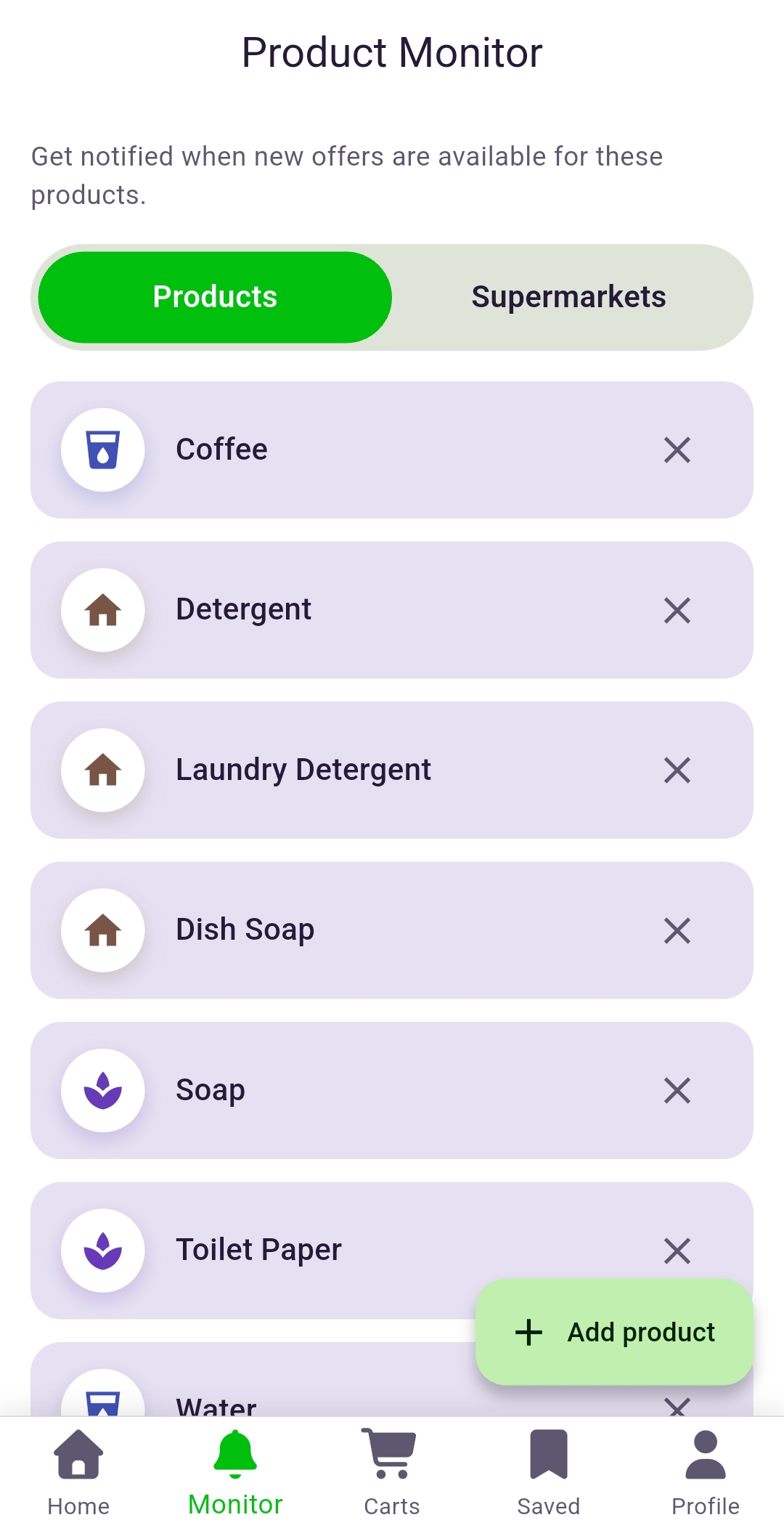
Rappn tip: If you know your repeat buys (coffee, detergent, toilet paper), you can monitor them once and stop thinking about them. You only react when a real offer appears.
Decision 3: How you handle protein (the silent budget killer)
Protein is where Swiss grocery budgets quietly explode, especially if you buy fresh, last-minute, and mostly at full price.
Three tiers of protein spending (for a couple, per week):
- Meat most nights, bought fresh at Migros/Coop: CHF 60–100/week in protein alone
- Mix in eggs, legumes, and tofu 2–3 times/week: CHF 35–55/week
- Batch-buy frozen protein every 2–4 weeks (and freeze it): bought on promotion instead of at full price on the day you need it
This single category can move your monthly bill by CHF 100–200. It’s not about going vegetarian: it’s about not buying every protein at full price on the day you need it.
What a real optimised week costs (couple, realistic basket)
No theory. Just a shopping list.
Setup: Migros as base store, Aldi run once every 3 weeks.
Thursday main shop at Migros: ~CHF 85–110
| Item | Est. price |
|---|---|
| Seasonal vegetables for 5 days | CHF 18–25 |
| Budget milk 1L + yoghurt 500g | CHF 3–4 |
| Cooking butter 250g (budget line) | ~CHF 3.40 |
| Bread (500g) | CHF 2–3 |
| Eggs (10-pack) | CHF 5–7 |
| Spaghetti 1kg + pesto (budget line) | ~CHF 2.55 |
| Canned tomatoes 3×400g | CHF 2.55–3 |
| 2 proteins (e.g., chicken + salmon) | CHF 18–28 |
| One treat (chips or chocolate) | CHF 3–5 |
Every-3-weeks Aldi run: ~CHF 70–90
| Item | Est. price |
|---|---|
| Frozen chicken 1kg | CHF 12–16 |
| Frozen veg 2×500g | CHF 4–6 |
| Butter 250g | ~CHF 3.39 |
| Pasta + rice + canned beans | CHF 5–8 |
| Cleaning products (if needed) | CHF 8–12 |
Monthly total for two people: roughly CHF 620–780. Eating well. No deprivation. One store 90% of the time.
The habits that lower the bill further (without extra effort)
The Wednesday-evening habit
Promo weeks matter, but you don’t need to become a flyer addict. Ten minutes once a week is enough.
Coop, Migros and Denner start their new promotions every Thursday, and the Migros and Denner flyers come out on Wednesday, so Wednesday evening is when you can plan the week ahead.
That’s not coupon-clipping. It’s checking whether the things already on your list happen to be cheaper this week, then adjusting once.
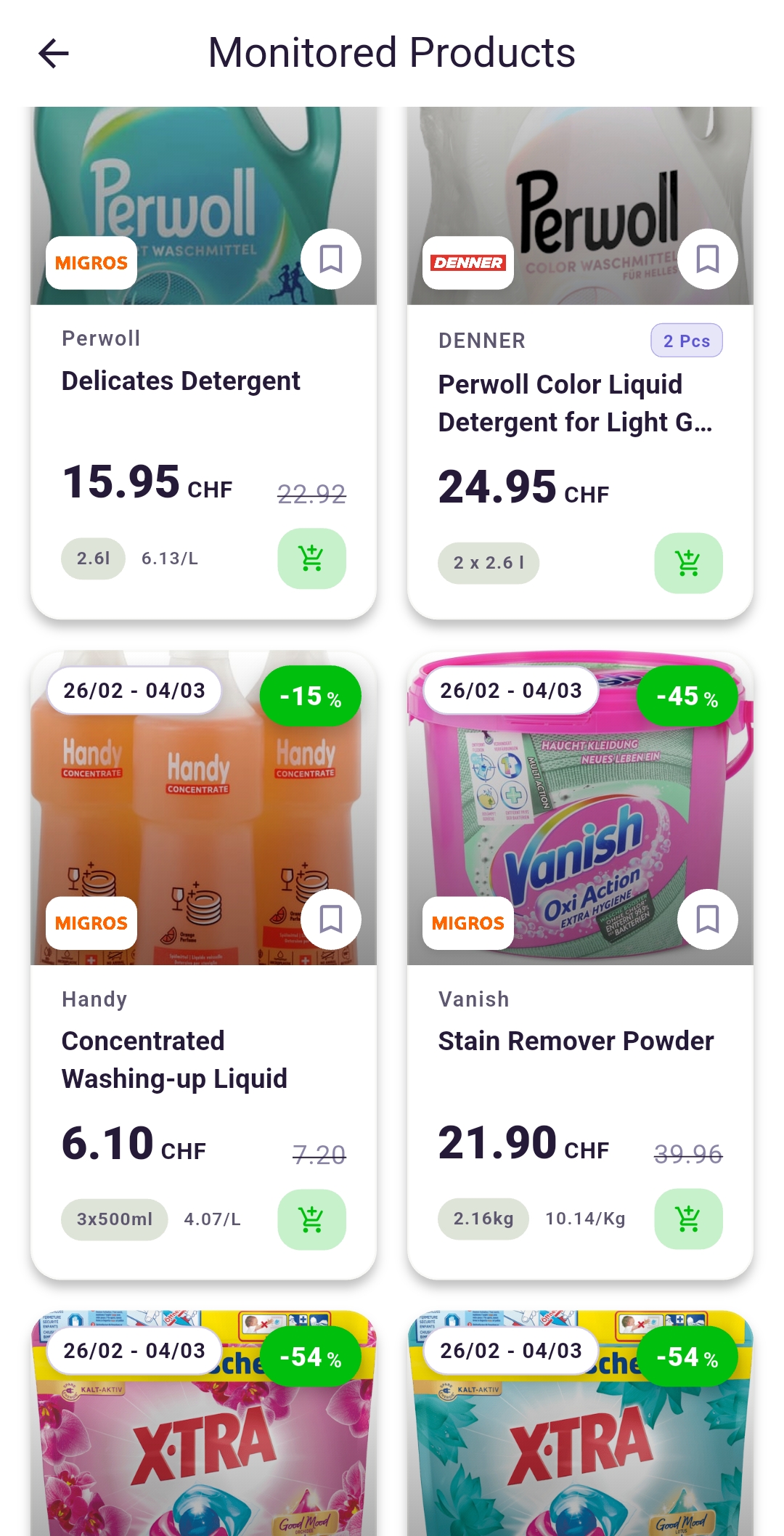
Rappn tip: This is where the app saves the most time. Instead of checking multiple retailer sites, you can track your always-buys (coffee, toilet paper, detergent, olive oil) and only act when an offer actually shows up.
Buy household items only during promo weeks
Toilet paper, detergent, dishwasher tabs, bin bags: bought one-off at full price, these quietly cost more than they need to.
The fix: stock up when discounts hit, then coast for 6–8 weeks. Boring savings. The best kind.
Stop paying the “convenience tax”
Convenience formats (station shops, express stores) charge significantly more for basics. If you do it a few times a week, it quietly adds up.
Rule: at a station shop, buy 3 items max. One staple + one protein + one fruit/veg. Then leave. Keep a small emergency stash at work (nuts, muesli bars) and the impulse stops.
The meal plan that doesn’t feel like a meal plan
You don’t need a spreadsheet with 21 meals. You need a loose structure:
- Pick 3–4 dinners for the week
- Leave 2–3 nights flexible (omelette, leftovers, whatever’s in the fridge)
- Write your list by store section (produce → dairy → pantry → protein)
The payoff is massive. Without a plan, the week fills up with “quick trips”, and each one adds impulse buys.
And food waste drops sharply too. Agroscope estimates around 90 kg per person per year is wasted in Swiss households.
The loyalty card question: are Cumulus, Supercard and Lidl Plus worth it?
Short answer: yes, if you’re already shopping there. No, if you’d switch stores just for points.
The practical move: activate the loyalty card for your base store, check the app once a week, and don’t change your behaviour to chase points. The real savings come from where you shop and what you buy, not points maths.
Your 5-minute action plan
You don’t need to change everything. Just make three choices today:
- Pick your default store based on your commute, not on a price table.
- Switch staples to the budget line (pasta, butter, canned tomatoes, milk, rice, cleaning).
- Check offers once a week before you shop and stock up on household staples when discounts hit.
That’s it. Three decisions. No five-store pilgrimage. No lifestyle overhaul. Just slightly better information → slightly better choices → significantly lower bills.
Frequently Asked Questions
How much should a single person spend on groceries in Switzerland?
A realistic range is CHF 350–650 per month. Shopping at Aldi/Lidl with a basic plan puts you near CHF 350–450. Shopping at Migros/Coop without planning puts you closer to CHF 550–650. The single biggest lever is defaulting to budget product lines for staples.
How much do groceries cost for a family of 4 in Switzerland?
Between CHF 850 and CHF 1'600 per month. The wide range reflects store choice, meat consumption, and organic preferences. A family using a Migros/Coop base with a discounter batch run every few weeks typically lands around CHF 900–1'100.
Is it really cheaper to shop at Aldi or Lidl?
On a like-for-like basket, K-Tipp found Aldi/Lidl cheaper than Migros and Coop in their 100-item comparison of August 2025. The practical difference depends on what you buy and whether you catch promo cycles.
How can I cut my grocery bill without changing what I eat?
Three moves: (1) switch staples to budget lines at your current store, (2) buy household and pantry items only during promo weeks, (3) do one planned weekly shop instead of multiple impulse trips. How much they save depends on your basket: check your receipts for a month before and after.
Start saving without the overhead
The hardest part of Swiss grocery budgeting isn’t discipline: it’s juggling multiple stores, promo schedules, and remembering what you wanted to buy when it finally goes on sale.
That’s exactly why we built Rappn:
- All deals in one place: Migros, Coop, Aldi, Lidl, Denner, filtered by your canton
- Product monitoring on items you actually buy: no spam, just a nudge when a real offer appears
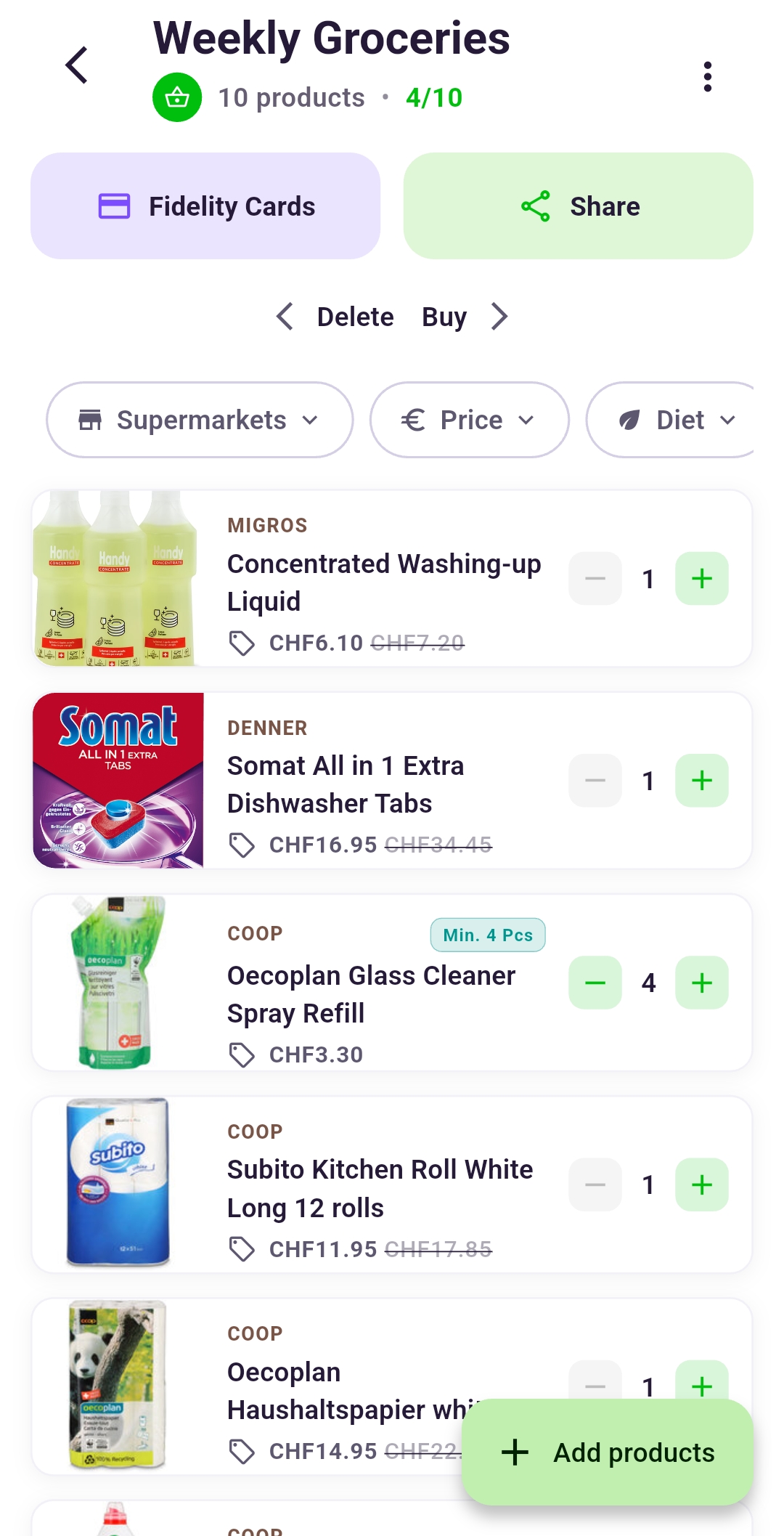
- Shared weekly carts with real-time sync, so two people don’t buy the same thing
It’s free, it takes 30 seconds to set up, and it replaces the flyer marathon with a single glance.