
Cross-Border Grocery Shopping in Italy: When It's Worth the Trip (and When It Isn't)
The 2025 customs cut to CHF 150 per person changed the math. Here are the new rules, the 1 kg meat / 5 L wine quantity caps, the four border routes, and the categories where the price gap is still wide enough to matter.
Rappn compares prices across all 7 chains live: free, no account.
See Swiss prices first. Rappn is free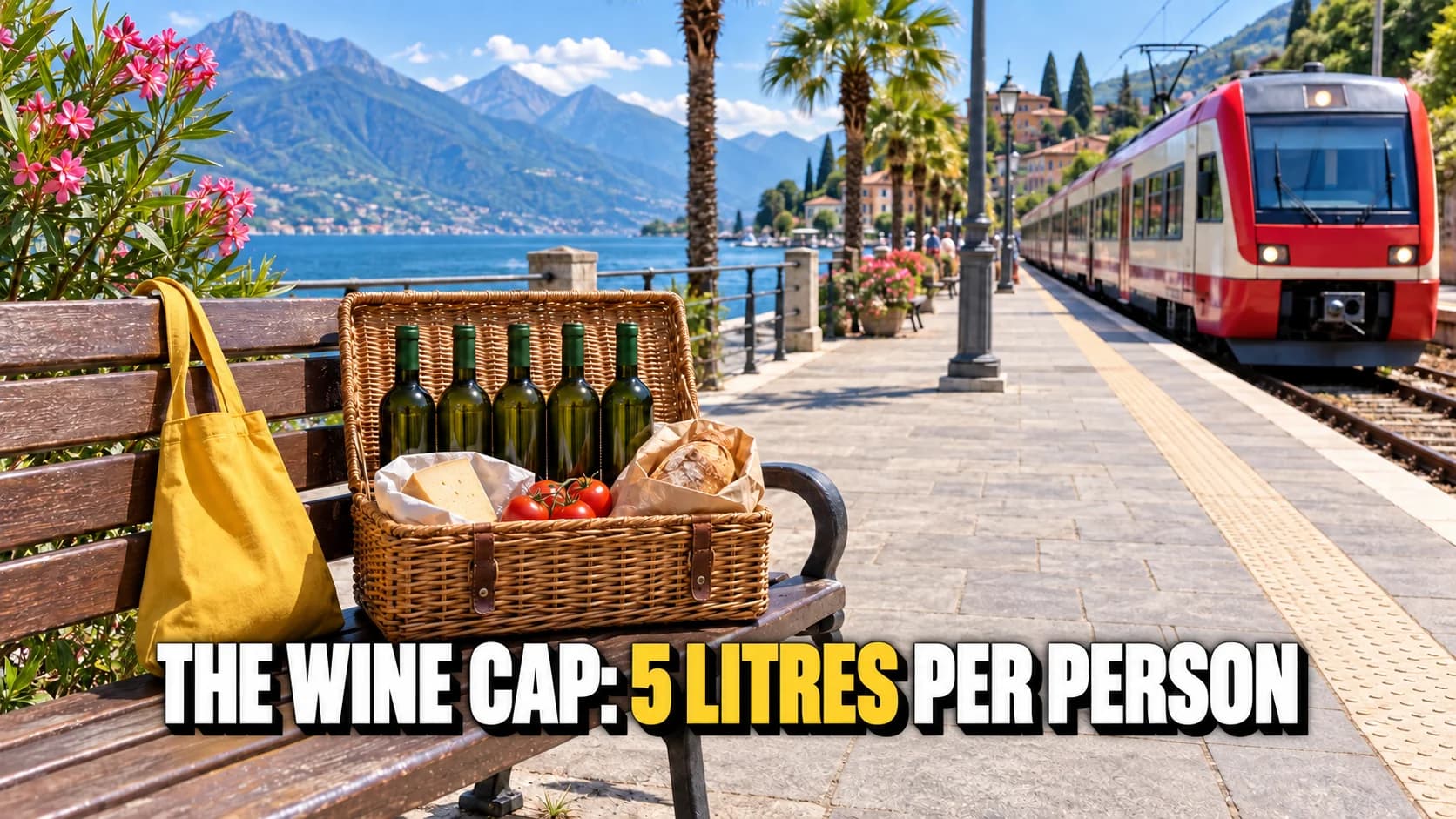
Crossing into Italy for groceries is one of the oldest Swiss savings tactics, and it still works, but the math changed sharply on 1 January 2025 when the duty-free allowance was cut from CHF 300 to CHF 150 per person per day. Most articles online still quote the old number. This guide gives the current rules straight from the Federal Office for Customs and Border Security (FOCBS), the quantity limits that actually catch people out (1 kg of meat, 5 litres of wine), where the savings are real (35-55% on Italian brands, wine, olive oil), and when crossing the border is actually worse than just waiting for a Denner Aktion.
Sources checked regularly. Customs rules verified at the Federal Office for Customs and Border Security (BAZG/FOCBS). Italian price data from Altroconsumo's 2025 supermarket survey. Live offers in the Rappn app.
Rappn is an independent grocery price comparison app in Switzerland, with no commercial agreements with any retailer.
The current rules: what changed in 2025
Until 31 December 2024, Swiss residents could import CHF 300 of goods per person per day from Italy without paying Swiss VAT. From 1 January 2025, that limit was cut in half to CHF 150 per person per day. The Federal Council made the change after years of lobbying from border-canton retailers; the practical effect is that "stocking up for a month" cross-border shopping no longer fits within the duty-free envelope for one person.
There are two separate rules to understand. They are independent and both apply.
Rule 1: VAT-free value limit (CHF 150 per person per day). If your total purchases stay at or below CHF 150, you owe no Swiss VAT. The limit is per person per day, and it includes children: a family of four travelling together has a combined CHF 600 allowance per day. Critical gotcha: if you exceed CHF 150, Swiss VAT (8.1% on most goods, 2.6% on foodstuffs) is charged on the entire value, not just the excess above CHF 150. CHF 160 of groceries triggers VAT on the full CHF 160, not on CHF 10.
| Good | Duty-free quantity per person per day |
|---|---|
| Meat (excluding game and fish) | 1 kg |
| Butter and cream | 1 kg / 1 litre |
| Oils, fats, margarine | 5 kg / 5 litres |
| Wine and beer (under 18% alcohol) | 5 litres |
| Spirits (over 18% alcohol) | 1 litre |
| Cigarettes | 250 |
Source: BAZG/FOCBS official allowance tables, current. Alcohol and tobacco allowances apply only to those aged 17 and above.
Verifying customs: the easiest way is the official QuickZoll app from FOCBS. Enter your purchases, the app calculates duties and VAT, you pay in-app, and you cross via the green lane. If your total stays under CHF 150 with no quantity overshoots, you don't need to declare anything.
Compare current offers and their supplied unit prices. Check the pack size, canton and validity dates.
See Swiss prices first. Rappn is freeFree, no account required · iOS & Android
Swiss baseline · TI
Offers
Where to actually shop: the 4 main border-crossing routes
Most Swiss residents who do this regularly use one of four routes. The math depends entirely on which one is closest to you.
Chiasso–Como (15 minutes from Lugano). The most popular route. Como has Iperal, Esselunga, Carrefour and a Lidl Italia. The Altroconsumo ranking is often quoted loosely, so here it is exactly: in its 2025 survey the Iperal store in Como came second among individual points of sale in Italy, behind the Iper Rossetto in Marcon near Venice. That is a ranking of one shop, not of the Iperal chain: by chain, the cheapest were the discounters. Either way, that specific Como store is one of the strongest price addresses within reach of Ticino.
Stabio–Gaggiolo (south of Mendrisio). Quieter than Chiasso, often faster on busy weekends. Connects to the Varese province, with a strong cluster of Esselunga and Tigros stores.
Ponte Tresa (west of Lugano). Closest crossing for the western shore of Lake Lugano. Lavena Ponte Tresa has small but useful supermarket access; serious shopping requires driving into Luino or Varese.
Domodossola (from Brig / Upper Valais). The main crossing for German-Swiss residents in Valais. Note before you drive: there is no Esselunga in Domodossola. The nearest one is the Esselunga Superstore in Verbania, Viale Azari 94, about 40 km further on, and Verbania is the better stop for a larger trip anyway. Discounter branches in and around Domodossola change, so check the chain store finders before setting off. Store names last verified September 2026.
For shoppers from Geneva, Zurich, Bern, or Basel, the Italian border is rarely worth the trip on grocery alone. France (for Geneva) or Germany (for Zurich/Basel) is closer and has its own savings dynamics.
Where the savings are actually real
| Category | Real savings vs Switzerland | Worth crossing for? |
|---|---|---|
| Italian wine (Chianti, Barolo, Prosecco) | 40-60% | Yes, especially with a 5L allowance |
| Olive oil (Italian extra virgin) | 35-50% | Yes, easily within the 5kg limit |
| Italian pasta (De Cecco, Barilla, Garofalo) | 30-50% | Yes, but only if buying in volume |
| Italian cheese (Parmigiano, Pecorino, Mozzarella di Bufala) | 30-50% | Yes, watch the 1kg butter/cream rule |
| Branded snacks and cookies (Mulino Bianco, Pavesi) | 25-40% | Only as part of a larger trip |
| Coffee (Lavazza, Illy, Segafredo) | 20-35% | Marginal: Denner Aktion often beats Italian shelf prices |
| Fresh meat | 30-50% | Yes, but the 1 kg limit per person caps the haul |
| Fresh produce | Variable, often similar | Not worth a dedicated trip |
| Household and personal care | 15-30% | Only as part of a larger trip |
| Fuel | Near parity | Don't detour for it |
Italian prices verified in Altroconsumo's March 2025 supermarket survey (1,150 stores, 67 cities). Swiss reference prices from migros.ch, coop.ch verified April 2026.
The clearest single insight: wine, olive oil, pasta, and Italian cheese are the categories where cross-border consistently wins. They are also the categories where the Swiss alternatives are most expensive due to import duties on Italian agricultural products. If your trip is anchored around those four categories, you are very likely ahead.
The clearest single category to not make a trip for: coffee. Denner runs 35% off Chicco d'Oro and Lavazza beans every 4-6 weeks, and that pricing matches or beats Italian shelf prices on the same brands. See our coffee prices in Switzerland breakdown.
Italian VAT refund: the second saving most people miss
Italy charges 22% VAT (IVA) on most goods, 10% on most groceries, 4% on certain staples. As a non-EU resident exporting goods home, you can claim back the Italian VAT on receipts above EUR 70.
The process: ask the store for a tax-free form (modulo tax-free) at checkout, get the form stamped at Italian customs when you cross back into Switzerland, then mail or hand the stamped form back to the refund operator. The refund typically arrives within 4-8 weeks at minus a service fee (10-20% of the refund).
The catch: VAT refund is per-receipt, so a CHF 60 receipt does not qualify even if you have several of them. For weekly grocery runs, the math often only works on larger receipts (EUR 80+) at single stores.
This is where the trip really compounds: a Ticino family of 4 making one CHF 600 cross-border run per month, claiming Italian VAT refund on the larger receipts, can save CHF 200-400 monthly versus the same basket at Swiss retail. That is real money.
Compare before you cross.
Rappn shows you the live Swiss price for everything on your list across all 7 retailers we cover. Cross only when the Italian saving actually beats this week's Aktion.
When crossing the border is NOT worth it
The CHF 150 limit changed the math for several common scenarios. These trips no longer pay off:
Solo "stock up for a month" trips. With CHF 150 per person, one adult shopping alone can no longer cover a month of groceries cross-border without triggering VAT on the whole receipt. The math now requires either travelling with family (each person gets their own CHF 150) or doing more frequent smaller trips.
Trips for fresh meat alone. The 1 kg per person daily limit caps the haul. A family of 4 can bring back 4 kg total, but at that point you have used most of your value allowance on meat alone.
Coffee runs. Denner Aktion pricing on Italian coffee brands typically matches Italian shelf prices. Add fuel and time and the Italian trip loses.
Fuel-only stops. Italian fuel is roughly equivalent to Swiss in CHF terms after exchange rate. No real saving.
Visits triggered by a single item. The trip cost (fuel, tolls, time) needs to be amortized across a basket. One CHF 30 saving on a single item does not justify a 90-minute round trip.
For most of these scenarios, the right answer is one of: switch to a Swiss discounter (Aldi or Lidl), buy on Aktion at Migros/Coop/Denner (track via the Rappn app), or include the item in a planned cross-border trip combined with other categories.
When it absolutely IS worth it
The trip pays off cleanly in four scenarios:
- You live within 30 minutes of an Italian crossing. At that distance, the marginal cost of the trip is low enough that even moderate savings compound.
- You are travelling as a household of 3 or more. Multiple CHF 150 allowances make the value cap less restrictive.
- Your basket is heavy in the high-saving categories (wine, olive oil, pasta, Italian cheese, branded Italian goods).
- You shop monthly, not weekly. One bigger planned trip per month with a focused list beats four impulse trips that each blow part of the value cap.
For Ticino families specifically, this is well-trodden territory: Como every 3-4 weeks, focused on wine + oil + pasta + cheese + frozen meat, with one stamped tax-free form on the largest receipt. The annual saving is comfortably 4-figure CHF for a family of 4. See also grocery shopping in Lugano for the Ticino-specific Swiss-side picture.
If your situation does not match these scenarios, the better strategy is usually focused Aktion timing across the 7 Swiss retailers Rappn covers (Migros, Coop, Aldi, Lidl, Denner, Aligro, Otto's). See our save money on groceries in Switzerland guide for the full domestic playbook, and monthly grocery spending review for tracking the cross-border line in your household budget.
Updated: .
Why Rappn?
Rappn is an independent grocery price comparison app in Switzerland, with no commercial agreements with any retailer. Our comparisons are truly independent.
- 100% free: no subscription, no hidden costs
- Neutral: no commercial agreements with Migros, Coop, Aldi, Lidl, Denner, Aligro, or Otto’s
- Updated daily, as soon as the chains publish their deals
- The chains’ deals in one place: search, filter, compare, no account needed
Ready to save on groceries?
Install Rappn and compare for yourself this week. No account required.Scan the code, install Rappn and compare current offers. No account needed.
Built in Switzerland, for Switzerland
Frequently Asked Questions
What is the current Swiss customs limit for grocery shopping in Italy?
CHF 150 per person per day, effective from 1 January 2025 (down from CHF 300 previously). If you exceed this value, Swiss VAT applies to the entire value of the goods, not just the excess. VAT is 8.1% on most goods and 2.6% on foodstuffs. Quantity limits also apply separately: 1 kg meat, 1 kg butter/cream, 5 L wine under 18% alcohol, 1 L spirits over 18% alcohol, per person per day.
Can a family of four bring back CHF 600 of groceries duty-free?
Yes, if each person genuinely receives their own portion of the goods. The CHF 150 limit applies per person per day and includes children. Customs may ask how the goods are divided. You cannot bring back one CHF 600 item and split it across four allowances; the goods must be separate or genuinely divisible. For groceries, this is rarely an issue, but for single high-value items it matters.
How do I clear customs when bringing groceries back from Italy?
Easiest: the QuickZoll app from the Federal Office for Customs and Border Security. Enter your purchases, pay any due VAT or duty in-app, then cross via the green lane. If you stay below CHF 150 and within all quantity limits, you do not need to declare anything. If you have nothing to declare and customs ask, be ready to show receipts. Lying or hiding is a fast way to a fine plus the duty.
Is it still worth crossing the border to Italy after the CHF 150 cut?
For households of 3+ people living within 30 minutes of an Italian crossing, yes, especially for wine, olive oil, Italian pasta, Italian cheese, and branded Italian goods, where the price gap is widest. For solo shoppers or anyone living more than an hour from the border, the math is much less favorable than before 2025. A Swiss discounter run (Aldi or Lidl) plus Aktion timing usually wins.
Can I claim back the Italian VAT (IVA) when shopping in Italy?
Yes, on receipts above EUR 70 per store. Ask for a tax-free form at checkout, get it stamped by Italian customs when you cross back into Switzerland, and submit it to the refund operator. Italian VAT is 22% on most goods, 10% on most groceries, 4% on staples. Refunds usually arrive 4-8 weeks later, minus a service fee (typically 10-20% of the refund). Important: Swiss VAT is still owed on goods exceeding CHF 150 even if you successfully reclaim Italian VAT.
What happens if I bring back too much meat or wine?
You pay customs duty on the excess quantity. Meat duty is roughly CHF 17/kg, so 2 kg of meat (1 kg over the limit) costs about CHF 17 in duty. Plus, if your total value exceeds CHF 150, you pay VAT on the whole receipt. The QuickZoll app handles all of this automatically; just declare and pay. Failing to declare and getting caught means duty plus VAT plus a fine.