
Gluten-Free Prices in Switzerland (2026 Guide)
5 gluten-free deals at 2 chains for the canton of Zurich. Lowest price per kilo: CHF 6.50/kg. The next deals are expected from Tue 29 Sept. Updated 28 Sept 2026.
All gluten-free deals
CHF 6.50 per kilo
CHF 2.60
CHF 6.50 per kilo
CHF 2.60
CHF 6.50 per kilo
CHF 2.60
CHF 8.67 per kilo
CHF 2.60

 Coop2+ items −20%
CHF 9.33 per kilo
CHF 2.80

Promotions only, not regular shelf prices. Price per kilo: deal price divided by the weight in kilos, checked against the chain’s own figure where there is one. Source: deals published by the chains.


Guide
Gluten-free is 2 to 5x conventional in Switzerland. Since the IV cut on 1 January 2022, every franc saved is unsubsidised. Here is the real per-product gap, where the discounter rotations crash the premium, and how to track Schär, aha! and Free From for the 25-30% Aktion windows.
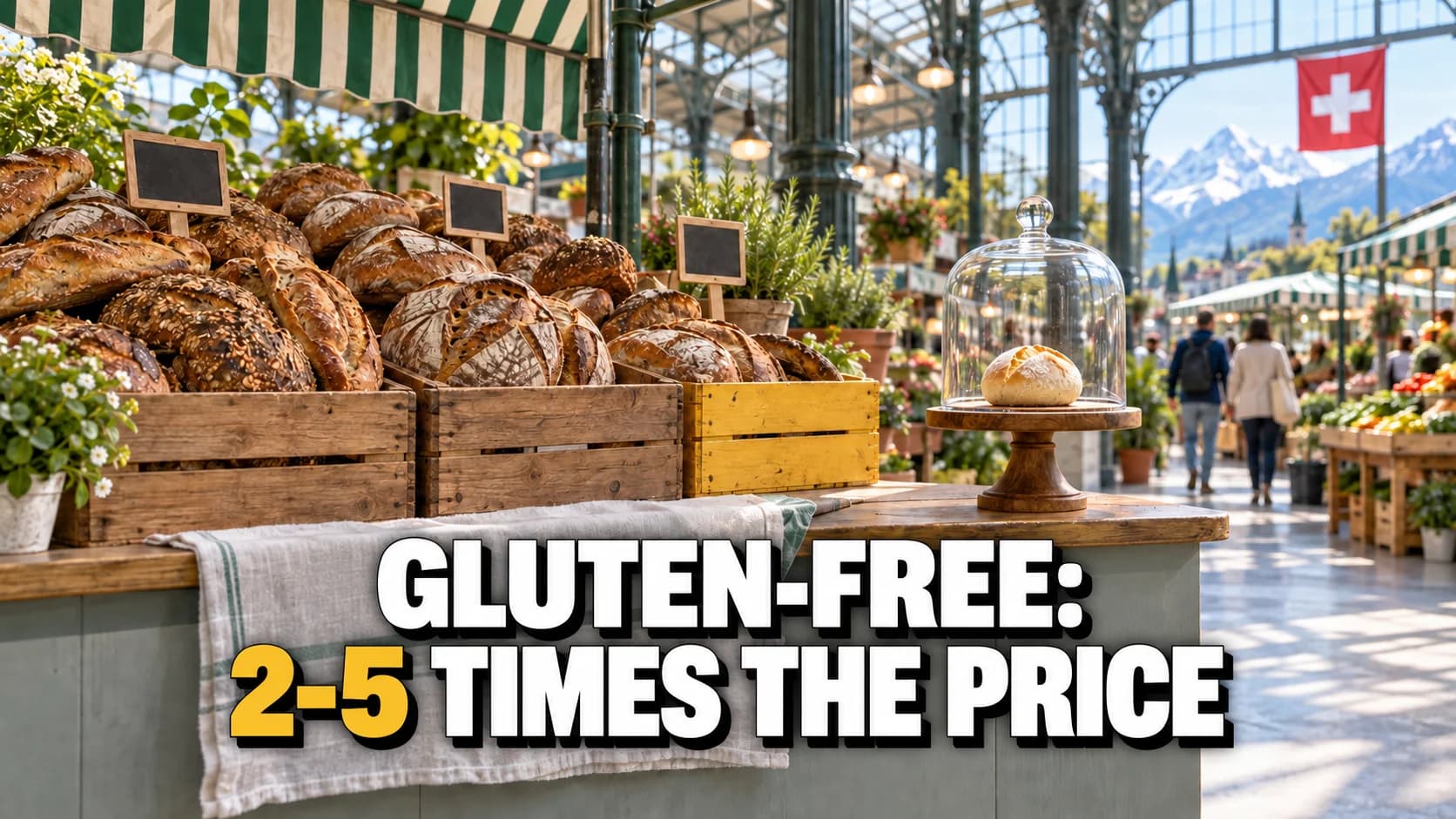
Gluten-free products in Switzerland cost between 2 and 5 times their conventional equivalent, depending on the category. A celiac household typically spends CHF 150 to CHF 300 more per month on the same basket as a non-celiac household. This guide shows the real price gaps across Migros, Coop, Lidl, Aldi, Denner and specialty stores, what the Swiss state does (and no longer does) to help, and how to track the products you actually buy so you only pay full price when you have to.
Sources checked regularly. Price points verified against migros.ch, coop.ch and Lidl Switzerland. Independent comparisons from RTS On en parle and the Fédération romande des consommateurs (FRC). Re-verified 25 July 2026: the RTS and FRC gaps still stand (Migros gluten-free Baguettini about 5x the regular version, Coop Free From vegetable broth CHF 5.20 against CHF 1.90 for Prix Garantie, FRC measuring up to 3.5x), and Gesundheitstipp confirms celiac disease is still off the IV list of congenital defects since 1 January 2022 with no federal replacement, with IG Zöliakie still lobbying. Live prices in the Rappn app.
Rappn is an independent grocery price comparison app in Switzerland, with no commercial agreements with any retailer.
How big is the price gap?
The cleanest way to see the gluten-free premium is to put each product next to its conventional in-house equivalent at the same retailer. Independent reporting from RTS On en parle (2022) and the FRC give matching figures, with the Migros and Coop budget lines as the conventional baseline.
| Product | Conventional (CHF) | Gluten-free (CHF) | Multiplier |
|---|---|---|---|
| Coop vegetable broth (Prix Garantie vs Free From) | 1.90 | 5.20 | 2.7x |
| Migros Baguettini (regular vs aha!) | ~1.00 | ~5.00 | ~5x |
| Pasta, basic spaghetti (Migros M-Classic vs aha!, per kg) | ~3.00 | ~9 to 11 | 3 to 3.7x |
| Lidl gluten-free spaghetti (when in rotation, per kg) | n/a | ~4.00 | ~1.3x vs conventional |
| Bread (sliced, 400g, Schär in specialty store) | ~3.50 conventional | ~7 to 9 | ~2 to 2.5x |
Two patterns matter. First, the gap widens fastest on processed staples (bread, baguettes, biscuits, pizza bases) where gluten replacement is technically demanding. Second, the gap collapses when discount retailers run rotating gluten-free items: Lidl gluten-free spaghetti at CHF 4/kg is genuinely close to conventional pasta. The savings opportunity is in catching those rotations.
For the broader pricing picture across Swiss supermarkets, see our breakdown of food prices in Switzerland.
Gluten-free usually costs more than the regular product in Switzerland, and the gap varies by chain and by week. Live offers from the seven chains that carry the range.
Find gluten-free offers. Rappn is freeFree, no account required · iOS & Android
"gluten free" · Gluten-free · bread, pasta, baking
Offers
Who sells what: the Swiss gluten-free landscape
Five places to find gluten-free products, each with a different role in the basket.
Migros (aha!). Launched in 2012, certified by the Swiss Allergy Centre, produced at Jowa Huttwil BE (Switzerland's largest gluten-free production site). Range covers bread, pasta, pizza bases, flour, baking mixes, ready meals, snacks. Roughly 140 certified items across food and cosmetics. The most consistent everyday range.
Coop (Free From). Running since 2006. Colour-coded labels mark gluten-free, lactose-free, and other allergen-free variants. Coop also distributes the Italian brand Schär across the same shelves. Selection comparable to Migros aha!, often slightly broader on prepared meals.
Schär (Italian brand). The reference international brand. Found at Coop, in Migros (some lines), in pharmacies, and in specialty health stores. Highest absolute prices, especially in pharmacy/specialty channels. Same product can cost CHF 1 to CHF 2 more in a pharmacy than at Coop.
Lidl and Aldi. Rotating gluten-free items, listed under their general "Free From" or seasonal ranges. Selection is unpredictable but prices can be the lowest in Switzerland when items are in rotation. Worth checking weekly.
Specialty: Alternis, Reformhaus, drugstores. Wider variety of imported brands (Bauckhof, organic and free-from niches), but the highest price points.
For comparison context, our Lidl vs Aldi breakdown covers how their rotating ranges actually work.
Why the gap exists
Three real reasons sit underneath the price gap, and they are not going away.
- Production complexity. Gluten replacement (modified celluloses, psyllium husk, multiple alternative starches) requires longer ingredient lists and dedicated production lines to avoid cross-contamination. Both Migros and Coop confirm this on the record.
- Smaller scale. The Swiss celiac population is roughly 0.25 to 1% of residents (estimates vary widely; the IG Zöliakie association cites approximately 80,000 affected people, only a fraction diagnosed). Volume per SKU is far below conventional staples.
- Limited budget-line presence. Conventional Swiss food has aggressive budget lines (M-Budget, Prix Garantie) priced 38 to 51% below the standard line. Gluten-free has almost no equivalent. See M-Budget vs Prix Garantie for what is normally available, and notice how thin the gluten-free shelf is on those labels.
Track your gluten-free staples. Only pay full price when you have to.
Add Schär bread, aha! pasta, Free From flour, or any specific SKU you buy weekly. Rappn alerts you the moment any of the 7 retailers runs them on Aktion.
What the Swiss state does (and no longer does)
This is the part most newly-diagnosed celiac families do not realise.
What basic insurance covers: the Grundversicherung covers nutrition counselling (Ernährungsberatung) for confirmed celiac disease, before and long after diagnosis. It does not cover gluten-free food itself.
What changed on 1 January 2022: celiac disease was removed from the IV (invalidity insurance) list of congenital defects. Before that date, children up to age 20 could receive an IV flat-rate compensation toward gluten-free diet costs, reported at between CHF 600 and CHF 1,450 per year; we could not re-confirm that range, so read it as a press figure. Around 3,000 insured persons received this in 2020. Since 1 January 2022, this is gone. There is no replacement federal scheme. The IG Zöliakie association is still lobbying for one.
Tax treatment: the additional cost of gluten-free food cannot be deducted as a health expense on the federal tax return.
International contrast: Italy reimburses gluten-free food costs through its national health service. Switzerland is unusual in not doing so.
The practical implication: for a Swiss celiac household, every franc saved on gluten-free groceries is unsubsidised. Tracking is not optional, it is the entire savings strategy.
How to actually save: a concrete approach
Three habits do almost all the work.
- Identify your fixed basket. Most celiac households cycle through the same 15 to 25 SKUs every month. Bread, two pasta shapes, flour, baking mix, breakfast cereal, biscuits, snack bars. Write the list once.
- Set price alerts on each one. Schär products go on Aktion at Coop roughly every 4 to 6 weeks at 25 to 30% off. Migros aha! runs 20 to 25% promotions less predictably but regularly. Lidl and Aldi rotations are the windfall events.
- Stock when the deal is real. Gluten-free shelf life on dry goods (pasta, flour mixes, crackers) is usually 6 to 12 months. Buying 2 to 3 months of supply on a 30% Aktion is the single most effective move.
For the broader savings playbook across all groceries, see our guide to save money on groceries in Switzerland.
Updated: .
Why Rappn?
Rappn is an independent grocery price comparison app in Switzerland, with no commercial agreements with any retailer. Our comparisons are truly independent.
- 100% free: no subscription, no hidden costs
- Neutral: no commercial agreements with Migros, Coop, Aldi, Lidl, Denner, Aligro, or Otto’s
- Updated daily, as soon as the chains publish their deals
- The chains’ deals in one place: search, filter, compare, no account needed
Ready to save on groceries?
Install Rappn and compare for yourself this week. No account required.Scan the code, install Rappn and compare current offers. No account needed.
Built in Switzerland, for Switzerland
Frequently Asked Questions
How much more do gluten-free products cost in Switzerland?
Typical gluten-free items cost 2 to 5x the price of their conventional equivalent. Migros gluten-free Baguettini run roughly 5x the regular Baguettini. Coop Free From vegetable broth cost CHF 5.20 vs CHF 1.90 for Prix Garantie when re-verified in July 2026. The Fédération romande des consommateurs has measured gaps up to 3.5x across a basket of staples.
Where are gluten-free products cheapest in Switzerland?
For everyday staples, Lidl and Aldi occasionally run gluten-free items at near-conventional prices, though selection rotates. For consistent range, Migros (aha! brand) and Coop (Free From) are the main options. Specialty stores carrying Schär are typically the most expensive. Tracking the same SKU across retailers is the only way to catch the cheapest week; this week's gluten-free deals, by price per kilo, are at the top of this page.
Does Swiss health insurance cover gluten-free food?
Basic Swiss health insurance (Grundversicherung) covers nutrition counselling for confirmed celiac disease, but does not reimburse the gluten-free food itself. Since 1 January 2022, celiac was removed from the IV congenital-defects list, ending the previous CHF 600 to CHF 1,450/year flat-rate compensation for affected children. Switzerland is unusual in Europe in this regard; Italy reimburses costs.
Are Migros aha! and Coop Free From actually gluten-free?
Yes. Migros aha! products are certified by the Swiss Allergy Centre and produced at the Jowa facility in Huttwil BE, the largest gluten-free production site in Switzerland. Coop Free From has been running since 2006 with colour-coded labelling for gluten, lactose, and other allergens. Both meet Swiss labelling rules for gluten-free (under 20 mg/kg).
How much can a celiac household save by tracking gluten-free prices?
What is measured here is the gap per product, not a household total. Re-verified on 25 July 2026: Coop Free From vegetable broth costs CHF 5.20 against CHF 1.90 for Prix Garantie, Migros gluten-free Baguettini run about 5x the regular ones, and the Fédération romande des consommateurs has measured gaps up to 3.5x across a basket of staples. Tracking the same items across retailers and buying the core staples (bread, pasta, flour, biscuits) in Aktion weeks is what narrows it. How much that is worth depends on how much of your basket has to be gluten-free.