Hofläden & Farm Shops in Switzerland: The Direct-from-Producer Guide (2026)
One Swiss farm in five sells direct off the farm (BFS 2023), down from 26 % in 2020; the 2016 census counted 11'358, up from 7'084 in 2010, and it is that older peak that is often quoted. Read on to 11'358 in the 2016 BFS census (NOT 8'000 per common claims). University of Bern Vertrauenskasse study: 95 % of goods correctly paid for in unsupervised Hofläden. vom-hof.ch is the canonical SBV directory (TWINT since Jan 2019, Liechtenstein since June 2023). Luzern adopted a revised shop-hours law on 26 January 2026 covering all unstaffed shops up to 30 m2, but referendums were announced and it is not in force. Solawi boom has cooled (Tsüri.ch: 6 of 9 Zurich Solawis seeking subscribers). Full directory + pricing reality vs supermarket Bio below.
Rappn compares prices across all 7 chains live: free, no account.
Compare farm-direct with supermarket Bio. Rappn is free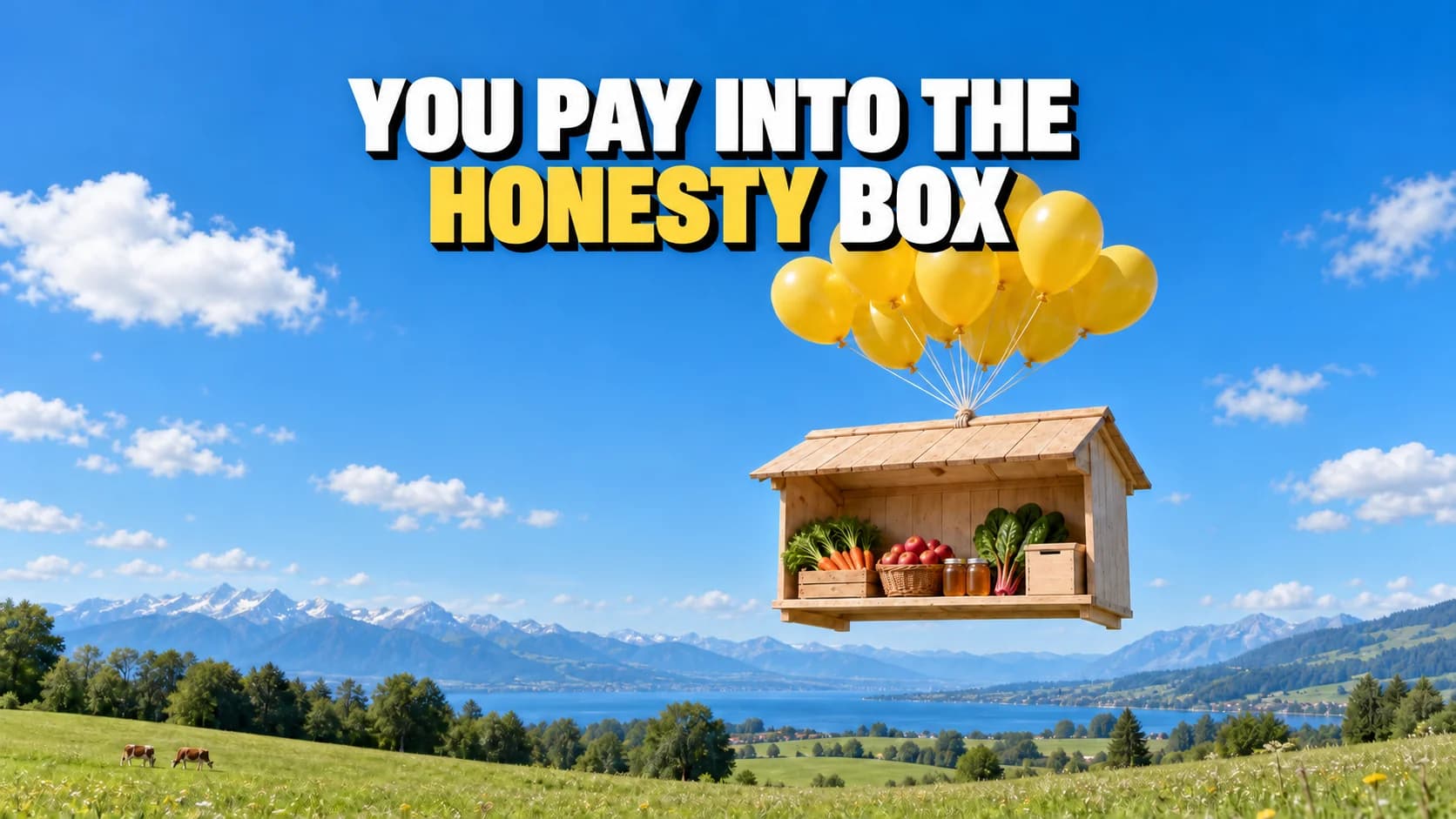
How do I find a Hofladen near me in Switzerland? The canonical national directory is vom-hof.ch, run by the Swiss Bauernverband, with farm profiles, opening hours, products and payment options across all four language regions and Liechtenstein. Cantonal Bauernverbände run regional lists; Bio Suisse publishes a Knospe-certified farm map at bio-suisse.ch; Biomondo.ch is the dedicated organic-farm marketplace; Crowd Container delivers from farms to your door across Switzerland. Many farms also have a roadside sign, the green Hofladen tafel, on the nearest main road. Per BFS, one Swiss farm in five (20 per cent) sold its own products direct to consumers off the farm in 2023, down from 26 per cent in 2020 and 22 per cent in 2016. Against roughly 46'000 farms that is about 9'000 to 9'500 of them, and the trend is downwards, not upwards. Wherever you are in Switzerland there is still one within driving or cycling distance.
Sources checked regularly. SBV press release January 2018 (11'358 farms in BFS 2016 census, up from 7'084 in 2010); SRF News January 2018; SBV July 2020; LID Direktvermarktung; swissinfo April 2026 citing University of Bern Vertrauenskasse study; vom-hof.ch (live, TWINT integration since January 2019, Liechtenstein expansion June 2023); Luzerner Kantonsrat, first reading 27.10.2025 (63:52) and final vote 26.01.2026 on the revised Ruhetags- und Ladenschlussgesetz, referendums announced; Tsüri.ch late 2024 on cooling Solawi boom; Bio Suisse + Verband regionale Vertragslandwirtschaft + Crowd Container (crowdcontainer.ch) corporate. Verified May 2026.
Rappn is an independent grocery price comparison app in Switzerland, with no commercial agreements with any retailer.
The Hofladen tradition and why it is quietly growing
The Swiss Hofladen is older than the supermarket, but the modern version has grown fast. In 2010, the Federal Statistical Office counted 7'084 farms selling produce direct. By 2016 the number had reached 11'358, a 60 percent jump in six years. That 11'358 figure is the 2016 census and is not the current state. BFS's latest reading, for 2023, has 20 per cent of farms selling direct off the farm, down from 26 per cent in 2020, plus 10 per cent doing on-farm processing for farm-shop sale. Direct sales represent about 5 to 7 percent of total Swiss agricultural production value (out of an annual CHF 11 billion), with shares varying sharply by product: cherries around 40 percent direct-sold, eggs around 30 percent, berries around 20 percent, other fruit and wine around 10 percent.
Three pressures drive the growth. Retail margin compression: selling direct earns more per kilo than selling through Migros, Coop or wholesale. Consumer pull: regional, traceable and seasonal have become real purchasing criteria. Tech: vom-hof.ch, TWINT, self-service units and digital weighing systems made it possible to operate a Hofladen without a cashier.
Explore current offers, shopping lists, price alerts and digital loyalty cards in Rappn. Open the different views to try the app.
Compare farm-direct with supermarket Bio. Rappn is freeFree, no account required · iOS & Android
Hofläden · 11,000+ farms, 95% honour-payment rate
Welcome
Where to find them: directories, apps, signage
- vom-hof.ch is the SBV's national directory. Search by postcode, product category or service (farm shop, market stall, vending machine, farm tourism, Apéro on the farm). Available in DE, FR, IT and Liechtenstein. TWINT-equipped farms are flagged.
- bio-suisse.ch for Knospe-certified farms specifically.
- Biomondo.ch is Bio Suisse's standalone marketplace where organic farms sell direct online (no fees).
- Cantonal Bauernverband sites for regional listings.
- Crowd Container (Zurich, cooperative) for direct-from-producer delivery anywhere in Switzerland.
- SaisonBox app for farm-direct ordering with delivery.
- greenpick.ch (formerly greenpick.app, which now redirects there) is no longer a farm-direct delivery service: it is a sustainability directory, KOMPASS, listing more than 1'000 sustainable businesses.
- Roadside signage: the green farm-icon Hofladen sign indicates a vom-hof.ch member. The yellow Bio Suisse Knospe sign indicates an organic farm.
Pricing reality vs supermarket Bio
The honest answer: Hofladen prices are usually similar to supermarket organic, sometimes higher, occasionally lower. The Hofladen has structural advantages on freshness, traceability and seasonal sourcing, but it does not have Migros or Coop's purchasing scale.
Where the Hofladen is often competitive on price:
- Eggs: Hofladen eggs at CHF 4 to 6 per 6 are competitive with supermarket Bio Knospe.
- Honey: substantially cheaper than the Migros Bio honey shelf.
- Apples and stone fruit in season: when you buy at the farm, you skip the cooling and logistics premium.
- Bread (where the farm has its own oven): typically cheaper than Coop Naturaplan or Migros Bio sourdough.
Where supermarket Bio tends to be lower: bulk pantry staples (oil, pasta, rice, sugar), Migros M-Budget and Prix Garantie undercut, and even Coop Naturaplan often costs less than a Hofladen equivalent if the farm sources externally. Imported products: by definition not a Hofladen strength. For a detailed Bio comparison see Coop Naturaplan vs Migros Bio.
What is actually fresher and what is not
Fresher at the Hofladen, often by hours: leafy greens cut the same morning, berries in season, eggs (often laid that day), heirloom tomatoes, on-farm-baked bread, fresh milk from a Milchautomat.
Not fresher: long-storage products (root vegetables in winter, apples after January, dry goods), pre-packaged dairy unless straight from the milking parlour, frozen foods (most Hofläden do not stock these meaningfully).
Gemüseabo and Vertragslandwirtschaft (Solawi)
Commercial Gemüseabo runs on a market price, with a producer (or cooperative like Crowd Container) selling a box of seasonal vegetables on a per-week or per-fortnight basis. Membership is light, you cancel any time.
Solidarische Landwirtschaft (Solawi), also called regionale Vertragslandwirtschaft (RVL), is the Swiss adaptation of CSA. Members pay an annual share that covers the farm's full production costs (we no longer quote a franc range, because the Zurich-area figures we previously carried could not be sourced), in exchange for a year of weekly vegetable shares. The risk is shared: poor harvest means less; great harvest means more. The first Swiss Solawi, Jardins de Cocagne, was founded in Geneva in 1978. Today solawi.ch counts around 40 initiatives nationally, about 30 of them in Romandie and a growing cluster in German-speaking Switzerland since the 2011 founding of the Verband regionale Vertragslandwirtschaft.
The COVID-era Solawi boom has cooled. Tsüri.ch reported in late 2024 that six of nine surveyed Zurich-area Solawis were looking for new subscribers. The model has matured; the people most drawn to it during lockdowns have largely moved on. For the right household (cooks, vegetable-forward, willing to take what the season gives), it remains the best fresh-vegetable deal in Switzerland.
Self-service and honour-payment shops: the Swiss trust culture
Most Swiss Hofläden are unmanned: a small room or wooden shed, shelves of produce with price labels, a wooden box (Kässeli or Vertrauenskasse) for cash, and an honour expectation that you calculate your total and drop the right francs in.
A University of Bern study found that 95 percent of goods are correctly paid for in Swiss Hofläden, despite the lack of supervision. The remaining 5 percent is concentrated in higher-value items (honey, cheese, occasionally meat); proximity to the farmhouse or to neighbours reduces theft further. The model only works in a high-trust society, and Switzerland is one of the few countries where it scales.
Payment options have modernised. TWINT has been available at vom-hof.ch farms since January 2019; QR-bill stickers are common; newer concepts (Rüedu in Bern, Holabox in Winterthur, Bioflix 24-hour bio shops, Kastl-Greissler from Austria) layer digital payments and access control on top of the trust model.
Seasonal calendar
- April-May: asparagus, wild garlic, rhubarb, first strawberries (low altitude), early lettuce
- June: strawberries peak, first cherries, early stone fruit, peas
- July-August: peak everything (tomatoes, peppers, cucumbers, courgettes, berries, stone fruit, early apples)
- September-October: apples, pears, plums, pumpkins, sweetcorn, autumn vegetables
- November-December: winter squash, root vegetables, kale, late apples, walnuts, Christmas trees
- January-March: storage vegetables (carrots, potatoes, beetroot, celeriac), eggs, dairy, preserved products, alpine cheese
Sunday and late-hour exceptions
Federal labour law (ArG) governs shop hours, but Hofladen rules are largely cantonal:
- Zug: Hofläden explicitly exempt from the Ladenöffnungsgesetz.
- Obwalden and Schwyz: direct sale of farm fresh products is exempt from public-holiday closure rules.
- Nidwalden: food shops up to 200 m² are exempt (not Hofladen-specific but covers most of them).
- Luzern: the Kantonsrat passed a first reading on 27 October 2025 by 63 votes to 52, rejecting a narrower Hofladen-only version 62 to 53 and full 24/7 liberalisation 83 to 30. It adopted the revised Ruhetags- und Ladenschlussgesetz on 26 January 2026, and the scope was widened well beyond farm shops: all unstaffed self-service shops up to 30 m2, plus shops at fast-charging stations up to 100 m2, may open 06:00 to 22:00 daily. Both the SP and a right-wing party announced referendums and a cantonal popular vote is expected, so the rules are not in force. Check lu.ch for the vote date before planning around them.
- Other cantons: a patchwork. Many tolerate unmanned Hofläden 24/7 in practice; few have written explicit exemptions.
Practical rule: a self-service unmanned Hofladen is almost always accessible on Sundays. A manned Hofladen depends on the canton, the farm and the day. Always check the specific farm's hours on vom-hof.ch. See also Sunday grocery shopping in Switzerland and public-holiday grocery shopping for the wider hours map.
Note: with Farmy now in bankruptcy (see our Farmy bankruptcy explainer), Hofläden + Crowd Container + supermarket Bio (organic food price comparison) are the practical alternatives.
Updated: .
Why Rappn?
Rappn is an independent grocery price comparison app in Switzerland, with no commercial agreements with any retailer. Our comparisons are truly independent.
- 100% free: no subscription, no hidden costs
- Neutral: no commercial agreements with Migros, Coop, Aldi, Lidl, Denner, Aligro, or Otto’s
- Updated daily, as soon as the chains publish their deals
- The chains’ deals in one place: search, filter, compare, no account needed
Ready to save on groceries?
Install Rappn and compare for yourself this week. No account required.Scan the code, install Rappn and compare current offers. No account needed.
Built in Switzerland, for Switzerland
Frequently Asked Questions
How do I find a Hofladen near me in Switzerland?
Start with vom-hof.ch, the Swiss Bauernverband's national directory, searchable by postcode and product. Bio Suisse runs a parallel directory for Knospe-certified organic farms. Cantonal Bauernverband sites list regional farms. Roadside signage (green Hofladen tafel) marks vom-hof.ch members.
Are Hofladen prices higher or lower than Bio at Migros?
Roughly similar on most items, with category-specific swings. The Hofladen is often competitive on eggs, honey, in-season fruit and on-farm bread. Supermarket Bio tends to be lower on bulk pantry staples (oil, pasta, rice) and on imported items the farm does not produce itself.
Can I shop at a Hofladen on Sundays?
Yes for most unmanned self-service Hofläden (Vertrauenskasse model). For manned Hofläden, it depends on the canton. Zug, Obwalden and Schwyz have explicit Sunday exemptions. Luzern voted in September 2024 to introduce a Hofladen-specific exemption with size and time limits, still being drafted. Other cantons vary. Check the specific farm's hours on vom-hof.ch.
What is a Gemüseabo and is it worth it?
A Gemüseabo is a vegetable subscription. Two models: commercial (per-box, you cancel any time, providers like Crowd Container) and Solidarische Landwirtschaft / Solawi (annual share, year-long commitment, risk-sharing with the farm). We do not quote a franc range for annual Solawi shares, because the Zurich-area figures we previously carried could not be sourced; ask the cooperative directly. Worth it for vegetable-forward households who cook from the box and accept what the season gives.
Do all Hofläden accept TWINT?
Most do, since TWINT integration was rolled out via vom-hof.ch in January 2019. Some smaller unmanned shops still operate cash-only, but the trend is fast toward TWINT plus optional QR-bill, with cash as a backup. Always have some coins for the wooden box if the farm looks classic.
Is the Vertrauenskasse honour system really safe?
A University of Bern study found that 95 percent of goods are correctly paid for in Swiss Hofläden without supervision. The remaining 5 percent is concentrated in higher-value items (honey, cheese, occasionally meat); proximity to the farmhouse or neighbours reduces theft further. The model only works in a high-trust society, which is why it scales in Switzerland and is rare elsewhere.