Own-brand or brand? When switching genuinely pays off
In the Kassensturz comparison (SRF, November 2025) the M-Budget basket was just under 38 percent and the Prix Garantie basket around 51 percent cheaper than comparable branded products. The honest caveat: budget means cheaper, not always the identical product. So the decision is per item, with the price per kilo and the current offer in front of you.
Rappn compares the current promotions of 7 Swiss retailers, updated daily: free, no subscription.
Compare own-brand vs brand in Rappn, free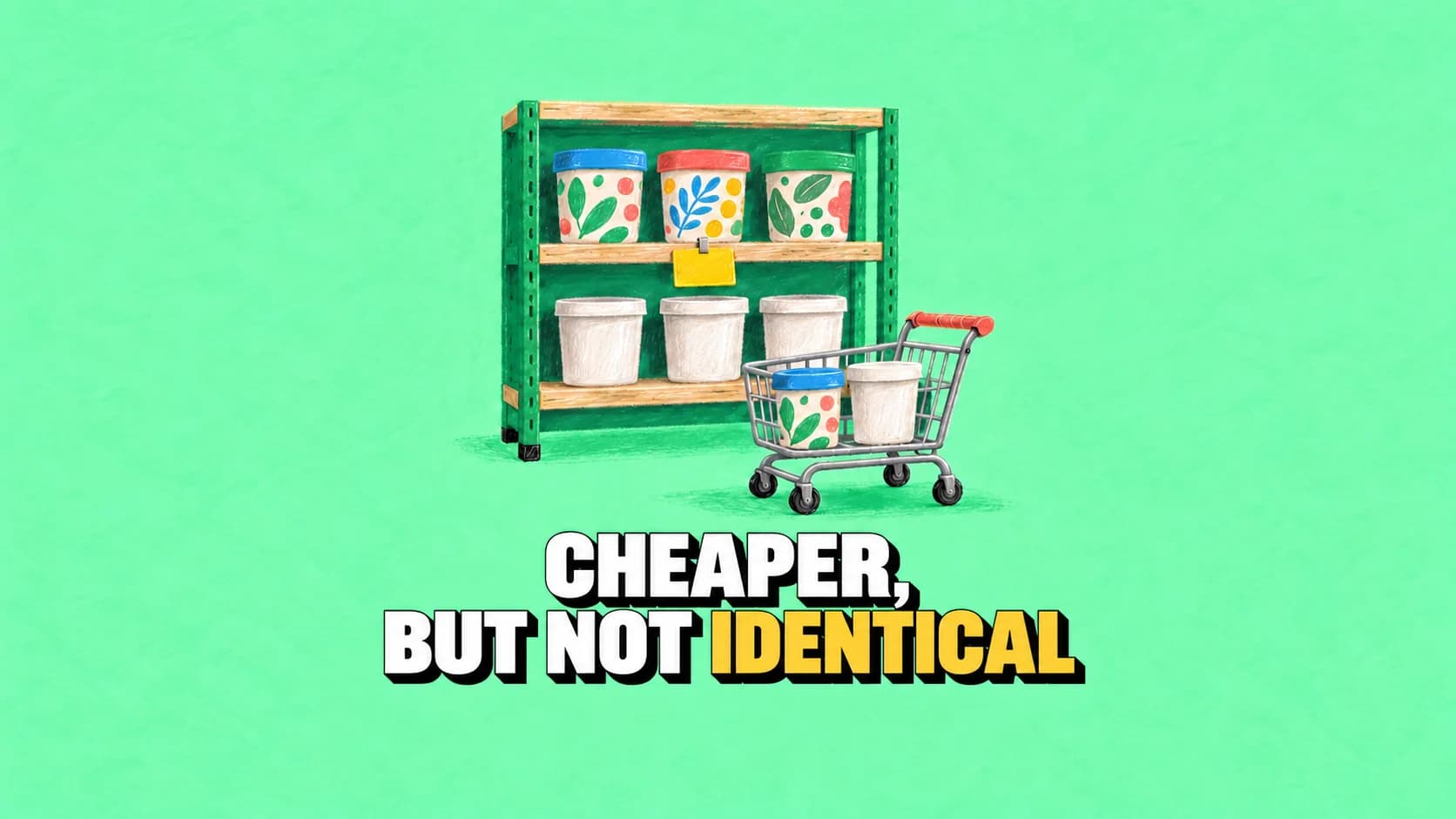
Updated regularly. Switching from name brands to the budget own-brand line is the single biggest saving lever at the till. In the latest Kassensturz comparison (SRF, November 2025) the M-Budget basket was just under 38 percent and the Prix Garantie basket around 51 percent cheaper than comparable branded products. The honest caveat: budget means cheaper, not always the identical product. So the comparison pays off per item.
Rappn is an independent grocery price comparison app in Switzerland, with no commercial agreement with any retailer. Migros, Coop, Aldi, Lidl, Denner, Aligro and Otto's do not pay us to rank them, and nothing below is sponsored.
How much cheaper is the own-brand than the brand?
| Source | M-Budget | Prix Garantie | Note |
|---|---|---|---|
| Kassensturz (SRF), Nov 2025 | ~38 % | ~51 % | basket |
| K-Tipp, 2016 | 41 % | 47 % | long-term comparison |
| K-Tipp, 2011 | ~40 % (avg) | ~40 % (avg) | single items vary widely |
These are live offers in Rappn, own-brand next to brand across the seven chains, so you can see per product where switching actually pays off. Type a product to try it.
Compare own-brand vs brand in Rappn, freeFree, no subscription · iOS & Android
"pasta"
Offers
Is switching always worth it? The honest answer
Not blindly. Budget own-brands are cheaper, but not by definition the same product. Kassensturz showed in 2025 that mid-price Tortelloni contained 12 percent ricotta while the M-Budget version had only 4.5 percent, topped up with cheaper potato filling. For many staples like flour, rice or pasta the difference is minimal, and the brand premium is pure name surcharge. So the question is never own-brand versus brand in general, but per product: where is the own-brand just as good, and where is the brand genuinely worth it? You decide that best with the price per kilo and the current offer in front of you.
The brand surcharge: what are you really paying for?
When you reach for a brand, only part of the price pays for what is actually inside the pack. Some of it does go into the recipe, as the tortelloni example higher up shows. But the larger share is often a pure name premium: advertising, polished packaging and the best spot on the shelf, right at eye level where your hand reaches first. Those costs land on the price tag without a single extra gram in the product.
For simple staples, the ingredient list is often almost identical. Flour, rice, sugar, pasta and oil are made of a few, tightly defined components, so there is little room for a hidden extra. None of the marketing around them changes what ends up on your plate, yet you still pay for the name printed on the packaging.
So take the decision back into your own hands instead of leaving it to the packaging. A simple self-test helps:
- Buy the staple as an own-brand once and try it properly at home.
- Ask yourself honestly whether you truly notice a difference in daily use.
- Keep the brand only where you clearly taste or feel that difference.
- For everything else, let the cheaper own-brand go into your basket.
That way you keep paying for real quality where it genuinely matters to you, and stop paying simply for a familiar logo on the front of the pack.
In the Rappn app you search a product and see the current promotions of the seven chains, own-brand next to brand, with the unit price per kilo or litre. That way you check, item by item, whether switching pays off, instead of guessing. More levers are in the how to save on groceries guide, and what is on offer this week is shown by the price comparison.
Updated: .
Why Rappn?
Rappn is an independent grocery price comparison app in Switzerland, with no commercial agreements with any retailer. Our comparisons are truly independent.
- 100% free: no subscription, no hidden costs
- Neutral: no commercial agreements with Migros, Coop, Aldi, Lidl, Denner, Aligro, or Otto’s
- Updated daily, as soon as the chains publish their deals
- The chains’ deals in one place: search, filter, compare, no subscription
- Meal planner in the Kitchen tab: plan the week, send the ingredients to your list

Ready to save on groceries?
Install Rappn and compare for yourself this week. No account required.Scan the code, install Rappn and compare current offers. No account needed.




Frequently Asked Questions
How much cheaper are own-brands than branded products?
In the Kassensturz comparison (SRF, November 2025) the M-Budget basket was just under 38 percent and the Prix Garantie basket around 51 percent cheaper than comparable brand items. A K-Tipp long-term comparison from 2016 found 41 and 47 percent respectively.
Are own-brands as good as branded products?
Often, but not always. Budget own-brands are cheaper but not necessarily the identical product: Kassensturz showed in 2025 that M-Budget Tortelloni had noticeably less ricotta than the mid-price version. For staples like flour or rice, though, the difference is often minimal.
When is the branded product genuinely worth it?
When the recipe or quality is noticeably better to you and worth the premium. For many staples the premium is pure name surcharge. Decide per product, ideally with the price per kilo and the current offer in front of you.
Does the own-brand come from the same factory as the brand?
Sometimes, but it cannot be claimed across the board, and even then the recipe can differ. More reliable than such assumptions is a direct per-item comparison: price per kilo, ingredient list and current promo price across every chain.
Is the brand surcharge the same on every product?
No, it varies a lot from product to product. On single items the gap runs well above or below the basket average. That is why it pays to check each product on its own.