
Stocking up on offers in Switzerland: which multi-buys pay per unit this week
Stocking up on offers pays for groceries that keep and that you will use, and only if the price per unit really drops: 3 for 2 is 33% off per unit, second item at 40% off only 20%.
This week’s stock-up check: unit prices and multi-buys
Canton of Zurich, as of 11 Oct 2026: for each category, the lowest verified unit price among the promotions, with the chain, the mechanic and validity.
| Item | Lowest verified unit price | Product | Chain | Deal | valid until | Promotions |
|---|---|---|---|---|---|---|
| Coffee | CHF 13.94/kg | La Mocca Organic Medium Roast Ethiopia 500 g | Coop | 2+ items −30% | Wed 14 Oct | 19, 15 of them multi-buys |
| Coffee capsules | Too few promotions this week to compare | |||||
| Dry pasta | CHF 2.04/kg | Linguine no. 10 1 kg | Migros | 3+ items −40% | Wed 14 Oct | 40, 16 of them multi-buys |
| Cooking oil | CHF 3.57/l | Liquid fabric softener Violet Senses 1 l | Migros | 2+ items −40% | Wed 21 Oct | 16, 14 of them multi-buys |
| Laundry detergent | CHF 0.13/wash | Gama Universal liquid laundry detergent, 100 washes | Otto’s | −61% | no verified end date | 43, none of them multi-buys |
| Toilet paper | Too few promotions this week to compare | |||||
| Rice | No live list: see the guide | |||||
Method: current promotions of the 7 chains in the Rappn database, canton of Zurich, as of 11 Oct 2026. Promotions with a real price cut are counted; the price is the lowest verified unit price among the category’s promotions, for multi-buys the per-unit price from the minimum quantity. Regular prices without a promotion are not included.
Rappn compares the current promotions of 7 Swiss retailers, updated daily: free, no subscription.
Watch a product in Rappn, free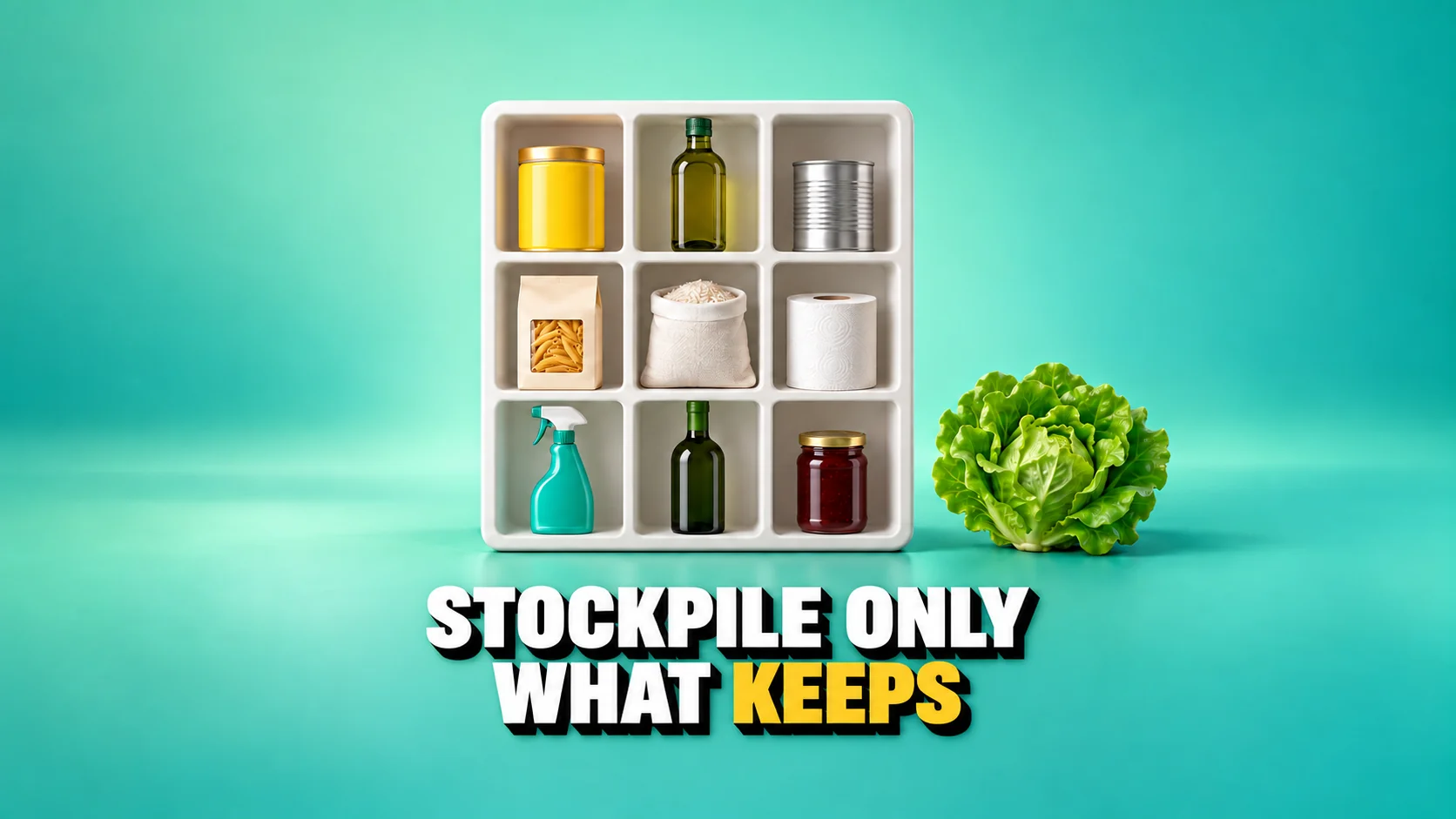
Stocking up on an offer only saves money under two conditions: the product keeps until you have used it, and the discount holds per unit, not just on the sign. Below is how to work out any multi-buy per unit, what belongs in a stockpile and what does not, and why this page does not predict when the next offer comes. In Switzerland a supermarket promotion is called an Aktion.
Rappn is an independent grocery price comparison app in Switzerland, with no commercial agreement with any retailer. Migros, Coop, Aldi, Lidl, Denner, Aligro and Otto's do not pay us to rank them, and nothing below is sponsored.
How to work out an offer per unit
| Mechanic | You pay for the quantity | Discount per unit |
|---|---|---|
| 40% off from 2 units (both reduced) | 2 × 0.6 = 1.2 prices for 2 | 40% |
| Second item at 40% off | 1 + 0.6 = 1.6 prices for 2 | 20% |
| 3 for 2 | 2 prices for 3 | 33% |
| 2 for 1 | 1 price for 2 | 50% |
| Bulk pack without an offer | pack price | not automatically: compare the unit price |
The Swiss consumer protection foundation (Stiftung für Konsumentenschutz) says it plainly in its guide to saving on food shopping (updated December 2025): offers only save money if you actually use the products, and bulk packs are not necessarily cheaper than single packs. What counts is the unit price per kilo, litre, roll or wash. Whether the bulk pack or the small pack on offer comes out ahead is decided by that comparison; more in the guide to bulk buying in Switzerland.
This is Rappn's monitored-products view: watch your staples and the app tells you when they go on offer, so you stock up during a promotion. Tap around to try it.
Watch a product in Rappn, freeFree, no subscription · iOS & Android
Monitored products
What belongs in a stockpile, and what does not
A stockpile is for what keeps and what you use regularly. How long something keeps is told by the printed date, not by a rule of thumb.
- Coffee and capsules: keep them unopened.
- Pasta, rice, tins, flour and sugar: dry and closed.
- Cooking oil: closed and in the dark; opened oil does not keep as long.
- Laundry detergent and toilet paper: they do not spoil, but they take up space.
- Meat, dairy and fresh vegetables: only via the freezer, see freezing food.
Two date labels help you decide. The best-before date is a quality date; much is still fine after it. The use-by date is on sensitive fresh food and is a safety limit: those products do not belong in a stockpile. The details are in best-before vs use-by date. If you are building an emergency stock following the federal list, it is on emergency food stock in Switzerland.
When will the next offer come?
This page does not say, and it does not guess. Rappn shows the offers running now and makes no statement about how often a product is on offer. Most weekly promotions change on Thursday; the details per chain are on promotion start days. If you do not want to check every week: watch the product in the Rappn app and it tells you when it goes on offer.
Keeping your stockpile from becoming food waste itself
A stockpile only saves money if you use it before it spoils. Buy more than you will use before the printed date and the discount ends up in the bin. In Switzerland each person throws away around 80 kilograms of food a year at home, worth around CHF 600 (foodwaste.ch, based on the 2025 interim monitoring report by ZHAW and the Federal Office for the Environment). A stockpile you do not keep on top of pushes exactly that number up.
- First in, first out: new purchases at the back, older ones used first.
- Store it visibly: do not stack too deep, so nothing disappears at the back.
- Honest quantity: buy only what you will use before the printed date.
- Note the purchase date: label larger supplies so you can see what needs using first.
More on waste in food waste is money. Why multi-buys also trigger impulse buys is covered in avoid impulse buys, and which price-tag tricks aim at quantity is explained in supermarket price traps.
Updated: .
Why Rappn?
Rappn is an independent grocery price comparison app in Switzerland, with no commercial agreements with any retailer. Our comparisons are truly independent.
- 100% free: no subscription, no hidden costs
- Neutral: no commercial agreements with Migros, Coop, Aldi, Lidl, Denner, Aligro, or Otto’s
- Updated daily, as soon as the chains publish their deals
- The chains’ deals in one place: search, filter, compare, no subscription
- Meal planner in the Kitchen tab: plan the week, send the ingredients to your list

Ready to save on groceries?
Install Rappn and compare for yourself this week. No account required.Scan the code, install Rappn and compare current offers. No account needed.




Frequently Asked Questions
Is it worth stocking up when groceries are on offer?
Yes, when three things line up: the product keeps, you will certainly use it, and the price per unit really drops. Convert the mechanic: 3 for 2 is 33% off per unit, 40% off from 2 units is 40%, second item at 40% off is only 20%. Perishables do not belong in a stockpile.
How do I work out a multi-buy per unit?
Divide the total by the number of units and compare with the single price. With second item at 40% off you pay 1.6 prices for 2 units, 20% per unit; with 3 for 2 you pay 2 prices for 3, 33%. If you only need one unit, the single price applies.
Which groceries are suitable for stocking up?
What keeps and what you use often: coffee and capsules (unopened), pasta, rice, tins, cooking oil, laundry detergent, toilet paper. The printed date tells you how long. Meat, dairy and fresh vegetables only via the freezer.
Is a bulk pack automatically cheaper than the offer?
No. What counts is the price per kilo, litre, roll or wash. A bulk pack without an offer can cost more than the small pack on a multi-buy; the Swiss consumer protection foundation also notes that bulk packs are not necessarily cheaper.
How do I know when a product is on offer again?
Watch the product in the Rappn app and it tells you when it goes on offer. The app is free. Rappn does not predict how often a product comes on offer.
How do I keep a stockpile from going to waste?
First in, first out: new purchases at the back, older ones first, a visible pantry, and only as much as you will use before the printed date.