How to Spot a Fake Discount at a Swiss Supermarket: A 2026 Guide
In Switzerland, '50% off' is a legal claim, but the law does not say what the regular price has to be. Since January 2025, a 30-day reference window is enough. The Preisbekanntgabeverordnung (PBV) explained, the seven Mondpreis tricks, and the 60-second check that catches them.
Rappn compares prices across all 7 chains live: free, no account.
Compare the Aktion across retailers. Rappn is free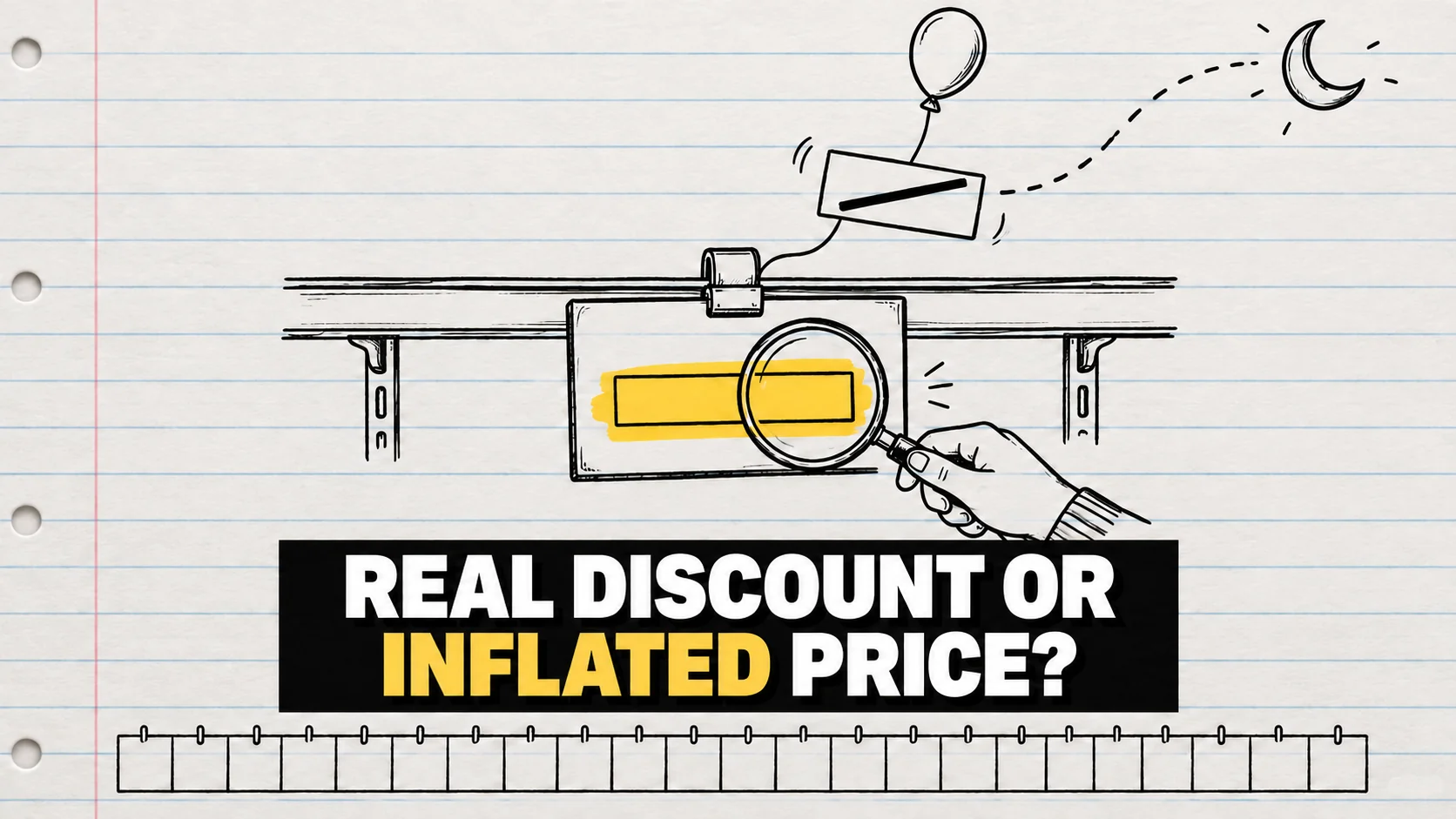
How can you tell if a Swiss supermarket discount is real? The 60-second method: check the unit price per kilo or per litre (Grundpreis), compare it to the private label alternative on the same shelf, check in Rappn whether another Swiss retailer has the same product on offer too, and read the small print on the price tag. If two of those four checks come back odd, the "Aktion" is not what it looks like.
In Switzerland, "50 per cent off" is a legal claim. The federal Preisbekanntgabeverordnung (PBV, SR 942.211) regulates what counts as a real comparison price. The catch is that the rules give chains enough room to engineer a fake without technically breaking the law. Here is how that works, and how to see through it.
Sources checked regularly. Federal ordinance SR 942.211 (PBV), UWG SR 241 articles 16-20 and 24, SECO control campaigns 2024 to 2026 (WBF/SECO release of 15 December 2025), March 2026 SECO ruling on Migros and Coop multi-buy tags, SECO intervention against IKEA Switzerland at the end of April 2026, K-Tipp Aktion analyses 2017-2025, Beobachter August 2025. The 30-day Selbstvergleich option was re-verified in July 2026 against the SECO Preisbekanntgabe pages (Selbstvergleich nach Art. 16 PBV) and the Stiftung für Konsumentenschutz price-indication guide.
Rappn is an independent grocery price comparison app in Switzerland, with no commercial agreements with any retailer.
What Swiss law actually requires
Swiss price disclosure is governed by the Preisbekanntgabeverordnung (PBV), ordinance SR 942.211, in force since 1978 and based on articles 16 to 20 and article 24 of the Federal Act against Unfair Competition (UWG, SR 241). The State Secretariat for Economic Affairs (SECO) holds federal oversight, while day-to-day enforcement sits with the cantons.
The PBV permits three kinds of comparison price:
- Selbstvergleich (self-comparison): the seller's own previous price. This is what "reduziert von CHF 8.90 auf CHF 4.45" means.
- Konkurrenzvergleich (competitor comparison): a clearly identified competitor's price.
- Einführungspreis (introductory price): the launch price for a new product.
On 30 October 2024 the Federal Council reformed the Selbstvergleich rules. The change, AS 2024 621, took effect on 1 January 2025. Sellers can now choose between two regimes:
- the old short-term rule: the previous (struck-through) price must have been valid for at least twice as long as the discount, and the whole comparison can run for a maximum of two months, or
- the new unlimited rule (Art. 16 para. 1 lit. a no. 2 PBV, in force since 1 January 2025): a Selbstvergleich can run indefinitely as long as the previous price was actually charged for at least 30 consecutive days beforehand. It is open-ended because the two-month cap in Art. 16 para. 3 covers only no. 1 and lit. b.
- the relisting rule (Art. 16 para. 3bis PBV, also new on 1 January 2025): a seller that temporarily delists an item and then puts it back on sale may keep using the last comparison price.
The new option, while reducing red tape for retailers, also widens the door for what shoppers know as Mondpreis: lifting the regular price for a brief period only to discount it from that artificial peak.
Since 1 January 2025 a Swiss Selbstvergleich only needs 30 days of pre-discount price to run indefinitely. In Rappn you can see whether another Swiss chain has the same or a similar product on offer this week, with the unit price. That is often how a Mondpreis gives itself away: the 'discount' is calculated against a temporarily inflated reference price at the same retailer.
Compare the Aktion across retailers. Rappn is freeFree, no account required · iOS & Android
Cross-retailer compare · spot the Mondpreis · 30-day rule
Monitored products
The 7 most common fake-discount tactics
1. The Mondpreis (moon price)
A "regular" price that was raised days or weeks earlier specifically to be discounted from. Since 1 January 2025, a 30-day reference window is enough for a legal Selbstvergleich, which makes this even easier than before. The fastest tell is to compare the "discounted" price against the same product at the other Swiss retailers: if Coop, Aldi or Lidl sell the same item for less at their regular price this week, the headline percentage off is measured against a temporarily inflated reference price, not against the real market.
2. The multi-buy ambiguity
"CHF 3.70" in big letters, valid only if you buy two. CHF 4.95 in small letters if you buy one. In March 2026, SECO ruled that Migros's price tags for these multi-buy promotions were not compliant with the PBV, and called Coop's practice borderline. Coop has since rolled out a redesigned discount tag. Migros is still working on it: a spokesperson said in 2026 that the design was being adapted and that the final technical rollout of the new layout would take some time, with no completion date announced. Until it is done, read the small print before reaching for the shelf.
3. The Aktion that is more expensive than the private label
K-Tipp tested three weeks of Coop and Migros Aktionen across roughly 70 products and found that a corresponding Prix Garantie or M-Budget item was usually cheaper than the discounted branded version. The "20 per cent off" Tartare cream cheese still cost more per gram than the always-available private label cream cheese sitting next to it.
4. The different-size trick
A six-pack at "Aktion price" placed next to a twelve-pack at normal price. Per-unit, the multi-pack is sometimes the more expensive option. Per-unit price (Grundpreis, mandatory under article 9 of the PBV for most packaged goods) is the only reliable comparison.
5. The member-only "regular price"
At the end of April 2026 SECO intervened against IKEA Switzerland for the same pattern: a large "Family price" advertised as if it were the regular price, with the actual price for non-members printed small and easy to miss. Migros Cumulus-Specials and Coop Supercard prices use a similar logic. The conditions are legitimate, but only if you read the tag.
6. The predictable seasonal cycle
K-Tipp has analysed Coop and Migros Aktionen from 2017 to 2025 and found that the same products go on Aktion in the same week of the year, every year. If the wine assortment is at minus 20 per cent every late February, the "regular price" the rest of the year is in part a stable Mondpreis. See also the Swiss supermarket promotion calendar.
7. The both-priced phantom Aktion
K-Tipp documented cases of products carrying an Aktion sticker while a non-Aktion variant of the same product sat on the same shelf at the same price. The discount is real for the package wearing the sticker; the rest is paid full price by anyone who does not notice.
How to verify a discount is real, the 60-second method
A four-step check anyone can do in a minute, without leaving the aisle:
- Read the unit price. Look for the Grundpreis (CHF per kg, per litre, or per piece). If the unit price is higher than what you usually pay for the same category, the discount is cosmetic.
- Look at the private label one shelf over. If the Aktion price on the branded item is still higher than the everyday Prix Garantie or M-Budget alternative, the cheaper choice is the regular one.
- Compare across retailers. A real Aktion is cheaper than the same product at Coop, Aldi or Lidl this week. A Mondpreis often isn't, because the "discount" is measured against a temporarily inflated reference price at the same retailer.
- Read the small print on the tag. Multi-buy condition, member-only condition, smaller package size: each can turn a headline price into a misleading one.
If two of these four checks come back odd, treat the Aktion as cosmetic.
Recent real examples
These are public, documented cases from 2025 and 2026:
- March 2026, Migros and Coop: After complaints to RTS's consumer programme A Bon Entendeur, SECO assessed Migros price tags for multi-buy Aktionen as not compliant with the PBV and Coop's as borderline. Migros is updating tags nationwide.
- End of April 2026, IKEA Switzerland: After a complaint by Stiftung für Konsumentenschutz, SECO ruled IKEA's Family-price tags misleading and non-compliant. On 7 May 2026 IKEA announced it would revise roughly 15,000 price tags across its ten Swiss stores.
- 2022 to 2024, K-Tipp private-label investigations: documented systematic price increases on M-Budget and Prix Garantie items (up to 100 per cent on individual SKUs), much of it not flagged in retailer communications.
- Beobachter, August 2025: identified three recurring tricks across Lidl, Denner, Coop and Migros: package-size manipulation, misleading competitor comparisons, and non-comparable products presented as comparable.
Your rights as a Swiss consumer
If you believe a Swiss retailer is using a misleading discount, you have free options:
- Stiftung für Konsumentenschutz (SKS) in German-speaking Switzerland: reports cases to SECO.
- Fédération romande des consommateurs (FRC) in Romandie: same role for French-speaking Switzerland.
- Associazione consumatrici e consumatori della Svizzera italiana (ACSI) in Ticino.
- K-Tipp / Saldo: independent consumer magazines that regularly investigate retailer pricing.
- Direct report to SECO via the PBV contact form, or to your cantonal consumer-protection office, which runs the day-to-day inspections.
The PBV is enforced. SECO runs annual control campaigns with the cantons: food retail in 2024; hairdressers, barbershops and cosmetic studios in 2025, where more than 3,600 businesses were checked and about 76 per cent displayed retail prices correctly; and garages in 2026 (WBF/SECO release of 15 December 2025). The regulator does intervene when a complaint reaches it, as the Migros and IKEA cases this year show. Checked September 2026. For the broader context on how Swiss Aktionen actually operate see how Swiss Aktionen work, and for the related practical playbook see save money on Swiss groceries.
How Rappn helps surface real versus fake Aktionen
Rappn lists the current promotions of the seven major Swiss chains (Migros, Coop, Aldi, Lidl, Denner, Aligro, Otto's) side by side, with the old and the new price and, where the pack size is known, the price per kilo or litre. When a product goes on Aktion at one chain, you can see whether another chain has the same or a similar product on offer right now, and at what unit price. Rappn shows promotions, not the regular shelf price of every product. Setting a Swiss grocery price alert on a product you buy regularly means Rappn tells you when it goes on offer; then compare that price with the other chains' offers instead of trusting the advertised "discount".
Rappn takes no payment from retailers and has no commercial bias. The next time you see a "50 per cent off" tag, look the product up in the app: you see whether another chain has the same or a similar product on offer this week, with the unit price. That is how you tell a real saving from a Mondpreis.
Updated: .
Why Rappn?
Rappn is an independent grocery price comparison app in Switzerland, with no commercial agreements with any retailer. Our comparisons are truly independent.
- 100% free: no subscription, no hidden costs
- Neutral: no commercial agreements with Migros, Coop, Aldi, Lidl, Denner, Aligro, or Otto’s
- Updated daily, as soon as the chains publish their deals
- The chains’ deals in one place: search, filter, compare, no account needed
Ready to save on groceries?
Install Rappn and compare for yourself this week. No account required.Scan the code, install Rappn and compare current offers. No account needed.
Built in Switzerland, for Switzerland
Frequently Asked Questions
Is it legal to fake a discount in Switzerland?
No, misleading price advertising violates the Federal Act against Unfair Competition (UWG) and the Preisbekanntgabeverordnung (PBV). Whether a specific case is illegal depends on whether the comparison price meets the PBV's conditions for Selbstvergleich, Konkurrenzvergleich or Einführungspreis. The law's grey zone is large enough that retailers can design discounts that look larger than they are and still meet the formal requirements.
What is the Preisbekanntgabeverordnung?
The PBV (ordinance SR 942.211) is the federal regulation governing how prices must be displayed and how discounts can be advertised in Switzerland. It is rooted in the Federal Act against Unfair Competition (UWG, SR 241) and overseen by SECO at federal level, with cantonal authorities handling inspections.
How can I report a misleading discount?
Contact your regional consumer-protection organisation (SKS, FRC or ACSI), or report directly to SECO and your cantonal economic-affairs office. SECO's recent interventions against Migros and IKEA show the process does produce results.
What is a Mondpreis?
A 'moon price' is a regular price that was raised briefly only to be discounted from, so the headline percentage off looks bigger than the real saving. Since 1 January 2025, a Mondpreis only needs to hold for 30 consecutive days to support an indefinite Selbstvergleich, which is why comparing the offer across retailers matters more than ever. The simplest test: if Coop, Aldi or Lidl sell the same product for less at their regular price this week, the headline percentage off is measured against an inflated reference, not against the real market.
Do Swiss chains get fined for fake Aktionen?
SECO's normal first step is intervention and required correction, not fines. Civil action under the UWG is available to competitors and consumer organisations. Cantonal authorities can pursue penalties under article 24 of the UWG for serious or repeated violations. The reputational cost (RTS, K-Tipp, Beobachter, SRF) tends to be the bigger deterrent.