
Yellow-Sticker Shopping in Switzerland: the Markdown Tiers of the 7 Chains, Checked July 2026
Saturday 15:00 to 17:00 is the widest sticker window of the week, because most stores stay shut on Sunday. The tiers moved in 2026: Coop went to 20 and then 40 per cent, Denner to a flat 30 per cent. Here is what each of the 7 Swiss chains marks down, when the stickers appear and which categories carry them almost daily. Checked 25 July 2026.
Rappn compares prices across all 7 chains live: free, no account.
Plan around this week's offers. Rappn is free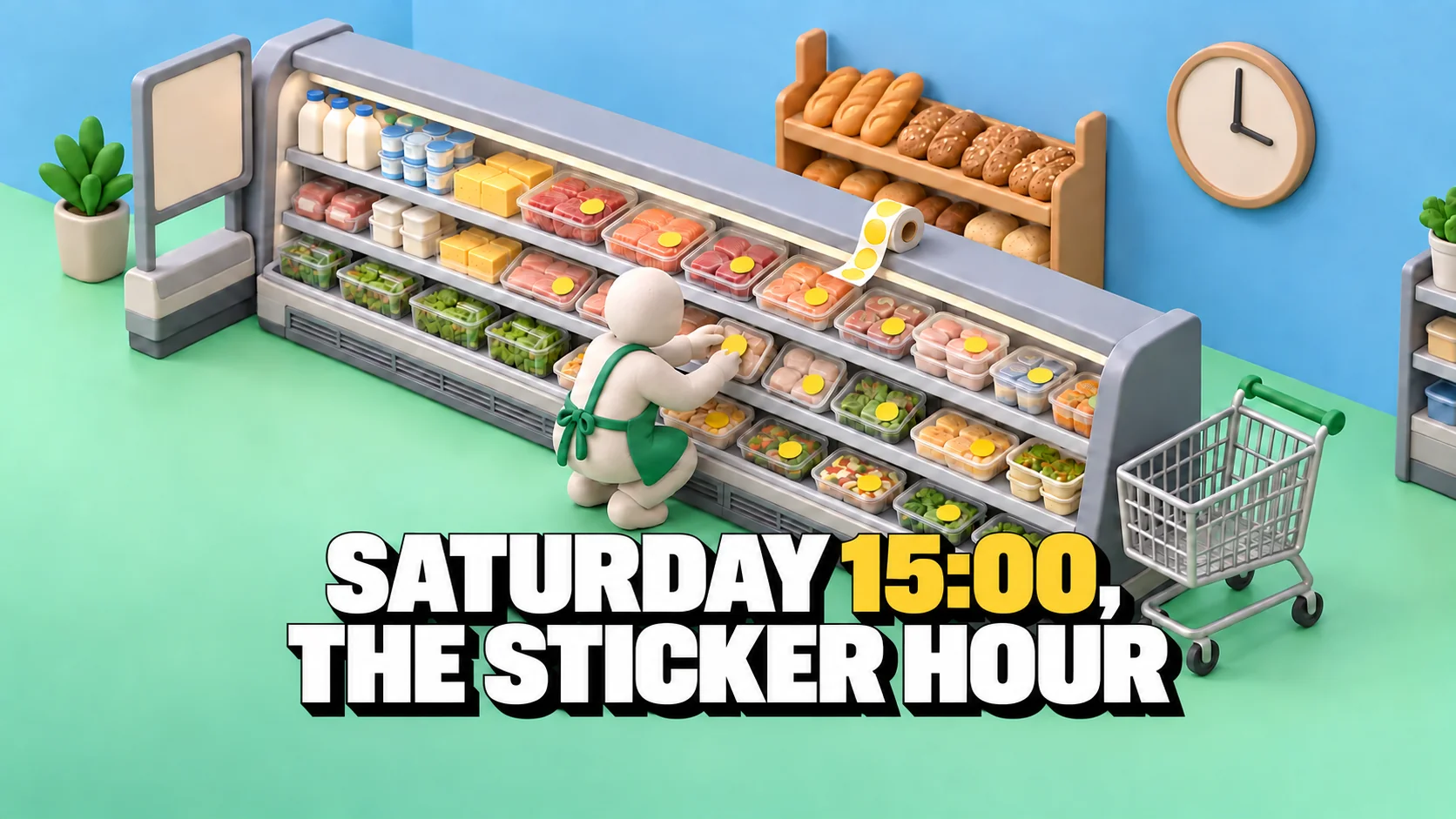
Every evening, in every Swiss supermarket, hundreds of perfectly good products are marked down with red or orange stickers because they're approaching their sell-by date. These markdowns typically slash standard prices by 20 to 50 percent depending on the chain, sometimes more. A roast chicken at CHF 14.90 in the afternoon can become CHF 7.45 at 18:30. A pack of cheese at CHF 8.50 becomes CHF 4.25. How much that adds up to over a weekly shop depends on your basket and on the chain: the sourced tiers below, chain by chain, are the honest starting point.
How does yellow-sticker shopping work in Switzerland?
The catch is timing and predictability. There's no calendar for when each store reduces what. But the rules are consistent enough across all 7 major Swiss retailers (Migros, Coop, Aldi, Lidl, Denner, Aligro, Otto's) that anyone willing to shift their shopping window by 30 to 60 minutes can build a reliable savings habit. This guide gives you the timing windows, the categories that get marked down hardest, the apps that complement the in-store hunt, and the tactics that work regardless of which store you walk into.
Sources verified regularly. Discount mechanics from moneyland.ch, Lost in Switzerland, IamExpat. Food-waste figures from Too Good To Go Switzerland and Federal Office for the Environment (BAFU). Discount bands re-verified 25 July 2026: Coop moved from 25/50 to 20/40 per cent on 6 January 2026 (20 Minuten, 28 December 2025), Denner replaced its 25/50 tiers with a flat 30 per cent two days before the date on 22 June 2026 (SRF Kassensturz Espresso and 20 Minuten, 6 July 2026), Migros still runs 25 then up to 50 per cent, Aldi Suisse runs 25 per cent the day before and 50 per cent on the last possible day of sale, and Lidl Schweiz 20 per cent several days ahead and up to 50 per cent on the last day, plus its Rettersäckli bags (20 Minuten, 30 December 2025). Live offers in the Rappn app.
Rappn is an independent grocery price comparison app in Switzerland, with no commercial agreements with any retailer.
Yellow stickers are the supermarkets’ in-store markdowns on items near their date, and they are not in any flyer. Rappn shows the weekly offers of the seven chains, so you can plan the rest of the shop around them.
Plan around this week's offers. Rappn is freeFree, no account required · iOS & Android
Near-expiry · 25–50% off
Offers
How Sticker Discounts Actually Work
Every Swiss supermarket runs the same basic system, with small variations. Products approaching their sell-by date are physically tagged with a coloured sticker, usually red or orange, sometimes yellow, indicating a price reduction. The bands are no longer identical across chains. Migros still runs 25 per cent and then up to 50 per cent. Coop cut its «Verwenden statt verschwenden» stickers from 25/50 to 20 and then 40 per cent on 6 January 2026, and store managers may now apply them several days before the date rather than only in the final hours (20 Minuten, 28 December 2025). Denner dropped its 50-per-cent sticker on 22 June 2026 and now gives a flat 30 per cent from two days before the date until closing on the last day of shelf life (SRF Kassensturz Espresso and 20 Minuten, 6 July 2026). Aldi Suisse and Lidl Schweiz kept their tiers. Per 20 Minuten of 30 December 2025, Aldi Suisse marks down 25 per cent the day before the date and 50 per cent on the last possible day of sale, while Lidl Schweiz starts earlier with 20 per cent several days ahead and goes up to 50 per cent on the last day, and additionally sells Rettersäckli bags of cosmetically imperfect fruit and vegetables at CHF 5 and bakery items at CHF 1.
The mechanics share three rules across stores:
Rule 1: The closer to closing time, the deeper the discounts. First markdowns appear in the late afternoon, around 16:00 to 17:00 in many stores. The 50 percent tier typically appears in the final 1 to 2 hours before close. Some store managers do a final pass 30 minutes before close, applying additional reductions to anything still on the shelf.
Rule 2: Saturdays are the biggest day. Most Swiss supermarkets are closed on Sundays. Anything fresh that won't survive the weekend gets marked down hard on Saturday afternoon. Saturday between 15:00 and 17:00 is the single most productive sticker-hunting window of the week, particularly in the meat, fish, and bakery sections.
Rule 3: Some sticker categories are far more reliable than others. Bakery, prepared foods, fresh meat and fish, dairy approaching expiry, and pre-cut produce are reduced almost daily. Long-shelf-life packaged goods rarely get sticker reductions, since they have weeks of shelf life ahead of them.
When to Go: The Timing Windows That Actually Work
| Category | Best window | Typical reduction | Notes |
|---|---|---|---|
| Bakery (bread, pastries) | 1 hour before close, daily | 30-50% | Bread doesn't survive the night; almost always discounted late |
| Fresh meat (counter and pre-pack) | Saturday 15:00-17:00, weekday evenings | 25-50% | Highest savings vs full price; Saturday is gold |
| Fresh fish | Saturday 15:00-17:00 | 30-50% | Won't survive Sunday closure |
| Prepared foods (pizza, salads, sandwiches) | 17:00 onward, daily | 30-50% | Especially at train-station stores |
| Dairy (yogurt, cheese, cream) | Last 2 days before sell-by | 25-50% | Often cleared in batches |
| Pre-cut and packaged produce | Late afternoon, daily | 25-50% | Smaller discounts but consistent |
| Roast chicken (rotisserie) | 30 mins before close | 50% | One of the most reliable wins |
| Sushi and fresh sushi-style items | 17:00-18:00 | 30-50% | Train-station stores especially |
A typical Swiss supermarket closes at 19:00 or 20:00 on weekdays, 17:00 or 18:00 on Saturday, depending on canton. Train-station stores often stay open until 22:00 or 23:00 daily, and they reduce on a different cycle, with deep discounts often appearing 60 to 90 minutes before close.
Which Stores Reduce, and How They Differ
| Chain | First tier | Second tier | Since | Source |
|---|---|---|---|---|
| Migros | 25% off the standard price | up to 50% | unchanged, checked 25 July 2026 | 20 Minuten, 30 December 2025 |
| Coop | 20%, now also several days before the date | 40% | 6 January 2026 | 20 Minuten, 28 December 2025 |
| Denner | flat 30% from two days before the date | none since the 50% sticker was dropped | 22 June 2026 | SRF Kassensturz Espresso and 20 Minuten, 6 July 2026 |
| Aldi Suisse | 25% the day before the date | 50% on the last possible day of sale | unchanged, checked 25 July 2026 | 20 Minuten, 30 December 2025 |
| Lidl Schweiz | 20% several days ahead | up to 50% on the last day, plus Rettersäckli bags | unchanged, checked 25 July 2026 | 20 Minuten, 30 December 2025 |
| Aligro | no consumer sticker cycle | occasional bulk lot clearances | not applicable | no dated source, see the paragraphs below |
| Otto's | no daily sticker cycle | irregular frozen and packaged clearances | not applicable | no dated source, see the paragraphs below |
Every percentage above is taken off that chain's own standard price, not off a comparison between chains. What the rows mean in the aisle:
Migros has the widest store network and the most predictable reductions. Big-city Migros stores reduce throughout the afternoon, with a final pass 30 to 60 minutes before close. M-Budget products generally do not get reduced (they're already positioned at the lowest price tier).
Coop runs sticker reductions across its full network. Coop also has the largest weekly Aktion calendar, which sometimes overlaps with sticker reductions to create deep discounts on already-promo items. Prix Garantie products generally don't get sticker-reduced, similar to M-Budget.
Denner stickers a lot of stock, especially in smaller stores where turnover is faster and shelf space is at a premium, but since 22 June 2026 the depth is capped at a flat 30 per cent from two days before the date, with no half-price tier on the last day (SRF Kassensturz Espresso, 6 July 2026). The upside is predictability: you now know exactly when the sticker appears.
Aldi Suisse and Lidl Schweiz both run sticker reductions, but their fresh ranges are smaller than Migros or Coop, so the absolute number of stickered items per visit is lower. Their advantage: their non-stickered baseline prices on standard meat and dairy are already 20 to 40 percent below Migros and Coop, so a stickered item at Aldi often lands at the low end of the range for that category.
Aligro, as a wholesale-oriented store, occasionally clears bulk lots at sharp reductions but doesn't follow the same consumer-oriented sticker cycle. If you're already shopping there for bulk, look for end-of-pallet reductions on meat and produce.
Otto's runs irregular bulk frozen and packaged-goods clearances rather than daily sticker reductions, but the price level on those clearances can be exceptional.
A useful piece of staff folklore: shop employees sometimes miss or forget to sticker products that should be discounted. They will normally only charge you half for products which expire on the same day, especially if you ask them shortly before closing time. This is not store policy at any chain, but it's a common informal practice.
What Doesn't Get Stickered (and Why)
Not everything ends up with a discount sticker. Some categories rarely or never see them:
Frozen products. Freezing extends shelf life by months. Frozen items rarely get marked down for expiry. They do get discounted via weekly Aktion cycles, which is a different mechanism.
Long-shelf-life dry goods. Pasta, rice, canned goods, oils, coffee. These have years of shelf life and aren't reduced for expiry. Aktion is the right channel for these.
Budget lines (M-Budget, Prix Garantie). Migros and Coop generally do not discount products in their M-Budget and Prix Garantie lines. The logic: these are already positioned as the cheapest option, so further reductions would erode the brand's price-floor positioning. By contrast, Aldi, Denner, and Lidl run promotions across their no-name groceries, including via stickers.
Branded national products. They get stickered when approaching expiry, but the sticker discount is calculated off the standard price, which is often 30 to 50 percent above the budget-line equivalent. A 50-percent sticker on a branded yogurt may still cost more than a regular-price M-Budget yogurt.
This last point matters. The right framing for sticker shopping is not "save the most on this product" but "get this specific product I'd want at a much better price". If you don't normally buy branded yogurts, a 50-percent sticker on one isn't a saving for you, it's a temptation.
Don't rely on sticker luck for the products you buy weekly.
Rappn lets you follow specific products (chicken breast, organic milk, your usual coffee brand) and notifies you the moment any of the 7 major Swiss retailers drops the price, whether via sticker, Aktion, or budget-line restock.
Wundertüten: the surprise-bag layer
Beyond in-store stickers, Switzerland has a parallel anti-food-waste system: Too Good To Go. The Danish app, active in Switzerland since 2018, partners with Migros, Spar, Volg, individual Coop Karma stores, and around 960 Coop supermarkets nationwide, plus thousands of restaurants, bakeries, and small shops.
How it works: an hour before close, partner stores list "Wundertüten" (surprise bags) in the app. Migros sells two types: a fruit-and-vegetable bag at CHF 4.90 with goods worth CHF 15.00, and a mixed grocery bag at CHF 5.90 with goods worth CHF 18.00. You pay through the app, then pick up at the store before close.
The trade-off: you don't choose what's in the bag. It's whatever the store has at risk of being thrown out. For households flexible on what they cook, the value per franc is strong: the CHF 4.90 and CHF 5.90 bags above hold goods the stores themselves value at CHF 15.00 and CHF 18.00. For households with specific dietary needs or strict shopping lists, Wundertüten are less useful.
Switzerland loses about 2.8 million tonnes of food a year, roughly 310 kg of avoidable food per person across the whole chain from field to plate. Households cause about a quarter of it: some 80 kg per person per year, worth about CHF 600, or around CHF 11.50 a week (BAFU / ZHAW monitoring interim report 2025). Apps like Too Good To Go are part of the response, but in-store sticker reductions move the same volume of food into household kitchens at the same kind of discount, just one product at a time rather than in mystery bundles.
Tactics That Make Sticker Shopping Worth the Time
Sticker hunting is a real saver, but only if you do it efficiently. The rules:
Make sticker hunting your normal shopping window, not an extra trip. The single biggest mistake is treating it as a separate errand. The savings only beat the cost of your time if you're shopping anyway. Shift your usual evening or Saturday shop to align with the markdown window.
Shop by category, not by sticker. It's tempting to fill the basket with everything that has a sticker. That's not saving, it's spending. The real win is when stickers cover what you were going to buy anyway. Use the same shared shopping list discipline as any other shop. See our guide to running a shared shopping list in Switzerland.
Plan around the freezer. Saturday-evening sticker meat is often a 50 percent discount on something with a sell-by of Sunday. Buy it, vacuum-pack and freeze, eat over the next month. The freezer turns short-shelf-life sticker bargains into long-shelf-life pantry value. The same logic applies to bread (slice and freeze), cheese (vacuum-pack), and prepared foods (most are freezer-safe).
Combine sticker hunting with the right base store. A 50 percent sticker on a Coop Naturaplan chicken is usually better than full-price Aldi chicken. But a non-stickered Aldi chicken is often cheaper than a non-stickered Migros one. Choose your base store on standard pricing, then add sticker hunting on top. See our cheapest supermarket in Switzerland breakdown.
Don't drive across town for stickers. A sticker basket is a discount on a normal shop, not a windfall. If you drive 20 minutes each way at Swiss fuel prices, the fuel can swallow what the stickers gave you. Sticker hunting works at the store you'd shop at anyway.
Watch the maths on branded vs budget. A 25-percent sticker on a CHF 6.50 branded yogurt = CHF 4.88. The full-price M-Budget equivalent is CHF 2.20. The sticker isn't always the cheaper option. Compare against your normal alternative, not just against the original branded price.
For the full picture on weekly savings discipline, see our save money on groceries in Switzerland guide.
A Realistic Weekly Routine
For a Swiss household serious about sticker discounts, here's a routine that actually fits a normal week:
Saturday afternoon (15:00 to 17:00). The big run. Hit your usual base store between 90 and 60 minutes before close. Bakery, meat counter, fresh fish, prepared foods. This is when the deepest reductions happen because of the Sunday closure.
Tuesday or Wednesday evening (60 to 90 minutes before close). A mid-week top-up at a smaller, closer store. Bread, dairy, anything that needs replenishing. Smaller store, fewer customers, often surprisingly good late-evening reductions.
Train-station stores after 20:00. If your route home passes a Coop or Migros at a Bahnhof, it's worth a 5-minute detour two or three times a week. These stores stay open later and reduce on a different cycle.
Don't go on Mondays. Stock just got refilled, sticker volumes are low, and most of what's on the shelf has full shelf life ahead of it.
This routine takes no extra time if you're going to shop anyway. What it adds up to over a year depends on your basket and on where you shop, so we put no figure on it: what you can count on are the tiers above, with their dates and their sources.
Updated: .
Why Rappn?
Rappn is an independent grocery price comparison app in Switzerland, with no commercial agreements with any retailer. Our comparisons are truly independent.
- 100% free: no subscription, no hidden costs
- Neutral: no commercial agreements with Migros, Coop, Aldi, Lidl, Denner, Aligro, or Otto’s
- Updated daily, as soon as the chains publish their deals
- The chains’ deals in one place: search, filter, compare, no account needed
Ready to save on groceries?
Install Rappn and compare for yourself this week. No account required.Scan the code, install Rappn and compare current offers. No account needed.
Built in Switzerland, for Switzerland

Frequently Asked Questions
When are products marked down at Swiss supermarkets?
Most Swiss supermarkets begin sticker reductions in the late afternoon, around 16:00 to 17:00, with the deepest discounts (40 to 50 per cent depending on the chain) appearing in the final 1 to 2 hours before close. Saturday between 15:00 and 17:00 is the single best window because most stores are closed Sunday and clear short-shelf-life stock aggressively. Train-station stores follow a different cycle, with deep reductions often appearing 60 to 90 minutes before their later closing time.
How big are the discounts on near-expiry groceries?
It depends on the chain since 2026. Migros still runs 25 and then up to 50 per cent. Coop moved to 20 and then 40 per cent on 6 January 2026 (20 Minuten). Denner replaced its 25/50 tiers with a flat 30 per cent from two days before the date on 22 June 2026 (SRF Kassensturz Espresso). Aldi Suisse stays at 25 per cent the day before and 50 per cent on the last possible day of sale, and Lidl Schweiz at 20 per cent several days ahead and up to 50 per cent on the last day (20 Minuten, 30 December 2025). Store managers occasionally go deeper to clear prepared foods in the last 30 minutes before close.
Why don't M-Budget and Prix Garantie products get reduced stickers?
Migros and Coop generally do not discount their budget lines via stickers because these products are already positioned as the cheapest option in the store. The logic protects the brand's price-floor positioning. By contrast, Aldi, Denner, and Lidl do run promotions and stickers across their no-name groceries.
Are Wundertüten worth it in Switzerland?
Yes for households flexible on what they cook. The surprise-bag lane covers Migros nationally, Spar, Volg, around 960 Coop supermarkets, and thousands of restaurants and bakeries. Wundertüten cost CHF 4.90 to CHF 5.90 for goods worth CHF 15 to CHF 18, picked up an hour before close. The trade-off: you don't choose what's in the bag.
How does Rappn complement sticker shopping?
Stickers are reactive, you find them when you find them. Rappn is proactive: you follow specific products and get notified the moment any of the 7 major Swiss retailers (Migros, Coop, Aldi, Lidl, Denner, Aligro, Otto's) drops the price via Aktion or budget-line stocking, in your canton, in your language. Use Rappn for predictable wins on products you buy weekly; use sticker hunting for opportunistic savings.
Will sticker products make me sick?
No. Sell-by dates in Switzerland are conservative and most products are perfectly safe well past them, especially dairy, packaged meat, and bread. The reduction is a logistics decision, not a quality one. Common sense applies: trust your senses (smell, appearance), follow proper storage after purchase, and freeze anything you won't eat within 1 to 2 days.