
Shared shopping list in Switzerland: does it really sync in real time?
A shared shopping list only helps if everyone sees the same list: in Rappn the household list is shared in real time, free and without an account, so what one person adds lands on the other phones and not on a private copy. Each entry also shows whether one of the 7 chains has it on Aktion this week, on the Thursday to Wednesday cycle Coop has run since January 2025.
Rappn compares prices across all 7 chains live: free, no account.
Start sharing your list. Rappn is free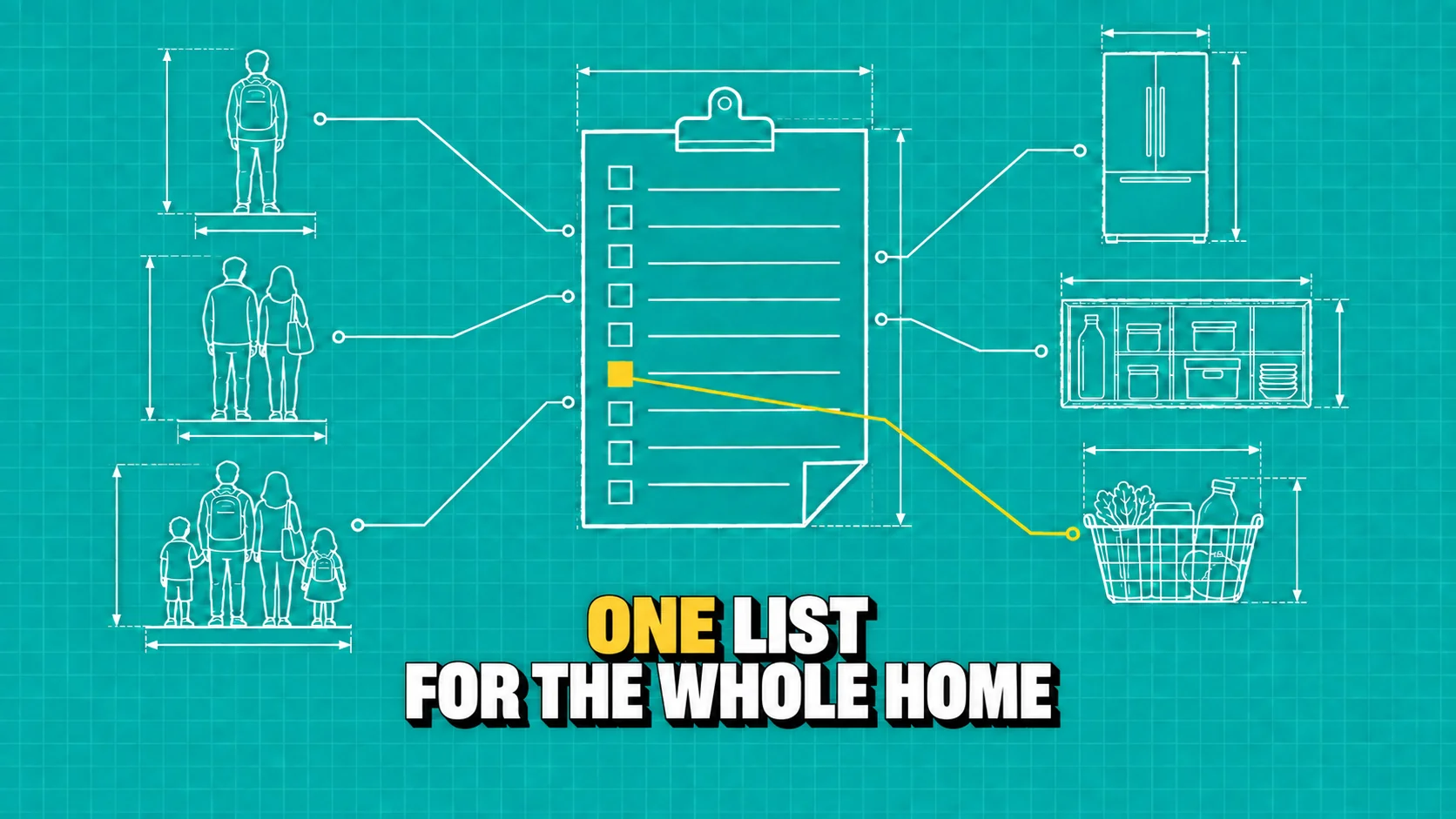
Content verified: April 2026. Practical guide based on Swiss household patterns and the 7-retailer Aktion calendar.
A grocery list is the cheapest household productivity tool that exists. It costs nothing, takes seconds, and the same Swiss household that "doesn't need a list" is also the household that buys two bottles of olive oil because nobody knew the other person had grabbed one. Whether you live alone, share a flat with a partner, or run a family of four, the way you handle your shopping list determines how much you spend, how much you waste, and how much weekly mental energy goes into food.
This is a practical guide. No theory, no productivity philosophy. Just what works for Swiss households across all 7 major retailers (Migros, Coop, Aldi, Lidl, Denner, Aligro, Otto's), in all 4 languages, with their weekly Aktion cycles.
What one person adds, the others see straight away: how the shared list works
The complaint that kills a list is always the same: one person adds milk from the office, the other is already at the till and never sees it. In Rappn the household list is shared in real time, so an item added on one phone lands on the same list on the other phones, not on a private copy of it. The list is free and needs no account, so a partner, a flatmate or a grandparent can be on it without signing up for anything.
Two things make it more than a notepad. Every entry can be searched across the chains with its unit price per kilo, litre or piece, so "pasta" becomes a real product with a real price. And every entry is matched against the Aktionen of the 7 chains the app covers, in your canton and in your language, on the Thursday to Wednesday cycle Coop has run since January 2025 and Migros and Denner since February 2026. A recipe can be sent to the same list in one step.
Rappn is an independent grocery price comparison app in Switzerland, with no commercial agreements with any retailer. Our recommendations are truly independent.
One shared cart, four phones in sync. Tick off items as you go, see live offers per product, and never end up with two cartons of milk in the fridge again.
Start sharing your list. Rappn is freeFree, no account required · iOS & Android
Shared with household
Weekly
Why a Shared Shopping List Changes Your Week
Three problems show up in nearly every Swiss household, regardless of size.
Forgotten items. You needed yeast for the weekend bake. You remember at the till. You go anyway, then drive back midweek for one ingredient. Time lost: 20 to 40 minutes. Cost in fuel and impulse buys on the second trip: CHF 5 to CHF 15. Multiply by 50 weeks a year.
Duplicate buys. In a couple or family, this is the silent budget leak. Two open jars of mustard, three half-empty milk cartons, two opened packs of butter that all need to be used by Sunday. Swiss household food waste runs into tens of kilos per person per year, and a meaningful share of that traces back to overbuying or duplicates that nobody knew about.
Missed Aktion windows. Swiss retailers run weekly promotional cycles. Coop has run a Thursday-to-Wednesday cycle since January 2025, and Migros and Denner switched to the same cycle in February 2026. If your list lives in your head, you cannot match what you need against what is discounted that week. A list lets you do that in seconds.
A shared shopping list, used properly, fixes all three. It captures "I need this" moments as they happen during the week, prevents duplicate buys when more than one person shops, and lines up your needs against the offers that are actually live in your canton.
The Three Household Patterns
The right shopping system depends on who is shopping with you. Most Swiss households fall into one of three patterns.
Solo households. Often the most underestimated case. Living alone means nobody nags you to write things down, nobody notices when the fridge has only ketchup in it, and pack sizes are usually wrong. Single-portion packs cost more per kilo, family-size promos cause spoilage. The list matters more here, not less, because nothing else acts as a backup memory.
Couples and shared flats. The classic problem: two heads, two memories, no shared layer. One person buys laundry detergent on Tuesday, the other buys it on Thursday. Or one person assumes the other has handled dinner, and neither did. The list is not just a memory tool here, it is a coordination tool.
Families. The complexity scales. Kids have specific items they want, partners have preferences that are non-negotiable, and someone has to actually go shopping. Families that run smoothly tend to have one rule: anyone who notices something is missing adds it to the list, full stop. No "remind me later", no "tell mum". It goes on the list right now.
How to Build a List That Actually Works
A good shopping list is not a brain dump. It is a structured tool. Three principles do most of the work.
Sort by store section, not by when you thought of it. Produce, dairy, meat, dry goods, frozen, household. When you walk through the store you walk through these sections in order. A list sorted by section means you do not backtrack. A list in random order means you walk past the dairy fridge, then realise you forgot yogurt, then walk back. Multiply by 30 items.
Build it during the week, not in the store. The single biggest mistake is sitting down on Saturday morning and trying to remember what you need. By then you have forgotten half of it. The trick is to add to the list the moment you notice something running low. Out of olive oil? Add it now. Used the last roll of toilet paper? Add it now. The list becomes accurate by accumulation, not by memory.
Make it store-aware when it matters. Some items have a clear best store. Bulk meat at Aligro. M-Budget or Prix Garantie staples on a Migros or Coop run. The cheapest meat in Switzerland generally comes from a discounter run that you batch every two to four weeks. You do not need to over-engineer this, but a quick tag like "(Aldi)" next to two or three items lets you split a weekly shop sensibly without thinking twice.
The Swiss Layer: Multilingual, Multi-Store, Multi-Loyalty
Swiss grocery shopping has a few quirks that flatter markets do not have.
Multiple languages in one household. Common in Geneva, Bern, Basel, Lausanne, and most of Ticino's expat-heavy zones. One partner adds "Schinken", the other expects "jambon", a grandparent uses "prosciutto cotto". A shared list that works across all 4 Swiss languages removes that friction.
Multiple stores per shop. Most Swiss families do not shop at one place. The pattern is: a discounter run for meat and standard staples, Migros or Coop for the speciality items the discounters do not stock, and Denner for specific promotional pantry items. Two or three stops per week is normal. A list that lets you flag which item belongs to which stop saves real time. See our cheapest supermarket in Switzerland breakdown for which stops earn their place in your week.
Multiple loyalty cards. Cumulus at Migros, Supercard at Coop, Lidl Plus. Denner and Aldi run no customer card at all, so there is nothing to scan on those stops. Couples often have one card per chain and one person scans at one store, the other elsewhere. The list should reflect who is shopping where and which card is active.
Cantonal availability. Some products and promotions are canton-specific. A list that connects to live offers in your canton, not generic national flyers, is what separates "in theory cheaper" from "actually cheaper".
One list. Every phone. Real-time.
Rappn's shared cart syncs across your household so nobody buys two of the same thing again, and every item shows whether it is on Aktion this week. Open Rappn.
Rules That Save Time and Money
Different households need different rules. Pick what fits.
For couples and shared flats
Agree on one shared list. Not two notes apps, not two scraps of paper, not "I will text you". One list, on both phones, in real time. Whoever notices the gap, whoever is at the store, sees the same thing.
Decide who is responsible for what. Not in a rigid way, but as a default. One person handles the weekly fresh shop, the other handles the discounter run for staples. Or you alternate weeks. The point is to remove the every-week negotiation.
Mark items as bought. Whoever shops, ticks. The other person needs to know whether the milk question is solved before they swing past the store on the way home.
Talk about preferences. Pretending the household has unified taste leads to fights and waste. If one person likes one yogurt brand and the other prefers another, put both on the list with names attached.
For families
Anyone can add. Including kids old enough to write. The cost of letting a six-year-old add "popcorn" is zero. The benefit, when they learn that adding to the list is how you ask for it, is huge.
Plan one or two meals in advance. Not the whole week, that is exhausting. Just two meals where you know what you will cook, with all ingredients on the list. The rest stays flexible.
Use a "low stock" rule. When something hits the last 25 percent (a quarter of the milk left, a third of the toilet paper), it goes on the list. Not when it is empty. This prevents the Sunday-night panic.
Batch by category for the big shop. If you are doing a Saturday family shop, sort the list by category before you go. With a young child in tow, every minute saved on backtracking is a minute that has not turned into a meltdown.
For solo households
The list is your second brain. There is nobody else to remind you. Add items the second you notice them, even if you are heading out the door. A 5-second add now is a 30-minute return trip avoided later.
Buy realistic pack sizes. Family promotions are tempting but a 1-kilo bag of spinach for one person ends up half in the bin. Track what actually gets eaten. If you keep throwing out half a loaf of bread, switch to half-loaves or freeze half on the day you buy.
Use the list to manage variety, not just quantity. Solo shoppers tend to buy the same things repeatedly. The list, used over a few weeks, shows you the pattern. Then you can deliberately break it.
The same logic applies whether you are shopping for one or shopping for five: the list is what makes the difference between saving money on groceries in Switzerland on autopilot and re-inventing the wheel every week.
How Rappn's Shared Cart Makes This Simple
Rappn's shared cart is built for exactly the household problems above. One household, one list, every phone in real time, and every item connected to live offers across the 7 major Swiss retailers.
One list, multiple phones, instant sync. Add an item from the office, your partner sees it before they leave for the store. No more "did you get the eggs?" texts.
Tagged by store. Items can be flagged for the discounter run, the Migros run, or the Aligro bulk trip, so a multi-stop week stays organised without spreadsheets.
Live offers attached to your list. When you add "chicken breast" to the list, Rappn shows whether any of the 7 major retailers has it on Aktion this week, in your canton, in your language. The list and the offer feed become one tool instead of two.
All 4 Swiss languages. Mixed-language households add items in whichever language is natural and everyone reads them in their own. "Schinken", "jambon" and "prosciutto cotto" all map to the same product.
Works for one person too. Solo households use the same shared cart, just without the sharing. The benefit is the live-offer connection: you add yogurt, Rappn tells you which store has it cheapest this week.
The shared cart is one of Rappn's most-used features for a reason. Grocery shopping is the most-repeated transactional task in a household, and the cost of doing it badly compounds week over week. A working list removes that cost.
Updated: .
Why Rappn?
Rappn is an independent grocery price comparison app in Switzerland, with no commercial agreements with any retailer. Our comparisons are truly independent.
- 100% free: no subscription, no hidden costs
- Neutral: no commercial agreements with Migros, Coop, Aldi, Lidl, Denner, Aligro, or Otto’s
- Updated daily, as soon as the chains publish their deals
- The chains’ deals in one place: search, filter, compare, no account needed
Ready to save on groceries?
Install Rappn and compare for yourself this week. No account required.Scan the code, install Rappn and compare current offers. No account needed.
Built in Switzerland, for Switzerland

Frequently Asked Questions
Does the shared list really sync what my family adds?
Yes: the list is shared in real time, so what one member adds appears on the same list on the other phones instead of on a private copy. It is free and needs no account, so everyone in the household can be on it. Each entry also shows whether one of the 7 chains has it on Aktion this week in your canton, on the Thursday to Wednesday cycle Coop has run since January 2025 and Migros and Denner since February 2026.
What's the difference between a shared shopping list and a normal shopping list?
A normal list is one person's memory written down. A shared list is the household's memory, synchronised in real time, accessible to whoever is at the store. For couples and families this is the difference between guessing what you need and knowing what's already covered.
Does a shopping list still help if I live alone?
Yes, often more than for couples. Solo households have no second person to catch the things you forget. The list becomes your backup memory. The benefit is making sure nothing slips between weeks and that small needs do not turn into emergency shop-runs that cost CHF 10 to CHF 20 in impulse buys.
How does the list work across Swiss languages?
A good shared list lets each person add items in their own language and shows them to other household members in theirs if needed. Rappn's shared cart understands that Schinken, jambon and prosciutto cotto are the same product, so no manual translation is needed.
Can a shopping list help me catch items when they're on Aktion?
Yes, if the list is connected to live offers. Coop weekly promotions start on Thursday and run to Wednesday, a rhythm in place since January 2025. Migros and Denner run the same cycle. Rappn connects your list to live offers across all 7 major Swiss retailers automatically.
Is Rappn's shared cart really free?
Yes. The shared cart, offers feed, price comparisons and notifications are all free. Rappn does not run ads and has no commercial agreements with any retailer, which is why our offer comparisons stay neutral.