
VAT on Food in Switzerland: When You Pay 2.6% and When It Jumps to 8.1%
Food in Switzerland carries the reduced VAT rate of 2.6%, and almost everything else in the trolley the standard rate of 8.1%; both have applied since 1 January 2024 (ESTV). Alcohol and tobacco are expressly taxable at the standard rate, as is a meal eaten in a restaurant, while take-away falls under the reduced rate if the receipt evidences it. You never see the tax separately in a shop: the shelf price is the final price including levies. And because the rates are identical for every chain, VAT explains no price difference at all between two supermarkets.
Rappn compares the current promotions of 7 Swiss retailers, updated daily: free, no subscription.
Track your spending freeThe current offers from the seven chains, searchable and filterable by product, category, price and canton, with the unit price per kilo or litre next to the pack price. All prices are gross, VAT included.
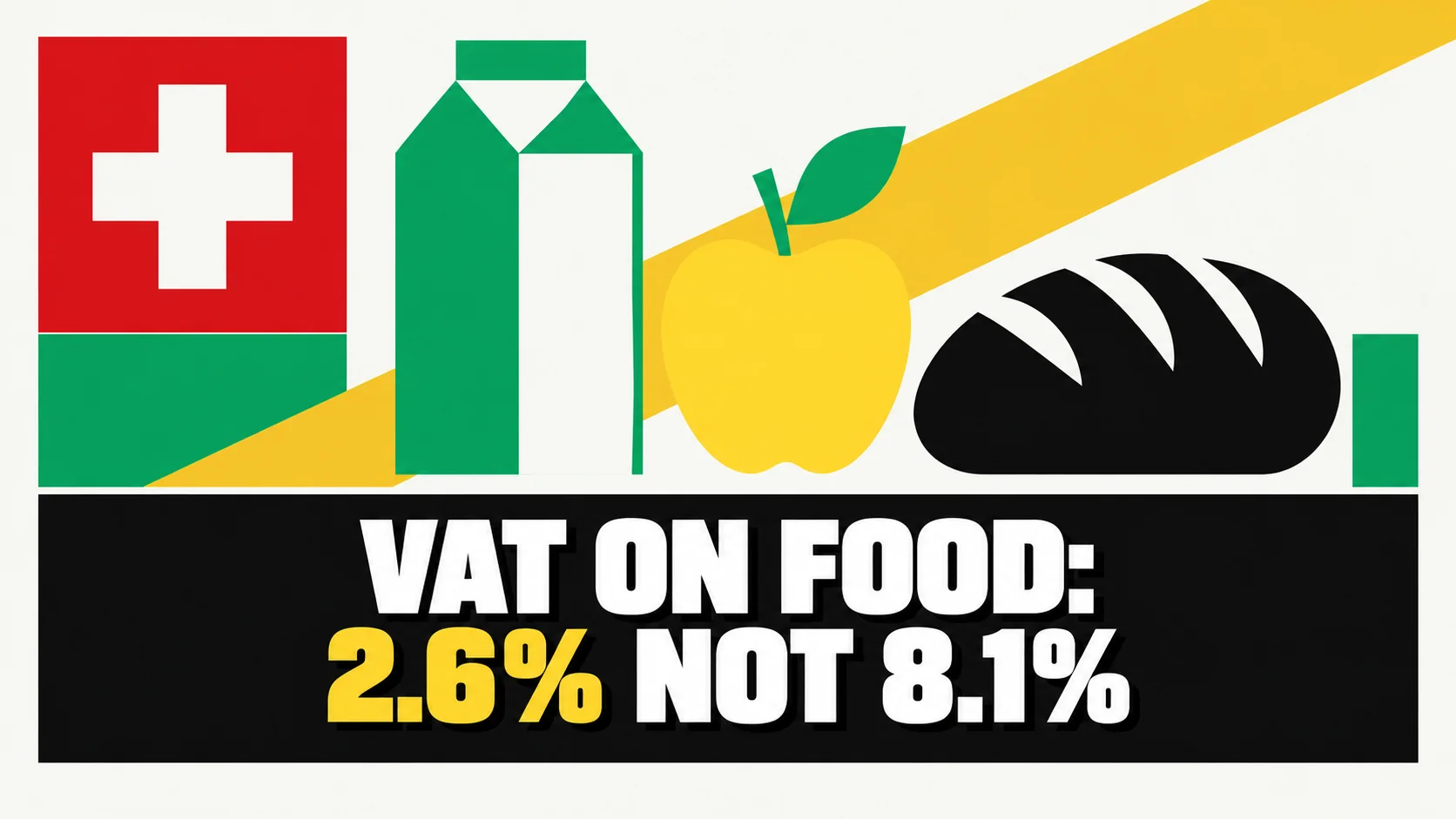
The rate is low, but it is not zero. Food in Switzerland carries the reduced VAT rate of 2.6 percent, while the standard rate of 8.1 percent applies to everything that is not expressly on the reduced list. Both have been in force since 1 January 2024, alongside the special rate of 3.8 percent for accommodation, which has nothing to do with groceries (Federal Tax Administration ESTV, "Swiss VAT rates", checked September 2026). In practice: a trolley holding bread, laundry detergent and a bottle of wine carries two different rates at once, and you see neither of them on the shelf label.
Last updated: September 2026. Sources: Federal Tax Administration ESTV, "Swiss VAT rates" (estv.admin.ch) for the three rates and the list of goods at the reduced rate; the ESTV VAT web publications (gate.estv.admin.ch) for alcohol, tobacco and take-away; kmu.admin.ch, "Kennzeichnung der Preise", for price display and the unit price; admin.ch for the federal popular vote of 25 September 2022 on additional AHV financing through a VAT increase. Every franc figure in this guide is computed from the two rates, none of them is a price observed in a shop.
Rappn is an independent grocery price comparison app in Switzerland, with no commercial agreements with any retailer.
How much VAT do you pay on food in Switzerland?
2.6 percent. According to the ESTV, the reduced rate covers water supplied through pipes, foodstuffs under the Foodstuffs Act, livestock, poultry and fish, cereals and seeds, plants and cut flowers, animal feed and bedding, fertilisers and plant protection products, medicines, newspapers, magazines and books without advertising character, and, since 1 January 2025, menstrual hygiene products. Anything that is neither on that list nor under the special rate is taxable at the standard rate of 8.1 percent.
A second rule matters just as much day to day: the amount is already inside the price. Swiss price display rules require the shelf price to be the retail price actually payable, the one that includes public levies such as VAT (kmu.admin.ch, "Kennzeichnung der Preise"). Nothing is added at the till, unlike the sales tax many expats know from the United States. To work out how much tax sits inside an amount, run it backwards: at 2.6 percent that is 2.6 divided by 102.6, roughly 2.53 percent of the receipt total. At the standard rate it is 8.1 divided by 108.1, roughly 7.49 percent.
The screen shows your spending week by week, gross and therefore with the 2.6 or 8.1 percent VAT already inside: Rappn is free and needs no account.
Track your spending freeFree, no subscription · iOS & Android
"weekly basket"
Your spending
What is taxed at 2.6 percent and what at 8.1 percent in your trolley
| What is in the trolley | Rate | Basis |
|---|---|---|
| Bread, milk, meat, vegetables, tinned and frozen food | 2.6% | Foodstuffs under the Foodstuffs Act (ESTV) |
| Mineral water, coffee, tea, soft drinks | 2.6% | Foodstuffs under the Foodstuffs Act (ESTV) |
| Wine, beer, spirits | 8.1% | Alcoholic drinks, expressly at the standard rate (ESTV) |
| Cigarettes, tobacco products | 8.1% | Tobacco and tobacco products, standard rate (ESTV) |
| Cat and dog food, animal bedding | 2.6% | Animal feed and bedding on the ESTV list |
| Cut flowers, potted plants, seeds | 2.6% | Plants, cut flowers and seeds on the ESTV list |
| Newspapers, magazines and books without advertising character | 2.6% | ESTV reduced-rate list |
| Menstrual hygiene products | 2.6% | ESTV list, from 1 January 2025 |
| Medicines | 2.6% | ESTV reduced-rate list |
| Detergent, cleaning products, cosmetics, kitchen roll, non-food | 8.1% | Not on the reduced list, so the standard rate (ESTV) |
| A meal eaten in at a restaurant | 8.1% | Catering service (ESTV) |
| Take-away evidenced on the receipt | 2.6% | Supply of food to take away (ESTV) |
Two edge cases are worth knowing. Newspapers and books only get the reduced rate without advertising character, so a promotional flyer does not. And menstrual hygiene products moved to 2.6 percent on 1 January 2025, while the rest of the toiletries aisle stays at the standard rate (ESTV).
Alcohol and tobacco: the two lines that switch rate in the trolley
Alcoholic drinks are food in every other sense, but they are excluded from the reduced rate. The ESTV states it plainly in its VAT web publications: the supply of alcoholic drinks and of tobacco and tobacco products is taxable at the standard rate. Wine, beer and spirits therefore carry 8.1 percent. Alcohol-free beer and grape juice stay at 2.6 percent, because they fall under the ordinary food rule.
For the weekly basket that means one thing: the moment a bottle of wine goes in, the same receipt contains two rates. What that is worth in francs is further down. What a given bottle costs this week is a different question: Swiss promotions at the big chains start on Thursday, with a second wave on Monday at Aldi Suisse and Lidl Schweiz, and they change every week. You see the current state of play live in Rappn. Where and from what age you can buy alcohol in a supermarket is covered in our guide to buying alcohol in Swiss supermarkets.
Take-away or eat in: the same plate, two rates
Food consumed on the premises is a catering service and is therefore accounted for at the standard rate of 8.1 percent. Take the same sandwich away and the reduced rate of 2.6 percent applies, but only with evidence. According to the ESTV, for food sold over the counter the documents, delivery notes, invoices or receipts, must clearly show that this is a supply of food to take away. Without that evidence the ESTV treats the sale as a catering service, to be accounted for at the standard rate. Alcoholic drinks stay at the standard rate even as take-away.
That is why the counter staff ask whether you are taking it with you: the answer decides the rate, not the packaging. Whether a business passes the difference on to you or charges the same gross price either way is its own pricing decision, not a federal rule. What a meal in a retailer-run restaurant costs is covered in our guide to Migros restaurant prices.
What 2.6 percent instead of 8.1 percent is worth in francs
| Amount at the till | Rate | VAT contained | Net amount |
|---|---|---|---|
| CHF 100.00 of food | 2.6% | CHF 2.53 | CHF 97.47 |
| CHF 100.00 of wine or cleaning products | 8.1% | CHF 7.49 | CHF 92.51 |
| CHF 250.00 weekly basket, food only | 2.6% | CHF 6.34 | CHF 243.66 |
The gap in one sentence: a CHF 250.00 weekly basket of pure food contains CHF 6.34 of VAT. If the same net amount were taxed at the standard rate, the receipt would read CHF 263.40, which is CHF 13.40 more. A CHF 15.00 bottle of wine contains CHF 1.12 of tax; at the same net price and the food rate, the same bottle would come to CHF 14.24.
And for take-away: a sandwich sold at CHF 12.00 to eat in has a net price of CHF 11.10. If the business sells the same sandwich at the same net price to take away, the reduced rate gives CHF 11.39, a gap of CHF 0.61. That is the order of magnitude: tiny on a single sandwich, noticeable on alcohol and non-food, and over a year still an amount that counts.
What changed on 1 January 2024
The current rates have applied since 1 January 2024: standard rate 8.1 percent, reduced rate 2.6 percent, special accommodation rate 3.8 percent (ESTV). The increase follows the federal popular vote of 25 September 2022 on additional financing for the AHV old-age pension through a VAT increase (admin.ch). Since then the tax inside your weekly basket also helps fund the state pension.
For shelf prices the step was small, but not nothing. How much food actually became more expensive in recent years, and which categories moved most, is covered in our guide to grocery inflation in Switzerland in 2026. And if you suspect VAT explains the Swiss price level, the honest answer is in why groceries are expensive in Switzerland: on food, the tax is roughly 2.53 percent of the receipt, and the rest has other causes.
Why VAT never explains which chain is cheaper
Because it is the same everywhere. The rates are federal law and apply identically to Migros, Coop, Aldi Suisse, Lidl Schweiz, Denner, Aligro and Otto's: the same pack of butter carries 2.6 percent at every one of them. And because the shelf price is the final price including levies, you always compare gross with gross, including the unit price per kilo or litre that federal rules require for measurable goods (kmu.admin.ch). Any difference between two chains therefore comes from buying, margin, a promotion or the pack size, never from the tax.
That is good news for the weekly shop: there is no tax trick you could have missed, only prices that can be compared. The border is a different matter, where import rules and duty-free allowances come in; the detail is in our guide to cross-border shopping and customs.
Next step: open the current offers and search for the product that is on your list this week. Rappn brings together the running promotions from the seven chains, with the unit price per kilo or litre next to the pack price, both gross and therefore directly comparable. Rappn is free, needs no account, and is paid by no retailer.
Updated: .
Why Rappn?
Rappn is an independent grocery price comparison app in Switzerland, with no commercial agreements with any retailer. Our comparisons are truly independent.
- 100% free: no subscription, no hidden costs
- Neutral: no commercial agreements with Migros, Coop, Aldi, Lidl, Denner, Aligro, or Otto’s
- Updated daily, as soon as the chains publish their deals
- The chains’ deals in one place: search, filter, compare, no subscription
- Meal planner in the Kitchen tab: plan the week, send the ingredients to your list

Ready to save on groceries?
Install Rappn and compare for yourself this week. No account required.Scan the code, install Rappn and compare current offers. No account needed.



Frequently Asked Questions
How much VAT is charged on food in Switzerland?
2.6 percent. According to the Federal Tax Administration, the reduced rate covers foodstuffs under the Foodstuffs Act, water supplied through pipes, medicines, animal feed, plants and cut flowers, and newspapers and books without advertising character. It has applied at this level since 1 January 2024. Anything not on that list is taxable at the standard rate of 8.1 percent.
Why is wine taxed at 8.1% and grape juice at 2.6%?
Because alcoholic drinks are excluded from the reduced rate. The ESTV states in its VAT web publications that the supply of alcoholic drinks and of tobacco and tobacco products is taxable at the standard rate. Grape juice and alcohol-free beer fall under the ordinary food rule instead and stay at 2.6 percent.
Is take-away taxed lower than eating in a restaurant?
Yes, but only with evidence. Eating on the premises is a catering service at the standard rate of 8.1 percent. For food sold over the counter the ESTV requires the documents, receipts or invoices, to show clearly that the food is to take away; without that, the standard rate applies. Alcoholic drinks stay at 8.1 percent even as take-away.
Is VAT added to the shelf price at the till?
No. Per kmu.admin.ch ("Kennzeichnung der Preise"), the retail price actually payable must be displayed, and that price includes public levies such as VAT. The shelf price is therefore the final price, unlike US sales tax. To find the tax inside it, work backwards: roughly 2.53 percent of the amount at the reduced rate, roughly 7.49 percent at the standard rate.
What changed on 1 January 2024?
Since that date the current rates apply: standard rate 8.1 percent, reduced rate 2.6 percent and special accommodation rate 3.8 percent (ESTV). The increase follows the federal popular vote of 25 September 2022 on additional financing for the AHV old-age pension through a VAT increase (admin.ch).
Do you pay more VAT at Migros than at Aldi Suisse?
No. The rates are federal law and identical at Migros, Coop, Aldi Suisse, Lidl Schweiz, Denner, Aligro and Otto's. The same pack of butter carries 2.6 percent everywhere. A price difference between two chains therefore comes from buying, margin, a promotion or the pack size, never from the tax.