
Vegetarian Grocery Shopping in Switzerland: The 2026 Retailer Guide
Coop had around 800 V-Label products under Karma as of 2023 (line launched 2013). Migros started with Cornatur in 1996, 13 years before Beyond Meat existed. Lidl Next Level and Aldi MY VAY cost less. Tofu, tempeh, seitan, legumes and the full per-retailer landscape.
Rappn compares prices across all 7 chains live: free, no account.
See vegetarian offers near you. Rappn is free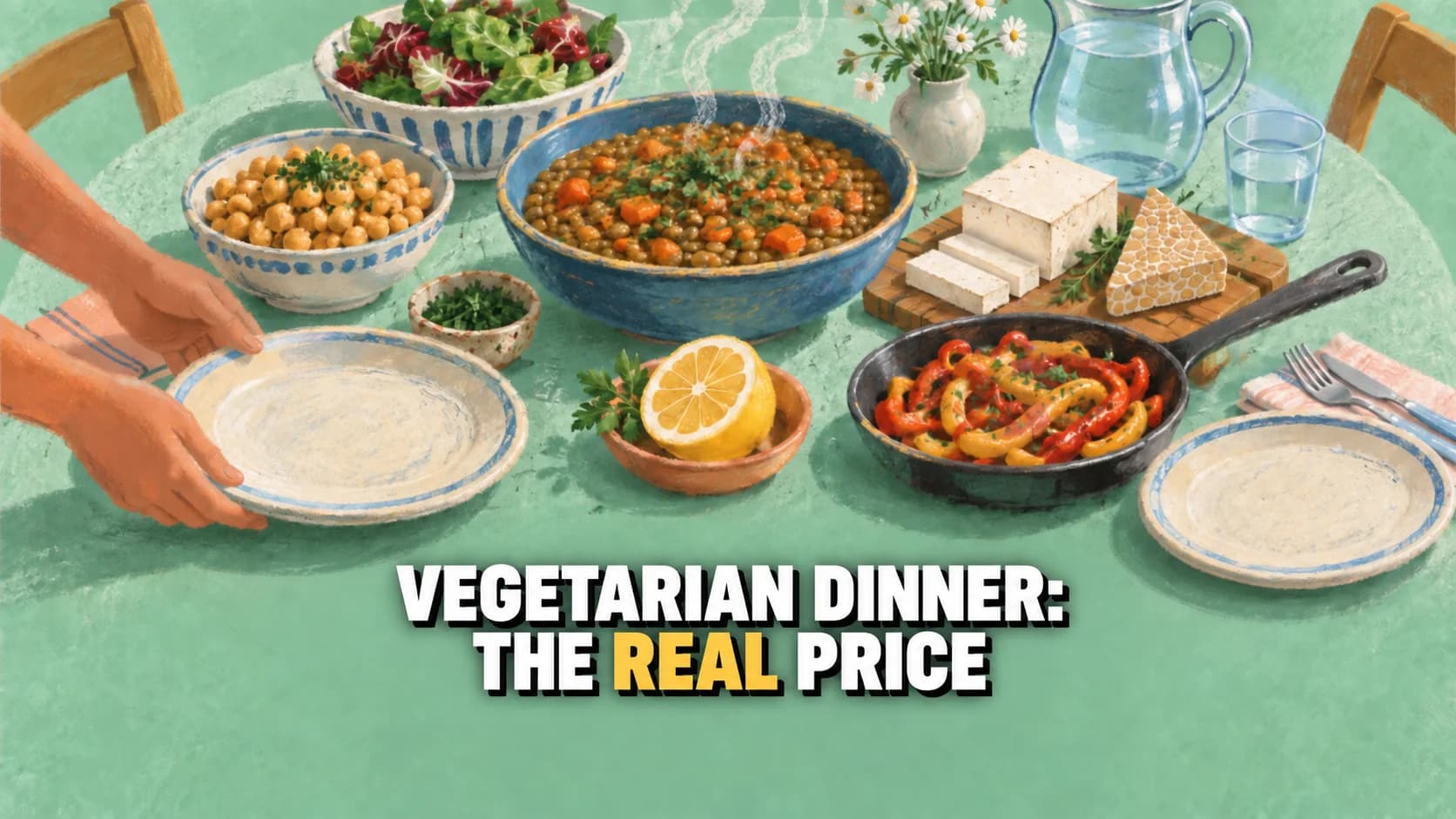
Coop has the widest officially V-Label-certified vegetarian range in Switzerland at around 800 products (as of 2023), with its Karma line (launched 2013) anchoring the sustainability positioning. Migros pioneered the category with Cornatur in 1996 and expanded with the newer V-Love line. Lidl Schweiz (Next Level, 2019) and Aldi Suisse (MY VAY, JUST VEG!, GUT BIO) offer narrower but significantly cheaper own-brand plant-based options. Denner stocks selected items from the same supply pool.
Sources checked regularly. Brand-history facts verified via Swissveg (swissveg.ch), V-Label corporate history (v-label.com), retailer corporate sites (migros.ch, coop.ch, lidl.ch, aldi-suisse.ch, denner.ch), Coop Plant Based Food Report 2021, nau.ch 2023 V-Label product count, plus direct Migros Brand Manager quotes published 2020-2024. Re-verified 25 July 2026: coop.ch still lists over 800 V-Label articles, Karma launched in 2013, and Swissveg's Meilensteine page confirms the V-Label project started in 1996 alongside the launch of Migros Cornatur. Prices reflect typical regular shelf prices.
Rappn is an independent grocery price comparison app in Switzerland, with no commercial agreements with any retailer.
How Swiss supermarkets approach vegetarian: the chain-by-chain map
Vegetarian retail in Switzerland is not evenly distributed. Each of the major chains has a different angle, a different price tier, and a different range depth. Knowing which store does what saves time and money.
Migros is the heritage player. Cornatur was launched in 1996 in cooperation with Swissveg (then called Schweizerische Vereinigung für Vegetarismus), and it became the first supermarket-brand vegetarian product line in Switzerland certified with the V-Label. Migros added V-Love later as a more innovative, design-led plant-based line targeting flexitarians and younger shoppers. The classic Cornatur range stays focused on family-friendly meat substitutes: Quorn-based escalopes, mince, sausages and cold cuts. Migros also sells under its M-Classic and M-Budget labels with vegetarian items, and a smaller Demeter and Migros Bio organic range.
Coop has the deepest officially-labelled range. The own-brand Karma launched in 2013 as a vegetarian-and-flexitarian line, with around 70 to 90 percent of products also vegan. Coop also runs Délicorn, an older vegetarian line dating to 2006. As of 2023, Coop carried roughly 800 V-Label-certified vegetarian products (compared with ~362 at Migros at the same date), and the retailer opened a Karma-branded fully vegetarian/vegan small-format store (140 m²) in Zug train station in 2018. Coop also stocks partner brands: Planted, The Green Mountain, Beyond Burger, Garden Gourmet, Yolo, New Roots, Veganz, plus Betty Bossi Plant Kitchen.
Lidl Schweiz entered the category in 2019 with the "Next Level" range, launching with the Next Level Burger (CHF 3.95 for a 227g two-pack) and Next Level Hack (CHF 3.95 for 275g). The pitch was direct: a Beyond-Burger-style plant patty at discounter price. Since 2023, Lidl has rolled out dedicated "Veggie-Block" sections in the cold aisle of its Swiss stores (193 as of January 2026). Note: Lidl runs both the Next Level and Vemondo names in its European portfolio, and we have not been able to confirm which one currently carries the range on Swiss shelves, so check the pack.
Aldi Suisse runs a two-brand approach: MY VAY is the main modern plant-based line, while JUST VEG! remains as a smaller secondary lineup. Aldi Suisse publishes no product count for either that we can source, so we quote none. GUT BIO is the organic line, which overlaps with vegetarian shoppers on tofu, hummus, dairy alternatives and spreads. All Aldi Suisse plant-based products carry the V-Label.
Denner does not run a vegetarian own-brand and stocks a curated, smaller selection from third-party brands and from the same supply pool as Migros (since Denner is part of the Migros Group). The range is narrow but the prices are competitive.
Aligro and Otto's are out of scope for everyday vegetarian shopping, though not for the reason often given: Aligro is a cash-and-carry sized for gastronomy buyers, but it is open to everyone, private customers included, and no card is needed to shop there. It is the pack sizes, not the door policy, that make it a poor fit for a weekly veg basket. Otto's offers limited fresh and chilled selection.
Coop has 800 V-Label products, Migros pioneered the category with Cornatur in 1996, and the discounters have their own lines too. Live tofu and vegetarian offers below, switch the query for any plant-based staple.
See vegetarian offers near you. Rappn is freeFree, no account required · iOS & Android
"tofu" · Cornatur · Karma · Next Level · MY VAY · V-Label
Offers
Cornatur: the Migros line that started it all
In 1996, today's Swissveg (then operating as Schweizerische Vereinigung für Vegetarismus, SVV) decided to extend the V symbol into product certification. A year later, in 1997, the first supermarket-brand line of meat alternatives bearing the V-Label arrived on Swiss shelves: Cornatur. Migros, then as now Switzerland's largest grocery retailer, partnered with the small SVV office to launch and certify the range. Cornatur became one of the early vegetarian own-brand lines in European retail.
This matters for the wider story. Beyond Meat was founded in 2009. The Impossible Burger launched in 2016. The Western "alternative protein boom" started to dominate headlines around 2018. Cornatur predates all of it by more than a decade. Switzerland mainstreamed supermarket vegetarian retail before most of the world started thinking about it.
The current Cornatur range is anchored by Quorn-based products (Quorn is a mycoprotein technology, not a Migros invention; Cornatur is the brand and Migros Industrie the producer). A 200g pack of Cornatur Quorn mince retails around CHF 4.75 (CHF 23.75 per kg). A 240g Cornatur Quorn schnitzel sits around CHF 5.95 (CHF 24.79 per kg). The line is positioned for family use rather than as a premium or innovative product, with V-Love covering the more design-led plant-based positioning.
Coop Karma and Délicorn: the sustainability play
Coop's vegetarian story is older than most shoppers realise. Délicorn, the original Coop vegetarian own-brand, launched in 2006 (a decade after Cornatur). Karma was added in 2013 as a wider, more lifestyle-focused vegetarian and flexitarian range. Karma's positioning explicitly courts the "flexitarian" segment: Coop's own market research found that around 40% of Swiss consumers skip meat at almost every third main meal. The branding plays into the calm-and-conscious aesthetic rather than the protein-and-performance aesthetic of competing lines.
Karma's range covers ready meals, salads, sandwiches, tofu, spreads, milk alternatives, yoghurts, and dairy-free cheese. All Karma products are V-Label certified, and approximately a quarter carry the Bio Suisse organic bud. Coop also stocks the major plant-based brand portfolio (Planted, Beyond Burger, New Roots, Veganz, The Green Mountain, Garden Gourmet, Yolo, Vuna) as one of the first Swiss retailers to bring most of them to mainstream shelves, plus the Betty Bossi Plant Kitchen line.
The Karma flagship store concept (Zug train station, 2018) was a strategic signal as much as a retail format: a fully vegetarian/vegan 140 m² Coop store with bulk bins, a barista bar, and prepared bowls and sandwiches made in-house.
Lidl Next Level and Aldi MY VAY: the discount-tier reality
The discounters arrived late, with low entry prices. Lidl's Next Level Burger debuted in Switzerland in September 2019, with the Next Level Hack following the same week. Both at CHF 3.95 per pack, both V-Label certified, both shelved in the cold aisle alongside fresh meat. The promise was simple: a comparable plant-based burger experience at roughly half the price of branded alternatives.
That promise still holds. The structural difference at the discounters is range depth, not quality at any one product. Lidl Schweiz's Next Level lineup runs to perhaps 20 to 30 active SKUs, complemented by V-Label items in other categories (plant-based yoghurts, plant-based milks, frozen ready meals). Aldi Suisse's MY VAY runs slightly broader, plus JUST VEG! and GUT BIO contributing tofu, spreads and dairy alternatives. Neither retailer matches Coop's roughly 800-item certified range (2023), but neither tries to: their job is the staple basket at the lowest price.
The price gap is real. A Lidl Next Level Burger at CHF 3.95 (227g, two patties) costs roughly CHF 17.40 per kg of plant-based burger. A comparable Beyond Burger 4-pack at Coop runs closer to CHF 30+/kg. For weekly grocery basket budgeting, the discounter route on staples is usually CHF 8 to CHF 15 cheaper per week for a family that uses meat substitutes regularly.
Vegetarian range comparison (approximate, 2023-2026)
| Retailer | Main veg own-brand | Launch year | V-Label products (approx.) | Strength | Weakness |
|---|---|---|---|---|---|
| Migros | Cornatur + V-Love | 1996 / late-2010s | ~362 (2023) | Heritage, family classics, M-Industry production | Smaller labelled count than Coop |
| Coop | Karma + Délicorn | 2013 / 2006 | ~800 (2023) | Widest range, sustainability positioning, partner brands | Higher base price than discounters |
| Aldi Suisse | MY VAY + JUST VEG! + GUT BIO | (current) | ~50 own-brand + V-Label items | Lowest price tier, growing range | Smaller selection, limited fresh prepared meals |
| Lidl Schweiz | Next Level + Vemondo (transition) | 2019 (CH) | ~30 own-brand + V-Label items | Lowest price tier, Beyond-style burger | Smallest range, transition phase |
| Denner | (no veg own-brand) | n/a | curated selection | Competitive price, Migros Group supply | No dedicated line |
| Aligro | (out of scope) | n/a | n/a | Bulk pricing for gastronomy, open to everyone | Gastronomy pack sizes, thin veg own-brand |
| Otto's | (out of scope) | n/a | n/a | Occasional discounts | Very limited fresh range |
Product counts are approximate, based on retailer corporate communications and Swissveg/V-Label data 2023-2026.
The plant-protein staples: tofu, tempeh, seitan, legumes
Beyond branded meat substitutes, the real backbone of vegetarian cooking in Switzerland is the protein-staple aisle. The prices here are surprisingly stable across chains.
Tofu is the most widely stocked plant protein. A standard 200g block of plain tofu costs roughly CHF 2.20 to CHF 2.80 at Migros and Coop, dropping to CHF 1.50 to CHF 2.00 at Aldi and Lidl. Organic tofu (Migros Bio, Naturaplan, GUT BIO) lands at CHF 3.00 to CHF 3.80 per 200g. Premium and Swiss-produced brands like Soyana and Lord of Tofu run CHF 3.50 to CHF 5.00 for the same format. Discounters usually sit below Migros/Coop on like-for-like product.
Tempeh has narrower distribution. Migros and Coop both stock it (usually in the Karma or chilled vegetarian section); Aldi and Lidl carry it inconsistently. Typical price: CHF 3.50 to CHF 5.00 for 200g.
Seitan is less mainstream but available at Migros (Cornatur produces seitan-based products), Coop and specialised health-food sections. Pre-cooked seitan slices typically retail CHF 4.00 to CHF 6.00 per 200g.
Legumes (chickpeas, lentils, beans) are the cheapest plant protein by a wide margin. A 500g pack of dry red lentils costs around CHF 2.50 to CHF 3.50 at all retailers; canned chickpeas run CHF 1.20 to CHF 1.80 per 400g tin (cheaper in discount own-brand). For a family doing serious vegetarian cooking, legumes consistently beat any branded meat substitute on protein per franc.
Vegetarian apéro and dinner: what it actually costs
A real-world vegetarian week reads differently than the marketing implies. A typical weekly basket for two adults built around vegetarian eating runs CHF 80 to CHF 130 at Migros or Coop full price, CHF 65 to CHF 100 at Aldi or Lidl, and CHF 50 to CHF 80 if the household uses legumes and pulses as the protein base with one or two branded items per week. The branded meat-substitute spend (Cornatur, Karma, Next Level, MY VAY, Beyond, Garden Gourmet) drives most of the price variance.
For vegetarian apéro, Karma cheese alternatives, Coop's plant-based pâtés, Cornatur cold cuts, hummus from GUT BIO at Aldi, and falafel from most chilled sections are the reliable choices. A typical apéro-for-four sits CHF 18 to CHF 30, depending on whether the cheese alternatives are own-brand or branded.
For dinner, the cheapest tier is legume-based (lentil curry, chickpea stew, bean chilli) at CHF 2 to CHF 4 per person. The mid-tier is tofu, tempeh and own-brand meat substitutes at CHF 4 to CHF 7 per person. The premium tier is branded plant-based meat (Beyond, Planted, Garden Gourmet) at CHF 7 to CHF 12 per person. A household that mixes all three tiers, with two legume-based dinners, two own-brand meat-substitute dinners, and one branded meal per week, lands close to the Aldi/Lidl basket figure: CHF 65 to CHF 100 per week for two.
For the vegan-specific picture, see vegan grocery shopping in Switzerland. The protein angle is covered in depth at high-protein grocery shopping, and the organic-aisle pricing in organic food price comparison.
How to find the best vegetarian offers with Rappn
Rappn shows the current vegetarian offers of the 7 Swiss retailers (Migros, Coop, Aldi, Lidl, Denner, Aligro, Otto's), filtered by your canton and your usual stores. The dietary filter lets you narrow to vegetarian (or vegan, or organic) in one tap. Monitor the items you actually buy (Cornatur Quorn mince, Karma falafel, Next Level Burger, Aldi tofu) and Rappn notifies you when they go on Aktion. For the broader weekly-budget context, see the family of four grocery budget guide and the cheapest supermarket in Switzerland ranking.
Rappn takes no payment from retailers, has no commercial bias, and shows the promotions of seven chains side by side, whichever chain they come from.
Updated: .
Why Rappn?
Rappn is an independent grocery price comparison app in Switzerland, with no commercial agreements with any retailer. Our comparisons are truly independent.
- 100% free: no subscription, no hidden costs
- Neutral: no commercial agreements with Migros, Coop, Aldi, Lidl, Denner, Aligro, or Otto’s
- Updated daily, as soon as the chains publish their deals
- The chains’ deals in one place: search, filter, compare, no account needed
Ready to save on groceries?
Install Rappn and compare for yourself this week. No account required.Scan the code, install Rappn and compare current offers. No account needed.
Built in Switzerland, for Switzerland

Frequently Asked Questions
Which Swiss supermarket has the widest vegetarian range?
Coop has the largest officially V-Label-certified vegetarian range, with roughly 800 products as of 2023, supported by its own-brand Karma (launched 2013) and the older Délicorn (2006). Migros has the longest heritage with Cornatur (1996) and the newer V-Love line, but a smaller labelled count at around 362 products at that same 2023 date. Lidl and Aldi Suisse offer narrower own-brand ranges at lower prices.
Was Cornatur invented in Switzerland?
Cornatur is a Migros own-brand launched in 1996 as one of the first supermarket-brand vegetarian product lines in Europe to carry V-Label certification, in cooperation with Swissveg. The brand is Swiss; some of the technologies behind specific products (notably Quorn mycoprotein) are licensed from international producers, but the brand, the range design and the production via Migros Industrie are Swiss.
Is Migros Cornatur still made in Switzerland?
Yes. Cornatur is produced and managed by Migros Industrie, the in-house manufacturing arm of the Migros Group. Specific input ingredients (Quorn mycoprotein, certain soya and wheat proteins) are imported, but the products themselves are formulated and produced in Swiss Migros Industrie facilities.
Are vegetarian meat substitutes really cheaper than meat?
Sometimes, not always. Own-brand discounter meat substitutes (Next Level, MY VAY) at CHF 17 to CHF 20 per kg are usually cheaper than equivalent fresh chicken breast (typically CHF 18 to CHF 30 per kg outside of Aktion) and cheaper than fresh beef mince. But branded plant-based meat (Beyond Burger, Planted, Garden Gourmet) at CHF 25 to CHF 40 per kg is often more expensive than mid-tier fresh meat. The cheapest plant proteins overall remain dried legumes at well under CHF 10 per kg of protein source.
What's the difference between Cornatur and Karma?
Cornatur is a Migros line focused on classic meat substitutes (escalopes, mince, sausages, cold cuts), launched in 1996 and oriented to family use. Karma is a Coop line launched in 2013 with a broader scope: ready meals, prepared salads, tofu, milk alternatives, yoghurts and cheese alternatives, with around 70 to 90 percent of products also vegan. Cornatur is heritage and classic; Karma is wider and more lifestyle-oriented.
Where can I buy tempeh in Switzerland?
Tempeh is most reliably stocked at Coop (Karma chilled section and partner brands like Soyana) and Migros (Cornatur and adjacent chilled vegetarian section). Aldi and Lidl carry tempeh inconsistently as part of seasonal or limited-time ranges. Specialised health-food stores and online retailers like Alnatura.ch and Velt.ch stock a wider tempeh selection. Typical price: CHF 3.50 to CHF 5.00 per 200g.