
Cross-Border Grocery Shopping in Germany: The Swiss Guide for 2026
Since 1 January 2025 you can bring groceries worth CHF 150 per person per day into Switzerland duty-free, half the old CHF 300 allowance, and fresh meat is capped at 1 kg per person per day. Above those limits Swiss VAT applies to the whole amount, 2.6 percent on food and 8.1 percent on other goods, plus CHF 17 per kilo of duty on meat. The trip still wins on cheese, eggs, beer, coffee and toiletries, less on fresh meat. Rules verified July 2026.
Rappn compares prices across all 7 chains live: free, no account.
See Swiss prices first. Rappn is free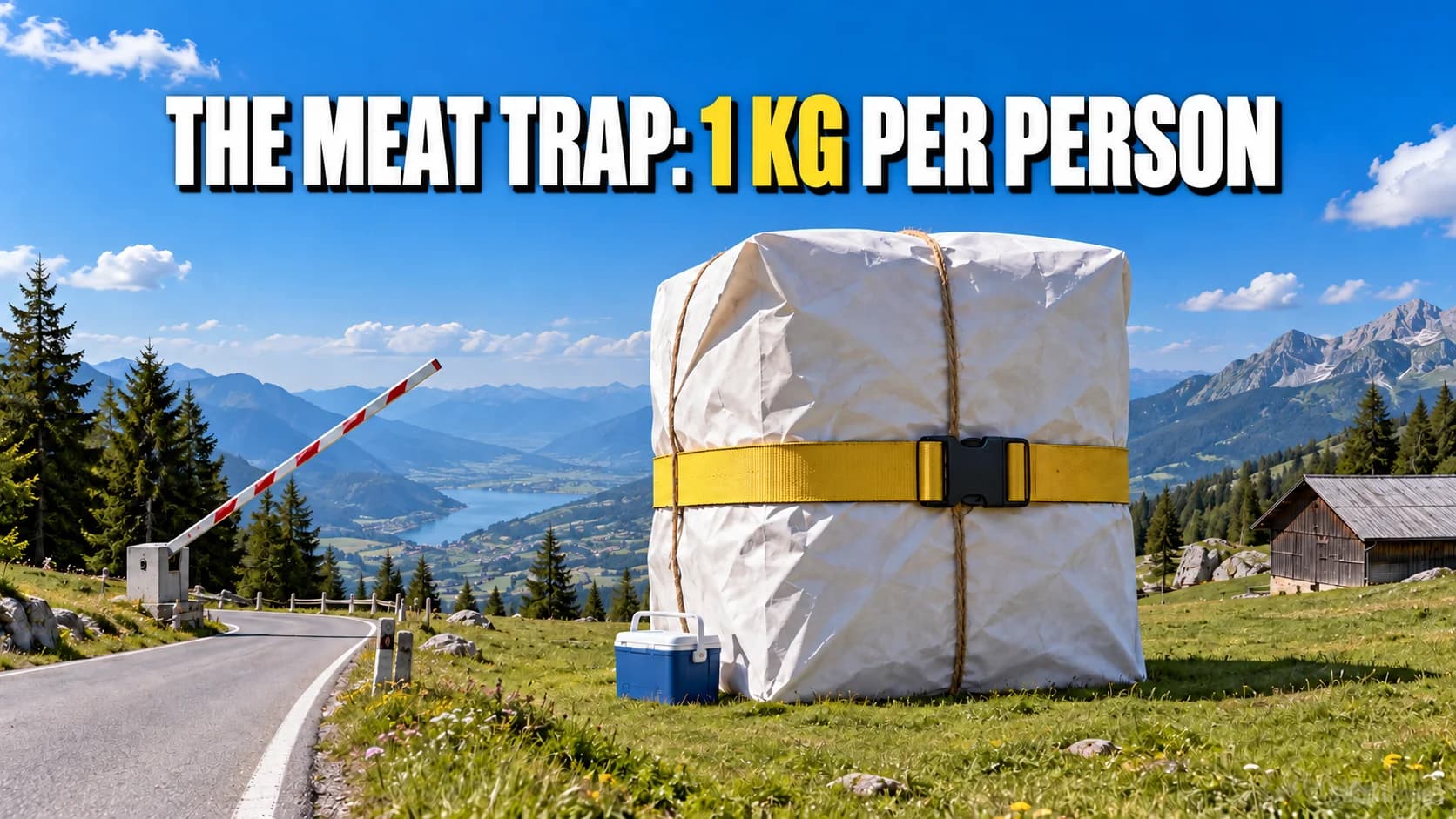
Cross-border grocery shopping is one of the largest savings levers available to Swiss households, and one of the most misunderstood. As of 2026, Swiss residents can import goods worth up to CHF 150 per person per day duty-free from Germany, half the previous CHF 300 allowance that applied until end of 2024. Meat is capped at 1 kg per person per day. Beyond those limits, you pay Swiss VAT (8.1 percent on most goods, 2.6 percent on food), and on meat you pay an additional CHF 17 per kilo customs duty.
Is cross-border grocery shopping in Germany still worth it in 2026?
The trip still pays off for many households, but only when planned around the new rules. The HSG study Einkaufstourismus Schweiz 2025 (published 24 September 2025) puts total cross-border spending at CHF 9.26 billion, roughly 9 per cent of Swiss retail consumer spending, of which about CHF 1.6 billion is online. Food accounts for around CHF 4.0 billion, about 43 per cent of the total, and 72 per cent of the Swiss population shops abroad, on average 5.1 times a year. The benefit is concentrated in border-living households who do the maths correctly. This guide gives you the rules, the math, and a clear answer to whether the trip is worth it for your specific situation.
Sources verified: July 2026. Customs rules from BAZG / Federal Office for Customs and Border Security (bazg.admin.ch, CHF 150 VAT-free travellers' allowance re-checked), German VAT-refund rules and the dAKZ digital-export-certificate pilot from German customs (zoll.de, “Umsatzsteuererstattung”: receipt total must exceed EUR 50 including VAT; pilot from 16 June 2026 at selected border customs offices, voluntary), price comparisons from 20 Minuten and IamExpat household-basket studies, cross-border shopping volumes from the Swiss Journal of Economics and Statistics (Sept 2025) and Swiss Retail Federation. Live offers in the Rappn app.
Rappn is an independent grocery price comparison app in Switzerland, with no commercial agreements with any retailer. Our recommendations are truly independent.
Compare current offers and their supplied unit prices. Check the pack size, canton and validity dates.
See Swiss prices first. Rappn is freeFree, no account required · iOS & Android
Swiss baseline · SH
Offers
What Changed in 2025: The CHF 150 Limit
The single most important rule for any Swiss cross-border shopper is the duty-free import allowance. As of 1 January 2025, travellers can import goods for private use tax-free up to CHF 150 per person per day. Beyond this limit, Swiss VAT applies. The previous CHF 300 limit, in force until the end of 2024, is gone.
Key points that catch people out:
The limit is per person per day, not per car. A family of four can legally import CHF 600 worth of goods in one trip, but the items have to be separable, not one large CHF 600 purchase split between names.
VAT is owed on the entire amount, not just the excess. An individual bringing in CHF 160 of groceries triggers VAT of CHF 4.16 (160 × 2.6 percent, the reduced food rate), not CHF 0.26 on the CHF 10 excess. On non-food goods at the standard 8.1 percent, the same CHF 160 costs CHF 12.96. This is a critical difference from the old assumption that you only pay VAT on what's over the limit.
Foreign VAT can be deducted. Swiss customs uses the value after deduction of foreign VAT, provided it is shown on the receipt. So if you've claimed back German VAT (more on that below), the value Swiss customs uses is the lower one.
QuickZoll handles the declaration. The federal QuickZoll app lets you declare and pay VAT before crossing. Since June 2026 the app takes both VAT rates into account: you enter the value of goods separately for the 8.1 percent standard rate and the 2.6 percent reduced rate (food, non-alcoholic drinks, books, medicines and similar), and the app calculates the VAT due (BAZG announcement of 02.06.2026). Before that update it charged 8.1 percent on everything, which overtaxed food shoppers.
The Meat Trap: 1 kg Per Person, Per Day
Meat is the second rule that catches everyone. A maximum of 1 kg of fresh meat and meat preparations per person per day can be imported duty-free, except game, fish, crustaceans, molluscs and other aquatic invertebrates.
Beyond 1 kg, the duty rate is steep. Between 1 kg and 10 kg, the rate is CHF 17 per kg. Beyond 10 kg, CHF 23 per kg. These tariffs exist to protect Swiss livestock farmers, and they make importing more than 1 kg of meat per person per day economically pointless for almost any household.
In practice: a family of four can legally bring back 4 kg of fresh meat. That's enough for a week of family meals. But two adults bringing back 5 kg of meat for the freezer? CHF 17 × 3 = CHF 51 in duty, plus VAT, on top of the German purchase price. The math collapses fast.
The same 1 kg cap applies to butter and cream. Vegetable margarine is more generous at 5 kg. Fish and game are excluded from the meat cap, so you can bring back additional fish without it counting toward the 1 kg meat allowance.
Don't pay for offers you didn't need.
Rappn shows you live grocery offers across all 7 major Swiss retailers (Migros, Coop, Aldi, Lidl, Denner, Aligro, Otto's) before you decide whether the cross-border trip is worth it this week.
Where Swiss Shoppers Actually Go
The cross-border map is well established. The most popular destinations for cross-border shoppers include the German city of Konstanz, which remains the hotspot, alongside Weil am Rhein, Lörrach and Waldshut-Tiengen. Each town serves a different Swiss catchment, and the choice depends on where you live more than on which town has the best stores.
Konstanz sits across the border from Kreuzlingen (Thurgau). It's the largest cross-border destination in numbers and has the deepest selection. The main grocery destinations are Kaufland on Carl-Benz-Strasse, an enormous grocery store with wide selection, low prices, free toilets and free parking, and Aldi in the Lago shopping centre in old town, plus an Edeka on Bodanstrasse. From Zurich it's about an hour by car.
Lörrach is the destination of choice for Basel residents. It has Galeria (the department store still widely called Karstadt, at Turmstrasse 1, about 9,000 sqm), Müller, H&M and most of the big-box stores in the pedestrian zone of the old town centre. For groceries, Rewe on Am Alten Markt is the main stop. The B+B Parkhaus on Bahnhofstrasse is the standard parking option, a couple of blocks from the main shopping area.
Weil am Rhein is closer to Basel than Lörrach by a few minutes and has its own Rewe and several smaller chains. It's quieter and easier on a busy Saturday than Konstanz.
Waldshut and Singen serve specific Swiss regions. Waldshut and Jestetten are smaller shopping towns, only worth it if you live close. Singen is popular with shoppers near Schaffhausen for its big-box grocery store on Georg-Fischer-Strasse: a former Real of roughly 6,400 sqm of sales floor, converted to Kaufland in June 2021. Store names last verified September 2026.
A practical note from people who do this regularly: on Fridays and Saturdays the road from Kreuzlingen into Konstanz is normally heavily congested. If you can do mid-week, do.
What's Actually Cheaper
| Category | German savings vs Switzerland | Notes |
|---|---|---|
| Eggs | 50% to 60% cheaper | An organic egg costs CHF 0.78 at Aldi Suisse vs CHF 0.31 at Aldi Süd, a typical pattern |
| Cheese & dairy (above butter cap) | 30% to 50% cheaper | Major win, with no special quantity restrictions on most cheeses |
| Beer & soft drinks | 40% to 60% cheaper | Watch the alcohol limit (5 L under 18%, 1 L over 18% per person) |
| Toiletries & household | 30% to 50% cheaper | DM and Müller drugstores are the destinations |
| Coffee & breakfast cereal | 30% to 40% cheaper | High-margin Swiss categories |
| Pasta, rice, oil | 30% to 50% cheaper | Easy to stockpile, long shelf life |
| Fresh meat | 50%+ cheaper, but capped at 1 kg | Math fails fast above the cap |
| Sweets & confectionery | 40% to 60% cheaper | Especially German national brands |
What's not meaningfully cheaper: fresh fruit and vegetables (Swiss prices have come down significantly post-Aldi-cuts), most electronics, and any premium organic with Swiss certifications you can't replicate from German bio labels.
For a fair comparison of what the Swiss side actually costs week-to-week, see our cheapest supermarket in Switzerland breakdown.
The German VAT Refund (Tax-Free Shopping)
This is the part most casual shoppers skip, and it adds 7 percent to your savings. If a single German receipt exceeds EUR 50 including VAT, you can claim back the German VAT on it. To do it, request an export certificate (Ausfuhrbescheinigung) at the store, then have it stamped by German customs at the border before re-entering Switzerland. So anyone who shops in Germany and spends between EUR 50 and CHF 150 per person can avoid paying any VAT or customs duties in either country.
In practice this means: spend EUR 50 at Kaufland on a single receipt, ask for the export form at the till, get it stamped at the German customs window on your way out, and the store refunds you the German VAT (typically 7 percent on food, 19 percent on non-food). This either gets handed back at the customs window directly, sent to your bank, or processed via a refund service like Global Blue.
If you're at or below the CHF 150 Swiss limit, you pay no Swiss VAT either, so the refunded German VAT is pure savings.
The paper stamp is being phased out, slowly. German customs started piloting a digital export certificate (dAKZ) on 16 June 2026. Participation is voluntary for both shops and shoppers, it runs only at selected border customs offices and participating retailers, and it works through an app that records the border crossing so you no longer stop at the customs window. Until your crossing and your shop are both in the pilot, assume the paper procedure and the EUR 50 threshold still apply.
The Math: Is the Trip Worth It?
Here's the honest framework. The trip pays off if all three are true:
1. You live within 30 minutes of the border. Beyond that, fuel + time costs eat the savings. A 90-minute round trip from Zurich to Konstanz at Swiss fuel prices and Swiss labour-time value rarely beats optimising at Aldi/Lidl Switzerland for a normal weekly basket.
2. You're shopping for a household, not just for one. The CHF 150 allowance per person makes the trip far more efficient for a family of three or four. Solo shoppers can still do it but lose the multiplier.
3. You're buying the right categories. A trip focused on cheese, eggs, beer, toiletries, coffee, and pasta is a very different trip from one focused on fresh meat (where the 1 kg cap kills the math) or fresh produce (where the gap is now small).
A typical family-of-four cross-border run, planned correctly, saves CHF 80 to CHF 150 vs the same basket bought in Switzerland. Multiplied by the 6 to 12 trips per year that border-living households typically do, that's CHF 500 to CHF 1,800 per year.
Combined with saving money on groceries in Switzerland on the rest of the basket, total household savings can reach CHF 2,000+ per year for disciplined shoppers.
When NOT to Go: The Swiss Side Got Cheaper
This is the part most cross-border guides skip. The Swiss side has changed.
The Aldi Suisse meat price cuts of September 2024 (up to 36 percent on fresh meat), the November 2025 follow-up cuts, and Migros's CHF 500 million 2025 price-reduction programme have meaningfully narrowed the gap on standard groceries. The cheapest meat in Switzerland is no longer dramatically more expensive than the German equivalent at the discounter level. M-Budget and Prix Garantie staples close another large chunk of the gap.
If your cross-border trip was historically built around fresh meat, beef mince, or pork filet, the math has flipped. You can now get those items at Aldi or Lidl Switzerland for 80 to 90 percent of what they cost in Germany, without the trip, the time, or the customs hassle.
The trip still wins on cheese, eggs, beer, coffee, toiletries, and confectionery. It loses on standard meat. Plan accordingly.
What to Bring and What to Avoid
Bring:
- Cooler bag or insulated cooler for cold-chain items (cheese, dairy, meat)
- Receipts in a single folder (you may need them at customs)
- Reusable shopping bags (German stores charge for plastic bags)
- Cash and card both (some smaller German shops are still cash-preferred)
- Your Swiss ID card (faster border crossing than passport for Swiss residents)
Avoid:
- More than 1 kg of meat per person (don't risk the duty)
- More than 1 kg of butter or cream per person (same trap)
- Animal products from non-EU countries (prohibited entirely, including from gift shops)
- Single high-value items above CHF 150 (you trigger VAT on the entire purchase)
- Counterfeits, weapons, restricted plants, separate ban list, never worth the risk
A Practical Workflow
Step 1: Wednesday evening, check Swiss-side offers. Look at the live Aktion week starting Thursday. If your usual cross-border categories (cheese, beer, eggs) are already heavily discounted on the Swiss side this week, defer the trip.
Step 2: Plan the trip for Thursday or Friday morning. Avoid Saturday traffic. Build a list of what you actually need and tag the items by store (Kaufland for groceries, DM for toiletries, etc.).
Step 3: At the German store, get the export certificate (Ausfuhrbescheinigung) for any single receipt over EUR 50. Tell the cashier before they ring you up.
Step 4: At the border, stop at the German customs office to get the export form stamped. Then declare via QuickZoll on the Swiss side if you're over CHF 150 per person, or use the red lane.
Step 5: Back home, file the German VAT refund. The store either refunds at the till on next visit or via Global Blue / similar service.
This is a routine, not an event. Households that do it well treat it as a planned errand once every 6 to 8 weeks, not a weekly trip.
Updated: .
Why Rappn?
Rappn is an independent grocery price comparison app in Switzerland, with no commercial agreements with any retailer. Our comparisons are truly independent.
- 100% free: no subscription, no hidden costs
- Neutral: no commercial agreements with Migros, Coop, Aldi, Lidl, Denner, Aligro, or Otto’s
- Updated daily, as soon as the chains publish their deals
- The chains’ deals in one place: search, filter, compare, no account needed
Ready to save on groceries?
Install Rappn and compare for yourself this week. No account required.Scan the code, install Rappn and compare current offers. No account needed.
Built in Switzerland, for Switzerland
Frequently Asked Questions
What is the duty-free limit for cross-border grocery shopping in 2026?
CHF 150 per person per day, in force since 1 January 2025. The previous CHF 300 limit is gone. The limit is per person, so a family of four can import CHF 600 worth, but the goods must be separable per person, not one large item split between names. If you exceed the limit, Swiss VAT (8.1 percent on most goods, 2.6 percent on food) applies to the entire amount, not just the excess.
How much meat can I bring back from Germany?
1 kg per person per day, including children. A family of four can bring back 4 kg total. Beyond the 1 kg per person, customs duty applies at CHF 17 per kg (1-10 kg) or CHF 23 per kg (above 10 kg), in addition to Swiss VAT. The cap also applies to butter and cream. Fish and game are excluded from the cap.
Is the trip from Zurich or Geneva still worth it?
Less so than five years ago. Aldi and Lidl Switzerland have permanently cut prices on fresh meat (up to 36 percent in September 2024), narrowing the gap. The trip still pays off for households within 30 minutes of the border buying cheese, eggs, beer, coffee, toiletries and confectionery, where Swiss prices remain 30 to 60 percent above German equivalents. For fresh meat specifically, optimising at Aldi/Lidl Switzerland now beats the cross-border run for most shoppers.
How does the German VAT refund work?
Go over EUR 50 including VAT on a single receipt in a German store, request an export certificate (Ausfuhrbescheinigung) from the cashier, then have it stamped by German customs at the border before re-entering Switzerland. The store refunds the German VAT either directly, by bank transfer, or via a service like Global Blue. For purchases between EUR 50 and CHF 150, you avoid paying any VAT in either country. German customs began piloting a digital version (dAKZ, app-based, no customs stop) on 16 June 2026 at selected crossings and participating shops; outside the pilot the paper stamp still applies.
What apps or tools help with cross-border shopping?
On the Swiss side, the federal QuickZoll app handles customs declaration and VAT payment automatically for amounts over CHF 150. For deciding whether the trip is worth it in the first place, Rappn shows live offers across all 7 major Swiss retailers (Migros, Coop, Aldi, Lidl, Denner, Aligro, Otto's) so you can see whether the Swiss-side Aktion week already covers your shopping list.
Can I shop in France or Italy with the same rules?
Yes. The CHF 150 limit and the 1 kg meat cap apply to all neighbouring countries. Swiss residents from French-speaking cantons typically shop in Annemasse, Saint-Louis, or Pontarlier; Ticino residents shop in Como. The savings on standard categories are similar. The German VAT refund described above has equivalents in France (TVA refund), Italy (IVA), and Austria, with slightly different minimum-purchase thresholds.