
Foie Gras in Switzerland: Who Sells It, Who Does Not, and What the Law Requires
Producing foie gras has been banned in Switzerland for more than 40 years, while importing and selling it remain legal (admin.ch, 28 May 2025). Coop has not sold it since 2001 according to the FRC, and Migros lists it regionally, above all in French-speaking Switzerland and Ticino. A declaration duty applies since 1 July 2025 with a two-year transition: from July 2027 the force-feeding statement must appear on every affected pack.
Rappn compares the current promotions of 7 Swiss retailers, updated daily: free, no subscription.
See live festive offersOpens the Rappn search for “Foie gras” in the current deals of all 7 chains, filterable by chain, category, price and canton.
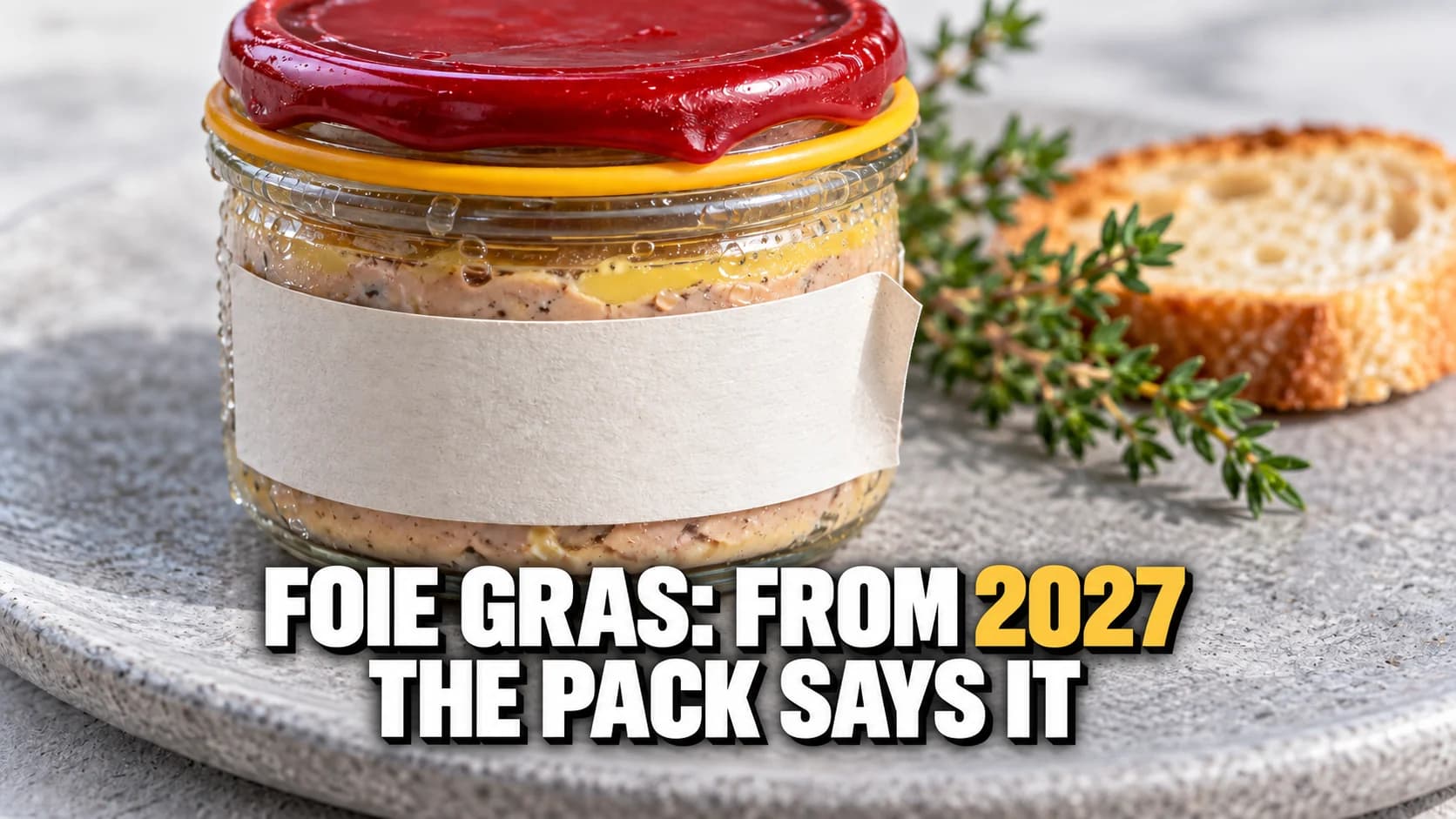
Producing foie gras is banned in Switzerland. Importing it and selling it are not. That contradiction is what you are looking at on the shelf in December. Since 1 July 2025 a declaration duty also applies to products from force-feeding, but with a two-year transition period: only from July 2027 must every affected pack state that it comes from force-fed ducks or geese. This guide sets out who sells foie gras in Switzerland, who does not, what the label has to say now and from 2027, and what Parliament decided in 2026. The current festive-range offers you see live in Rappn.
Last updated: September 2026. Sources: Federal Council media release of 28 May 2025 on the new declaration duties for animal-origin foods (admin.ch); legal and import overview by Four Paws Switzerland based on customs data from the FOCBS and the Swiss-Impex database (accessed September 2026); swissinfo.ch on the National Council debate of 18 March 2026; Four Paws press release of 19 March 2026 on the content of the counter-proposal; watson.ch of 8 June 2026 on the Council of States decision; Fédération romande des consommateurs FRC, "Foie gras or not foie gras?", 29 December 2014, for Coop's position; Rhône FM for the Migros cooperatives and for Manor; happyfoie.com of 17 January 2024 for the Happy Foie listing. This guide deliberately quotes no prices.
Rappn is an independent grocery price comparison app in Switzerland, with no commercial agreements with any retailer.
Is foie gras banned in Switzerland?
No, but producing it is. Force-feeding ducks and geese has been prohibited in Switzerland for more than 40 years, according to the Federal Council media release of 28 May 2025, while the practice remains legal abroad. Four Paws Switzerland points to article 4 of the Animal Welfare Act read together with article 20 letter e of the Animal Welfare Ordinance. No Swiss farm may force-feed.
Importing and selling are not covered by that ban. What sits on the shelf here is therefore imported, essentially from France according to the FRC of 29 December 2014. In practice you are legally buying a product that cannot be made here. This guide takes no position on that: it describes the rules and shows where the product is sold.
The phone shows the current festive offers of the seven Swiss chains side by side, filtered to your canton, with the unit price next to the pack price, and the app is free.
See live festive offersFree, no subscription · iOS & Android
"Foie gras"
Offers
Which chains sell foie gras in Switzerland, and which do not?
| Retailer | Foie gras in the range? | Since when, per which source | Note |
|---|---|---|---|
| Coop | No | Not since 2001 (FRC, 29 December 2014) | The chain removed the item from its range |
| Migros | Yes, regionally | Geneva, Vaud, Valais, Neuchâtel-Fribourg, Ticino cooperatives (Rhône FM) | Mainly ahead of the holidays |
| Migros, Happy Foie | Yes | French-speaking Switzerland plus Zurich, Aar and Basel (happyfoie.com, 17 January 2024) | Liver from birds that are not force-fed |
| Manor | Yes | Mainly in French-speaking Switzerland (Rhône FM) | Department store with a fresh-food floor |
| Denner, Aldi Suisse, Lidl Schweiz, Otto's, Aligro | No information | In September 2026 we found no public statement and no reachable product page | So neither a yes nor a no is stated here |
That map also explains why the search feels so different from one region to the next. In German-speaking Switzerland your odds of finding foie gras on a supermarket shelf are lower than in Geneva, Vaud or Ticino.
What must the pack say, and from when?
On 28 May 2025 the Federal Council adopted amendments to the Foodstuffs and Utility Articles Ordinance (LGV) and to the Ordinance on Food Information (LIV). They entered into force on 1 July 2025, with a two-year transition period. From July 2027, every affected imported product from force-feeding must carry the statement that it was obtained from force-fed geese, or from force-fed ducks.
For December 2026 that means one simple thing: you are in the middle of the transition period. Some packs already carry the wording, others do not yet. It sits near the origin details and the ingredient list, not on the front of the pack. According to admin.ch the same revision covers further products, among them frogs' legs, beef from cattle dehorned or castrated without anaesthesia, pork from farms practising tail docking or castration without pain relief, eggs and poultry meat from beak-trimmed birds, and milk from cows dehorned without pain relief. Restaurants and retailers have to ensure compliance through their own self-monitoring.
What did Parliament decide in 2026?
| Date | Decision | Source |
|---|---|---|
| For more than 40 years | Force-feeding banned in Switzerland, importing still allowed | admin.ch, 28 May 2025 |
| 2001 | Coop takes foie gras out of its range | FRC, 29 December 2014 |
| 28 May 2025 | Federal Council adopts the declaration duty (LGV and LIV) | admin.ch, 28 May 2025 |
| 1 July 2025 | Duty enters into force, two-year transition period | admin.ch, 28 May 2025 |
| 18 March 2026 | The National Council rejects the import-ban initiative by 105 votes to 58 with 21 abstentions and adopts the indirect counter-proposal by 96 to 76 with 12 abstentions | swissinfo.ch, 18 March 2026 |
| Early June 2026 | The Council of States adopts the counter-proposal with its own amendments, 24 votes to 15 with 3 abstentions; the bill returns to the National Council | watson.ch, 8 June 2026 |
| July 2027 | The wording becomes compulsory on the pack | admin.ch, 28 May 2025 |
The indirect counter-proposal does not rely on an import ban but on the declaration duty that is already in force, plus monitoring. According to the Four Paws press release of 19 March 2026, the federal government is to monitor imported volumes of foie gras, magret and confit systematically from July 2027 and publish a report every five years; if volumes do not fall, further measures up to import restrictions are foreseen. Animal welfare organisations consider that too weak, while supporters of the counter-proposal regard an import ban as disproportionate. According to watson.ch, the Council of States has not yet taken its formal decision on the popular initiative itself.
How much foie gras does Switzerland import?
Two sets of figures are public, both published by organisations that campaign for an import ban, and both naming their data source. Four Paws Switzerland reads the customs data of the FOCBS and the Swiss-Impex database and arrives, for the years 2021 to 2025, at 162 to 209 tonnes a year, which it puts at roughly 350,000 birds a year; for 2024 the organisation states 200 tonnes. On 8 June 2026 watson.ch cited Alliance Animale Suisse with a band of about 180 to 260 tonnes a year in recent years. Back in 2014 the FRC gave roughly 200 tonnes for 2011, essentially from France.
The order of magnitude has therefore stayed remarkably stable across a decade and a half: a few hundred tonnes a year, concentrated into a handful of weeks.
Why is foie gras a December product?
Because it is eaten almost only on festive occasions. On 8 June 2026 watson.ch noted that consumption sits above all in French-speaking Switzerland and around celebrations, and according to Rhône FM, Migros sells the product mainly ahead of the year-end holidays. For you that means the range is at its widest in November and December, and then largely disappears.
And because festive ranges follow the same weekly rhythm as everything else: Migros, Coop and Denner start their weekly promotions on Thursday, Coop since the week of 21 January 2025, Migros and Denner since 5 February 2026; Aldi Suisse and Lidl Schweiz run two rounds a week, on Monday and Thursday. Prices therefore move every Thursday, and Rappn shows you the ones currently running. The December shopping plan puts all of this into the holiday weeks.
What does foie gras cost, and why is there no price here?
Because in September 2026 we found no price we could quote to you with a date, a pack size and a source. The product pages and search engines of migros.ch, coop.ch and aligro.ch do not answer automated requests, and no dated price from a consumer publication was available. A number without evidence is not information, it is an assertion, so there is none here.
What can be said is how the price is built. What compares is not the pack but the price per 100 grams, because formats run from a small terrine to a whole block, and goose liver is, according to the FRC, rarer and dearer than duck liver. The names then vary by degree of processing, whole liver, block or mousse, which makes comparing two labels almost impossible without a unit price. In Rappn the unit price sits next to the pack price, and you see the current offers of the seven chains, filtered to your canton. The app is free and needs no account. If you are planning the festive meal, the summary of the cost of an apéro for six, the wine and spirits guide and the explainer on Swiss food labels will help you read the declaration on the pack correctly.
Updated: .
Why Rappn?
Rappn is an independent grocery price comparison app in Switzerland, with no commercial agreements with any retailer. Our comparisons are truly independent.
- 100% free: no subscription, no hidden costs
- Neutral: no commercial agreements with Migros, Coop, Aldi, Lidl, Denner, Aligro, or Otto’s
- Updated daily, as soon as the chains publish their deals
- The chains’ deals in one place: search, filter, compare, no subscription
- Meal planner in the Kitchen tab: plan the week, send the ingredients to your list

Ready to save on groceries?
Install Rappn and compare for yourself this week. No account required.Scan the code, install Rappn and compare current offers. No account needed.




Frequently Asked Questions
Is it legal to buy foie gras in Switzerland?
Yes. Producing it is banned, buying it is not. Force-feeding has been prohibited in Switzerland for more than 40 years according to the Federal Council media release of 28 May 2025, while importing and selling remain legal. What you find on the shelf here is therefore imported.
Does Coop sell foie gras?
No. According to the Fédération romande des consommateurs FRC ("Foie gras or not foie gras?", 29 December 2014), Coop took the item out of its range in 2001 and has not sold it since. For Denner, Aldi Suisse, Lidl Schweiz, Otto's and Aligro we found no public statement in September 2026, which is why our table leaves that row blank.
Where does Migros stock foie gras?
Regionally. According to Rhône FM, the Geneva, Vaud, Valais, Neuchâtel-Fribourg and Ticino cooperatives list the product, mainly ahead of the holidays. Happy Foie, a liver from birds that are not force-fed, is available according to the maker's announcement of 17 January 2024 in French-speaking Switzerland and in the Zurich, Aar and Basel cooperatives.
What must the pack say from July 2027?
That the product was obtained from force-fed geese, or from force-fed ducks. The Federal Council adopted the amendment to the LGV and the LIV on 28 May 2025; it has been in force since 1 July 2025, with a two-year transition period. In December 2026 we are in the middle of that period, so you will meet both cases on the shelf.
Did Parliament ban the import?
No. On 18 March 2026 the National Council rejected the import-ban initiative by 105 votes to 58 with 21 abstentions and adopted an indirect counter-proposal by 96 to 76 with 12 abstentions (swissinfo.ch). In early June 2026 the Council of States approved that counter-proposal with its own amendments, 24 votes to 15 with 3 abstentions (watson.ch, 8 June 2026). The counter-proposal relies on the declaration duty plus monitoring of imported volumes from July 2027, with a report every five years.
Where can I see the current festive offers?
In Rappn. Weekly promotions start on Thursday at Migros, Coop and Denner, and additionally on Monday at Aldi Suisse and Lidl Schweiz, which is why this guide quotes no prices. In the app you see the current offers of the seven chains, filtered to your canton and with the unit price next to the pack price. It is free and needs no account.