
What percentage of income goes to food?
In Switzerland only around 6.2 percent of gross income goes to food at home (BFS HABE 2023, about CHF 638 per month). That is low internationally, because incomes are high. Measured against disposable income, that is what remains after mandatory deductions, the share reaches around 8.9 percent, because much of income goes first to taxes, social charges, housing and savings.
Rappn compares the current promotions of 7 Swiss retailers, updated daily: free, no subscription.
Track your food share in Rappn, free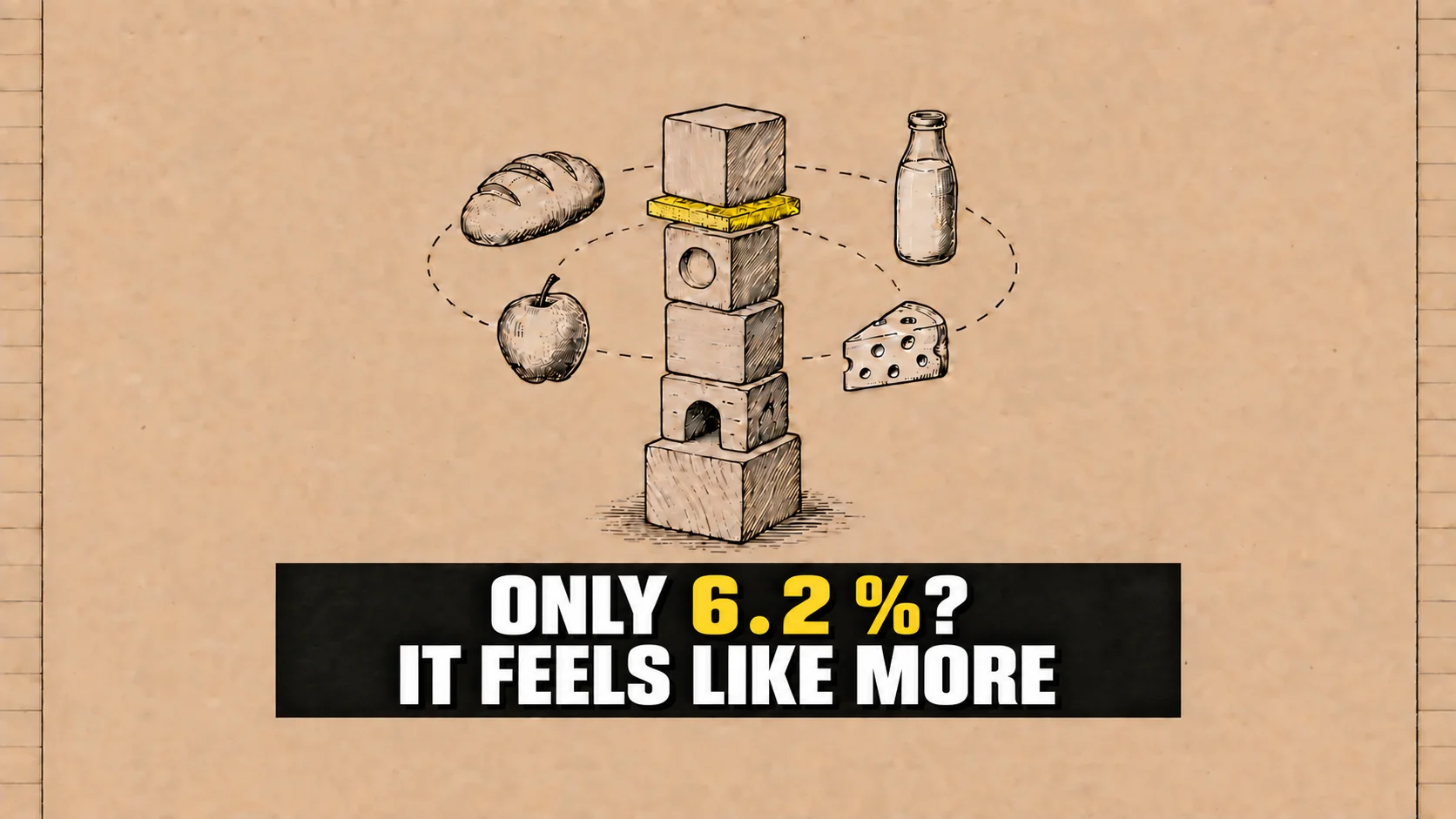
Updated regularly. What percentage of income goes to food has a surprisingly low answer: in Switzerland it is only around 6.2 percent of gross income for food at home (BFS, Household Budget Survey 2023, about CHF 638 per month). That it feels like more in daily life has a reason, and it lies in the denominator.
Rappn is an independent grocery price comparison app in Switzerland, with no commercial agreement with any retailer. Migros, Coop, Aldi, Lidl, Denner, Aligro and Otto's do not pay us to rank them, and nothing below is sponsored.
What percentage of income do Swiss households spend on food?
| Reference base | Food's share | What it shows |
|---|---|---|
| Gross income (~CHF 10'341/mo) | ~6.2 % | of total income |
| Disposable income (~CHF 7'186/mo) | ~8.9 % | after mandatory deductions of CHF 3'154 |
Scan your receipts in Rappn and view recorded spending by category. Review your grocery budget using your own purchases.
Track your food share in Rappn, freeFree, no subscription · iOS & Android
Your spending
Gross or disposable: which denominator is fair?
The 6.2 percent measures food against gross income. A more honest denominator is disposable income, that is what remains after mandatory deductions. That is because around CHF 3'154 goes off the top first each month, which is 30.5 percent of gross income: taxes (around CHF 1'245), social insurance (about 10.3 percent) and health insurance (about 6.7 percent). Of the CHF 10'341 gross income, around CHF 7'186 is left as disposable. Measured against that figure, the same grocery bill of roughly CHF 638 is no longer 6.2 but around 8.9 percent. The amount stays the same, the share rises because the denominator gets smaller.
After disposable income, housing and energy (around CHF 1'449) and on average around CHF 1'736 of savings also go out. Both figures in the table are correct, they simply answer different questions. Switzerland's food share is low by international standards mainly because incomes are high: the higher the income, the smaller the share that goes to food. This link is known as Engel's law. A low share therefore does not mean food is cheap, but that income is high.
Why 6 percent feels like more
Because you do not experience the rent, the health insurance and the taxes fresh every week, but you do experience the shop. That is exactly why the felt share is higher than the statistical one, and exactly why the grocery bill is the item where saving pays off most directly: it is the one large expense you influence weekly. A note for comparisons: the 6.2 percent is of gross income. Rules of thumb like the 50-30-20 rule work with net income, so the two percentages must not be set directly against each other.
In the Rappn app you scan your receipts and see your real share, instead of working with the average. Through the price comparison you lower it. For how many francs that is, see how much money for food per month, and where food fits into a whole budget, the 50-30-20 rule.
Updated: .
Why Rappn?
Rappn is an independent grocery price comparison app in Switzerland, with no commercial agreements with any retailer. Our comparisons are truly independent.
- 100% free: no subscription, no hidden costs
- Neutral: no commercial agreements with Migros, Coop, Aldi, Lidl, Denner, Aligro, or Otto’s
- Updated daily, as soon as the chains publish their deals
- The chains’ deals in one place: search, filter, compare, no subscription
- Meal planner in the Kitchen tab: plan the week, send the ingredients to your list

Ready to save on groceries?
Install Rappn and compare for yourself this week. No account required.Scan the code, install Rappn and compare current offers. No account needed.



Frequently Asked Questions
What percentage of income goes to food in Switzerland?
Around 6.2 percent of gross income on food at home (BFS HABE 2023, about CHF 638 per month). That is low, because incomes are high. Measured against disposable income, after mandatory deductions, the share is around 8.9 percent.
Why does the share feel higher than 6 percent?
Because much of gross income is not freely available: around 30 percent goes to obligatory expenses (taxes, social insurance, health insurance), plus housing and savings. Of what you actually spend, food makes up a noticeably larger share.
Can I compare the food share with the 50-30-20 rule?
Not directly. The 6.2 percent is of gross income, while the 50-30-20 rule of thumb works with net income. Because the denominators differ, a 6.2 percent share of gross is a larger share of net income.
Is the food share high or low in Switzerland?
Low by international standards, because wages are high. At around 6.2 percent of gross income, Switzerland is at the low end. That does not change that food is the large spending item you can influence most directly and weekly.
How much of disposable income goes to food in Switzerland?
Around 8.9 percent. After mandatory deductions of CHF 3'154, about CHF 7'186 of the CHF 10'341 gross remains disposable (BFS HABE 2023). The roughly CHF 638 for food is about 8.9 percent of that.