
Frozen Food Price Comparison in Switzerland: Vegetables, Fish & Ready Meals (2026)
Frozen is not nutritionally inferior to fresh, the European Food Information Council says spinach retains 70% of vitamin C frozen vs 0% at room temperature for a week. The retail spread is the story: Lidl Freshona peas at CHF 1.85 vs CHF 4+ for the same bag at a premium grocer.
Rappn compares prices across all 7 chains live: free, no account.
Compare frozen-aisle prices. Rappn is free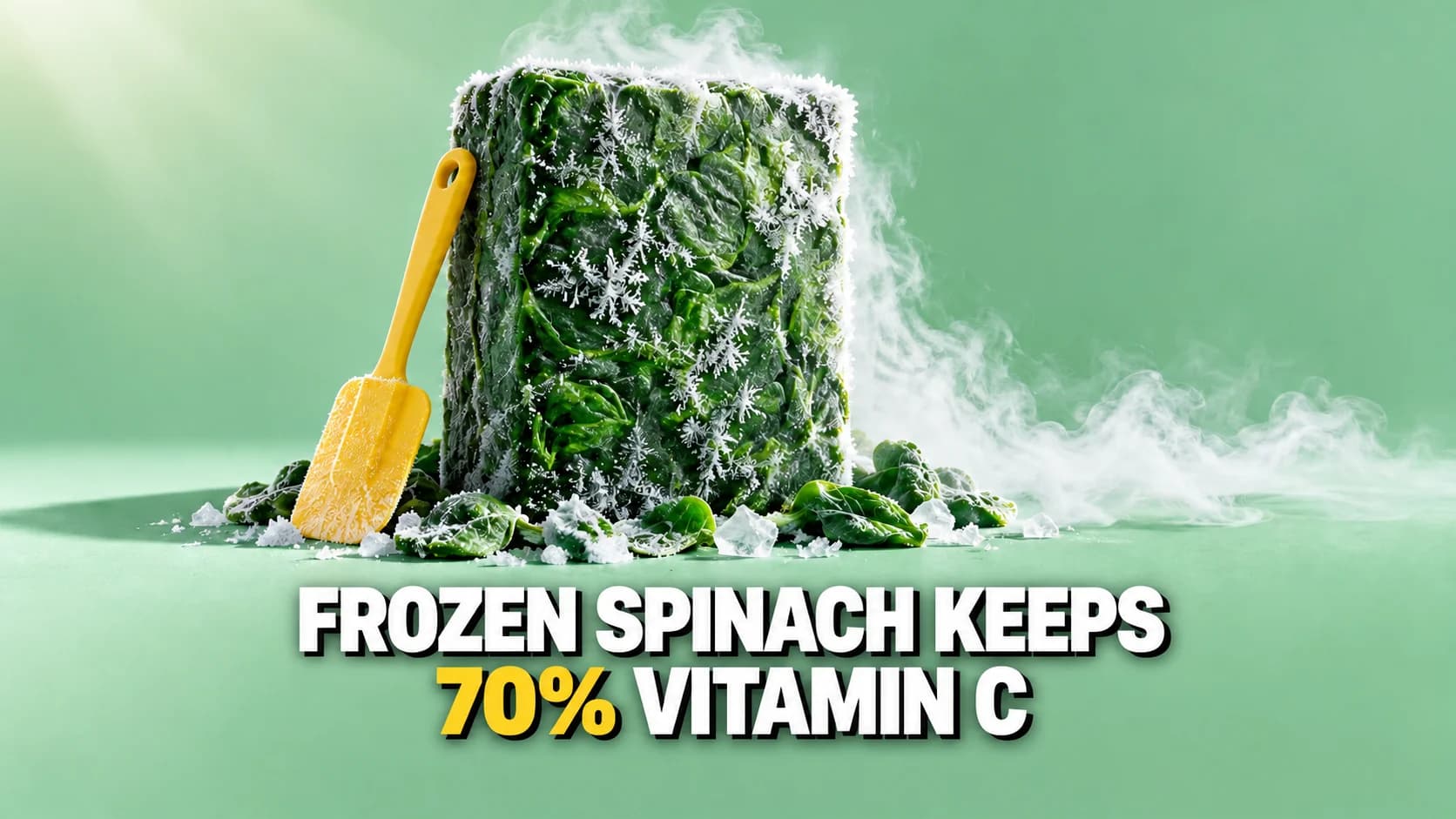
A bag of frozen peas costs CHF 1.85 at Lidl and over CHF 4 at a Swiss premium grocer. Same vegetable. Same weight. Sometimes from the same processing plant. The spread on frozen food in Switzerland is wider than on most fresh produce, partly because the category is poorly understood. Swiss consumers carry an assumption that frozen is "lesser" food, which lets premium retailers maintain prices that the underlying product does not justify. The Swiss consumer magazine K-Tipp put it bluntly in its frozen-foods test: tiefgekühlt günstiger und ebenso gesund (frozen is cheaper and equally healthy).
This page maps the actual prices across all major Swiss frozen-food retailers, covers fish, vegetables, and ready meals, and addresses the recurring "is frozen worse?" question with research rather than guesswork. Frozen pizza has its own dedicated comparison: see frozen pizza prices Switzerland for that category.
Sources checked regularly. Lidl Schweiz (Freshona), Aldi Suisse (NATURE'S GOLD, ALL SEASONS, SAVEURS SUISSES), Migros (M-Budget, M-Classic, Sélection), Coop (Prix Garantie, Qualité&Prix, Fine Food, Naturaplan), Findus (Nomad Foods Switzerland, acquired from Froneri/Nestlé November 2020 for ~€110m), K-Tipp frozen-vegetable test, European Food Information Council on freezing and vitamins, Bouzari et al. 2015 study.
Rappn is an independent grocery price comparison app in Switzerland, with no commercial agreements with any retailer.
The Swiss frozen-food retail map
Switzerland has five practical sources for frozen food, each with a different value proposition.
Discount supermarkets (Lidl, Aldi): Cheapest by a clear margin on private-label frozen vegetables, fish, and ready meals. Lidl uses Freshona as its frozen brand; Aldi uses NATURE'S GOLD (vegetables), ALL SEASONS (vegetables and prepared), and SAVEURS SUISSES (Swiss-origin lines). Coverage of branded frozen products is thinner.
Mid-market (Migros, Coop, Denner): Wider branded selection plus private labels. Migros stocks M-Budget, M-Classic, and Migros Sélection frozen ranges, plus Optigal and Farmer for meat-side items. Coop carries Prix Garantie, Qualité&Prix, Fine Food, and Naturaplan (organic). Denner is between discounter and supermarket on most frozen prices.
Premium and specialist: Globus, Manor Food, and Migros Sélection-positioned stores stock the wider brand range at the highest prices. Manor Food is shrinking in German-speaking Switzerland (Rapperswil, Emmen and Basel pass to Coop in 2026-2027), so check manor.ch for your nearest branch. Strong on premium frozen seafood and specialty ready meals; weak on price for everyday frozen vegetables.
Direct brand stores and Findus distribution: Findus is the dominant Nomad Foods brand in Switzerland (Iglo is the same parent company but its main markets are Germany, Austria, the Netherlands, Belgium, and Portugal, not Switzerland). Nomad Foods acquired Findus Switzerland from Froneri/Nestlé in November 2020 for approximately €110 million. Findus is widely available in Migros, Coop, Manor Food, and Denner.
Online specialists: Marginally relevant for everyday frozen because of cold-chain shipping costs. Used mostly for specialty seafood and bulk fish purchases.
The pattern across all categories is consistent: discount supermarkets win on price for private label, mid-market supermarkets win on selection, premium retailers win at neither but charge more.
Compare current offers and their supplied unit prices. Check the pack size, canton and validity dates. Preset search: «Findus».
Compare frozen-aisle prices. Rappn is freeFree, no account required · iOS & Android
"Findus" · Findus · Freshona · NATURE'S GOLD · M-Classic · Coop
Offers
Frozen vegetables (the largest category)
| Product | Lidl (Freshona) | Aldi | Migros (M-Budget / M-Classic) | Coop (Prix Garantie / Findus) |
|---|---|---|---|---|
| Frozen peas, ~750-900 g | CHF 1.85 to 2.50 | CHF 2.89 (NATURE'S GOLD 900 g) | CHF 2.20 to 3.50 (M-Budget); CHF 3.50 to 4.50 (M-Classic) | CHF 2.20 to 3 (Prix Garantie); CHF 4 to 5 (Findus) |
| Frozen broccoli, ~500-750 g | CHF 2 to 3 | CHF 3.39 (ALL SEASONS) | CHF 3.50/kg (M-Budget per K-Tipp) | CHF 2.50 to 4 |
| Frozen spinach (leaf), ~600-750 g | CHF 2 to 3 | CHF 3.59 (ALL SEASONS) | CHF 3 to 5 | CHF 3 to 5 |
| Frozen cauliflower | under CHF 5/kg | CHF 3.39 (ALL SEASONS) | CHF 3.50 to 5/kg | CHF 4 to 6/kg |
| Frozen mixed vegetables, ~750-1000 g | CHF 2.50 to 4 | CHF 4.79 (ALL SEASONS fein) | CHF 3 to 5 | CHF 3.50 to 6 |
| Frozen berries (mixed), ~500-750 g | CHF 4 to 6 | CHF 6 to 8 (Sweet Valley) | CHF 5 to 8 | CHF 5 to 9 |
K-Tipp's frozen-versus-fresh test reported 1 kg of M-Budget frozen broccoli at Migros for CHF 3.50, against roughly CHF 7 for the equivalent kilo of fresh Swiss cauliflower at most retailers, and frozen cauliflower at Aldi and Lidl under CHF 5/kg.
For frozen berries, the gap to fresh is dramatic: K-Tipp's test recorded fresh Swiss strawberries at CHF 10/kg at Aldi and CHF 12 to 16/kg at Migros, Coop, and city markets, while Aldi's unsweetened frozen strawberries (Sweet Valley) sat at CHF 8/kg, year-round.
The buying rule: for everyday cooking (stir-fries, stews, sauces, smoothies), private-label frozen vegetables at Lidl or Aldi are the most cost-effective option in Swiss retail. Reserve Findus or Migros Sélection only for specific preparations where the brand-specific product format matters.
Frozen fish and seafood
| Product | Lidl / Aldi private label | Migros / Coop standard | Migros / Coop premium | Specialist (Manor Food, fishmonger) |
|---|---|---|---|---|
| Frozen cod fillets, 400 g | CHF 5 to 8 | CHF 8 to 12 | CHF 12 to 18 (Coop Fine Food, MSC-certified) | CHF 14 to 22 |
| Frozen salmon fillets, 400 g | CHF 9 to 13 | CHF 12 to 16 (Migros M-Classic) | CHF 15 to 22 (Coop Fine Food, ASC) | CHF 18 to 28 |
| Fish fingers (~10 pieces) | CHF 3 to 5 (private label) | CHF 5 to 7 (Findus) | n/a | n/a |
| Frozen shrimp / scampi, ~250 g | CHF 6 to 10 | CHF 8 to 14 | CHF 12 to 20 (Coop Fine Food) | CHF 15 to 25 |
For everyday cod and salmon, the discount supermarket option is genuinely viable for most households. The trade-off is origin transparency and certification: Coop and Migros mid-tier and premium ranges carry MSC (wild-caught) and ASC (farmed) labelling more consistently than the discount lines. If sustainability certification matters to your household, the price gap between Lidl/Aldi and Coop Fine Food is worth paying.
For shrimp and scampi, the production-method gap is harder to ignore: cheaper frozen shrimp is overwhelmingly farmed in Southeast Asia under uneven environmental standards. Coop Fine Food and Manor Food carry better-labelled alternatives at notably higher prices.
Frozen ready meals (lasagne, gratin, pasta, Asian, vegetarian)
| Product | Lidl / Aldi private label | Migros / Coop standard | Findus / branded | Premium |
|---|---|---|---|---|
| Frozen lasagne, ~400 g portion | CHF 2.50 to 4 | CHF 4 to 6 (M-Classic, Qualité&Prix) | CHF 5 to 8 (Findus) | CHF 7 to 11 |
| Frozen vegetable gratin, ~400 g | CHF 2.50 to 4 | CHF 4 to 6 | CHF 5 to 8 | CHF 7 to 10 |
| Frozen Asian wok / fried rice, ~400 g | CHF 3 to 5 | CHF 4 to 7 | CHF 5 to 9 | CHF 7 to 11 |
| Frozen filled pasta, ~400-500 g | CHF 3 to 5 | CHF 5 to 8 | CHF 7 to 10 | CHF 8 to 12 |
| Frozen vegetarian/vegan main, ~350-400 g | CHF 3 to 5 (Vemondo at Lidl) | CHF 5 to 8 (V-Love at Migros) | n/a | CHF 8 to 12 |
Most Swiss households over-pay on frozen ready meals because the category is bought on impulse rather than comparison. A pragmatic rule: any frozen ready meal you eat more than twice a month deserves a private-label test. If your household cannot taste the difference, the per-meal gap in the table above is what stays in the basket, week after week.
Frozen meat (overlap note)
Frozen meat (chicken breast, mince, sausages) is covered in detail in our cheapest meat in Switzerland guide. The short version: Aldi and Lidl carry frozen chicken breast and pork mince at meaningfully lower prices than Migros and Coop, but the labelling on origin is less consistent. For Swiss-origin meat (Suisse Garantie label), Migros and Coop remain the default. For everyday cooking volume, the discount supermarkets are the cost-efficient choice.
Brand versus private label, when each wins
This is the recurring question across all frozen categories. Here is the honest framework.
Private label wins when: the product is a simple ingredient (peas, spinach, cod fillet, mince) where processing and presentation are standardised across producers. K-Tipp's repeated frozen-food tests confirm that private-label frozen vegetables match branded equivalents on nutritional content and often share suppliers.
Brand wins when: the product is a specific recipe or format the brand has developed (e.g., Findus' creamed spinach, fish fingers, specific ready-meal recipes). For ingredients, there is no quality justification for the brand premium. For finished products, brand recipes can be genuinely different.
Note on ownership: Nomad Foods owns Findus, Iglo, Birds Eye, Goodfella's, Aunt Bessie's, and others. In Switzerland, Findus is the dominant Nomad Foods brand; Iglo is sold in neighbouring markets but is not a primary Swiss retailer presence.
The hidden cost of frozen (energy, freezer space, real nutrition)
Frozen has three legitimate costs that grocery-aisle pricing does not capture.
Freezer energy. A typical Swiss household freezer consumes 150 to 300 kWh per year, costing roughly CHF 35 to 70 at current electricity tariffs. Loading the freezer efficiently (full, organised, defrosted regularly) recovers most of that.
Freezer space. A 750 g bag of frozen peas takes up shelf-meaningful volume. Households with small freezers in Swiss apartments need to be selective rather than stockpiling.
The nutrition reality. According to the European Food Information Council, spinach can lose all its vitamin C within a week at room temperature, 75% if refrigerated, but only about 30% when frozen. Green peas lose 60% of their vitamin C content when stored for a week at room temperature, 15% if refrigerated, and only 10% when frozen. Multiple peer-reviewed studies (Bouzari et al. 2015, University of Georgia 2013) find no significant difference between fresh and frozen vegetables on most vitamins, with frozen sometimes higher when fresh has been stored for several days.
The pragmatic conclusion: frozen vegetables purchased at a Swiss discount supermarket are nutritionally equal to (and often superior to) fresh vegetables that have spent a week in transport and another few days in your fridge. The price gap is not a quality compromise.
How Rappn fits in
Rappn compares the current weekly offers across 7 Swiss retailers (Migros, Coop, Aldi, Lidl, Denner, Aligro, Otto's). Frozen vegetables, fish, and ready meals are part of that comparison. When Findus runs an action at Coop and a parallel offer at Migros, or when Lidl drops Freshona prices for a themed week, both show up in the app side by side with the rest of your shopping list. For the broader weekly-basket context see family of four grocery budget and cheapest supermarket in Switzerland.
Rappn takes no payment from retailers and has no commercial bias.
Updated: .
Why Rappn?
Rappn is an independent grocery price comparison app in Switzerland, with no commercial agreements with any retailer. Our comparisons are truly independent.
- 100% free: no subscription, no hidden costs
- Neutral: no commercial agreements with Migros, Coop, Aldi, Lidl, Denner, Aligro, or Otto’s
- Updated daily, as soon as the chains publish their deals
- The chains’ deals in one place: search, filter, compare, no account needed
Ready to save on groceries?
Install Rappn and compare for yourself this week. No account required.Scan the code, install Rappn and compare current offers. No account needed.
Built in Switzerland, for Switzerland

Frequently Asked Questions
Where can I buy the cheapest frozen vegetables in Switzerland?
Lidl (Freshona brand) and Aldi (NATURE'S GOLD, ALL SEASONS, SAVEURS SUISSES) carry the cheapest frozen vegetables, with private-label peas, spinach, and mixed veg typically CHF 2 to 4 per kilo. Migros M-Budget and Coop Prix Garantie are competitive on a smaller selection. K-Tipp's frozen-foods comparison recorded M-Budget frozen broccoli at CHF 3.50 per kilo, comparable to the discount supermarkets on that specific item.
Are frozen vegetables less nutritious than fresh?
No, in most cases the opposite. According to the European Food Information Council and multiple peer-reviewed studies, frozen vegetables retain or exceed the nutrient content of fresh vegetables that have spent several days in transport and refrigeration. Spinach, peas, broccoli, and beans are particularly well-preserved by freezing.
Where can I buy the cheapest frozen salmon in Switzerland?
Lidl and Aldi private-label frozen salmon is the cheapest by margin, typically CHF 9 to 13 for a 400 g pack. For ASC-certified farmed salmon or MSC-certified wild fish, Coop Fine Food and Migros Sélection are CHF 15 to 22 for an equivalent portion. The price gap reflects certification and origin documentation more than the raw fish quality.
Is private-label frozen food the same quality as branded?
For simple ingredients (peas, spinach, fish fillets, mince), yes. K-Tipp's repeated tests confirm that private-label frozen vegetables match branded equivalents on nutritional content, and many private-label products are produced by the same factories as branded versions. For specific recipes and proprietary formats (Findus creamed spinach, branded fish fingers, specific ready-meal recipes), the brand offers a genuine product difference.
How long can I keep frozen food in a household freezer?
Most frozen vegetables and fruit retain quality for 8 to 12 months at minus 18 degrees Celsius. Frozen fish: 3 to 6 months for fatty fish (salmon, mackerel), 6 to 9 months for white fish (cod, hake). Frozen cooked meat: 2 to 3 months. Frozen ready meals: follow the best-before date on the packaging.
Why is Findus more expensive at Migros than Coop?
Both Migros and Coop set their own retail prices on Findus products, and weekly promotional cycles run independently. Findus pricing in Switzerland is set by Nomad Foods at wholesale; the difference at retail reflects each chain's margin policy and current promotional schedule rather than a different product. Rappn surfaces both prices side by side each week, which is the simplest way to catch the lower one.