Cereal & Müesli Prices in Switzerland: Where to Actually Buy (2026)
Bircher-Benner invented müesli in Zurich around 1900. bio-familia (Sachseln OW since 1954) still makes the heritage brand. Yet Familia is 6 to 10% cheaper at Kaufland Germany (December 2025) than at Swiss retailers. The factor-of-five spread between discount private label (CHF 0.29/100g) and premium Bio (CHF 2.00/100g) is the real story.
Rappn compares prices across all 7 chains live: free, no account.
Catch this week's müesli offers. Rappn is free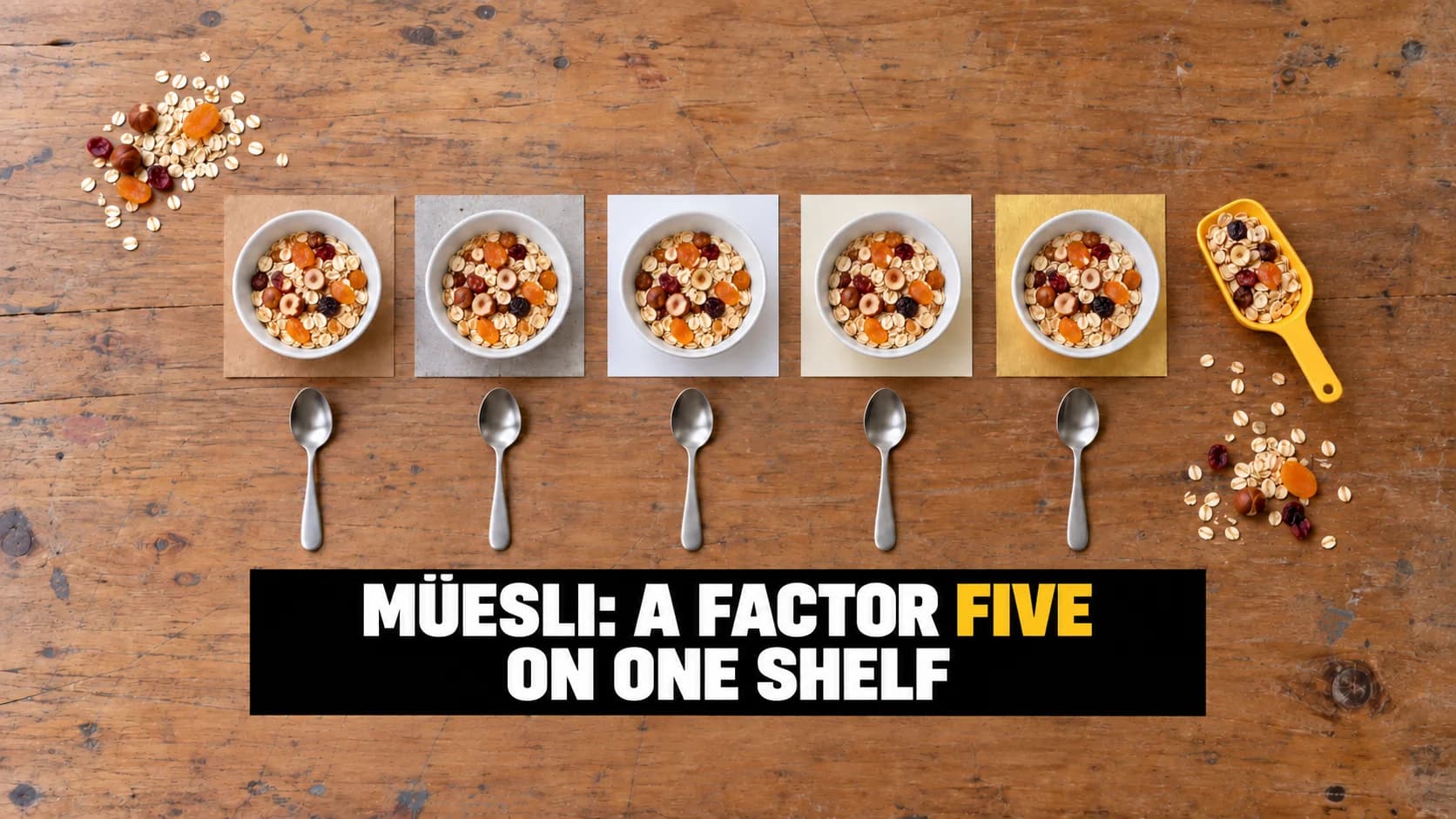
Müesli is a Swiss invention. Dr. Maximilian Bircher-Benner developed the original Bircher müesli around 1900 at his Lebendige Kraft sanatorium in Zurich, a soaked-oats-fruit-and-nuts therapeutic breakfast he prescribed to patients. A hundred and twenty-five years later, the country that invented the dish imports most of what fills its supermarket shelves, and the heritage Swiss brand Familia is roughly 6 to 10% cheaper at Kaufland in Germany (listing of December 2025) than at the average Swiss retailer once you do the currency conversion. The Swiss müesli market has become exactly the kind of category where price discipline and label literacy save you real money. Here is the honest 2026 map.
Sources checked regularly. Bio-Familia AG corporate (bio-familia.com, founded 1954 in Sachseln OW); Kaufland Germany product listing (December 2025); Lidl Schweiz product catalogue (May 2026); Saldo / Kassensturz crunchy müesli laboratory test (February 2023); K-Tipp oat flake test (issue 16/2020). Prices verified in Zurich, April to May 2026.
Rappn is an independent grocery price comparison app in Switzerland, with no commercial agreements with any retailer.
A Swiss invention, still made in Sachseln
Bircher-Benner's recipe was simple: rolled oats soaked overnight in water or apple juice, mixed with grated apple, lemon juice, hazelnuts and condensed milk. It was a therapeutic intervention, not a breakfast trend. The recipe spread through the sanatorium's patients and then, slowly, through Swiss home kitchens.
The commercial pivot came in 1959, when bio-familia AG (founded in Sachseln, canton Obwalden, in 1954 by Anny Metzner and Georg Hipp) launched the first commercial Bircher müesli with permission from Bircher-Benner's descendants. Familia is still produced in Sachseln today, with around 180 employees and an annual turnover of about CHF 60 million, exporting to more than 40 countries. The brand is BIO SUISSE certified and remains family-controlled.
Compare current offers and their supplied unit prices. Check the pack size, canton and validity dates. Preset search: «müesli».
Catch this week's müesli offers. Rappn is freeFree, no account required · iOS & Android
"müesli" · Familia · Knusperone · Crownfield · M-Classic · Naturaplan Bio
Offers
The Familia paradox: cheaper abroad than at home
Here is the cultural irony. A 500g pack of Familia Original Swiss Müesli is listed at Kaufland in Germany for €4.99 (December 2025), which is roughly CHF 4.65 at current exchange rates. The 600g Familia C.M. Plus sells at Lidl Switzerland for CHF 5.95, the 500g equivalent being about CHF 4.96. Specialist Swiss-foods retailers in Germany (Migros-Shop.de) list the 575g Bio Birchermüesli at €7.99, but the regular Familia in mainstream German supermarkets sits noticeably below average Swiss shelf prices for the same product.
This is not unique to Familia. It applies across most branded Swiss food products that export. The mechanism is the standard one: Swiss retail margins, real-estate costs and supplier-side pricing tiers all push the Swiss shelf price up. The takeaway is not that you should drive across the border for müesli, but that the "premium Swiss brand at premium Swiss prices" framing is largely a Swiss-shelf phenomenon.
The müesli comparison: brands and own-labels
| Product | Retailer | Pack size | Price | Per 100g |
|---|---|---|---|---|
| Familia Bircher Original | Coop, Migros, Volg | 600g | ~CHF 5.95 to 6.95 | ~CHF 0.99 to 1.16 |
| Familia Bio Birchermüesli | Coop, Migros | 575g | ~CHF 7.50 to 8.50 | ~CHF 1.30 to 1.48 |
| Knusperone Knusper Müesli | Aldi Suisse | 750g | ~CHF 2.99 | ~CHF 0.40 |
| Crownfield Crunchy Müesli | Lidl Schweiz | 750g | CHF 2.15 | CHF 0.29 |
| M-Classic Müesli | Migros | 500g | ~CHF 3.30 | ~CHF 0.66 |
| Coop Prix Garantie Crunchy | Coop | 500g | CHF 2.30 | CHF 0.46 |
| Naturaplan Bio Bircher | Coop | 500g | ~CHF 5.95 | ~CHF 1.19 |
| Migros Bio Müesli | Migros | 500g | ~CHF 5.50 | ~CHF 1.10 |
| Karma Bio Granola | Coop | 350g | ~CHF 6.95 | ~CHF 1.99 |
The pattern is consistent: discount private labels (Crownfield, Knusperone, Prix Garantie, M-Budget where stocked) sit at CHF 0.29 to 0.46 per 100g, mid-tier private labels (M-Classic, Coop standard) at CHF 0.50 to 0.70, brands like Familia at CHF 1.00 to 1.20, and premium Bio at CHF 1.30 to 2.00. A factor-of-five spread on what is, structurally, the same category of breakfast food.
For more retailer-level context, see our Coop products and prices and Aldi Switzerland products and prices deep dives.
Cold cereals: Kellogg's vs private label
Cornflakes, Frosties, Rice Krispies, Tresor Choco Nut. The branded Kellogg's range is the same product worldwide and Swiss shelf prices reflect import-tier pricing. Kellogg's Cornflakes at Coop typically sits around CHF 4.95 for 500g, the same product at Aldi or Lidl runs around CHF 3.49 to 3.99. Private-label equivalents are dramatically cheaper: Migros M-Classic Cornflakes around CHF 2.20 for 500g, Coop Prix Garantie around CHF 1.95, Aldi's own around CHF 1.49.
For most cornflake-equivalent products, blind-test panels struggle to distinguish branded from private label. The structural premium for the Kellogg's name is roughly 100 to 150% over the cheapest store equivalent.
The sugar reality
The Saldo crunchy-müesli laboratory test (with Kassensturz, SRF) sampled 14 berry crunchy müesli and found sugar content ranging from 12 to 25 grams per 100 grams. The Swiss-Italian nutrition researcher Christine Brombach at ZHAW noted that anything above 20 grams per 100g is "clearly too high" once you factor in milk and any sweetened yoghurt added on top. The WHO recommends a maximum of 40 grams of total daily sugar for adults. A 70g bowl of a 25%-sugar crunchy müesli, with a sweetened fruit yoghurt, runs through more than half your daily sugar allowance before lunch.
The clean reads from the test: Coop Prix Garantie Crunchy Müesli Wild Berries placed in the top three on freshness, contamination and price (CHF 2.30 for 500g). At the bottom: a Globus-stocked Jordans product with traces of six different pesticides, and an Aldi Gourmet Premium with the highest aggregate pesticide reading in the sample. Aldi told Saldo it would investigate with the supplier. The pattern is not that private label is automatically cleaner than branded, or vice versa: the variability is product-by-product. Read labels.
Bio müesli: Naturaplan, Migros Bio, Aldi Nature
If you want certified organic müesli, three lines dominate the shelves:
Coop Naturaplan is the oldest and broadest. The line launched in 1993, three years before the EU's organic regulation existed, and Naturaplan Bio Bircher sells at around CHF 5.95 for 500g. The depth of the Naturaplan range is the differentiator: dozens of müesli, granola and oat variants.
Migros Bio runs a comparable range at slightly lower per-100g prices, around CHF 5.50 for 500g on the standard Bircher. Migros's Bio oats specifically were rated top of category by K-Tipp in 2020 (joint top with Spar Natural, Alnatura and Steinermühle).
Aldi's Bio line "Retour aux sources" (launched in Switzerland in 2022) is the discount entry. In saldo's organic basket of 40 products (published 18 March 2026), Aldi came to CHF 123.48 against CHF 152.38 at Coop, about 19% less, with a narrower range and less consistent in-store availability.
The decision criterion is simple: if you buy Bio across most categories, the Naturaplan/Migros Bio premium is usually worth it for the range. If you only buy a few Bio basics, Aldi delivers the same certified-organic status at a much lower price. See our organic food price comparison for the full category map.
Children's cereals: the cost-per-serving trap
Branded children's cereals (Kellogg's Frosties, Choco Pops, Nesquik, Smacks) are priced not by weight but by parent willingness to pay. A 375g box of Choco Pops at Coop sits around CHF 5.50, which is CHF 1.47 per 100g, more than triple what a 750g Crownfield crunchy müesli costs per 100g. Children get used to crunchy private-label rapidly if you transition gradually, and the per-bowl savings compound across a school year.
The sugar number is the bigger argument. Most branded children's cereals run 25 to 35g sugar per 100g, against 8 to 15g for a standard crunchy private label.
Build-your-own müesli: the optimisation
The cheapest and cleanest müesli in Switzerland is the one you assemble yourself. Plain rolled oats at Coop Prix Garantie or M-Budget sit around CHF 0.20 per 100g. Add raisins, almonds, sunflower seeds, dried apples and a small amount of honey, and the per-100g cost lands in the CHF 0.40 to 0.60 range, comparable to discount private-label crunchy but with zero added sugar (you control the honey).
For oats specifically, the cheapest national private labels (M-Budget, Prix Garantie, Knusperone, Crownfield) are essentially identical and consistently top-rated in K-Tipp tests. The brand premium on oats is genuinely arbitrary.
For a wider basket-cost view, see our family of four grocery budget Switzerland framework, where breakfast cereals are a meaningful weekly line item. For the protein-side angle on oats, see high-protein grocery shopping. For dairy pairings see milk and cheese prices.
Updated: .
Why Rappn?
Rappn is an independent grocery price comparison app in Switzerland, with no commercial agreements with any retailer. Our comparisons are truly independent.
- 100% free: no subscription, no hidden costs
- Neutral: no commercial agreements with Migros, Coop, Aldi, Lidl, Denner, Aligro, or Otto’s
- Updated daily, as soon as the chains publish their deals
- The chains’ deals in one place: search, filter, compare, no account needed
Ready to save on groceries?
Install Rappn and compare for yourself this week. No account required.Scan the code, install Rappn and compare current offers. No account needed.
Built in Switzerland, for Switzerland

Frequently Asked Questions
Was müesli invented in Switzerland?
Yes. Dr. Maximilian Bircher-Benner developed the original Bircher müesli around 1900 at his Lebendige Kraft sanatorium in Zurich. The recipe (soaked oats, grated apple, hazelnuts, lemon juice, condensed milk) was designed as a therapeutic breakfast for his patients. The dish was named after him and remains the foundation of every 'Bircher' or 'Birchermüesli' sold today.
Is Familia still produced in Switzerland?
Yes. bio-familia AG was founded in Sachseln, canton Obwalden, in 1954, and all Familia müesli is still manufactured there in 2026. The company has approximately 180 employees and exports to more than 40 countries. Familia products are BIO SUISSE certified.
Is Bircher müesli cheaper at Migros or Coop?
The price difference between Migros and Coop on a 600g Familia Bircher is small (typically less than 50 centimes). Where it matters is the private-label tier: in the table above, mid-tier own brands such as M-Classic and Coop's standard line sit at about CHF 0.50 to 0.70 per 100 g against CHF 1.00 to 1.20 for Familia, and Prix Garantie Crunchy Müesli at CHF 0.46 per 100 g.
Are Aldi and Lidl cereals the same as branded products?
Often produced in the same European plants as the branded equivalents, but with different specifications. K-Tipp and Saldo blind tests repeatedly show Knusperone (Aldi) and Crownfield (Lidl) müesli scoring at or above mid-tier branded products on freshness, ingredients and overall quality. The exception is high-sugar children's cereals, where private labels typically run a few percentage points lower in sugar than the branded equivalents.
What's the cheapest sugar-free müesli in Switzerland?
Build your own. Plain rolled oats (Coop Prix Garantie, M-Budget, Knusperone, Crownfield) at around CHF 0.20 per 100g, plus your choice of dried fruit and nuts, gives you a sugar-controlled breakfast at a fraction of the cost of any pre-mixed crunchy. For a pre-mixed option, the no-added-sugar Familia variant sits at the high end on price but is among the most reliable on ingredient quality.