
Which apps and options can you actually use to rescue food in Switzerland?
Switzerland offers five ways to rescue food: surplus apps with surprise bags, day-old shops like Äss-Bar, free community fridges (Madame Frigo counts over 190), in-store markdown stickers, and charities such as Schweizer Tafel, which are not open to private households. The app lane is the smallest of the five: a single provider dominates and genuine consumer alternatives are rare. The results improve when you combine the in-store markdown (Migros 25 then up to 50%, Coop 20 then 40%, Denner a flat 30% since 22 June 2026) with one free channel rather than relying on a single source.
Rappn compares the current promotions of 7 Swiss retailers, updated daily: free, no subscription.
Save the offers you want in Rappn, free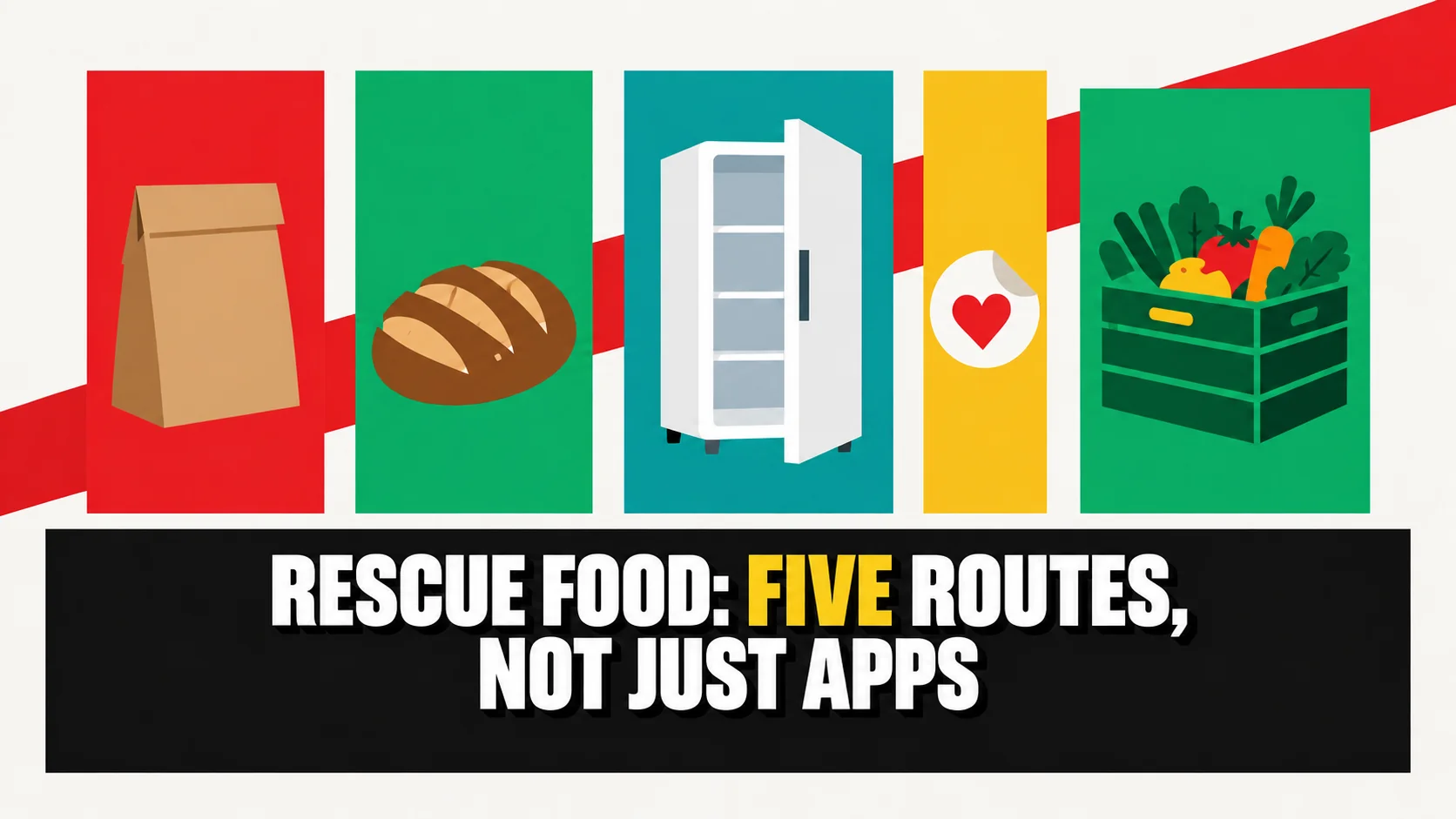
Rescuing food in Switzerland runs through five distinct channels, and only one of them is an app in the strict sense. There are surplus marketplaces (Too Good To Go), day-old shops (Äss-Bar), free community fridges (Madame Frigo, RestEssBar, foodsharing Fair-Teiler), in-store markdown stickers, and charities such as Schweizer Tafel, which explicitly do not serve the general public.
The app lane is smaller than it looks. If you expect a dozen Too Good To Go alternatives, you will be disappointed: most of Switzerland's rescue infrastructure is analogue, volunteer-run, or lives on the price label inside the store. This page maps the options, gives a checkable order of magnitude for each, and says who each one actually suits.
Sources checked regularly. Operator figures from the providers themselves: madamefrigo.ch (fridges, volunteers, tonnes rescued), restessbar.ch (umbrella association, location list), aess-bar.ch (store list, history, FAQ), schweizertafel.ch (institutions, daily volume), wiki.foodsharing.network (how it is organised in Switzerland). Markdown bands per SRF Kassensturz Espresso, 6 July 2026; the Denner start date per 20 Minuten, 6 July 2026. Bakery participation in Too Good To Go per the Swiss Association of Master Bakers-Confectioners (panissimo, 2 December 2020). The closure of Äss-Bar St. Gallen per St. Galler Tagblatt, 20 November 2020. Swiss food-waste totals per the Federal Office for the Environment (BAFU). Too Good To Go's Swiss headline figures from its own press release of 28 August 2025, as in our Too Good To Go guide. As of July 2026.
Rappn is an independent grocery price comparison app in Switzerland, with no commercial agreements with any retailer.
What food-rescue options actually exist in Switzerland?
Five channels, each with a different logic:
- Surplus marketplace: you pay little for a bag whose contents you cannot see. Too Good To Go is effectively alone here.
- Day-old shop: a real shop sells yesterday's baked goods, visible on the shelf. In Switzerland that is Äss-Bar.
- Community fridge: free, but you take what is there. Madame Frigo, RestEssBar, and the Fair-Teiler run by foodsharing groups.
- In-store markdown: no app, no sign-up, and you pick freely from the reduced shelf.
- Charity: Schweizer Tafel states it collects around 35 tonnes a day and passes it to more than 500 social institutions reaching over 300'000 people affected by poverty. This is poverty relief, not a savings tactic for private households, and the food is not publicly collectable.
This is Rappn's saved-offers view: keep the deals you actually want in one list, so a rescue bag or a markdown shelf stays a bonus instead of deciding your dinner. Tap around to try it.
Save the offers you want in Rappn, freeFree, no subscription · iOS & Android
Saved offers
What does each option cost, and who picks the contents?
| Option | What you get | Price | Coverage (as of July 2026) | Do you choose? |
|---|---|---|---|---|
| Too Good To Go | Surprise bag of the day's surplus | CHF 3.99 to 11.99, roughly a third of the original price | around 7,500 partner businesses, August 2025 figures | No |
| Äss-Bar | Yesterday's bread and pastries, visible on the shelf | "heavily reduced", priced per branch | 8 fixed branches plus a foodtruck and a pop-up (BS, BE, VD, LU, ZH) | Yes |
| Madame Frigo | Whatever is in the public fridge right now | free | over 190 fridges nationwide | Yes, but only from what is there |
| RestEssBar / foodsharing Fair-Teiler | Rescued food on a shelf or in a fridge | free | 21 RestEssBar locations; foodsharing groups incl. Basel, Bern, Zurich, Zug | Yes, but only from what is there |
| In-store markdown | Regular stock close to its date | Migros 25 then up to 50%, Coop 20 then 40%, Denner flat 30% | nationwide, but each branch decides itself | Yes |
| Schweizer Tafel | Distribution to social institutions | free to the institution | more than 500 institutions | Not open to the general public |
When is a surprise bag worth it, and when is it not?
Too Good To Go is the default because it has reach: over 14 million Surprise Bags saved in Switzerland since 2018, more than 2.6 million registered users, and around 7,500 partner businesses (press release of 28 August 2025). On the merchant side, the business pays Too Good To Go a commission per bag; the platform does not publish a Swiss rate, so we quote none. The bag sells for about a third of the original price, and what you pay is the price shown in the app. Around a third of Swiss bakeries-confectioners cooperated with the platform in December 2020, per the Swiss Association of Master Bakers-Confectioners. No newer association figures are public, and the terms may have changed since.
The math works if you live in a city, eat flexibly, and would have bought the contents anyway. It stops working when your nearest listing is a drive away, or when you end up eating pastries you would never have put on a list. The full breakdown by bag type is in the Too Good To Go guide.
How do Madame Frigo, RestEssBar and foodsharing work?
Madame Frigo runs public fridges looked after by volunteers: over 190 fridges, around 700 volunteers, and around 900 tonnes of food saved per year by its own account. On 26 July 2026 the locations map on madamefrigo.ch showed 191 entries, from Zurich and Bern through Aargau and Lucerne to Fribourg, Jura and Ticino.
RestEssBar Schweiz is the national umbrella association for locally and independently run sites; its location list currently names 21 places, including Baden, Burgdorf, Grenchen, Kreuzlingen, Olten, Schaffhausen, Solothurn, St. Gallen, Sursee, Willisau, Winterthur and Zofingen. Its manifesto sets the rule plainly: free for all, accessible to all.
foodsharing works differently here than in Germany. Per the project wiki there is no registered national association in Switzerland, only local groups on the shared platform, active in Basel, Bern, Zurich and Zug among others. Practical note: foodsharing.ch no longer resolves, and foodsharingschweiz.ch redirects to foodsharing.network, which is where you register for food baskets and find Fair-Teiler.
All three share one trait: free, but unplannable. They supplement the weekly shop, they do not replace it. That is exactly where Rappn sits: it shows you in advance which items on the rest of your list are on promotion at the seven chains this week, so the rescue round stays a bonus rather than a substitute for planning.
Is Äss-Bar better than a Surprise Bag?
Äss-Bar sells yesterday's baked goods from an ordinary shop. It started in Zurich in 2013 (first test sale on 21 October 2013), employs around 100 people today, and says it has rescued "several hundred tonnes". Its own store list showed eight fixed branches on 26 July 2026 (Basel, Bern, Biel, Lausanne, Lucerne, Winterthur, Zurich Niederdorf, Zurich Stadelhofen) plus a foodtruck and a pop-up in Zurich. St. Gallen is missing from that list: the branch on Spisergasse closed on 28 November 2020, per St. Galler Tagblatt, because the commercial risk had become too great during the second Covid wave. So if you are reading an older city round-up, check it against the store list.
The decisive difference from a Surprise Bag: you see what you buy. Per the FAQ, goods are collected from partner bakeries every morning, the first tour starting around 06:00, in most cases across three tours a day, so the first baked goods are on the shelf when the shop opens. Äss-Bar gives no percentage of its own, describing prices only as heavily reduced and setting them per branch.
Is the in-store markdown better than an app?
For volume and choice, often yes, and 2026 changed more here than in the app lane. Per SRF Kassensturz Espresso on 6 July 2026: Migros still reduces by 25 per cent and then up to 50 per cent, Coop has given "20 and then 40 per cent" since January instead of up to 50, and Denner dropped its tiers altogether. Denner now applies a flat 30 per cent from two days before the date until closing on the last day of shelf life; 20 Minuten gives 22 June 2026 as the start date. The logic is to discount earlier but less deeply. One caveat for expectations: per SRF, each branch decides itself when and what gets reduced. The markdown tiers chain by chain, each with its date and source, are under yellow-sticker markdowns.
Why is the list of apps so short?
Because consumer apps are hard to sustain in this field. One Swiss challenger, GoNiña, launched in February 2024 as a surplus platform for smaller businesses with a 25 per cent commission or a maximum of CHF 2.50 per order, per watson.ch. On 26 July 2026 gonina.com presents the company as a B2B product instead: AI demand forecasting for gastronomy, bakeries and retail, citing figures such as 52 per cent less surplus across more than 50 locations. It is a useful reminder that Switzerland's rescue infrastructure is mostly shops, fridges and volunteers rather than app icons. For scale: the Federal Office for the Environment puts Swiss food losses at around 2.8 million tonnes a year across the whole value chain, about 310 kilograms of avoidable losses per person per year, and the Federal Council adopted an action plan on 6 April 2022 aiming to halve avoidable losses by 2030 against 2017.
Which option suits whom?
It depends, and on three things: where you live, how flexible you are, and how much you buy anyway. In a city with a fridge within walking distance and a well-rated bakery nearby, one free channel plus one Surprise Bag a week is a strong combination. If you live rurally or get home after 19:00, almost everything comes from the in-store markdown, because it works during any opening hours and forces no detour. And if you are short on time, the biggest win is making the ordinary weekly shop cheaper first rather than chasing leftovers. Set a price alert in Rappn on the ten products you genuinely buy every week; whatever you rescue after that is real extra, not a replacement.
Updated: .
Why Rappn?
Rappn is an independent grocery price comparison app in Switzerland, with no commercial agreements with any retailer. Our comparisons are truly independent.
- 100% free: no subscription, no hidden costs
- Neutral: no commercial agreements with Migros, Coop, Aldi, Lidl, Denner, Aligro, or Otto’s
- Updated daily, as soon as the chains publish their deals
- The chains’ deals in one place: search, filter, compare, no subscription
- Meal planner in the Kitchen tab: plan the week, send the ingredients to your list

Ready to save on groceries?
Install Rappn and compare for yourself this week. No account required.Scan the code, install Rappn and compare current offers. No account needed.



Frequently Asked Questions
What is the best alternative to surprise-bag apps in Switzerland?
There is currently no equivalent consumer app. The realistic alternatives are not apps at all: Äss-Bar for day-old baked goods in a shop, the free channels Madame Frigo, RestEssBar and foodsharing, and the markdown sticker inside the supermarket. A 2024 Swiss challenger, GoNiña, presents itself on gonina.com in July 2026 as a B2B forecasting product for businesses.
Are there ways to get free food in Switzerland?
Yes, through community fridges and Fair-Teiler. Madame Frigo states it runs over 190 public fridges with around 700 volunteers. The umbrella association RestEssBar Schweiz lists 21 locations, and its manifesto says free for all, accessible to all. The Fair-Teiler of local foodsharing groups work the same way. You cannot reserve anything: you take what happens to be there.
How much do food-rescue apps really save you?
A surprise bag sells for roughly a third of the original price, per the Swiss Association of Master Bakers-Confectioners in December 2020. Listing prices observed in Switzerland run from CHF 3.99 to 11.99. What decides the outcome is whether you would have bought the contents anyway: a discount on food you did not plan for is not a saving. Apply that filter and the numbers get honest.
Where are the community fridges in Switzerland?
Madame Frigo's locations map showed 191 entries on 26 July 2026, spread from Zurich, Bern and Basel through Aargau and Lucerne to Fribourg, Jura and Ticino. RestEssBar sites include Baden, Burgdorf, Grenchen, Kreuzlingen, Olten, Schaffhausen, Solothurn, St. Gallen, Sursee, Willisau, Winterthur and Zofingen. Per the project wiki, foodsharing groups are active in Basel, Bern, Zurich and Zug among others.
Is Äss-Bar cheaper than a Surprise Bag?
It is different rather than automatically cheaper. Äss-Bar gives no percentage of its own, describing prices as heavily reduced and setting them per branch. The advantage is choice: you see the pastries on the shelf instead of paying for a bag with unknown contents. Its store list showed eight fixed branches plus a foodtruck and a pop-up on 26 July 2026.
Is the in-store markdown worth more than an app?
For choice and availability usually yes, because it works in every branch during any opening hours. Per SRF Kassensturz Espresso on 6 July 2026, Migros reduces by 25 and then up to 50 per cent, Coop has given 20 and then 40 per cent since January, and Denner now applies a flat 30 per cent from two days before the date until closing on the last day of shelf life, with 20 Minuten giving 22 June 2026 as the start date. Each branch decides itself when and what gets reduced.