
Grocery Prices in Ticino 2026: More Expensive or Cheaper Than the Rest of Switzerland?
The honest answer: there is no official cantonal grocery price index, so no credible figure for how much more or less expensive Ticino is. Because Migros and Coop largely apply national pricing, a basket in Ticino is broadly comparable to the rest of Switzerland. What is distinctive about Ticino is not the price level but its closeness to Italy: cross-border shopping weighs noticeably. Content verified: July 2026.
Rappn compares the current promotions of 7 Swiss retailers, updated daily: free, no subscription.
Compare prices in Rappn, free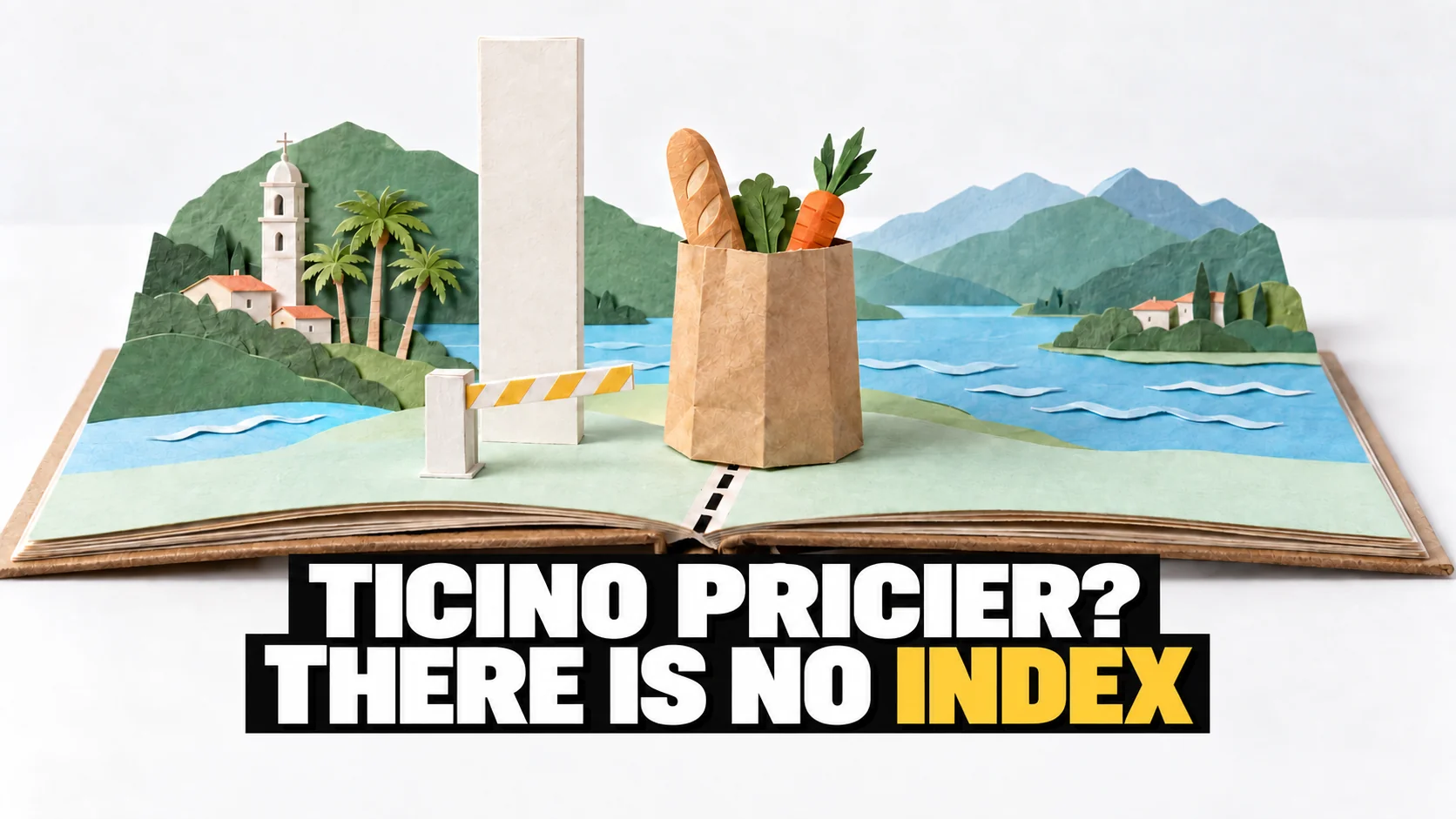
Content verified: July 2026. Prices change weekly, see the current promotions live in Rappn.
"Is it more expensive in Ticino?" cannot be answered with a hard number, and that is the honest information. The Federal Statistical Office keeps no cantonal grocery price index (regional indices exist only for Basel-Stadt, Geneva and the city of Zurich). Any specific "Ticino is X% more expensive" figure would therefore be invented.
Why prices are broadly comparable
Migros and Coop largely apply the same national shelf prices (Migros is increasingly centralising purchasing). A standard basket at Migros, Coop, Aldi, Lidl or Denner therefore costs roughly the same in Ticino as in the rest of Switzerland, not systematically more. Exact price parity cannot be claimed with a sourced number, though.
What is distinctive about Ticino: the Italian border
What stands out is not the price level but cross-border shopping. According to the retail association, Ticino residents increasingly spend across the border, over five years the amount rose from around CHF 500 million to around CHF 700 million per year. Conversely, in nearby Como Swiss shoppers were about 61% of extra-EU tax-free customers in 2025: a share of customers, not of turnover. A neutral SRF/Kassensturz survey, however, found only a modest gap of around 5% on groceries, up to about 20% cheaper in Italy for fresh meat and fish (Kassensturz, 8 November 2013, order of magnitude).
The bigger picture
Swiss groceries sit on average around 60% above the EU average, that is a national figure, not a Ticino peculiarity. Anyone crossing the border should know the customs rules: since 1 January 2025 the duty-free value limit is CHF 150 per person per day, plus quantity limits per product.
In Ticino or elsewhere, the biggest difference comes from the chain and the week. Rappn compares the promotions of Migros, Coop, Aldi, Lidl, Denner and two more chains live and neutrally, so you can see what in your Ticino basket is on promotion this week, and where.
In Ticino the biggest difference comes from the chain and the week. Rappn's home screen shows the live offers of the seven chains, so you see where your products are on offer this week. Tap around to try it.
Compare prices in Rappn, freeFree, no subscription · iOS & Android
Welcome
Updated: .
Current deals for the canton of Ticino: a selection
A selection from the chains’ currently published offers, sorted by discount depth. The region and the start of the promotion week are given in the line below.
Prices for the canton of Ticino, promotion week since 8 Oct 2026.

- XXL burger processed cheese slicesCoop−51%CHF 1.60instead of CHF 3.25· until 14 Oct
- LIVARNO LED Halloween string lightLidl Switzerland−50%CHF 2.49instead of CHF 4.99· until 14 Oct
- Mirácoli Spaghetti NapoliDenner−50%CHF 9.90instead of CHF 19.80· until 14 Oct
- L'Oréal Elseve Color Vive Shampoo 1lDenner−49%CHF 9.90instead of CHF 19.60· until 14 Oct
- Black Angus beef rumpDenner−49%CHF 2.99instead of CHF 5.90· until 14 Oct
- Whiskas 1+ Classic selection in jelly 60x85gDenner−45%CHF 21.95instead of CHF 39.75· until 14 Oct
- Barilla Spaghetti n.5 5x500gDenner−44%CHF 6.95instead of CHF 12.50· until 14 Oct
- WC Frisch Activ Blue Toilet Rim Block 4x50gDenner−43%CHF 7.95instead of CHF 13.90· until 14 Oct
Why Rappn?
Rappn is an independent grocery price comparison app in Switzerland, with no commercial agreements with any retailer. Our comparisons are truly independent.
- 100% free: no subscription, no hidden costs
- Neutral: no commercial agreements with Migros, Coop, Aldi, Lidl, Denner, Aligro, or Otto’s
- Updated daily, as soon as the chains publish their deals
- The chains’ deals in one place: search, filter, compare, no subscription
- Meal planner in the Kitchen tab: plan the week, send the ingredients to your list

Ready to save on groceries?
Install Rappn and compare for yourself this week. No account required.Scan the code, install Rappn and compare current offers. No account needed.




Frequently Asked Questions
Are groceries more expensive in Ticino than the rest of Switzerland?
There is no sourced figure: the Federal Statistical Office keeps no cantonal grocery price index. Because Migros and Coop largely apply national pricing, a basket in Ticino is broadly comparable to the rest of Switzerland.
Is there a price index for Ticino?
No. The Federal Statistical Office keeps regional indices only for Basel-Stadt, Geneva and the city of Zurich, no cantonal grocery price index for Ticino.
How significant is cross-border shopping in Ticino?
Noticeable: Ticino customers' spending in Italy rose over five years from around CHF 500 to around CHF 700 million per year. In nearby Como Swiss shoppers were about 61% of extra-EU tax-free customers in 2025, a share of customers and not of turnover.
How much cheaper is shopping in Italy?
A neutral SRF survey found only around 5% difference on groceries, up to about 20% for fresh meat and fish. The figures come from a Kassensturz report of 8 November 2013; since 2025 the CHF 150 duty-free limit also applies.