
Who Checks Grocery Prices in Switzerland?
Nobody sets them: retailers calculate their own prices, and only the way a price is displayed is policed. The Price Indication Ordinance (SR 942.211) requires a retail price and a unit price, the cantons enforce it and SECO holds federal oversight. The Price Supervisor is competent only where prices were not formed in free competition, which almost never applies in a supermarket.
Rappn compares the current promotions of 7 Swiss retailers, updated daily: free, no subscription.
Compare butter for freeThe current offers of the seven chains, filterable by product, category and canton, with the unit price next to the pack price.
No Swiss authority decides what a kilo of minced beef or a six pack of mineral water may cost. The retailer sets that price. What is regulated is not the amount but the way it is displayed: the Price Indication Ordinance (Preisbekanntgabeverordnung, PBV or OIP, SR 942.211) requires a legible retail price, a unit price for measurable goods, and it governs when a struck through comparison price is allowed at all. Enforcement belongs to the cantons, SECO holds federal oversight. The Price Supervisor, meanwhile, almost never reaches a supermarket shelf, because his mandate stops exactly where competition begins.
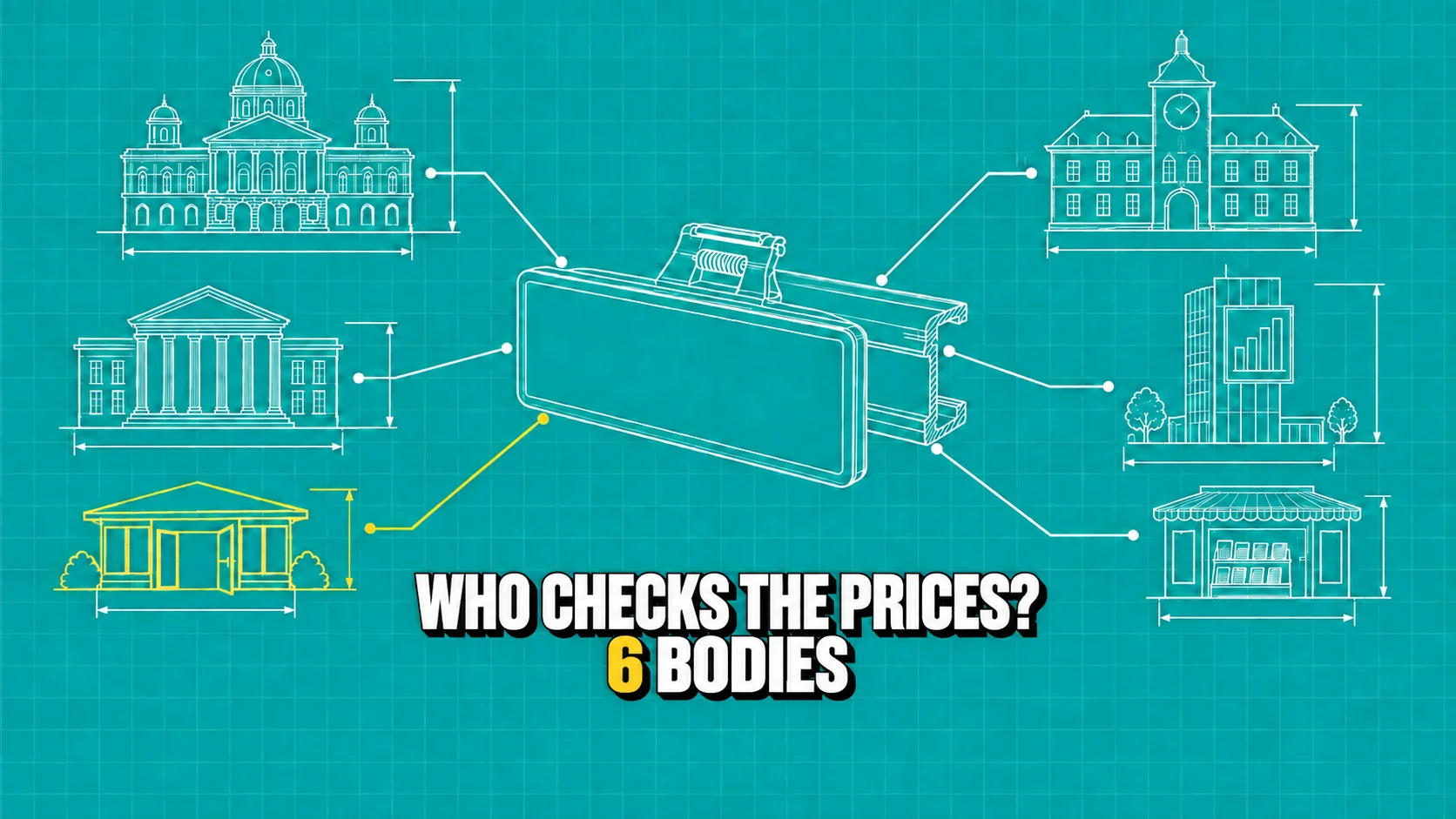
Six bodies deal with prices in Switzerland, and each one can do something different: the Price Supervisor, SECO together with the cantonal enforcement offices, the Competition Commission, the Federal Statistical Office, the consumer organisations and the Swiss Commission for Fairness. This guide sorts them by what they may legally do, and ends with where your report actually belongs when something on the shelf looks wrong.
Last updated: September 2026. Sources: preisueberwacher.admin.ch (FAQ and complaint form), seco.admin.ch (price indication and PBV FAQ), kmu.admin.ch (price labelling, latest amendment in force since 1 January 2025), EAER media release of 15 December 2025 on the PBV control campaign, weko.admin.ch, Federal Statistical Office (CPI for August 2026, published 3 September 2026), konsumentenschutz.ch, faire-werbung.ch. All pages checked in September 2026.
Rappn is a neutral grocery price comparison for Switzerland: free, no account needed, and no commercial agreements with any retailer.
Who sets grocery prices in Switzerland?
The retailers do. Migros, Coop, Aldi Suisse, Lidl Schweiz, Denner, Aligro and Otto's each calculate their own prices, and the federal government steps in only where competition does not work. That is the misunderstanding behind the question: the state polices the rules of the game, not the number on the label. There is no official desk where you can report a block of butter as too expensive and have the price lowered.
So if you want to know whether a price is reasonable, you have to compare it yourself: across the chains, and ideally per kilo or per litre rather than per pack. At Migros, Coop and Denner the Aktionen change every Thursday, and Rappn shows the current ones side by side for free. The unit price on the shelf label is the tool the law provides for exactly that, and our guide to Swiss price tags and the unit price explains how to read it.
The state only polices how a price is displayed, never the amount: here you see for free which of the seven chains have butter on offer this week, with the price per kilo next to the pack price.
Compare butter for freeFree, no subscription · iOS & Android
"butter"
Offers
The Price Supervisor: powerful, but not in the supermarket aisle
The Price Supervisor, currently Stefan Meierhans, is the best known address for price grievances and the most frequently misdirected one. His remit is narrow. On preisueberwacher.admin.ch it says he is competent to assess prices where they were not formed in free competition but were set by a market dominant company, a cartel or the state (page checked in September 2026). That covers hospital tariffs, water, waste collection and public transport. It does not cover butter on a shelf, which several chains compete for.
Where he does find abuse, he is not toothless: under Art. 10 of the Price Supervision Act he can prohibit an increase in whole or in part, or order a price reduction after a formal procedure. Filing a complaint costs nothing, and the office states that its analyses are free. The form is addressed to anyone who suspects that maintaining or raising the price of a product or service is abusive, and the report may be published in anonymised form (Art. 4 para. 3 PüG). You may always file. On a supermarket price, expect to be told it falls outside his competence.
SECO and the cantons: the rule that really applies on the shelf
The regulation that matters most for grocery shopping is the Price Indication Ordinance. SECO states that its purpose is for prices to be clear, comparable with one another and free of misleading indications, and that the ordinance (OIP, SR 942.211) rests on articles 16 to 20 and 24 to 27 of the Federal Act against Unfair Competition (UWG or LCD, SR 241). For measurable goods the unit price per kilo or litre must be shown, with exceptions such as sales by the piece or where the retail price is no more than CHF 2.00. Since 1 January 2025, a comparison price is only permitted if the item was offered at that price for at least 30 days beforehand (Art. 16 para. 1 PBV).
Enforcement is not federal: the cantons are responsible for enforcing the ordinance, and SECO says that observed violations are to be reported to the cantonal enforcement offices. SECO itself handles no individual cases and acts as the supervisory authority over cantonal enforcement. Breaches can be punished with a fine of up to CHF 20'000 (kmu.admin.ch, as of 1 January 2025).
How much checking actually happens is visible in the annual control campaign. On 15 December 2025 the EAER published the 2025 results: 3'651 businesses were checked, retail prices for goods were indicated correctly in 76 per cent of them and in 77 per cent for services, with 853 warnings, 8 fines and 7 criminal complaints. The sector under review was barbershops, hairdressers and cosmetic studios, and according to the same release the 2026 campaign covers garages. Supermarkets were the target of neither campaign. That does not mean nobody looks, but it does mean there is no systematic sweep of grocery shelf labels. How chains use the room the 30 day rule leaves them is covered in our guide to spotting fake discounts.
COMCO: cartels, market power and the Swiss surcharge
The Competition Commission describes its tasks as fighting harmful cartels, supervising abuse by market dominant companies, carrying out merger control and preventing state restrictions on competition (weko.admin.ch, September 2026). It looks at agreements and structures, never at a single price tag.
For groceries, the relevant rule is relative market power, in force since 1 January 2022. It targets cases where a Swiss buyer cannot source abroad on local terms, one of the mechanisms behind what shoppers call the Swiss surcharge. COMCO provides a notification form for this, and a separate one on the incomplete passing on of exchange rate advantages; its factsheet on relative market power was updated on 14 March 2025. Manage your expectations, though: those forms address affected companies, not customers at the till. The structural reasons behind the price level are set out in why groceries are so expensive in Switzerland.
The Federal Statistical Office measures prices, it does not intervene
The Federal Statistical Office compiles the consumer price index every month. It is a thermometer, not a tool: it records how the price level moves and changes nothing about it. For August 2026 the office reported on 3 September 2026 a rise of 0.4 per cent against the previous month, to 101.5 points (December 2025 = 100), with annual inflation at 0.8 per cent. That figure describes a statistical basket, not your trolley. What it means for food specifically is covered in grocery inflation in Switzerland 2026.
Consumer organisations and media: no fines, but real effect
The Stiftung für Konsumentenschutz (SKS) in Bern offers telephone advice Monday to Friday, 08.00 to 12.00 and 13.00 to 17.00, plus a template letter generator and online guides (konsumentenschutz.ch, September 2026). In French speaking Switzerland the FRC plays the same role, in Ticino the ACSI. Then there are the media: K-Tipp and saldo publish comparative tests, SRF runs Kassensturz and Espresso on consumer cases, and RTS runs A Bon Entendeur on product and price tests.
None of these bodies can issue a fine or force a price down. Their power is publicity, and it is real: a test that makes a gap visible often changes an assortment faster than a legal procedure does. If you approach them, a photo of the shelf label with the date, the branch and the pack size is worth more than a long letter.
The Swiss Commission for Fairness: where misleading price advertising lands
Advertising has its own private complaints body. The Swiss Commission for Fairness was founded in 1966 and is made up in equal parts of consumers, media professionals and advertisers. Its site states that any person is entitled to challenge commercial communication they consider unfair. The limit is just as clear: it issues no judgments enforceable by the state, only recommendations. In 2025 it handled 240 complaint proceedings. A flyer announcing a discount that does not exist belongs here, and in parallel with the cantonal enforcement office.
Where your report belongs, case by case
| Body | Basis | What it can do | Where to go |
|---|---|---|---|
| Price Supervisor | Price Supervision Act | prohibit an increase or order a reduction (Art. 10), outside competitive markets only | price complaint form, free |
| Cantonal enforcement office | PBV, SR 942.211 | warning, fine up to CHF 20'000, criminal complaint | wrong shelf price, missing unit price, illicit comparison price |
| SECO | PBV, federal oversight | control campaigns, interpretation, coordinating the cantons | no individual cases, guidance on the rule |
| COMCO | Cartel Act | cartels, market power, mergers | notification forms, designed for companies |
| Federal Statistical Office | federal statistics | measures the CPI monthly | not a complaints desk |
| SKS, FRC, ACSI | private | advice, tests, template letters, campaigns | the organisation's advice service |
| Swiss Commission for Fairness | industry self regulation | recommendations, no state sanctions | complaint against the advertising |
Which leaves the uncomfortable truth: on the level of a grocery price, nobody is competent on your behalf. And because Migros, Coop and Denner start their weekly Aktionen on Thursday while Aldi Suisse and Lidl Schweiz publish new offers twice a week, the price you remember is often no longer the one on the shelf. Rappn shows the current offers of the seven chains side by side, with the unit price next to the pack price, across all 26 cantons and in four languages, free and without an account. You know the rules now: the comparison takes you thirty seconds.
Updated: .
Why Rappn?
Rappn is an independent grocery price comparison app in Switzerland, with no commercial agreements with any retailer. Our comparisons are truly independent.
- 100% free: no subscription, no hidden costs
- Neutral: no commercial agreements with Migros, Coop, Aldi, Lidl, Denner, Aligro, or Otto’s
- Updated daily, as soon as the chains publish their deals
- The chains’ deals in one place: search, filter, compare, no subscription
- Meal planner in the Kitchen tab: plan the week, send the ingredients to your list

Ready to save on groceries?
Install Rappn and compare for yourself this week. No account required.Scan the code, install Rappn and compare current offers. No account needed.



Frequently Asked Questions
Who checks grocery prices in Switzerland?
Nobody checks the amount. Retailers set their own prices. What is checked is the display: the Price Indication Ordinance (SR 942.211) requires a clear retail price and, for measurable goods, a unit price. According to SECO the cantons are responsible for enforcement, while the Confederation holds only federal oversight. The Price Supervisor deals only with prices that were not formed in free competition.
Can I report an expensive supermarket price to the Price Supervisor?
You can file, but the outcome is predictable. His office states that it is competent where prices were not formed in free competition but set by a market dominant company, a cartel or the state. A supermarket price arises from competition and therefore falls outside that scope. Filing is free, the office says its analyses cost nothing, and the report may be published in anonymised form (Art. 4 para. 3 PüG).
Where do I report a wrongly displayed shelf price?
To the cantonal enforcement office. SECO states that the cantons are responsible for enforcing the Price Indication Ordinance and that observed violations are to be reported to those offices; SECO itself handles no individual cases. A photo of the label with the date, the branch and the pack size makes the report far more useful.
What is the fine for a wrongly indicated price?
Up to CHF 20'000. According to kmu.admin.ch (as of 1 January 2025), breaches of the ordinance can be punished with a fine of up to that amount. In the 2025 control campaign published on 15 December 2025, of 3'651 businesses checked the authorities mostly issued warnings: 853 warnings against 8 fines and 7 criminal complaints.
Does the federal government check supermarket promotions?
Not systematically. Since 1 January 2025, Art. 16 para. 1 of the ordinance allows a comparison price only if the item was offered at that price for at least 30 days beforehand. Checks happen case by case and through annual campaigns covering a different sector each year: in 2025, per the EAER, barbershops, hairdressers and cosmetic studios, and in 2026 garages. Supermarkets were the target of neither campaign.
What does reporting to a consumer organisation achieve?
Publicity rather than a sanction. The SKS advises consumers, provides template letters and runs campaigns; K-Tipp and saldo publish comparative tests and SRF airs Kassensturz. None of them can issue a fine. For misleading advertising there is also the Swiss Commission for Fairness, which issues recommendations with no state enforcement and handled 240 complaint proceedings in 2025.