
Unit Price Comparison in Switzerland: CHF per Litre, Kilo and 100 g
The price per litre or kilo is the unit price, and it is mandatory for measurable goods (Art. 5 para. 1 of the Price Indication Ordinance, SR 942.211, status 1 January 2025); prepacked goods need both the retail and the unit price. Article 6 para. 2 allows either per kilo or per 100 g, so two shelf labels are not automatically comparable. And in ten cases Article 5 para. 3 waives the unit price entirely, including multipacks and packs up to CHF 2.00.
Rappn compares prices across all 7 chains live: free, no account.
Compare prices per unit in Rappn, free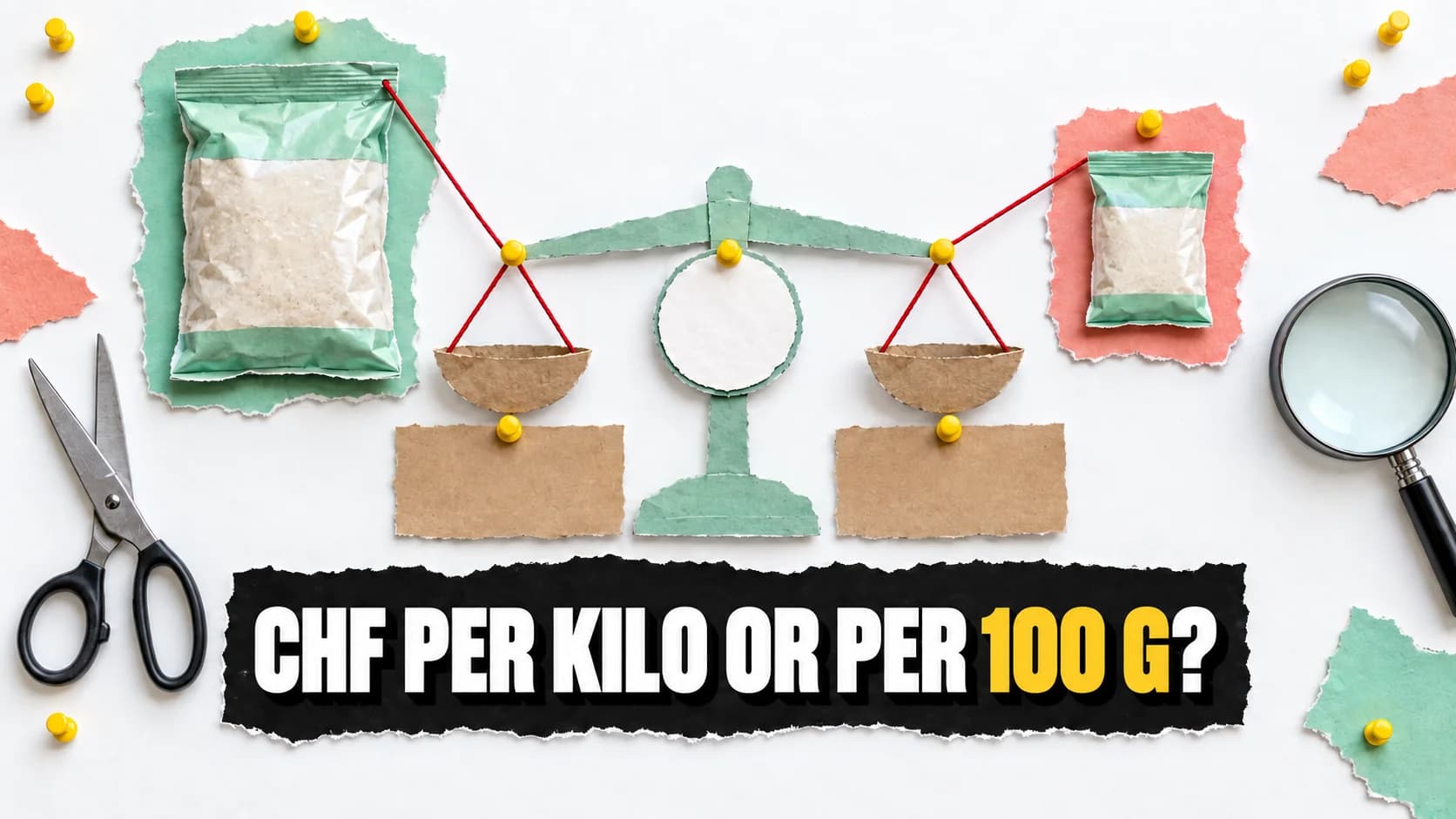
The price per litre or per kilo is called the Grundpreis in German-speaking Switzerland, prix unitaire in French and prezzo unitario in Italian, and displaying it is a legal duty rather than a courtesy. Article 5 paragraph 1 of the Price Indication Ordinance (PBV / OIP, SR 942.211, of 11 December 1978, status 1 January 2025) requires that whenever measurable goods are offered to consumers, the unit price must be indicated at all times; for prepacked goods, paragraph 2 requires both the retail price and the unit price. Article 6 paragraph 2 defines the unit price as the price per litre, kilogram, metre, square metre or cubic metre «or a decimal multiple or sub-multiple of those units», which is exactly why one shelf shows CHF per 100 g and the next shows CHF per kilo. You have to do the maths yourself precisely where the ordinance grants exemptions: combination packs, multi-part packs and gift packs, per-piece sales, and prepacks whose retail price does not exceed CHF 2.00 (Art. 5 para. 3).
Last reviewed: August 2026. Sources: Price Indication Ordinance (PBV / OIP, SR 942.211) of 11 December 1978, status 1 January 2025, official consolidated text on Fedlex, checked article by article on 3 August 2026; Article 16 in the version under No. I of the ordinance of 30 October 2024, in force since 1 January 2025 (AS 2024 621). Weekly promotions start on Thursday at Migros, Coop and Denner since 5 February 2026, per Migros Corporate and the Denner press release. Every figure on this page is labelled as a worked example and is not a market price. Note that the legally binding text exists in German, French and Italian; the English terms here are translations.
Rappn is the only neutral grocery price comparison app in Switzerland, with no commercial agreements with any retailer.
How do you work out the price per litre or per kilo?
It is one division, and you do not need your phone for it. Divide the retail price by the quantity, then convert the result into a single unit that you use for every pack on the shelf.
- Convert the quantity first. Grams to kilos and millilitres to litres, dividing by 1,000: 750 g becomes 0.75 kg.
- Divide price by quantity. CHF 6.30 for 0.75 kg is CHF 8.40 per kilo.
- Stick to one unit. Everything per kilo, or everything per 100 g. Mixing the two is the most common mistake in front of a shelf.
A pure worked example, not market prices: pack A costs CHF 4.50 for 500 g, which is CHF 9.00 per kilo. Pack B costs CHF 6.30 for 750 g, which is CHF 8.40 per kilo. Pack C is a six-pack of 150 g units at CHF 8.40, so 900 g for CHF 8.40, which is CHF 9.33 per kilo. Here the largest pack is the dearest per kilo, not because «big packs cost more» but because those three numbers were chosen that way. That is the whole point: the pack price hides it, the unit price shows it instantly.
What is the unit price and where must it appear?
The purpose of the ordinance is set out in its Article 1: to ensure that prices are clear and comparable and that misleading price information is prevented. The unit price is the instrument for that. No home-made definition is needed, because the ordinance supplies one in Article 6 paragraph 2: the unit price is the price per litre, kilogram, metre, square metre or cubic metre, «or a decimal multiple or sub-multiple thereof», on which the retail price is based.
Article 7 governs placement: retail and unit prices must appear on the goods themselves or immediately next to them; where that is impractical for technical reasons, a shelf label or a price list suffices. Article 8 adds that both prices must be easily visible, legible and given in figures, and Article 9 that the product and unit of sale must be identifiable. On paper, then, everything you need for a comparison is there: product, quantity, retail price, unit price.
What does a complete label under those three articles look like? A specimen shows it faster than a commentary. Note that the figures below are invented worked examples, not market prices. «Yoghurt, 480 g, CHF 2.40, 100 g CHF 0.50» is complete, because product, quantity, retail price and unit price are all present and the two prices agree with each other. «Jam, 340 g, CHF 4.90, 100 g CHF 1.44» likewise. A label reading only «Yoghurt CHF 2.40» satisfies neither Article 9, because the unit of sale is missing, nor Article 5, because the unit price is missing. So the quickest test at the shelf is not a legal one but an arithmetic one: multiply the displayed unit price by the quantity and you should land back on the retail price. 4.8 times CHF 0.50 is CHF 2.40, so that label is internally consistent.
Loose goods follow the same logic. Anything sold by weight is a measurable good within the meaning of Article 5 paragraph 1, and the unit price belongs on the goods or immediately beside them, in the usual «CHF 5.50 / kg» form. Sold by the piece, however, it falls under the exemption in Article 5 paragraph 3 letter a, and no price per kilo is required. That is why the cucumber next to it can do without one and the bag of carrots cannot.
When may the unit price be missing? The statutory exemptions
This is the part almost nobody knows, and it explains why the comparison sometimes fails you. Article 5 paragraph 3 lists, in ten lettered points from a to j, the cases in which the unit price is not mandatory. A shop may still show it, but nothing obliges it to.
| Exemption (Art. 5 para. 3) | What it looks like on the shelf | What you have to do |
|---|---|---|
| Let. a: sales billed per piece or by number of pieces | Cucumber, mango, a loaf sold singly | For per-piece goods the price per kilo is often not the right question |
| Let. b: sales of 1, 2 or 5 litres, kilograms, metres, square metres or cubic metres «or their decimal multiples or sub-multiples» | The standard sizes 100 g, 200 g, 500 g, 1 kg, 2 kg, 1 l, 2 l | Those sizes are easy mental maths; the odd sizes beside them are not |
| Let. c: spirits in containers of 35 and 70 cl | The classic bottle formats | Convert to litres when a 50 cl or 1 l bottle sits next to them |
| Let. d: prepacks with a net or drained weight of 25, 125, 250 and 2,500 g | Butter, jam, many tins | Do the division yourself as soon as a 300 g or 340 g jar sits alongside |
| Let. e: combination packs, multi-part packs and gift packs | Multipacks and sets | Add up the total quantity, then divide |
| Let. f: canned foods made of a mixture of solid products, provided the component weights are declared | Mixed tins | Read the declared component weights |
| Let. g: prepacks whose retail price does not exceed CHF 2.00 | A large share of the entry-level range | This is exactly where the division pays, because small packs sit side by side |
| Let. h: prepacks whose unit price exceeds CHF 150.00 per kilo or litre for foods (CHF 750.00 for other goods) | Saffron, truffle and the like | Work in price per gram |
| Let. i: catering establishments | Restaurant, take-away | The rules for services apply instead |
| Let. j: prepacked medicines in dispensing categories A and B, and category C | Pharmacy and drugstore | Irrelevant to a grocery run, but the list would be incomplete without it |
Read that list backwards: the exemptions land squarely on multipacks, sub-CHF 2.00 packs and non-standard sizes, which are precisely the cases where a pack price tells you least. Two of the ten letters, i and j, have nothing to do with grocery shopping; the other eight you meet in the supermarket regularly.
Is the bigger pack really cheaper?
Honest answer: it depends, and it depends on that specific pack on that specific day. Arithmetically an XXL pack can cost more per kilo than the mid-size one the moment the mid-size one goes on promotion, because the discount lands on the retail price and the unit price follows it. Conversely a small pack can win on a per-100 g basis when it is part of a multi-buy. And because multipacks are exempt from the unit price under Article 5 paragraph 3 letter e, in those cases the answer is often written nowhere on the shelf.
So the unit price is a method, not a rule. Which pack leads on price per kilo this week changes with every promotion cycle. That is why Rappn compares the live offers of seven Swiss chains (Migros, Coop, Aldi Suisse, Lidl, Denner, Aligro, Otto's) and puts the per-unit prices side by side, instead of selling you a rule of thumb that will be wrong next week. See it live rather than guessing it.
Why is it CHF per 100 g here and CHF per kilo there?
Because both are permitted. Article 6 paragraph 2 expressly allows the price per litre or kilogram «or a decimal multiple or sub-multiple» of those units. A shelf at CHF 1.29 per 100 g and a shelf at CHF 11.90 per kilo are both correctly labelled, and you still have not compared anything. Multiply the 100 g figure by ten: CHF 12.90 per kilo against CHF 11.90 per kilo.
The second trap is tinned food. Article 6 paragraph 3 states that where a drained weight is declared, the unit price must relate to it. With chickpeas, sweetcorn or peeled tomatoes you are therefore comparing what is left in the sieve, not the fill weight.
What does the unit price have to do with shrinkflation?
It is the only number on the label that moves when the contents shrink. If the retail price stays put and the quantity falls, the unit price necessarily rises: that is the same division as above, not a market claim. Our guide to shrinkflation in Switzerland puts the phenomenon in context.
The struck-through price beside it has a rule of its own, and it is often reported too narrowly. Article 16 paragraph 1, in the version of 30 October 2024 in force since 1 January 2025 (AS 2024 621), permits a comparison price on three grounds: self-comparison (letter a), an introductory price (letter b), or comparison with competitors (letter c). The much-quoted 30 days belong to the first ground only: in a self-comparison the goods must actually have been offered at that price either right up to the announcement (no. 1) or for at least 30 consecutive days (no. 2). Saying a promotional price always requires 30 days of run-up therefore narrows the provision.
What matters to you at the shelf: the unit price is untouched by that debate. It tells you what you pay per kilo, whatever comparison price sits next to it. Enforcement of the ordinance lies with the cantons under Article 22; SECO exercises overall supervision under Article 23.
When is checking the unit price most worthwhile?
On the day the new weekly promotions start, because that is when most prices change at once.
| Chain | Weekly promotions start | Unit-price duty under the ordinance | Comparable in Rappn |
|---|---|---|---|
| Migros | Thursday, since 5 February 2026 | yes, Art. 5 | yes |
| Coop | Thursday, since 5 February 2026 | yes, Art. 5 | yes |
| Denner | Thursday, since 5 February 2026 | yes, Art. 5 | yes |
| Aldi Suisse | Monday and Thursday | yes, Art. 5 | yes |
| Lidl Schweiz | Monday and Thursday | yes, Art. 5 | yes |
| Aligro | no confirmed weekday in our sources | yes, Art. 5 | yes |
| Otto's | no confirmed weekday in our sources | yes, Art. 5 | yes |
The duty applies to all of them equally: under Article 2 the ordinance covers goods offered to consumers, and under Article 20 the duty to indicate prices correctly falls on the manager of businesses of every kind. Only the timing of the price changes differs. Shopping on Thursday with a list rather than on impulse lets you compare more unit prices in less time. For planning the week, see our guide to saving money on groceries in Switzerland; to see how far unit prices spread on drinks, look at the mineral water deals.
So what should you actually do?
Memorise three numbers instead of a rule: the price per kilo, the price per litre, and the price per 100 g for everything in between. Once your regular products live in your head in those units, you no longer need a leaflet to tell whether an offer is an offer.
Next step: take the five products you buy every week, milk, butter, rice, laundry detergent, mineral water, and write down their unit price once. Rappn compares the live offers of seven chains with the price per unit, alerts you when prices drop, and is free. After that, the decision takes five seconds.
Sources checked: .
This is Rappn's offers view: the same product across 7 Swiss chains, so you can put the price per litre and per kilo side by side. Tap around to try it.
Offers
Free, no account required · iOS & Android
Why Rappn?
Rappn is the only neutral grocery price comparison app in Switzerland, with no commercial agreements with any retailer. Our comparisons are truly independent.
- 100% free: no subscription, no hidden costs
- Neutral: no commercial agreements with Migros, Coop, Aldi, Lidl, Denner, Aligro, or Otto’s
- Real-time data: prices updated continuously
- +10,000 offers, +3,000 supermarkets, 100% free
Ready to save on groceries?
Install Rappn and compare for yourself this week. No account required.Scan the code, install Rappn, and start tracking real grocery savings this week. No account required.
Built in Switzerland, for Switzerland

Frequently Asked Questions
How do I calculate the price per kilo?
Divide the retail price by the quantity and bring both packs to the same unit. Worked example: CHF 6.30 for 750 g is 6.30 divided by 0.75 kg, so CHF 8.40 per kilo. If the pack next to it is labelled per 100 g, multiply that figure by ten to get the price per kilo. Both labellings are lawful: Article 6 paragraph 2 of the Price Indication Ordinance allows the price per kilogram or litre «or a decimal multiple or sub-multiple» of those units.
Is the unit price legally required in Switzerland?
Yes. Article 5 paragraph 1 of the Price Indication Ordinance (PBV / OIP, SR 942.211, of 11 December 1978, status 1 January 2025) requires that where measurable goods are offered to consumers, the unit price must be indicated at all times. For prepacked goods, paragraph 2 requires both the retail price and the unit price. Enforcement lies with the cantons under Article 22; SECO exercises overall supervision under Article 23.
Why is the price per kilo missing on some packs?
Because Article 5 paragraph 3 sets out exemptions. The unit price is not required for per-piece sales; for sales of 1, 2 or 5 litres or kilograms and their decimal multiples or sub-multiples; for prepacks of 25, 125, 250 or 2,500 g; for combination, multi-part and gift packs; for prepacks whose retail price does not exceed CHF 2.00; and for foods whose unit price exceeds CHF 150.00 per kilo or litre. A shop may still display it voluntarily.
Is the bigger pack always cheaper per kilo?
No, that does not generalise. Arithmetically a large pack can cost more per kilo than a mid-size one as soon as the mid-size one goes on promotion, because the discount applies to the retail price and the unit price follows. Since multipacks are exempt from the unit price under Article 5 paragraph 3 letter e, the answer is often not shown on the shelf at all. Recalculating, or comparing the live offers per unit, is the only reliable route.
Does the unit price on tinned food refer to the drained weight?
Yes, where the drained weight is declared. Article 6 paragraph 3 states that in that case the unit price must relate to the drained weight. With chickpeas, sweetcorn or peeled tomatoes you are therefore comparing what remains after draining, not the fill weight.
How does the unit price relate to shrinkflation?
The unit price is the only number on the label that moves when the quantity falls while the retail price stays the same: the price per kilo necessarily rises. Anyone remembering only the pack price will miss the change. For promotional prices, Article 16 paragraph 1 also applies in its version in force since 1 January 2025 (AS 2024 621). It permits a comparison price on three grounds: self-comparison (let. a), an introductory price (let. b), or comparison with competitors (let. c). The 30 days apply only to self-comparison, where the goods must have been offered at that price either right up to the announcement or for at least 30 consecutive days.