
Cheapest protein sources in Switzerland: CHF per 20 g of protein
Converted into francs per 20 grams of protein, low-fat quark costs about CHF 0.47, firm tofu about CHF 0.51, canned tuna about CHF 0.71 and chicken breast CHF 1.39 to CHF 2.76, dried pulses lead at around CHF 0.31. Protein values from the Swiss Food Composition Database V 7.1 (status 1 July 2026), prices from the BFS (January 2026) and a dated shelf-price check on 3 August 2026.
Rappn compares prices across all 7 chains live: free, no account.
Compare protein prices in Rappn, free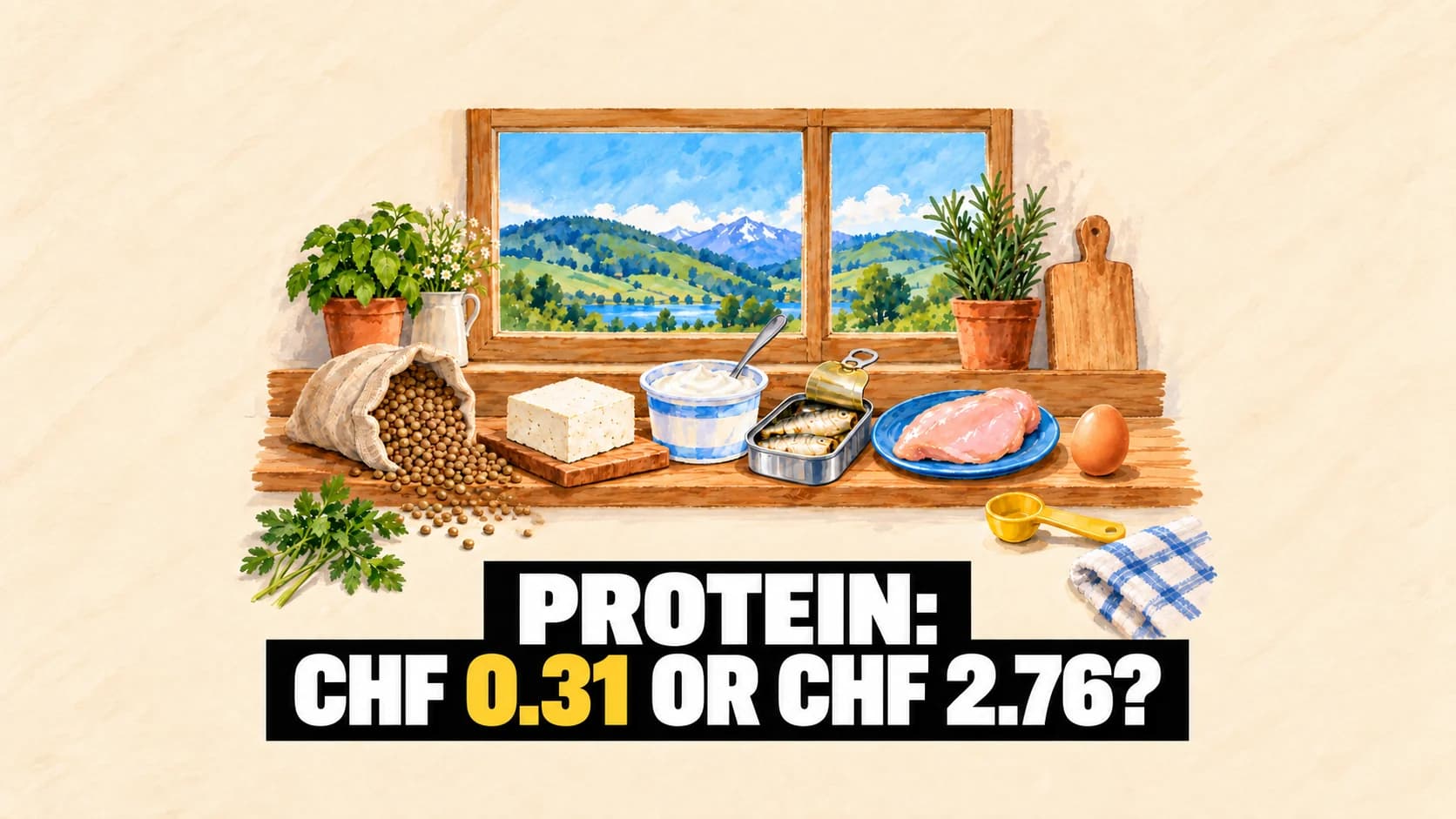
Convert Swiss groceries into francs per 20 grams of protein and the ranking stops looking anything like the shelf price. Using the protein values in the Swiss Food Composition Database (version 7.1, status 1 July 2026) and the dated prices below, low-fat quark works out at roughly CHF 0.47 per 20 g of protein, firm tofu at about CHF 0.51, canned tuna at about CHF 0.71, and chicken breast at CHF 1.39 to CHF 2.76 depending on the cut and the product line. Dried pulses beat all of them at around CHF 0.31. The expensive end is not meat, it is anything that delivers a lot of water per gram of protein.
Last reviewed: August 2026. The prices below are dated snapshots from exactly two price sources, not weekly prices and not promotions.
Sources checked regularly. Protein content: Swiss Food Composition Database, version 7.1, generic foods, status 1 July 2026, retrieved 3 August 2026 (Federal Food Safety and Veterinary Office, BLV). Average prices: Swiss Federal Statistical Office (BFS), "CPI, average prices of selected products, monthly values", period 1.1.–31.1.2026. Individual shelf prices: the Lidl Schweiz assortment webshop, retrieved 3 August 2026 (regular list prices, promotions excluded). Coop chicken-breast prices: K-Tipp 03/2024 of 13 February 2024. High-protein price premiums: SRF/"Kassensturz" of 24 May 2022 and the Swiss Consumer Protection Foundation guide "Proteine: Was steckt wirklich dahinter?", status 6 January 2026. Egg consumer prices for 2024: Agricultural Report 2025 of the Federal Office for Agriculture. Top-20 list of protein-rich foods: Swissmilk, 8 May 2026, based on the BLV nutrient database 2025.
Rappn is the only neutral grocery price comparison app in Switzerland, with no commercial agreements with any retailer.
What is the cheapest source of protein in Switzerland?
On the calculation below it is dried pulses, closely followed by low-fat quark and firm tofu. All three come in under CHF 0.55 per 20 g of protein. The method matters: the "protein per 100 g" column comes only from the Swiss Food Composition Database, and the "price basis" column names a source and a date for every row. Where we have no verified price, there is no number.
| Protein source | Protein per 100 g | Price basis (source, date) | Price per 100 g | CHF per 20 g protein |
|---|---|---|---|---|
| Lentils, whole, dried | 24.4 g | Organic dried pulses, 500 g at CHF 1.89, Lidl Schweiz, 3 August 2026 | CHF 0.38 | CHF 0.31 |
| Quark, plain, low fat | 10.6 g | Low-fat quark 500 g at CHF 1.25, Lidl Schweiz, 3 August 2026 | CHF 0.25 | CHF 0.47 |
| Tofu, firm, plain | 14.7 g | Organic tofu 2 × 200 g at CHF 1.49, Lidl Schweiz, 3 August 2026 | CHF 0.37 | CHF 0.51 |
| Tuna in oil, drained | 27.3 g | Tuna 112 g drained weight at CHF 1.09, Lidl Schweiz, 3 August 2026 | CHF 0.97 | CHF 0.71 |
| Whole milk, pasteurised | 3.2 g (density 1.03) | 1 litre at CHF 1.35, Lidl Schweiz, 3 August 2026 | CHF 0.14 per 100 ml | CHF 0.82 |
| Whole milk, pasteurised | 3.2 g (density 1.03) | 1 litre at CHF 1.80, BFS average price January 2026 | CHF 0.18 per 100 ml | CHF 1.09 |
| Canned lentils, cooked | 8.8 g | 260 g drained weight at CHF 1.29, Lidl Schweiz, 3 August 2026 | CHF 0.50 | CHF 1.13 |
| Canned chickpeas, cooked | 7.3 g | 400 g drained weight at CHF 1.69, Lidl Schweiz, 3 August 2026 | CHF 0.42 | CHF 1.16 |
| Emmentaler, full fat | 28.4 g | 100 g at CHF 1.82, BFS average price January 2026 | CHF 1.82 | CHF 1.28 |
| Tilsiter, pasteurised | 24.1 g | 100 g at CHF 1.63, BFS average price January 2026 | CHF 1.63 | CHF 1.35 |
| Chicken inner fillet | 24.6 g (breast without skin) | 350 g at CHF 5.99, Lidl Schweiz, 3 August 2026 | CHF 1.71 | CHF 1.39 |
| Chicken minute schnitzel | 24.6 g (breast without skin) | 400 g at CHF 7.99, Lidl Schweiz, 3 August 2026 | CHF 2.00 | CHF 1.62 |
| Chicken breast, Coop Prix Garantie | 24.6 g | CHF 23.30 per kilo, K-Tipp 03/2024 of 13 February 2024 | CHF 2.33 | CHF 1.89 |
| Plain yoghurt | 3.9 g | 180 g at CHF 0.81, BFS average price January 2026 | CHF 0.45 | CHF 2.31 |
| Chicken breast, Coop Qualité & Prix | 24.6 g | CHF 34.00 per kilo, K-Tipp 03/2024 of 13 February 2024 | CHF 3.40 | CHF 2.76 |
| Hen's egg, whole, raw (without shell) | 12.6 g | 6 Swiss barn eggs at CHF 2.56, BFS January 2026, i.e. CHF 0.43 per egg | — | no figure, see below |
Two things for context. First, the shelf prices come from a single publicly viewable assortment webshop because it publishes unit prices per 100 grams openly. That is one retailer's snapshot on one day, not a ranking of retailers. Second, the BFS figures are Swiss-wide averages across all outlets, which is why the milk line sits higher there than a discounter's list price. Both views are deliberately shown side by side.
How do you calculate francs per 20 grams of protein?
The formula has three steps and you can redo it in front of any label. One: work out the price per 100 grams, pack price divided by weight, times 100. Two: divide that by the grams of protein per 100 grams, which gives the price per gram of protein. Three: multiply by 20.
Worked through on quark: CHF 1.25 for 500 grams is CHF 0.25 per 100 grams. Divided by 10.6 grams of protein that is roughly 2.4 centimes per gram, so CHF 0.47 for 20 grams. On tuna: CHF 1.09 for 112 grams drained is CHF 0.97 per 100 grams; divided by 27.3 grams and multiplied by 20 gives CHF 0.71. Milk adds one detail: the database gives whole milk a density of 1.03, so a litre weighs about 1030 grams and holds just under 33 grams of protein. CHF 1.35 divided by 33, times 20, is CHF 0.82.
The dry versus cooked reference point decides everything. Dried lentils carry 24.4 grams of protein per 100 grams in the database; cooked lentils only 8.8 grams, and the difference is almost entirely water. That is why the can looks expensive even though the bag and the can end up as similar meals. If you have the twenty minutes of cooking time, buy dry; if you do not, you are paying roughly three times as much per gram of protein for the convenience.
Why do quark and pulses come out on top?
Because neither carries expensive processing steps. Low-fat quark is essentially skimmed milk with water removed: the database puts it at 10.6 grams of protein per 100 grams, while plain yoghurt sits at 3.9 grams. At a comparable price per kilo, that alone produces the gap you see in the table. Cottage cheese, at 12.4 grams, is the sensible alternative if quark is too sour for you.
With pulses it is the dry matter. Split lentils reach 27.0 grams of protein per 100 grams according to the database, dried chickpeas 18.6 grams. Keeping both in the cupboard lets you lift the protein share of a meal very cheaply without touching the meat you buy. What that does to a full weekly shop is covered in our guide to high-protein grocery shopping in Switzerland.
What does chicken cost per 20 grams of protein?
Chicken is the densest of the everyday sources: breast without skin holds 24.6 grams of protein per 100 grams according to the database, more than twice as much as low-fat quark. It still comes out expensive because the price per kilo is high. On the table above, an inner fillet lands at roughly CHF 1.39 per 20 grams of protein and a minute schnitzel at roughly CHF 1.62.
Within one retailer the spread can be large. On 13 February 2024, K-Tipp reported that a kilo of chicken breast cost CHF 34.00 in Coop's standard Qualité & Prix line and CHF 23.30 in the Prix Garantie line, by our calculation CHF 2.76 versus CHF 1.89 per 20 grams of protein. Coop told K-Tipp at the time that all of its Swiss chicken came from BTS-certified farms and that the Prix Garantie pieces simply had a different cut. Those are February 2024 figures, not today's shelf prices: they show the size of the product-line effect, not tomorrow's price.
And this is where it genuinely depends. Which of these sources is cheapest in your canton this week cannot be answered in general terms: promotions move individual items by 30 to 50 percent and regularly flip the order of this table. That is exactly what Rappn is for, the app shows over 10,000 live offers across seven retailers (Migros, Coop, Aldi Suisse, Lidl, Denner, Aligro and Otto's) with unit-price comparison, so you can see what your quark, your chicken or your lentils actually cost today.
When is it worth waiting for the weekly promotions?
Almost always, if you can freeze or store it. The weekly rhythm in Switzerland has been more uniform since 5 February 2026, and it decides when protein-heavy goods get repriced.
| Retailer | Weekly promotions start | What that means for protein |
|---|---|---|
| Migros | Thursday (since 5 February 2026) | Dairy aisle and fresh meat repriced on the same day |
| Coop | Thursday (since 5 February 2026) | Fresh meat and cheese lines turn over on the Thursday cycle |
| Denner | Thursday (since 5 February 2026) | Canned goods such as tuna and pulses run on the weekly cycle |
| Aldi Suisse | Monday and Thursday | Two entry points per week instead of one |
| Lidl Schweiz | Monday and Thursday | Two entry points per week instead of one |
Aligro and Otto's are in Rappn too; we make no claim about their promotion start day because we have no verifiable source for it. In practice: buy storable protein, cans, dried pulses, hard cheese, freezable chicken, inside the promotion window, and buy short-dated fresh goods only in the quantity you will actually finish.
Are "high protein" products worth it?
The two relevant Swiss consumer bodies are blunt about this. The Swiss Consumer Protection Foundation writes in its guide (status 6 January 2026) that high-protein products cost up to 145 percent more than the conventional version, while many contain only marginally more protein. SRF and "Kassensturz" measured premiums of 60 percent (a protein drink) up to 339 percent (a protein bar) on 24 May 2022; a high-protein mozzarella was over 200 percent above the normal variant. Michael Grund, professor at HWZ, concluded in the same programme that such differences cannot be explained by production costs.
None of that makes these products bad, they are convenient, and nobody has to eat quark. It only means the premium buys convenience, not nutrition. Once the francs-per-20-grams number is in your head, you can see that at the shelf.
What about whey powder?
We deliberately publish no figure. We found no dated Swiss shelf price for whey powder that we could document the way we documented every other line, and whey protein prices have moved sharply during 2026. For orientation: the Swiss database lists skimmed milk powder at 34.3 grams of protein per 100 grams, so powder form on its own does not make a product exceptional. If you use whey, run the same formula, price per 100 grams, divided by the declared protein content, times 20, and you will see where your tub would land in this table.
How much protein is in an egg, and why is there no figure?
The Swiss database gives 12.6 grams of protein per 100 grams of raw egg without shell, and 14.0 grams for a hard-boiled egg. The price side is well documented: for January 2026 the BFS records CHF 2.56 for six Swiss barn eggs and CHF 2.12 for six imported eggs, so roughly 43 and 35 centimes per egg. The Federal Office for Agriculture's Agricultural Report 2025 gives 2024 consumer prices of 40.23 centimes per Swiss barn egg, 62.66 centimes for free range and 86.73 centimes for organic.
What is missing is the link between the two: converting "centimes per egg" into "francs per 20 grams of protein" needs a documented average edible egg weight, and we found no dated Swiss source for it, so we do not publish the number. More on egg prices and housing systems is in our guide to egg prices in Switzerland.
How much protein do you actually need per day?
That is not a Rappn recommendation but a question for the specialist bodies. The Swiss Consumer Protection Foundation cites 0.8 grams per kilo of body weight for adults under 65, at least 1 gram from 65, 1.1 grams in pregnancy, 1.3 grams while breastfeeding and around 1.5 grams for athletes. In 2022 SRF pointed to a 2021 BLV study showing that actual intake in Switzerland already sits above that: 1.10 grams per kilo for women and 1.23 grams for men.
For shopping, that means one thing above all: the interesting question is rarely "how do I get more protein" but "how do I pay less for the protein I already eat". That is precisely what this table makes visible. Where meat is cheapest in general is covered in our guide to the cheapest meat in Switzerland.
Next step: set a price watch in Rappn on the three items that land in your basket most often, say low-fat quark, chicken breast and canned tuna. The app compares unit prices across seven retailers, alerts you when a price drops, and shows you by canton what is actually running this week. Rappn is free, available in German, French, Italian and English, and is not paid by any retailer.
Sources checked: .
These are live offers in Rappn: search a protein staple like quark, tuna or chicken and see which of the 7 chains has it cheapest this week, then do the francs-per-20-grams maths on the real price. Type a product to try it.
Offers
Free, no account required · iOS & Android
Why Rappn?
Rappn is the only neutral grocery price comparison app in Switzerland, with no commercial agreements with any retailer. Our comparisons are truly independent.
- 100% free: no subscription, no hidden costs
- Neutral: no commercial agreements with Migros, Coop, Aldi, Lidl, Denner, Aligro, or Otto’s
- Real-time data: prices updated continuously
- +10,000 offers, +3,000 supermarkets, 100% free
Ready to save on groceries?
Install Rappn and compare for yourself this week. No account required.Scan the code, install Rappn, and start tracking real grocery savings this week. No account required.
Built in Switzerland, for Switzerland

Frequently Asked Questions
What is the cheapest source of protein in Switzerland?
On a francs-per-20-grams-of-protein basis, dried pulses come first at around CHF 0.31, followed by low-fat quark at around CHF 0.47 and firm tofu at around CHF 0.51. The basis is the protein content in the Swiss Food Composition Database version 7.1 (status 1 July 2026), shelf prices retrieved on 3 August 2026 and BFS average prices from January 2026. Promotions can change the order in any given week.
How do I calculate francs per 20 grams of protein?
Three steps: pack price divided by weight, times 100, gives the price per 100 grams. Divide that by the grams of protein per 100 grams. Multiply the result by 20. Worked example with quark: CHF 1.25 for 500 grams is CHF 0.25 per 100 grams; divided by 10.6 grams of protein and multiplied by 20 that is CHF 0.47.
Is low-fat quark cheaper than whey powder?
For quark we can document it: roughly CHF 0.47 per 20 grams of protein, calculated from a shelf price retrieved on 3 August 2026 and 10.6 grams of protein per 100 grams per the Swiss Food Composition Database. For whey powder we deliberately publish no figure, because we could not verify a dated Swiss shelf price. Run the same formula on your own tub: price per 100 grams, divided by the declared protein content, times 20.
How much protein is in an egg?
The Swiss Food Composition Database gives 12.6 grams of protein per 100 grams of raw egg without shell, and 14.0 grams for a hard-boiled egg. How much protein a single egg holds depends on its weight, and we publish no figure for that because we found no dated Swiss source for an average edible egg weight. The price is documented: per the BFS, six Swiss barn eggs cost CHF 2.56 in January 2026.
Are high-protein products worth it in Switzerland?
The Swiss Consumer Protection Foundation writes in its guide (status 6 January 2026) that high-protein products cost up to 145 percent more than the conventional version even though many contain only marginally more protein. SRF and "Kassensturz" measured premiums of 60 to 339 percent on 24 May 2022. The premium mostly buys convenience.
Are dried lentils really cheaper than canned lentils?
Per gram of protein, yes. The Swiss Food Composition Database lists whole dried lentils at 24.4 grams of protein per 100 grams and cooked lentils at 8.8 grams, the difference is almost entirely water. In our calculation dried pulses land at around CHF 0.31 per 20 grams of protein and canned lentils at around CHF 1.13, close to three times as much.