
Best Before vs Use By in Switzerland: What Do the Two Dates Actually Mean?
A best-before date is a quality statement, a use-by date is a safety limit. Per the BLV, food may still be sold after the best-before date provided quality and safety are guaranteed and consumers are not deceived; after the use-by date the product may be neither sold nor processed. The legal basis is Art. 13 para. 1 LIV (SR 817.022.16), with the use-by date in Art. 13 para. 2.
Rappn compares the current promotions of 7 Swiss retailers, updated daily: free, no subscription.
Watch the price on what you actually eat. Rappn is free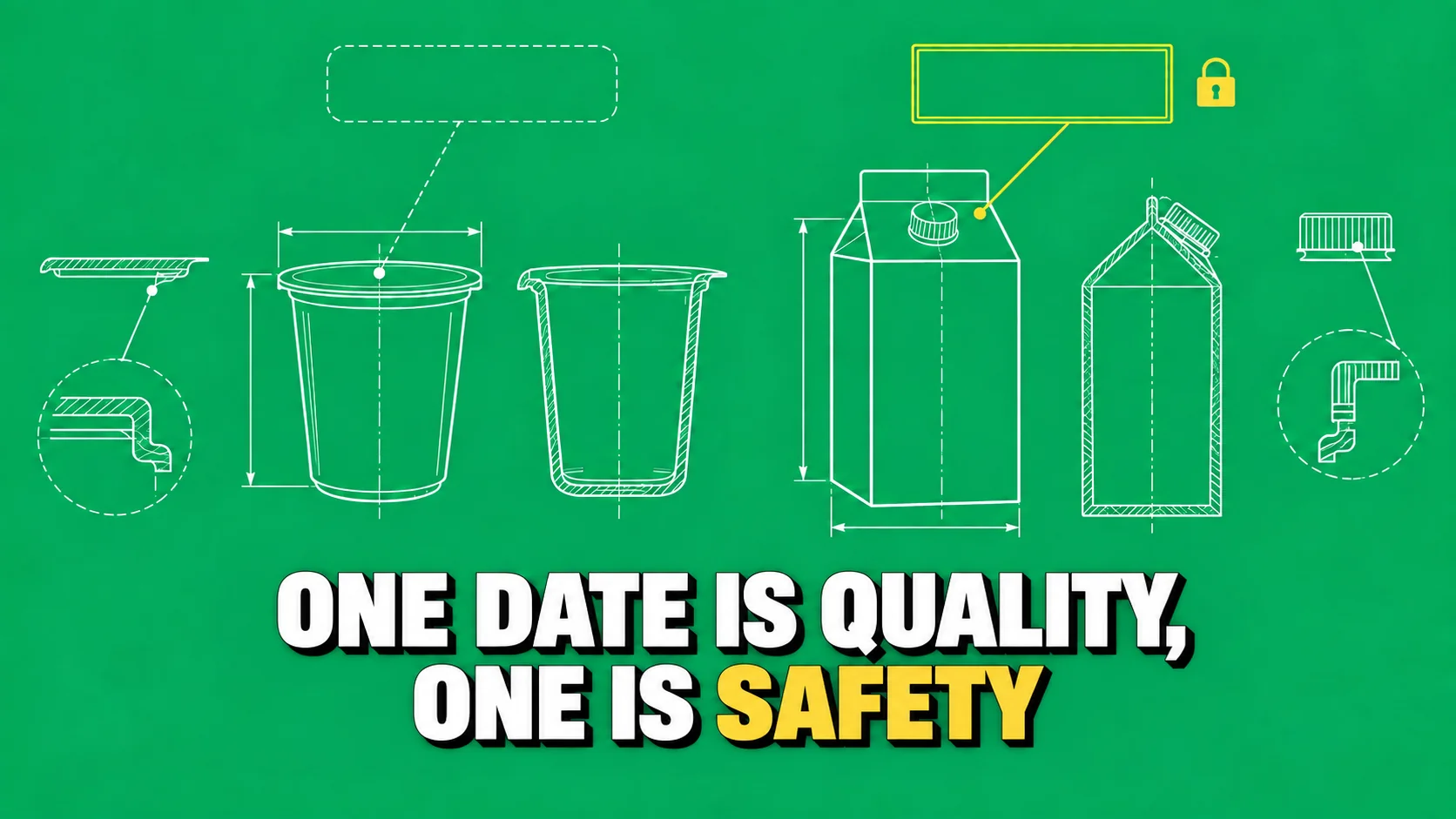
Swiss food packs carry two different dates, and only one of them is a safety limit. The best-before date is printed as «mindestens haltbar bis …» in German, «à consommer de préférence avant le …» in French and «da consumarsi preferibilmente entro il …» in Italian when the day is given, and as «mindestens haltbar bis Ende …», «à consommer de préférence avant fin …» or «da consumarsi preferibilmente entro fine …» when it is not (Annex 8 item 1.1 of the LIV).
What is the difference between best-before and use-by dates?
According to the Federal Food Safety and Veterinary Office (BLV) it tells you how long a food keeps its quality when stored properly. The use-by date is always printed as «zu verbrauchen bis», «à consommer jusqu'au» or «da consumare entro» (Annex 8 item 2.1), and the BLV requires it on particularly sensitive foods because it serves food safety.
The practical gap between them is wide. The BLV states that foods may still be sold after the best-before date provided quality and safety are guaranteed and consumers are not deceived. After the use-by date, in the BLV's words, the product «may be neither sold nor processed». Knowing which of the two phrases is on the pack is the difference between throwing away good food and eating something you should not.
Sources checked regularly. BLV, food label information (German, French and Italian pages). EDI Ordinance on Food Information (LIV, SR 817.022.16) of 16 December 2016, status 1 July 2025, Art. 13, Art. 14 and Annex 8, checked in the official text on Fedlex. Swiss Consumer Protection Foundation (Stiftung für Konsumentenschutz) online guide on shelf-life dates. Federal Office for the Environment (BAFU) on food losses. foodwaste.ch on its retail programme. On retail practice: 20 Minuten (3 May 2024), Infosperber (2 May 2024), Der Schweizer Bauer (28 July 2023). Note that the legally binding wording on a Swiss pack is in German, French or Italian; the English terms here are translations. Last reviewed: July 2026.
Rappn is an independent grocery price comparison app in Switzerland, with no commercial agreements with any retailer.
The date on the pack decides how much you can safely stock up on. Rappn watches the products you buy week after week, so you catch them in their promo week and only in the quantity you will finish.
Watch the price on what you actually eat. Rappn is freeFree, no subscription · iOS & Android
Monitored products
What is the difference between a best-before date and a use-by date in Switzerland?
| Best-before date | Use-by date | |
|---|---|---|
| Wording on a Swiss pack (Annex 8 LIV) | With a day: «mindestens haltbar bis …» / «à consommer de préférence avant le …» / «da consumarsi preferibilmente entro il …». Without: «... bis Ende …» / «... avant fin …» / «... entro fine …» (item 1.1) | Always «zu verbrauchen bis» / «à consommer jusqu'au» / «da consumare entro» (item 2.1) |
| What it is about | Quality: taste, smell, colour, consistency | Food safety |
| Legal basis (LIV, SR 817.022.16) | Art. 13 para. 1, the default for foods | Art. 13 para. 2, for microbiologically highly perishable foods that can pose an immediate danger to human health after a short time |
| Typical products per the BLV | Crisps, salami, raw ham, butter, yoghurt, quark, hard cheese, eggs, fruit juice | Fresh meat, pasteurised cured products, soft and fresh cheese, filled rolls and sandwiches, fresh pizza, fresh or pasteurised ready meals, patisserie, prepared salads, sprouts |
| Sale after the date | Permitted if quality and safety are guaranteed and consumers are not deceived (BLV) | May be neither sold nor processed (BLV) |
| What the authorities say about eating it | BLV: many products are still edible after the best-before date as long as they smell, look and taste flawless | Consumer Protection: eat or freeze it by that date |
The two are mutually exclusive: under Art. 13 para. 2 LIV the use-by date is given «instead of the best-before date», so you will never find both on the same pack. A freezing date can appear in addition, and Annex 8 item 3.1 prescribes the wording «eingefroren am …» / «produit congelé le …» / «congelato il …» for it.
Which of the two is mandatory is not the manufacturer's taste but the ordinance's rule. Art. 13 para. 1 LIV requires a best-before date as the default; only for the highly perishable foods described in paragraph 2 must a use-by date take its place. The business does set the shelf life itself and has to assess whether its product falls under paragraph 2, which is why two near-identical yoghurts can be dated differently.
Which foods in Switzerland need no date at all?
Not everything has to be dated. The BLV puts it plainly: almost all foods must carry a date, with a few exceptions such as fresh fruit and vegetables, vinegar or table salt. The exempt list per the BLV covers fresh fruit and vegetables, bread, and long-keeping products such as alcoholic drinks from 10 percent by volume, chewing gum, vinegar, salt and solid sugars.
The binding list is Annex 8 item 1.4 of the LIV, and it is narrower than the summary. It exempts fresh fruit and vegetables «including potatoes, which have not been peeled, cut or similarly treated», and states that the exemption «does not apply to germinating seeds and similar products such as legume sprouts». For bread it is not all baked goods but only those «which, by their nature, are normally consumed within twenty-four hours of production». Wine and other drinks at 10 percent by volume or more, vinegar, table salt, solid sugars, near-pure confectionery and chewing gum complete the list.
In practice that means you judge carrots, onions, potatoes and a loaf of bread yourself, because there is no date to read. A bagged ready-cut salad falls outside the exemption precisely because it has been cut, and sprouts are expressly carved out of it, which fits the fact that the BLV lists them among the use-by products. Salt, vinegar and sugar carry no date because they are microbiologically stable.
How must the date be written on the pack?
That is regulated too, and it explains why some packs name only a month. For the best-before date, Annex 8 item 1.3 LIV requires «the unencoded indication of the day, the month and, where applicable, the year» in that order, but allows three short forms: where shelf life is under three months, day and month suffice; where it is more than three but no more than eighteen months, month and year suffice; and where it exceeds eighteen months, the year alone suffices. A tin marked «best before end 2027» is therefore not sloppy printing but the short form the law provides for.
The use-by date gets no such short cuts: item 2.3 requires day, month and, where applicable, year without exception, and item 2.4 requires the use-by date «on each prepacked individual portion». One more detail helps you spot safety-critical fresh goods on the shelf: foods under Art. 13 para. 2 LIV must carry a statement of the storage temperature (Art. 14 para. 3 LIV). A concrete degree figure next to «zu verbrauchen bis» is a more reliable signal than any general «keep refrigerated» line.
Can a Swiss shop legally sell food after the best-before date?
Yes, with conditions, and this is where Switzerland differs from the German-language guides that dominate this search. Selling or handing over food after the best-before date is permitted in Switzerland if quality and safety are guaranteed and customers are not deceived, per the BLV. The business stays responsible, and the date cannot simply be covered up or hidden.
There is even a scheme for it: MHD+. foodwaste.ch writes that extended selling rests on two guidelines developed in 2021 by the Zurich University of Applied Sciences (ZHAW) on behalf of the BLV. How far past the date a product can go depends on the category: according to foodwaste.ch, citing the BLV's handover guideline, most foods dated with a best-before date can be handed over and eaten «between 6 and 360 days» longer depending on category. Infosperber (2 May 2024) quotes the ZHAW range as running from plus 14 days for boiled eggs to a full year past the best-before date for egg-free pasta.
The use-by date has no such flexibility. After it, the BLV says the product may be neither sold nor processed. For fresh goods, Der Schweizer Bauer (28 July 2023) describes a different route: freeze it while the printed date is still running. Per that report, highly perishable foods «may be frozen for three months up to the printed use-by date», and the matching freezer labels are part of the free package foodwaste.ch supplies, which the same article says also contains reduction stickers, customer information and the BLV guideline. Our guide to freezing food and shelf life in Switzerland goes through it at home.
MHD+ is legal, so why do you almost never see it?
Because the big chains barely use it. On 3 May 2024, 20 Minuten asked Migros, Coop, Aldi Suisse and Lidl Schweiz (position as of May 2024): Migros, Aldi Suisse and Coop said they do not sell MHD+ products, while Lidl Schweiz was running a pilot. That snapshot is now more than two years old. Migros cited the effort involved, saying it would mean greater logistical work. Lidl Schweiz was the only one of the big retailers running a pilot. Coop and Denner had pilots in which, per 20 Minuten, the retailers «freeze fresh meat products from the expiry date and donate them», they do not resell them themselves. Coop said it planned to expand the project and was also looking into selling the frozen goods, so at the time of that research a sale was still only an intention. Lidl told Infosperber that colleagues check the best-before date of every article at least once a day and that expired products are generally not sold in its stores.
| Route | What you see | Who does it (as reported May 2024) |
|---|---|---|
| Price cut before the date | Reduction sticker on the shelf | Per 20 Minuten the standard route at Migros, Coop, Aldi Suisse and Lidl Schweiz |
| Selling past the best-before date (MHD+) | Extra label on the product | foodwaste.ch surveyed 72 shops in German-speaking Switzerland and Romandy at the end of 2025 that had implemented extended selling; more than 95 per cent of them recommend it. Its offer is addressed to retail and farm shops. The four big chains do not, per 20 Minuten, with a Lidl Schweiz pilot |
| Freeze and donate | Not on the normal shelf | Two different schemes. Coop freezes meat at the use-by date and sells it itself at 50 per cent off for up to 90 days (pilot from 24.07.2024 in 16 stores; today over 600 meat articles under «Verwenden statt Verschwenden»). Denner freezes meat and donates it to the Caritas-Märkte, where it sells at 66 per cent off: no longer a pilot, running in 300 branches since April 2026 after 15 pilot stores from March 2024 |
| Donation to charities | Not on the shelf | Per 20 Minuten, e.g. Tischlein deck dich |
| Surplus via an app | Surprise Bag | Too Good To Go and similar providers |
Best-before date passed: what do the Swiss authorities say?
We are not a food-safety authority, so here is only what the responsible bodies publish themselves. The BLV: many products are still edible after the best-before date as long as they smell, look and taste flawless. Swiss Consumer Protection advises not throwing the food away unexamined but checking it first, naming colour, consistency and the packaging as check points, and for longer-keeping products checking consistency for moisture or clumping, taste for rancidity, and smell. foodwaste.ch frames it as a general principle that with best-before products we can always use our senses to check whether a food is still good.
None of that applies to use-by products. Consumer Protection notes that harmful micro-organisms in these products are not detectable, so looking and smelling is not a safety test. The BLV adds one useful subtlety about the labelling rule: a note recommending refrigeration does not by itself make a use-by date mandatory. In other words, a «keep refrigerated» line on the pack does not automatically mean you are holding safety-critical fresh goods.
Why the date is a budget question
Because confusing the two dates costs money. The BAFU puts Swiss food losses at around 2.8 million tonnes a year from Swiss food consumption, and around 310 kg of avoidable losses per person per year across the whole value chain. Switzerland has committed to halving avoidable losses by 2030 against 2017; per the BAFU, about 5 percent has been achieved so far. Whatever you bin at home because you read «best before» as «expires on» is part of that number.
The less-discussed half is the shopping itself. A promo multipack only saves money if you finish it before the printed date, and with use-by goods that window is short. Planning beats discounting here: Rappn shows the current weekly promotions of seven Swiss chains with the unit price, so you can see in advance which pack size fits the quantity you will actually use. Which long-life products are on a multi-buy this week, worked out per unit, is on stocking up on offers. For anything that needs to keep longer, the freezer is the answer. See also reduce food waste and save money.
So what should you do? It depends
It depends on which phrase is on the pack. If it says «mindestens haltbar bis», the BLV gives you room, and the shop legally has room too, although in Switzerland it is mostly smaller stores that use it. If it says «zu verbrauchen bis», the date is a limit rather than a suggestion, and after it the product may no longer be sold at all.
It also depends on your household. If you cook fresh daily, you can buy use-by goods tight and exploit those short windows. If you eat out unpredictably, you will save more on long-keeping items on promotion than on reduced fresh food that quietly ages in the fridge. And if you want to save systematically, the decision happens before you reach the shelf.
Next step: set a price watch in Rappn on the products you buy regularly, yoghurt, butter, hard cheese, coffee. Then you buy them in their promo week at the low price, in the quantity you will actually finish by the date on the pack, instead of rescuing reduced fresh food you do not need. Rappn is free and is not paid by any chain.
Updated: .
Why Rappn?
Rappn is an independent grocery price comparison app in Switzerland, with no commercial agreements with any retailer. Our comparisons are truly independent.
- 100% free: no subscription, no hidden costs
- Neutral: no commercial agreements with Migros, Coop, Aldi, Lidl, Denner, Aligro, or Otto’s
- Updated daily, as soon as the chains publish their deals
- The chains’ deals in one place: search, filter, compare, no subscription
- Meal planner in the Kitchen tab: plan the week, send the ingredients to your list

Ready to save on groceries?
Install Rappn and compare for yourself this week. No account required.Scan the code, install Rappn and compare current offers. No account needed.



Frequently Asked Questions
What is the difference between a best-before date and a use-by date in Switzerland?
The best-before date is printed as «mindestens haltbar bis …», «à consommer de préférence avant le …» or «da consumarsi preferibilmente entro il …» when a day is given, and with «Ende» / «fin» / «fine» when it is not (Annex 8 item 1.1 LIV). Per the BLV it tells you how long a food keeps its quality when stored properly, taste, smell, colour, consistency. The use-by date is always printed as «zu verbrauchen bis», «à consommer jusqu'au» or «da consumare entro» and is a food-safety matter for microbiologically highly perishable foods that can pose an immediate danger to human health after a short time (Art. 13 para. 2 LIV).
Can you eat food after the best-before date?
The BLV states that many products are still edible after the best-before date as long as they smell, look and taste flawless. Swiss Consumer Protection advises not throwing food away unexamined but checking colour, consistency and the packaging first. None of that applies to use-by products: Consumer Protection notes that harmful micro-organisms in those are not detectable by looking or smelling.
Can a Swiss shop legally sell food after the best-before date?
Yes, with conditions. Per the BLV, foods may still be handed over after the best-before date provided quality and safety are guaranteed and consumers are not deceived. After the use-by date, by contrast, the product may be neither sold nor processed.
What does MHD+ mean in Switzerland?
MHD+ is the extended sale of goods past their best-before date. foodwaste.ch says it rests on two guidelines developed in 2021 by the ZHAW on behalf of the BLV, and that a survey of 72 shops at the end of 2025 found more than 95 per cent of them recommending it. How far past the date depends on the category: citing the BLV handover guideline, foodwaste.ch gives a range of 6 to 360 days.
Why do Migros and Coop not sell MHD+ products?
Because the big chains barely use the option. 20 Minuten reported on 3 May 2024 that Migros, Coop, Aldi Suisse and Lidl Schweiz all said they do not sell MHD+ products; Migros cited greater logistical effort and Lidl Schweiz was running a pilot. Instead, per the same report, the chains cut prices before the date and donate sound food to charities such as Tischlein deck dich.
Which foods in Switzerland need no date at all?
The BLV lists exceptions including fresh fruit and vegetables, bread, and long-keeping products such as alcoholic drinks from 10 percent by volume, chewing gum, vinegar, salt and solid sugars. The binding list is Annex 8 item 1.4 of the LIV and it is narrower: fresh fruit and vegetables including potatoes are exempt only as long as they have not been peeled, cut or similarly treated, sprouts are expressly excluded, and for baked goods the exemption covers only those normally consumed within twenty-four hours of production.