
Grocery Shopping in Switzerland: A Visitor's Guide for 2026
Sunday closing is not a shop decision but Art. 18 of the Labour Act: employing staff from Saturday 23:00 to Sunday 23:00 is prohibited. What stays open are shops in the large stations and airports on the federal list (Art. 26a ArGV 2), motorway and main-road petrol-station shops (Art. 26 ArGV 2), and businesses in tourist areas during the season (Art. 25 ArGV 2). Monday-to-Saturday hours are set canton by canton. Price level for food and non-alcoholic beverages in 2024 per Eurostat: 158.5 against an EU-27 average of 100.
Rappn compares prices across all 7 chains live: free, no account.
See this week's Swiss offers in Rappn, free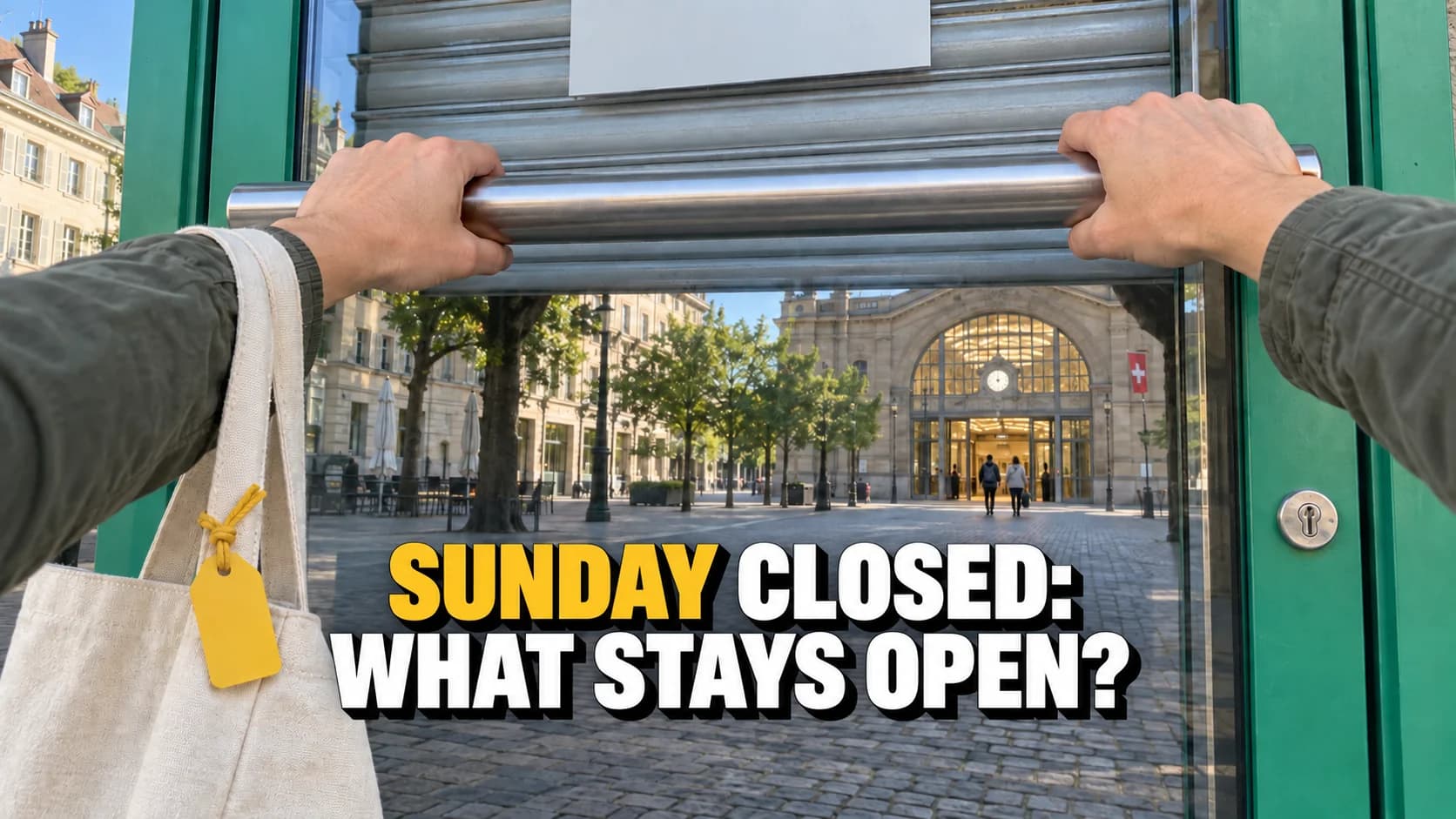
Almost every Swiss supermarket is shut on Sunday, and that is federal labour law rather than a shopkeeper's choice: employing staff between Saturday 23:00 and Sunday 23:00 is prohibited under Art. 18 of the Labour Act (ArG), as the State Secretariat for Economic Affairs (SECO) sets out in its FAQ on Sunday opening. The exceptions a visitor can actually use are shops in the large railway stations and airports on the federal list (Art. 26a ArGV 2), travel-need shops and petrol-station shops on motorways and main routes (Art. 26 ArGV 2), bakeries selling mostly their own products (Art. 27 ArGV 2), and businesses in tourist areas during the season (Art. 25 ArGV 2). There is no federal shop-closing law for the rest of the week: Monday-to-Saturday hours are written by the cantons, which is why Zurich and Geneva behave differently. And the food itself is expensive, in Eurostat's purchasing-power-parity series for 2024, the price level for food and non-alcoholic beverages in Switzerland stood at 158.5 against an EU-27 average of 100.
Last reviewed: August 2026.
Sources checked regularly. SECO, FAQ on Sunday shop opening (Art. 18 ArG; Art. 25, 26, 26a, 27 and 29 ArGV 2), retrieved 3 August 2026. Canton of Zurich, Ruhetags- und Ladenöffnungsgesetz (RLG) of 26 June 2000, § 4 and § 5. Canton of Geneva, Loi sur les heures d'ouverture des magasins (LHOM, RSG I 1 05), art. 9, 14 and 16, read on silgeneve.ch. Eurostat, dataset prc_ppp_ind, price level indices EU27_2020 = 100, reference year 2024, queried directly on 3 August 2026. Swiss Federal Tax Administration (ESTV), current VAT rates. Swiss Payment Monitor 2026, edition 1/2026 (ZHAW School of Management and Law and University of St.Gallen), surveyed October/November 2025, published 19 February 2026. SVGW, drinking-water FAQ. Swiss Recycle on PET beverage bottles. SVUG on mandatory deposits. BauernZeitung, 10 November 2022, on the reusable glass deposit. Watson, 7 February 2026, on store counts at end-2025. Company pages of ALIGRO and OTTO'S.
Rappn is the only neutral grocery price comparison app in Switzerland, with no commercial agreements with any retailer.
Why is everything closed on Sunday in Switzerland?
Because the restriction sits in employment law, not in retail policy. SECO states the rule plainly: between Saturday 23:00 and Sunday 23:00, employing staff is prohibited (Art. 18 ArG). A supermarket that wanted to open would first need permission to make people work, and for ordinary grocery retail that permission does not exist. SECO adds the second half that trips visitors up: whether a shop may open on a Sunday at all is settled in the cantonal shop-opening laws, so there is no single national answer.
The exceptions are narrow but useful. Ordinance 2 to the Labour Act exempts kiosks and travel-need outlets at stations, airports and transport terminals, and petrol-station shops on motorways and main routes serving travellers (Art. 26 ArGV 2). A separate federal list covers the large public-transport hubs, Zurich Hauptbahnhof and Genève-Cointrin among them, where the shops may simply open on Sunday (Art. 26a ArGV 2). Bakeries selling predominantly their own production are exempt (Art. 27 ArGV 2), as are florists (Art. 29 ArGV 2). And, decisive for a Zermatt or Interlaken trip, businesses in tourist areas may serve customers during the season (Art. 25 ArGV 2), which is why a resort village can feel open while a city suburb is dead.
In practice that means your Sunday shopping happens in a station or a petrol-station convenience format rather than a supermarket, and the assortment is smaller. Our guides to Sunday grocery shopping in Switzerland and to avec, Aperto and Swiss station kiosks go through what is actually on those shelves. Public holidays follow the same logic as Sundays, which catches people out on 1 August.
What time do Swiss supermarkets close?
That depends on the canton, and the spread is real. In the canton of Zurich, shops may in principle open Monday to Saturday without a time limit (§ 4 RLG), bounded only by the federal ban on night work between 23:00 and 06:00 (Art. 16 ArG); on public rest days they must stay closed (§ 5 RLG), and a municipality may designate up to four Sundays a year, uniformly for the whole municipality (§ 5 Abs. 3 RLG). Geneva writes the clock into the law instead. Under art. 9 of the cantonal shop-hours act (LHOM, RSG I 1 05) the ordinary closing time is 19:00, with 19:30 on Friday and 18:00 on Saturday. Art. 14 then allows shops to stay open one evening a week until 21:00, the law does not say which evening, and in Geneva that late night is traditionally Thursday, so check the branch rather than assuming.
| Question | Canton of Zurich | Canton of Geneva |
|---|---|---|
| Ordinary closing, Mon-Thu | No statutory closing time (§ 4 RLG) | 19:00 (art. 9 LHOM) |
| Friday | No statutory closing time (§ 4 RLG) | 19:30 (art. 9 LHOM) |
| Saturday | No statutory closing time (§ 4 RLG) | 18:00 (art. 9 LHOM) |
| Late-shopping evening | Not needed, no statutory limit | One evening a week to 21:00 (art. 14 LHOM); the day is not fixed by law |
| Sunday / public rest days | Closed in principle (§ 5 RLG) | Closed on Sundays and legal holidays unless an ArGV 2 derogation applies (art. 16 LHOM) |
| Sunday openings per year | Up to four per municipality (§ 5 Abs. 3 RLG) | Two per year, plus 31 December to 17:00 (art. 16 LHOM) |
| Night work | Prohibited nationwide 23:00-06:00 (Art. 16 ArG), there are no 24-hour supermarkets | |
Two practical consequences. First, a late arrival in Geneva after 19:00 on a Tuesday means a station or petrol-station shop, not a supermarket, unless you have landed on that shop's one late evening. Second, Thursday is the day the promotional week turns over: Migros, Coop and Denner start their weekly Aktionen on Thursday, while Aldi Suisse and Lidl Schweiz drop offers on Monday and Thursday. Per-branch times still vary; our Swiss supermarket opening hours guide covers the chain-by-chain picture.
How expensive is grocery shopping in Switzerland, really?
Expensive, and the honest benchmark is the EU rather than home. Eurostat's purchasing-power-parity programme covers the EU, EFTA and candidate countries, so there is no comparable US or UK line. Against the EU-27 average of 100 in 2024, the most recent year in the series, Switzerland came out at 158.5 for food and non-alcoholic beverages, 174.4 for household final consumption expenditure as a whole and 170.8 for restaurants and hotels. Put plainly: eating out costs roughly seven-tenths more than the EU average, and filling a fridge close to six-tenths more.
| Country | Price level, food and non-alcoholic beverages (2024, EU-27 = 100) | Reading |
|---|---|---|
| Switzerland | 158.5 | About 59 per cent above the EU-27 average |
| Austria | 110.5 | The dearest of the four neighbours |
| France | 110.1 | Practically level with Austria |
| Germany | 102.7 | Just above the EU average |
| Italy | 101.7 | Closest to the EU average of the four |
| EU-27 average | 100 | The reference line |
Eurostat, dataset prc_ppp_ind, price level indices EU27_2020 = 100, reference year 2024, category A0101 (food and non-alcoholic beverages), queried 3 August 2026.
Note the gap between the food figure and the restaurant figure: cooking in a rented flat is the biggest lever a visitor has. Tax is not the reason, the Swiss Federal Tax Administration puts VAT on foodstuffs bought in shops at the reduced rate of 2.6 per cent, against a standard rate of 8.1 per cent and 3.8 per cent on hotel accommodation. Food eaten in a restaurant falls outside that reduced rate, which is part of why the restaurant line sits so much higher.
Whether the same basket is actually cheaper at one chain or another this week is not something a guide can answer in the abstract: it depends on which products you buy, which chains are within reach of where you are staying, and what is on promotion that week. That is precisely what Rappn shows live, over 10,000 current offers from seven Swiss chains, free, with no chain paying for placement.
Which supermarket chains will I actually see?
Store counts below are for the end of 2025 as reported by Watson on 7 February 2026, except ALIGRO and OTTO'S, which come from the companies' own pages.
| Chain | What it is | Scale | Weekly promotions start |
|---|---|---|---|
| Migros | Full-range Swiss supermarket, strong own brands | 659 M / MM / MMM supermarkets (end-2025) | Thursday |
| Coop | Full-range supermarket, wide branded assortment | 982 supermarkets (end-2025) | Thursday |
| Denner | Small-format Swiss discounter, strong on wine | 872 stores (end-2025) | Thursday |
| Aldi Suisse | Hard discounter, compact range | 247 stores (end-2025) | Monday and Thursday |
| Lidl Schweiz | Hard discounter, weekly themed ranges | 192 stores (end-2025) | Monday and Thursday |
| ALIGRO | Cash-and-carry aimed at trade but open to private customers | 14 locations in German- and French-speaking Switzerland | Bulk formats, not a weekly supermarket rhythm |
| OTTO'S | Discount department store with a food and drink aisle | Over 140 branches | Changing clearance lines |
The longer version of who is who is in Swiss supermarkets explained. Beyond these you will meet Volg and Spar in villages.
Can I pay by card, or do I need Swiss francs?
Cards and phones carry the majority of counter payments. The Swiss Payment Monitor 2026, a ZHAW and University of St.Gallen study, surveyed in November 2025 and published in February 2026, measured the shares at the physical point of sale as 27.1 per cent debit card, 26.5 per cent cash, 24.8 per cent payments made with a mobile device and 18.7 per cent credit card. Cash is still roughly a quarter of transactions, so it has not disappeared: carry a modest reserve of francs for a market stall, a mountain hut or a village bakery, and put the rest on plastic.
Part of that mobile share is one Swiss app. Counting billing products individually, the same edition puts TWINT at 10.6 per cent of on-site payments. You will see locals scanning it at the till, but you do not need it, a contactless card or a phone wallet is what the same study counts under mobile payments, and it works on the same terminal. More in our guide to payment methods in Swiss supermarkets.
Is Swiss tap water safe to drink?
Yes, and it is the easiest saving on this page. The SVGW, the Swiss association of the gas and water industry, states that Switzerland has very good drinking-water quality, backed by comprehensive monitoring and risk management. Public fountains follow a helpful convention: the SVGW writes that a publicly accessible fountain is in principle assumed to carry drinking water that can be consumed without concern, and the owner must post a "kein Trinkwasser" sign if it does not. Carry a refillable bottle and skip the mineral-water aisle.
Do I get money back for bottles and cans?
Mostly no, which surprises visitors arriving from Germany or the Nordics. Switzerland has no mandatory deposit on PET bottles or cans, as the SVUG beverage-packaging association sets out. Instead there is a return obligation on the retail side: Swiss Recycle notes that PET beverage bottles can be handed back at all points of sale, part of a network of over 70,000 collection points, with a recycling rate above 80 per cent. The bins by the entrance are for recycling, not refunds.
A "Depot" does exist on reusable glass. BauernZeitung reported on 10 November 2022 that Coop's organic whole milk in a reusable glass bottle carried a deposit of 30 Rappen, refunded when the rinsed bottle is returned at the till, kiosk or info point. Beer crates work the same way; the full picture is in our guide to bottle deposits and recycling in Switzerland.
A short shopping vocabulary
| German | French | Italian | What it means for you |
|---|---|---|---|
| Aktion | Action | Azione | A temporary promotion, not a permanent price |
| Sammelaktion | Action collective | Raccolta punti | A collect-the-stickers or collect-the-points campaign, irrelevant on a short trip |
| Depot | Consigne | Deposito | Refundable deposit, in practice on reusable glass and crates |
| Grundpreis | Prix de base | Prezzo base | The unit price per 100 g, kg or litre on the shelf label, the honest comparison |
| Offen / Geschlossen | Ouvert / Fermé | Aperto / Chiuso | Open / closed on the door sign |
| Kasse | Caisse | Cassa | Checkout |
| Quittung | Ticket de caisse | Scontrino | Receipt |
| Kein Trinkwasser | Eau non potable | Acqua non potabile | The sign on a fountain you should not drink from |
So what should you do?
Do your real shopping between Monday and Saturday, in a supermarket, and treat the station shop as an emergency rather than a plan. Cook at least some meals: the Eurostat 2024 figures put restaurants and hotels at 170.8 and food and non-alcoholic beverages at 158.5 against the EU-27 average of 100, so the gap works in your favour every time you eat in. Refill your bottle from the tap. And if you are here on a Thursday, that is the day the promotional week turns over at Migros, Coop and Denner.
Next step: open Rappn before you walk to the shop. It compares this week's live offers across Migros, Coop, Aldi Suisse, Lidl, Denner, Aligro and OTTO'S, in English, German, French or Italian, with unit prices so you can see what a pack really costs per kilo. It is free and no chain pays for a placement.
Sources checked: .
This is Rappn's home screen: this week's offers from all 7 Swiss chains in one place, in English, German, French or Italian — handy when you only have a few days here. Tap around to try it.
Welcome
Free, no account required · iOS & Android
Why Rappn?
Rappn is the only neutral grocery price comparison app in Switzerland, with no commercial agreements with any retailer. Our comparisons are truly independent.
- 100% free: no subscription, no hidden costs
- Neutral: no commercial agreements with Migros, Coop, Aldi, Lidl, Denner, Aligro, or Otto’s
- Real-time data: prices updated continuously
- +10,000 offers, +3,000 supermarkets, 100% free
Ready to save on groceries?
Install Rappn and compare for yourself this week. No account required.Scan the code, install Rappn, and start tracking real grocery savings this week. No account required.
Built in Switzerland, for Switzerland
Frequently Asked Questions
Are supermarkets open on Sunday in Switzerland?
As a rule, no. SECO states that employing staff between Saturday 23:00 and Sunday 23:00 is prohibited under Art. 18 of the Labour Act, and that whether a shop may open on a Sunday is governed by the cantonal shop-opening laws. What may stay open: shops in the large railway stations and airports on the federal list (Art. 26a ArGV 2), kiosks and travel-need outlets plus petrol-station shops on motorways and main routes (Art. 26 ArGV 2), bakeries selling predominantly their own products (Art. 27 ArGV 2), and businesses in tourist areas during the season (Art. 25 ArGV 2).
Are shops open on Sunday in Zermatt or Interlaken?
Legally it is possible: Art. 25 ArGV 2 exempts businesses in tourist areas from the permit requirement so they can serve customers during the season, as SECO lists in its FAQ on Sunday opening. Whether a specific shop actually opens, and for how long, still depends on the cantonal shop-opening law and on the business itself, so check the hours of the individual branch.
What time do supermarkets close in Zurich and Geneva?
In the canton of Zurich there is no statutory closing time: shops may in principle open Monday to Saturday without a time limit (§ 4 RLG), bounded only by the national ban on night work between 23:00 and 06:00 (Art. 16 ArG). Geneva writes the times into law instead: art. 9 LHOM sets ordinary closing at 19:00, with 19:30 on Friday and 18:00 on Saturday, and art. 14 LHOM allows one evening a week until 21:00 without naming the day, in Geneva that late night is traditionally Thursday, so check the branch. There are no 24-hour supermarkets in Switzerland.
How much more expensive is food in Switzerland?
In Eurostat's price level comparison for 2024, the latest year in the series, Switzerland stood at 158.5 for food and non-alcoholic beverages against an EU-27 average of 100, at 174.4 for household final consumption expenditure overall and at 170.8 for restaurants and hotels (Eurostat, dataset prc_ppp_ind). For food and non-alcoholic beverages, Austria was 110.5, France 110.1, Germany 102.7 and Italy 101.7. The programme covers the EU, EFTA and candidate countries, so there is no comparable US or UK figure.
Can I pay by card everywhere in Switzerland, or do I need cash?
Cards and phones carry the majority of counter payments. The Swiss Payment Monitor 2026, edition 1/2026 (ZHAW and University of St.Gallen, surveyed October/November 2025, published 19 February 2026) measured point-of-sale shares of 27.1 per cent debit card, 26.5 per cent cash, 24.8 per cent payments with a mobile device and 18.7 per cent credit card. TWINT reaches 10.6 per cent of on-site payments in the same edition. Cash is still about a quarter of transactions, so carry a small reserve of francs for market stalls, mountain huts and village bakeries, but you do not need a thick wad.
Is Swiss tap water safe to drink, and can I drink from public fountains?
The SVGW, the Swiss association of the gas and water industry, states that Switzerland has very good drinking-water quality and that comprehensive monitoring and risk management give a high level of safety. For fountains, the SVGW writes that a publicly accessible fountain is in principle assumed to carry drinking water that can be consumed without concern, and that the owner must post a "kein Trinkwasser" sign if it does not. Bring a refillable bottle.