
Chestnut prices in Switzerland: the street stand, the supermarket and Ticino
Hot chestnuts at a Swiss stand cost around four francs per 100 grams: the Luzerner Zeitung reported roughly four francs on average on 2 October 2018, and the Aargauer Zeitung price check of 29 October 2013 already found CHF 3.50 to CHF 4.00. Roasting removes about 30 per cent of the weight, so the paper cone does not compare directly with the shelf price per kilo. This page shows both calculations with date and source, and the chains’ current offers are visible live in Rappn.
Rappn compares the current promotions of 7 Swiss retailers, updated daily: free, no subscription.
See live chestnut offersCurrent prices for chestnuts
One row per chain: the product with the lowest supplied unit price in this search result for “chestnuts”. The product name identifies the offered variant.
Prices for the canton of Zurich.

| Chain | Product | Price | Unit price | Condition | Valid |
|---|---|---|---|---|---|
| Migros | Peeled Chestnuts | CHF 6.65 500g | CHF 13.30/KG | list price | no end date given |
| Coop | Frozen peeled chestnuts | CHF 6.95 500g | CHF 13.90/KG | list price | no end date given |
The “Unit price” column reproduces the base price as declared by the chain itself, it is not recomputed here from the price and the pack size.
A chain with no row has no matching product in this search, which does not mean it does not sell it.
Opens the Rappn search for “chestnuts” in the current deals of all 7 chains, filterable by chain, category, price and canton.
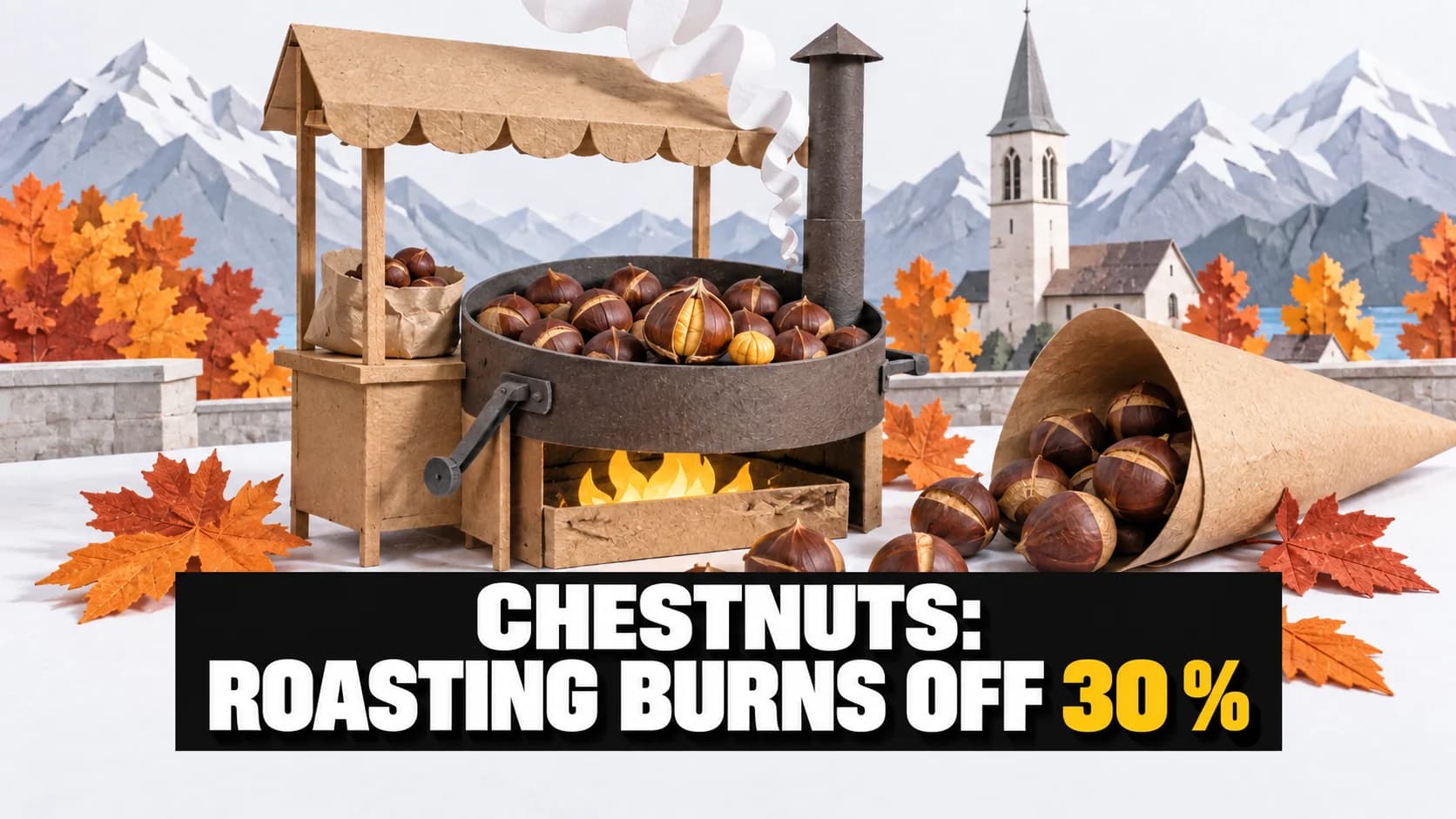
A paper cone of hot chestnuts at a Swiss street stand has cost around four francs per 100 grams for more than a decade. The Luzerner Zeitung reported roughly four francs on average for 100 grams on 2 October 2018, and the Aargauer Zeitung price check of 29 October 2013 found CHF 4.00 in Baden and Brugg and CHF 3.50 to CHF 3.90 in Aarau for the same amount. In a shop you do not buy a portion, you buy weight, and there the price per kilo is what counts. This guide puts the two calculations side by side, explains why they only compare after one conversion step, and covers the Ticino side of the story.
Last updated: September 2026. Sources for this page: «Heissi Marroni» kosten mehr, tagblatt.ch, 26 October 2012; the Aargauer Zeitung price check, 29 October 2013; «Heissi Marroni» sind fein aber teuer, Luzerner Zeitung, 2 October 2018; Schweizer Marroni sind rar und aufwendig, nau.ch, 8 October 2018; a chestnut seller on prices, blick.ch, 31 October 2021; «Castanicoltura, castagne e marronai in Canton Ticino e Bregaglia», the living traditions of Switzerland entry, on the list since 10 September 2012, consulted in September 2026; castanicoltori.ch, ccat.ch and ascona-locarno.com, consulted in September 2026. Weekly chain prices are not in the guide text: the big chains block automated queries to their online shops, and promotion prices change every Thursday.
Rappn is an independent grocery price comparison app in Switzerland, with no commercial agreements with any retailer.
What do hot chestnuts cost at a Swiss street stand?
| Date and source | Place | Amount | Price |
|---|---|---|---|
| 26 October 2012, tagblatt.ch | Eastern Switzerland, Sulejmani stand | 100 g | CHF 4.00, CHF 3.50 the year before |
| 29 October 2013, Aargauer Zeitung | Aarau, Bahnhofstrasse | 100 g | CHF 3.50 |
| 29 October 2013, Aargauer Zeitung | Aarau, Igelweid | 100 g / 500 g / 1 kg | CHF 3.90 / CHF 16.70 / CHF 32.00 |
| 29 October 2013, Aargauer Zeitung | Baden and Brugg | 100 g / 500 g | CHF 4.00 / CHF 16.00 |
| 2 October 2018, Luzerner Zeitung | Swiss average | 100 g | around CHF 4.00 |
| 2 October 2018, Luzerner Zeitung | Gzim Ismaili's stand | 150 g | CHF 5.00 |
| 31 October 2021, blick.ch | Zurich, Hardbrücke | 100 g | raised from CHF 3.50 to CHF 4.00 |
The third row is the informative one. It is the only one carrying a kilo price, CHF 32.00 at the Igelweid stand in Aarau in October 2013. A stand almost never posts a kilo price, it posts the cone, which is exactly why the price feels different from a shelf price. Two cones are an afternoon snack for two people. The same money in a shop is several kilos to carry home.
The phone shows the chestnut and Vermicelles offers running right now across the Swiss chains, with the unit price per kilo next to the pack price, and the app is free.
See live chestnut offersFree, no subscription · iOS & Android
"chestnuts"
Offers
Why do 100 grams of chestnuts cost that much?
Three reasons, none of them arbitrary. First, chestnuts lose weight when roasted: the living traditions entry on chestnut culture in Ticino and Bregaglia puts the loss at about 30 per cent. One kilo of raw goods therefore becomes roughly 700 grams of hot chestnuts before anyone has been paid.
Second, the raw material is not cheap. A Swiss grower sold his unroasted chestnuts for CHF 12.00 to CHF 15.00 per kilo according to nau.ch of 8 October 2018. Third, there is hand work in every cone: each nut is scored, roasting needs constant attention, and then come the permit, the pitch and the transport. A busy stand shifts more than 50 kilos of roasted chestnuts on a good day, per the same heritage entry, but it does so in 100 gram portions.
The long trend is therefore explainable rather than dramatic: nau.ch noted in 2018 that the same 100 grams had cost around three francs ten years earlier. Across the whole period we can document, 2012 to 2021, the portion price stayed between CHF 3.50 and CHF 4.00.
Chestnuts in Swiss supermarkets: raw, pre-cooked and as Vermicelles
In the shops chestnuts appear in several forms: raw in the autumn range, pre-cooked and vacuum packed, and processed into Vermicelles paste. Only the first genuinely compares with a stand, and even then only after the roughly 30 per cent roasting loss. Raw goods are sold by weight, so the shelf label carries the unit price per kilo next to the pack price. How to read that small number properly is covered in our guide to Swiss price tags and the unit price.
Weekly chain prices are not in the guide text. The big chains block automated queries to their online shops, and promotion prices change every Thursday in any case: Coop moved its weekly promotions to Thursday in the week of 21 January 2025, Migros and Denner followed on 5 February 2026, while Aldi Suisse and Lidl Schweiz run two waves a week, on Monday and on Thursday. What applies right now is therefore something you see live in the comparison, filtered to your canton, rather than a figure that would already be wrong next Thursday.
Where do the chestnuts we eat come from?
| Measure | Figure | Source and date |
|---|---|---|
| Harvest in Switzerland | around 100 tonnes a year | Luzerner Zeitung, 2 October 2018 |
| Annual imports | around 2'500 tonnes, mainly from Italy | Luzerner Zeitung, 2 October 2018 |
| Swiss consumption | around 2'000 tonnes a year | nau.ch, 8 October 2018 |
| Requirement according to the trade | 2'000 to 3'000 tonnes a year | Aargauer Zeitung, 29 October 2013 |
| Selling price of a Swiss grower, unroasted | CHF 12.00 to CHF 15.00 per kilo | nau.ch, 8 October 2018 |
| Weight lost in roasting | about 30 per cent | Living traditions, on the list since 10 September 2012 |
That dependence also explains the jumps after a bad harvest. In 2012 tagblatt.ch reported a harvest shortfall of up to 70 per cent, caused by the Asian chestnut gall wasp and poor weather, and the portion price went from CHF 3.50 to CHF 4.00. The Aargauer Zeitung noted in 2013 that the same insect had been found in Ticino four years earlier. A good Italian harvest, conversely, rarely lowers the stand price: labour, pitch and transport do not move.
In Ticino they are caldarroste, and the seller is the marronaio
Ask for «Marroni» in Ticino and you will be understood, but that is not the everyday word. The fruit is the castagna, the hot portion straight out of the pan is caldarroste, and the person at the fire is the marronaio, marunatt in dialect. That is set out in the living traditions of Switzerland entry on chestnut growing in Ticino and Bregaglia, which also records that about a dozen caldarroste sellers currently work the main Ticino squares and that the season runs roughly from September to March.
South of the Alps the chestnut is not a snack, it is heritage. The Centro di Competenze Agroalimentari Ticino calls it the «albero del pane», the bread tree, because it was a staple food for centuries; it grows between 200 and 1'000 metres and was dried slowly over a fire in small stone huts called grà. Flours, flakes, bread, pasta, cakes, jams and even beers still come out of it. What food costs in the canton overall is covered in our guide to grocery prices in Ticino.
The southern chestnut autumn: sagre and direct sales
| Event | When | Since | Source |
|---|---|---|---|
| Sagra della castagna, Valle di Muggio | second Sunday in October, rotating among ten villages of the valley | 1978 | Living traditions, consulted September 2026 |
| Festival della castagna, Val Bregaglia | early October, run by the Associazione Castanicoltori Bregaglia and its roughly 30 members | 2004 | Living traditions, consulted September 2026 |
| Autumn festival with chestnut day, Ascona | in October, organised by the Associazione Manifestazioni Ascona | date published each year | ascona-locarno.com, consulted September 2026 |
| Selling season of the marronai in Ticino | roughly September to March | ongoing | Living traditions, consulted September 2026 |
Behind all of it stands the Associazione dei castanicoltori della Svizzera italiana, founded in 1999 and based in Cresciano at the Unione Contadini Ticinesi. It runs the Festa della Castagna, the «Mès der castégna» and a centralised chestnut collection through which growers hand in their harvest together. The association publishes no price per kilo on the pages we were able to read, so none is quoted here.
When is chestnut season in Switzerland?
The harvest normally starts in mid September, as blick.ch recalled on 31 October 2021 while describing the usual calendar; that year it was two weeks late. Zurich stands run from October to February according to the same report, and 20 licensed chestnut stands were counted in the city streets in 2021. In Ticino the window is longer, roughly September to March. To place the season in the wider year, see the seasonal produce calendar; the other autumn category with a similar price logic is covered in our guide to game meat prices.
Cheaper at the stand or in the shop? It depends
It depends on what you are buying. Once the roughly 30 per cent roasting loss is factored in, a kilo of raw goods off the shelf is almost always more chestnut for your money, but it is not hot, not scored and not served in a paper cone. The stand sells a finished product and a moment, and CHF 4.00 per 100 grams is a price that has barely moved since 2012. A comparison that throws both into one basket misleads.
What does compare cleanly are the chestnut products in the chains: raw goods, vacuum packed pre-cooked chestnuts and Vermicelles. Rappn pulls the current offers from Migros, Coop, Aldi Suisse, Lidl, Denner, Aligro and Otto's into one view, in four languages, with a canton filter and with the unit price per kilo shown next to the pack price. That is the figure that decides, whenever goods are sold by weight.
Next step: open the current offers, search for «chestnuts» and filter to your canton. Then set a price alert so you do not have to check yourself every week in October. Rappn is free, works without an account and is paid by no chain.
Updated: .
Why Rappn?
Rappn is an independent grocery price comparison app in Switzerland, with no commercial agreements with any retailer. Our comparisons are truly independent.
- 100% free: no subscription, no hidden costs
- Neutral: no commercial agreements with Migros, Coop, Aldi, Lidl, Denner, Aligro, or Otto’s
- Updated daily, as soon as the chains publish their deals
- The chains’ deals in one place: search, filter, compare, no subscription
- Meal planner in the Kitchen tab: plan the week, send the ingredients to your list

Ready to save on groceries?
Install Rappn and compare for yourself this week. No account required.Scan the code, install Rappn and compare current offers. No account needed.




Frequently Asked Questions
What does 100 g of hot chestnuts cost in Switzerland?
Between CHF 3.50 and CHF 4.00 according to the dated price checks we could verify. The Aargauer Zeitung found CHF 4.00 in Baden and Brugg and CHF 3.50 to CHF 3.90 in Aarau on 29 October 2013, the Luzerner Zeitung reported roughly four francs on average for 100 grams on 2 October 2018, and blick.ch described a rise from CHF 3.50 to CHF 4.00 at a Zurich stand on 31 October 2021. Each stand sets its own price, no chain sets it.
Why are roasted chestnuts so expensive?
Because one kilo of raw goods becomes only about 700 grams after roasting: the living traditions entry on chestnut culture in Ticino and Bregaglia puts the loss at about 30 per cent. Add the raw material, sold by a Swiss grower for CHF 12.00 to CHF 15.00 per kilo according to nau.ch of 8 October 2018, and the hand work: scoring each nut, roasting, the pitch, the permit and the transport.
When does chestnut season start in Switzerland?
The harvest normally begins in mid September. Zurich stands run from October to February according to blick.ch of 31 October 2021, which counted 20 licensed chestnut stands in the city streets that year. In Ticino the selling season of the marronai is longer, roughly September to March, as the living traditions entry records.
Are chestnuts sold in Switzerland Swiss or Italian?
Almost always Italian. The Luzerner Zeitung put the Swiss harvest at around 100 tonnes and annual imports at around 2'500 tonnes, mainly from Italy, on 2 October 2018. The trade cited a requirement of 2'000 to 3'000 tonnes a year in the Aargauer Zeitung of 29 October 2013, and nau.ch estimated consumption at around 2'000 tonnes on 8 October 2018: the domestic harvest covers only a small share.
What are chestnuts called in Ticino?
The fruit is the castagna, the hot portion is caldarroste, and the seller is the marronaio, marunatt in dialect. That comes from the living traditions of Switzerland entry on chestnut growing in Ticino and Bregaglia, which counts about a dozen caldarroste sellers on the main Ticino squares. «Marroni» is the word used north of the Alps: you will be understood in Ticino, but it is not the everyday term there.
Are chestnuts cheaper at the stand or in the supermarket?
Per kilo of chestnut, almost always in the shop, because you are not paying for the preparation there. The two only compare after the roughly 30 per cent roasting loss, and shelf goods are neither hot nor scored. Which chain has which chestnut product on offer changes every Thursday, which is why no chain price appears here: you see the current one live in Rappn, with the unit price per kilo next to the pack price.