
Family of four grocery budget in Switzerland: how much a month?
A family of four should plan CHF 850 to 1'100 a month for food and non-alcoholic drinks, depending on income (Budgetberatung Schweiz, 2025/2026 guideline values). Each child aged 12 or over adds CHF 50 to 100 a month. Restaurants, alcohol, cleaning products and toiletries are not included.
Rappn compares the current promotions of 7 Swiss retailers, updated daily: free, no subscription.
Plan your week in Rappn, free
Guidelines say what to plan; the Federal Statistical Office (FSO) shows what couples with two children really spent: an average of CHF 955 a month in 2018-2019, the last years before Covid, and about CHF 1'000 in 2020-2021, Covid years when families ate at home more. At CHF 955, that is about CHF 221 a week (÷ 4.33) and CHF 239 per person per month (÷ 4), our own calculation. The CHF 850 to 1'100 comes from Budgetberatung Schweiz, the Swiss umbrella association of budget counselling services, and rises with net income. It is meant for two adults and two children (2025/2026 guideline values, in Swiss francs).
Updated October 2026. Sources: FSO, Household Budget Survey (HBS), tables by number of children and by household type (2018-2019 and 2020-2021), time series, detailed household spending 2023 and press release of 17 November 2025 (2022-2024 figures announced for November 2026); Budgetberatung Schweiz, budget examples for families with two children, version 2025/2026 (viewed on 9 October 2026).
How much does a family of four spend on groceries a month?
| Family of four (two adults, two children) | Per month | Per week (÷ 4.33) | Per person per month (÷ 4) | Per person per day (÷ 30.4) |
|---|---|---|---|---|
| Measured spending, FSO 2018-2019 | CHF 955 | CHF 221 | CHF 239 | CHF 7.90 |
| Measured spending, FSO 2020-2021 (Covid years) | CHF 1'000 | CHF 231 | CHF 250 | CHF 8.20 |
| Guideline 2025/2026, net income CHF 5'000 | CHF 850 | CHF 196 | CHF 213 | CHF 7.00 |
| Guideline, net income CHF 10'000 | CHF 1'100 | CHF 254 | CHF 275 | CHF 9.00 |
| Guideline with one child aged 12 or over (plus CHF 50 to 100) | CHF 900 to 1'200 | CHF 208 to 277 | CHF 225 to 300 | CHF 7.40 to 9.90 |
Table sources: FSO, table T20.02.01.00.43 (couples with children by number of children, 4.0 people per household); Budgetberatung Schweiz, version 2025/2026. Week, person and day are our own calculations: a month has 4.33 weeks on average (52 ÷ 12) and 30.4 days (365 ÷ 12).
In 2018-2019 groceries took 6.7% of these families’ gross income (CHF 14'364 a month) and about 9.4% of their disposable income (CHF 10'115; our calculation: 955 ÷ 10'115). In the same survey, couples with one child spent CHF 794 a month and couples with three or more children CHF 1'102. Other household sizes have their own pages: the grocery budget for a family of three, the guide to large families for five or more, and the single-parent grocery budget for one parent with two children. Every household size is in the grocery budget by household size.
These two screens show a week of dinners in the Kitchen planner and the ingredients of one day going to your Weekly shop cart, the step that turns a family budget into a list.
Plan your week in Rappn, freeFree, no subscription · iOS & Android
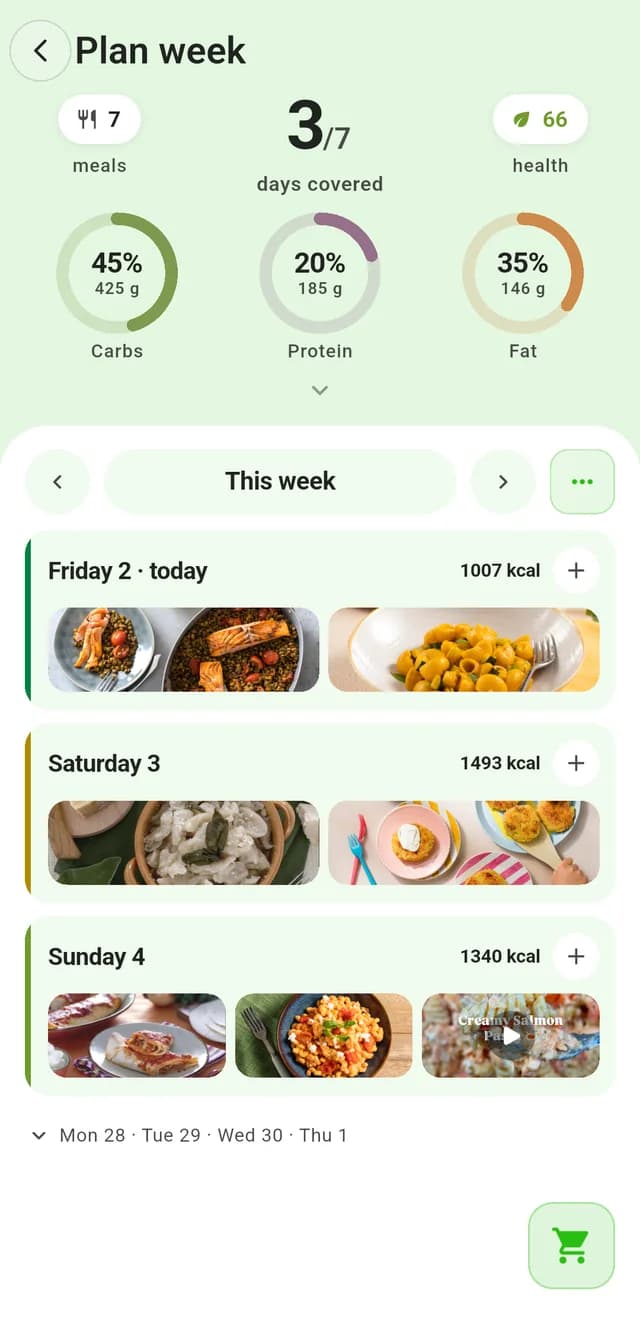
Plan the week
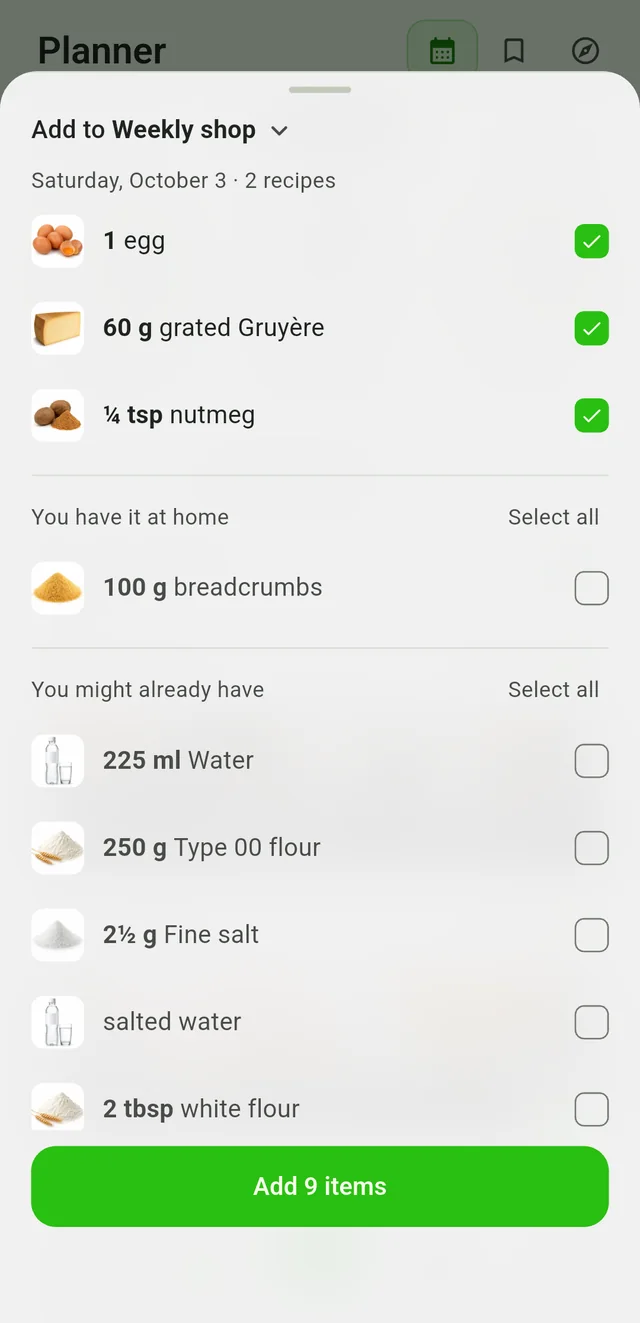
Send ingredients to your list
Why can’t you just multiply the per-person average by four?
Because spending per person falls as the household grows. According to the FSO, a Swiss household spent an average of CHF 638 a month on food and non-alcoholic drinks in 2023, 6.2% of gross income, with 2.07 people on average. That is about CHF 309 per person (637.76 ÷ 2.066, our calculation), and four times that makes CHF 1'236, the 2023 average of all households. Couples with two children spent CHF 955 in 2018-2019. The FSO publishes spending by household type, not by number of people, and the type closest to a family of four is the couple with two children, exactly 4.0 people on average.
Two reasons are likely: large packs often cost less per kilo, and small children eat less than adults. Compare the two: in 2018-2019 a person under 65 living alone spent CHF 337 a month, a member of a family of four about CHF 239.
What changes the amount: income, the children’s ages or eating out?
| Net income per month, without a 13th salary | Food and non-alcoholic drinks | Household extras | Both lines together |
|---|---|---|---|
| CHF 5'000 | CHF 850 | CHF 140 | CHF 990 |
| CHF 5'500 | CHF 900 | CHF 140 | CHF 1'040 |
| CHF 6'000 to 7'000 | CHF 950 | CHF 140 to 150 | CHF 1'090 to 1'100 |
| CHF 7'500 and 8'000 | CHF 1'000 | CHF 150 and 160 | CHF 1'150 and 1'160 |
| CHF 9'000 | CHF 1'050 | CHF 160 | CHF 1'210 |
| CHF 10'000 | CHF 1'100 | CHF 160 | CHF 1'260 |
Source: Budgetberatung Schweiz, budget examples for families with two children, version 2025/2026. Monthly amounts in francs. If your grocery money also covers cleaning products and toiletries, compare it with the last column (CHF 990 to 1'260), not with the food line alone.
The children’s ages. Budgetberatung Schweiz adds CHF 50 to 100 a month for each child aged 12 or over. With two teenagers the guideline rises to about CHF 950 to 1'300 (our calculation: 850 plus 2 × 50, 1'100 plus 2 × 100). The FSO average mixes all ages, because a couple counts as a family with children as long as at least one child is under 25. So the CHF 955 covers babies, schoolchildren and young adults.
Eating out. Neither figure includes restaurants, takeaway or alcohol. The FSO counts restaurants, canteens and hotels as one item, overnight stays included. On top of their groceries, couples with two children spent about CHF 777 a month on it in 2018-2019 and CHF 594 in 2020-2021. Childcare and work-related meals out are not in the food line either. Budgetberatung Schweiz puts them in the “available amount” left after all the budget lines.
What does a family spend its grocery money on?
Across all Swiss households in 2023, fruit and vegetables took 21% of the grocery budget, meat 19%, bread and cereal products 16%, milk, cheese and eggs 16% and non-alcoholic drinks 9% (our calculations from FSO figures, for example meat CHF 120 out of CHF 638 = 19%). Your own split shows only on your receipts. The item-by-item figures are in the guide to grocery spending by category.
How can you stay within the budget without eating less?
With habits that settle the shop before you reach the checkout. None guarantees an amount, because the effect depends on what your family eats.
- Plan the week around the promotions. Fix four or five dinners around what is on offer this week and leave one or two evenings for leftovers. You then buy only what already has a place in the plan, and you compare the price per kilo or litre, not the pack price. The family meal plan shows how to do it with children; how to meal plan in Switzerland gives the method step by step.
- Think per week, not only per month. CHF 850 to 1'100 a month leaves a family of four about CHF 196 to 254 a week, which is the limit for every big shop. How the figure changes with household size is in the guide to the weekly grocery cost.
- Check the receipts at the end of the month, not only the bank statement. The statement shows one line per shop: the store and the total. Only the receipt shows what was inside: food, cleaning products, drinks, deposit. It is the only way to separate groceries from the household extras in the table.
How do you find your family’s real figure?
If you want your own figure rather than an average, the free Rappn app imports the receipts of three big Swiss supermarkets’ loyalty programmes, up to 12 months back, and you add the others by photo; it then shows your spending by category and by month. You need a Rappn account and must be an adult; the programmes’ terms still apply and the operator can restrict the link (how linking works).
You can take the first step today: keep this week’s grocery receipts and, in the evening, photograph them or upload them from your gallery; enter purchases without a receipt by hand. Rappn is a free Swiss app (iOS and Android) that compares the current promotions of seven Swiss retailers and turns receipts into a spending overview. It sorts your purchases into categories and shows your spending by month, next to your own monthly average, and you can export your receipts as PDF or CSV. After a full month, compare your figure with the tables above. Rappn is independent, with no commercial agreement with any retailer, and free, with no subscription. It covers the grocery line of your budget, not rent, health insurance or taxes: for the whole budget you need a household budget template or the free tools of Budgetberatung Schweiz.
Rappn is building an AI assistant for groceries: you can join the waitlist.
Updated: .
Why Rappn?
Rappn is an independent grocery price comparison app in Switzerland, with no commercial agreements with any retailer. Our comparisons are truly independent.
- 100% free: no subscription, no hidden costs
- Neutral: no commercial agreements with Migros, Coop, Aldi, Lidl, Denner, Aligro, or Otto’s
- Updated daily, as soon as the chains publish their deals
- The chains’ deals in one place: search, filter, compare, no subscription
- Meal planner in the Kitchen tab: plan the week, send the ingredients to your list

Ready to save on groceries?
Install Rappn and compare for yourself this week. No account required.Scan the code, install Rappn and compare current offers. No account needed.




Frequently Asked Questions
How much does a family of four spend on groceries a month in Switzerland?
Budgetberatung Schweiz recommends CHF 850 to 1'100 a month for food and non-alcoholic drinks for a couple with two children, depending on net income (version 2025/2026). The Federal Statistical Office measured average spending of CHF 955 a month for these families in 2018-2019 and about CHF 1'000 in the Covid years 2020-2021, without restaurants or alcohol.
How much is a weekly grocery shop for a family of four?
About CHF 221 a week if you go by the Federal Statistical Office’s 2018-2019 average for couples with two children (CHF 955 divided by 4.33 weeks), or CHF 196 to 254 a week by the 2025/2026 guidelines of Budgetberatung Schweiz. Divide by 4.33 rather than 4: a month has 4.33 weeks on average (52 ÷ 12).
How much should we add to the grocery budget for two teenagers?
Budgetberatung Schweiz recommends adding CHF 50 to 100 a month for each child aged 12 or over (version 2025/2026). With two teenagers, the guideline for a family of four rises from CHF 850 to 1'100 to about CHF 950 to 1'300 a month (our calculation).
Do cleaning products and toiletries belong in the grocery budget?
No: both the Federal Statistical Office average and the guidelines cover only food and non-alcoholic drinks consumed at home. Budgetberatung Schweiz puts personal care, laundry and cleaning products and waste disposal on a separate line of household extras, CHF 140 to 160 a month for a family with two children; together with groceries that makes CHF 990 to 1'260 a month (version 2025/2026).
What share of income does a family of four spend on food?
In 2018-2019, couples with two children spent 6.7% of their gross income of CHF 14'364 a month on food and non-alcoholic drinks, which is about 9.4% of their disposable income (Federal Statistical Office; the second share is our calculation). Across all households the share was 6.2% of gross income in 2023.
How do we compare our spending with other families of four?
Add up a full month of grocery receipts, by hand or with the free Rappn app. You photograph a receipt, upload it from your gallery or enter a purchase by hand, and the app sorts your purchases into categories and shows your spending by month, next to your own monthly average. Then compare your figure with the Budgetberatung Schweiz guideline of CHF 850 to 1'100 and with the CHF 955 the Federal Statistical Office measured for couples with two children in 2018-2019.