
How to read a Swiss receipt: abbreviations, VAT codes and the words in German, French and Italian
A Swiss receipt runs from top to bottom: shop, items, discounts, deposit, total, payment and a VAT summary. That summary decodes the letters or digits next to the prices: 2.6% for food, 8.1% standard rate (VAT Act, since 1 January 2024). In German a receipt is a Kassenzettel, in French a ticket de caisse, in Italian a scontrino.
Rappn compares the current promotions of 7 Swiss retailers, updated daily: free, no subscription.
Put your receipts in Rappn, free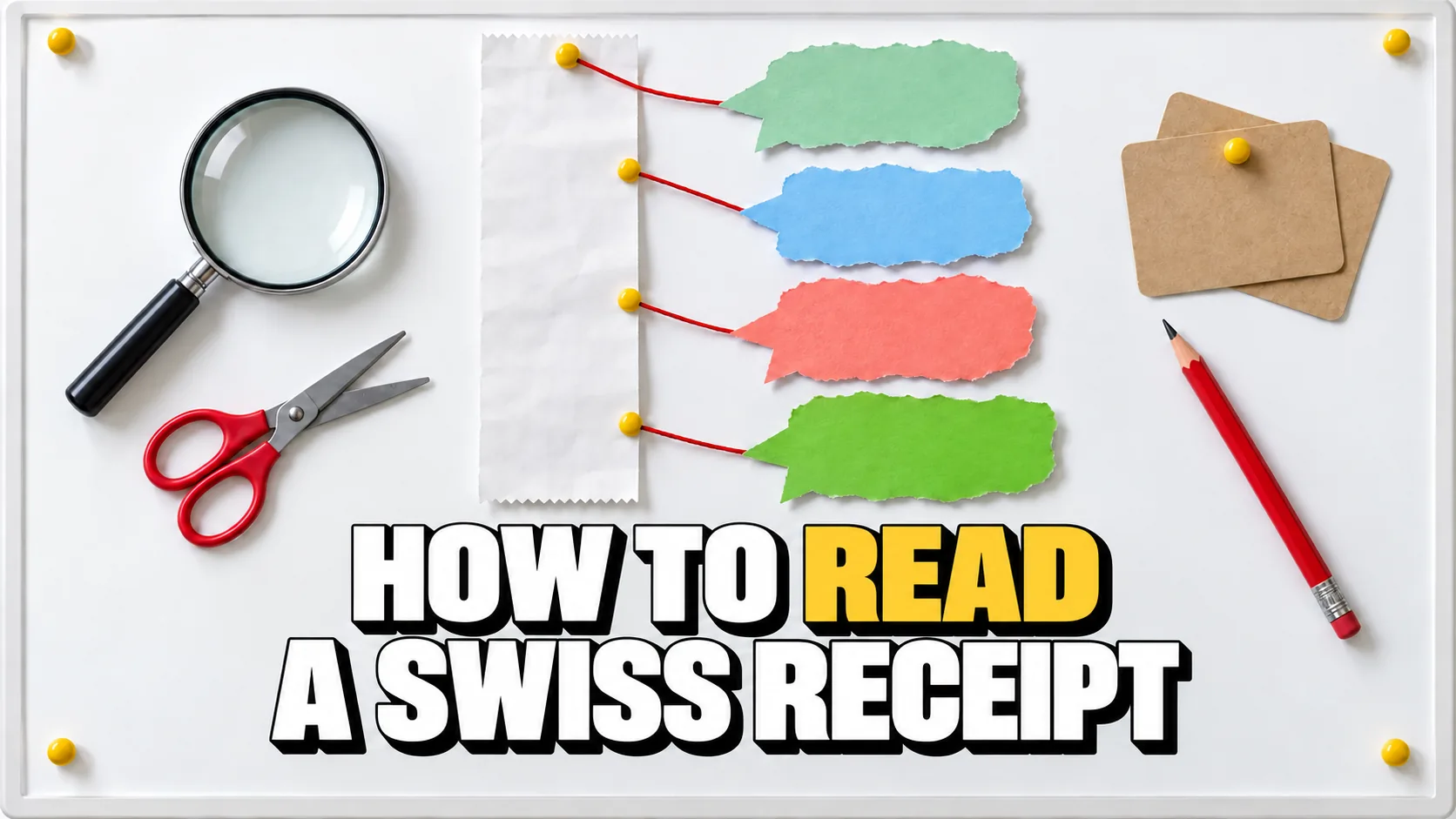
Here is how to read a Swiss receipt: from top to bottom, shop, items, discounts, deposit, total, payment and a VAT summary. That summary turns the codes next to the prices into rates: 2.6% for food, 8.1% standard rate (VAT Act, since 2024).
Updated October 2026. Sources: VAT Act, arts. 25 and 26, VAT Ordinance, art. 57, and Price Indication Ordinance (in German), art. 3 (fedlex.admin.ch); Federal Tax Administration (FTA), VAT number (in German) and VAT rates; Swiss National Bank (SNB), coins FAQ (viewed on 9 October 2026).
How do you read a Swiss receipt?
A receipt is the slip the till gives you for each purchase; a Swiss one usually has eight blocks:
- Header: shop, branch and VAT number, if the shop is VAT-registered (format: CHE-123.456.789 MWST).
- Date and time, till and receipt numbers.
- Items: quantity × unit price, or weight × price per kilo, plus a VAT code.
- Discounts: promotions, price cuts and vouchers, with a minus sign.
- Deposit, only for returnable containers.
- Total: in cash, usually rounded to the nearest 5 centimes, the smallest coin (SNB); this is shop practice, and we found no rule requiring it.
- Payment: cash and change, card or app (how to pay at a Swiss supermarket).
- VAT summary, loyalty points and exchange conditions; how long to keep the receipt: receipts and warranty.
This is what Rappn makes of your receipts: your grocery purchases sorted by category and by month, in your language.
Put your receipts in Rappn, freeFree, no subscription · iOS & Android
Your spending
What do the VAT codes on a Swiss receipt mean?
| VAT rate in % (art. 25 VAT Act, since 1 January 2024) | Applies to |
|---|---|
| 2.6% (reduced) | food and soft drinks, cut flowers, pet food |
| 8.1% (standard) | alcohol, tobacco and most non-food items, such as cleaning products and cosmetics |
| 3.8% (special) | accommodation, so not on grocery receipts |
For takeaway, see VAT on food in Switzerland.
How do you say receipt in German, French and Italian?
| English | German | French | Italian |
|---|---|---|---|
| receipt | Kassenzettel, Kassenbon, Quittung | ticket de caisse, quittance | scontrino, ricevuta |
| total | Total | total | totale |
| subtotal | Zwischentotal | sous-total | subtotale |
| VAT | MWST | TVA | IVA |
| special offer | Aktion | action | azione, offerta |
| discount | Rabatt | rabais | sconto |
| deposit | Depot | consigne | deposito |
| change | Rückgeld, Retourgeld | monnaie | resto |
| cash | Bargeld, bar | espèces | contanti |
| card | Karte | carte | carta |
| voucher | Gutschein | bon | buono |
| exchange | Umtausch | échange | cambio merce |
| weight | Gewicht | poids | peso |
| price per kilo | Kilopreis | prix au kilo | prezzo al chilo |
| till | Kasse | caisse | cassa |
| branch | Filiale | filiale | filiale |
| receipt number | Belegnummer | numéro de ticket | numero dello scontrino |
| warranty | Garantie | garantie | garanzia |
| rounding | Rundung | arrondi | arrotondamento |
| loyalty points | Treuepunkte | points de fidélité | punti fedeltà |
| self-checkout | Self-Checkout | caisse automatique | cassa self-service |
Three terms are typically Swiss: Aktion (action, azione) for a time-limited offer, Depot and Zwischentotal (in Germany, Pfand and Zwischensumme).
Which abbreviations appear on a Swiss receipt?
The most common ones stand for quantity, currency and VAT:
- Stk., pce, pz.: pieces; kg, g, l, dl, cl: weight and volume.
- CHF, Fr., fr.: francs; Rp., ct.: centimes.
- MWST, TVA, IVA: VAT in German, French and Italian. The VAT number is the company’s business ID (UID, starting with CHE) followed by one of these abbreviations, never by the English “VAT” (FTA).
What should you check on the receipt before you leave?
Five checks are enough:
- Have promotions and discounts been deducted?
- Is the weight of fruit, vegetables and cheese plausible?
- Has any item been counted twice?
- Does a deposit appear only for returnable containers?
- Do the total and your change match what you paid?
A mistake is easiest to fix right at the till (see receipt errors and your rights).
How to record your receipts in Rappn today
Photograph the receipt from your next shopping trip, upload it from your gallery or enter the purchase by hand in Rappn, a free Swiss app (iOS and Android) that compares the current promotions of seven Swiss retailers and turns receipts into a spending overview. Each purchase is recorded with store, date and total and sorted by category and by month; the app, in four languages, covers groceries, not rent or taxes.
If you would rather not photograph every receipt, Rappn imports receipts from the loyalty programmes of three big Swiss supermarkets, up to 12 months back, and you add other receipts by photo. You need a Rappn account and must be an adult; the programmes’ terms still apply and the operator can restrict the link (how linking works).
Updated: .
Why Rappn?
Rappn is an independent grocery price comparison app in Switzerland, with no commercial agreements with any retailer. Our comparisons are truly independent.
- 100% free: no subscription, no hidden costs
- Neutral: no commercial agreements with Migros, Coop, Aldi, Lidl, Denner, Aligro, or Otto’s
- Updated daily, as soon as the chains publish their deals
- The chains’ deals in one place: search, filter, compare, no subscription
- Meal planner in the Kitchen tab: plan the week, send the ingredients to your list

Ready to save on groceries?
Install Rappn and compare for yourself this week. No account required.Scan the code, install Rappn and compare current offers. No account needed.



Frequently Asked Questions
How do you say receipt in German, French and Italian?
A receipt is a Kassenzettel in German (also Kassenbon or Quittung), a ticket de caisse in French and a scontrino in Italian (also a ricevuta); the more formal French word quittance means a payment receipt, like Quittung. The total is Total in German, total in French and totale in Italian; VAT is MWST, TVA and IVA respectively.
What do the letters next to the prices on a Swiss receipt mean?
They are VAT codes. Each code stands for the rate applied to that line; because every shop uses its own letters or digits, the key is in the VAT summary at the bottom of the receipt. Groceries carry two rates: 2.6% for food and soft drinks, 8.1% for alcohol, tobacco and most non-food items (art. 25 VAT Act, since 1 January 2024).
Why is the total on a Swiss receipt rounded?
When you pay cash, the total is usually rounded to the nearest 5 centimes, because the smallest coin in circulation is 5 centimes: the 1-centime coin was withdrawn on 1 January 2007, and the Swiss National Bank (SNB) exchanges it until 31 December 2026. This is shop practice, and we found no federal rule that requires it. Cash is still the second most used means of payment in shops, after the debit card and ahead of payment apps (SNB, 2025 survey).
What is the deposit on a Swiss receipt?
A deposit (Depot in German, consigne in French) is an amount you pay for a returnable container, such as a reusable glass bottle or a crate, and get back when you return it. PET drink bottles carry no deposit: according to the Federal Office for the Environment, their price already includes an advance recycling fee.
Does a Swiss shop have to show VAT on the receipt?
Yes, if you ask for it. A VAT-registered shop must then issue an invoice that normally shows its name, location and VAT number, the date, what was sold, the amount and the VAT rate; if the price includes VAT, stating the rate is enough (art. 26 VAT Act). On till receipts up to CHF 400 your name may be left out (art. 57 VAT Ordinance).
Which languages is Rappn available in?
Rappn is a free Swiss app (iOS and Android) available in German, French, Italian and English. It compares the current promotions of seven Swiss retailers and turns receipts into a spending overview: you photograph a receipt, upload it from your gallery or enter the purchase by hand, and the app sorts your spending by category and by month.