
How couples split grocery costs fairly: 50/50, by income or a joint account
Couples in Switzerland split grocery costs in three ways: half each, in proportion to net income, or through a joint kitty. With unequal incomes a split by income is more balanced, and Budgetberatung Schweiz sets it as the usual rule for unmarried couples. It puts a couple’s food at CHF 550 to 700 a month (budget examples 2025/2026).
Rappn compares the current promotions of 7 Swiss retailers, updated daily: free, no subscription.
Share a list in Rappn, free
In practice, the income gap decides how a couple splits grocery costs: with similar incomes, half each works; with unequal incomes, a split by income is more balanced. Budgetberatung Schweiz’s 2025/2026 budget examples allow CHF 550 to 700 a month for a couple’s food, the basis for the kitty.
Updated October 2026. Sources: Budgetberatung Schweiz, factsheet on the budget of unmarried couples and couple budget examples (both PDFs in German), version 2025/2026; Federal Statistical Office (FSO), family surveys 2018 and 2023, Household Budget Survey 2018-2019 (viewed on 8 October 2026).
How do couples split grocery costs?
Decide three things, in this order: what counts as shared, how you divide it and how you pay. Swiss couples do this very differently: according to the FSO, in 2018, 71% of married couples pooled their entire household income, while 92% of unmarried couples without children kept at least part of their income separate (couples living together for at least two years, both partners aged 25 to 54). Grocery shopping is often a two-person job: in 2023, both partners shared the household shopping in 51% of couple households (both aged 25 to 54). So agree on the rule before your first settle-up.
In Rappn you share one list with your partner: each of you edits it and sees what is missing and what is already bought.
Share a list in Rappn, freeFree, no subscription · iOS & Android
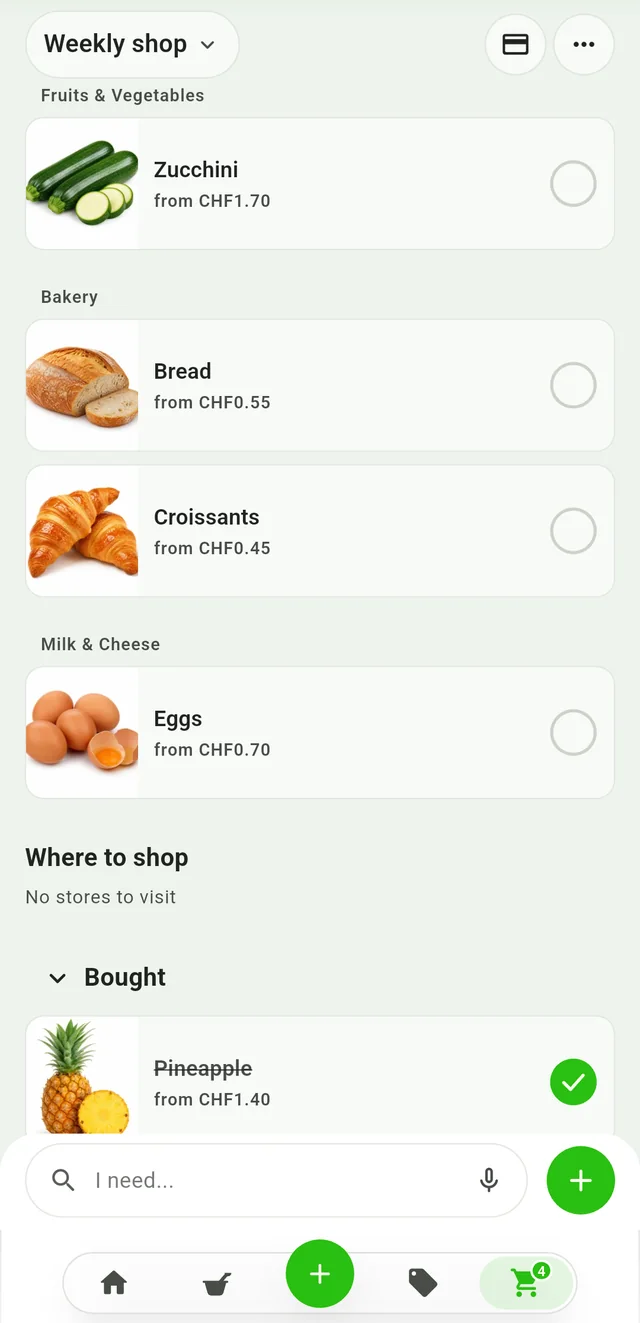
Tick off what is bought
50/50, by income or a kitty: the three models
| Model | How it works | Fair when | Watch out |
|---|---|---|---|
| Half each (50/50) | Each pays half of the shared costs, taking turns or with a monthly settle-up | Incomes and consumption are similar | With unequal incomes, the lower earner keeps a smaller share of their income |
| In proportion to income | Each pays the share that matches their part of the couple’s net income | Incomes differ: it is the split Budgetberatung Schweiz usually recommends | Recalculate when an income changes; housework is not counted |
| Kitty or joint account | Each pays in a fixed amount every month, equal or by income, that covers the groceries | You often shop together and want little bookkeeping | Adjust the amount when prices or habits change |
Source: Budgetberatung Schweiz, factsheet on the budget of unmarried couples (2025/2026, in German).
How do you calculate a share in proportion to income?
Your share is your net income divided by the couple’s net income: whoever earns 60% of the joint net income pays 60% of the shared costs and the other partner pays 40%.
- Add up both monthly net incomes, worked out the same way, for example both without a 13th-month salary (an extra month’s pay).
- Work out each share and apply it to the month’s total shared costs.
- Recalculate when an income changes, for example after a move to part-time work.
Why not just half each? An example in percentages only: shared costs take 40% of the couple’s net income, and one partner brings in 40% of it. At 50/50 each pays 20 points out of 100: the partner bringing in 40 keeps 40 minus 20, so 20, half of what they earn, while the other keeps 60 minus 20, so 40, two thirds. Split by income, each pays 40% of their own income and keeps 60%. To place groceries in the whole budget, see the 50-30-20 rule with Swiss numbers.
What goes in the kitty, and what stays out?
Whatever you both use. Budgetberatung Schweiz counts food, drinks and household extras (laundry and cleaning products, general toiletries, waste disposal) as shared costs.
- In the kitty: groceries for home, toilet paper, detergent, bin bags.
- Out of the kitty: lunches at work, snacks only one of you eats, and purchases such as furniture, which Budgetberatung Schweiz advises you not to pay for with shared funds.
- Decide together: alcohol, eating out, guests.
How much to pay in? For a couple, the 2025/2026 examples allow CHF 550 to 700 a month for food and non-alcoholic drinks (not counting eating out, guests or alcohol), plus CHF 50 to 100 for household extras, depending on income; the FSO measured about CHF 642 a month on food at home for couples under 65 without children (2018-2019, the last years before Covid). More in the grocery budget guide for couples and the grocery budget table by household size.
Who paid for what: tracking it without arguments
With three habits: a shared list, each partner’s own receipts and one settle-up a month.
- One list for two: a shared shopping list stops the milk being bought twice.
- Receipts, not just the bank statement: a statement shows only the shop and the total; the receipt shows what was inside, so you can leave out personal items. How to read them: analysing your grocery receipts.
- One settle-up a month: for each partner, take what they paid towards shared costs and subtract their share of the total. Whoever ends up below zero pays the difference to the other.
Flatmates follow slightly different rules: see splitting groceries in a flat share.
How to do it now with Rappn
Today: create a list in Rappn and share it with your partner, so you both edit it. Rappn is a free Swiss app (iOS and Android) that compares the current promotions of seven Swiss retailers and turns receipts into a spending overview. Each of you records your own receipts by photo, from your gallery or by hand; the app sorts them by category and month, and at month end you export them as PDF or CSV for the settle-up. The limit: Rappn does not work out who owes whom and only covers groceries; for the rest, see expense tracking without a bank connection.
If you would rather not photograph everything, the free Rappn app imports the receipts of three big Swiss supermarkets’ loyalty programmes, up to 12 months back, and you add the others by photo. You need a Rappn account and must be an adult; the programmes’ terms still apply and the operator can restrict the link (how linking works).
Updated: .
Why Rappn?
Rappn is an independent grocery price comparison app in Switzerland, with no commercial agreements with any retailer. Our comparisons are truly independent.
- 100% free: no subscription, no hidden costs
- Neutral: no commercial agreements with Migros, Coop, Aldi, Lidl, Denner, Aligro, or Otto’s
- Updated daily, as soon as the chains publish their deals
- The chains’ deals in one place: search, filter, compare, no subscription
- Meal planner in the Kitchen tab: plan the week, send the ingredients to your list

Ready to save on groceries?
Install Rappn and compare for yourself this week. No account required.Scan the code, install Rappn and compare current offers. No account needed.




Frequently Asked Questions
What is the fairest way for a couple to split grocery and household costs?
It depends on the income gap: with similar incomes, half each is simple and fair; with unequal incomes, splitting in proportion to net income is more balanced. For the shared costs of unmarried couples living together, the Swiss umbrella body for budget advice, Budgetberatung Schweiz, usually recommends splitting by income (factsheet 2025/2026).
Is a joint account for groceries a good idea?
Yes, if you often shop together: each partner pays in a fixed amount every month, equal or by income, and food and household items are paid from the joint account. As a guide, Budgetberatung Schweiz budgets CHF 550 to 700 a month for a couple’s food and non-alcoholic drinks, plus CHF 50 to 100 for household extras (budget examples 2025/2026).
How do you split groceries if one partner earns more?
In proportion to net income: each partner’s share is their net income divided by the couple’s net income. Whoever earns 60% of the joint net income pays 60% of the shared costs and the other partner pays 40%. Recalculate whenever an income changes.
Which app can couples use to track their expenses?
It depends on the job: expense-splitting apps work out who owes whom, general budget apps or a spreadsheet cover the whole budget, and a banking app’s spending tab shows only the shop and the total of each purchase. For the shopping list and the receipts there is the free Rappn app: a shared list, receipts by photo, spending by category and by month, and export as PDF or CSV.
Can we use Rappn as a couple?
Yes: you both edit a shared list in Rappn, and each of you records your own receipts by photo, from the gallery or by hand, and exports them as PDF or CSV. You do the settle-up yourselves: Rappn does not work out who owes whom.