
Monthly grocery budget in Switzerland by household size: 1 to 5 or more people
An average Swiss household of 2.07 people spends about CHF 638 a month on food and non-alcoholic drinks at home (Federal Statistical Office, Household Budget Survey 2023). By household type, the measured average runs from about CHF 337 for one person under 65 to about CHF 1'102 for a couple with three or more children (FSO 2018-2019).
Rappn compares the current promotions of 7 Swiss retailers, updated daily: free, no subscription.
Find your own grocery figure in Rappn, free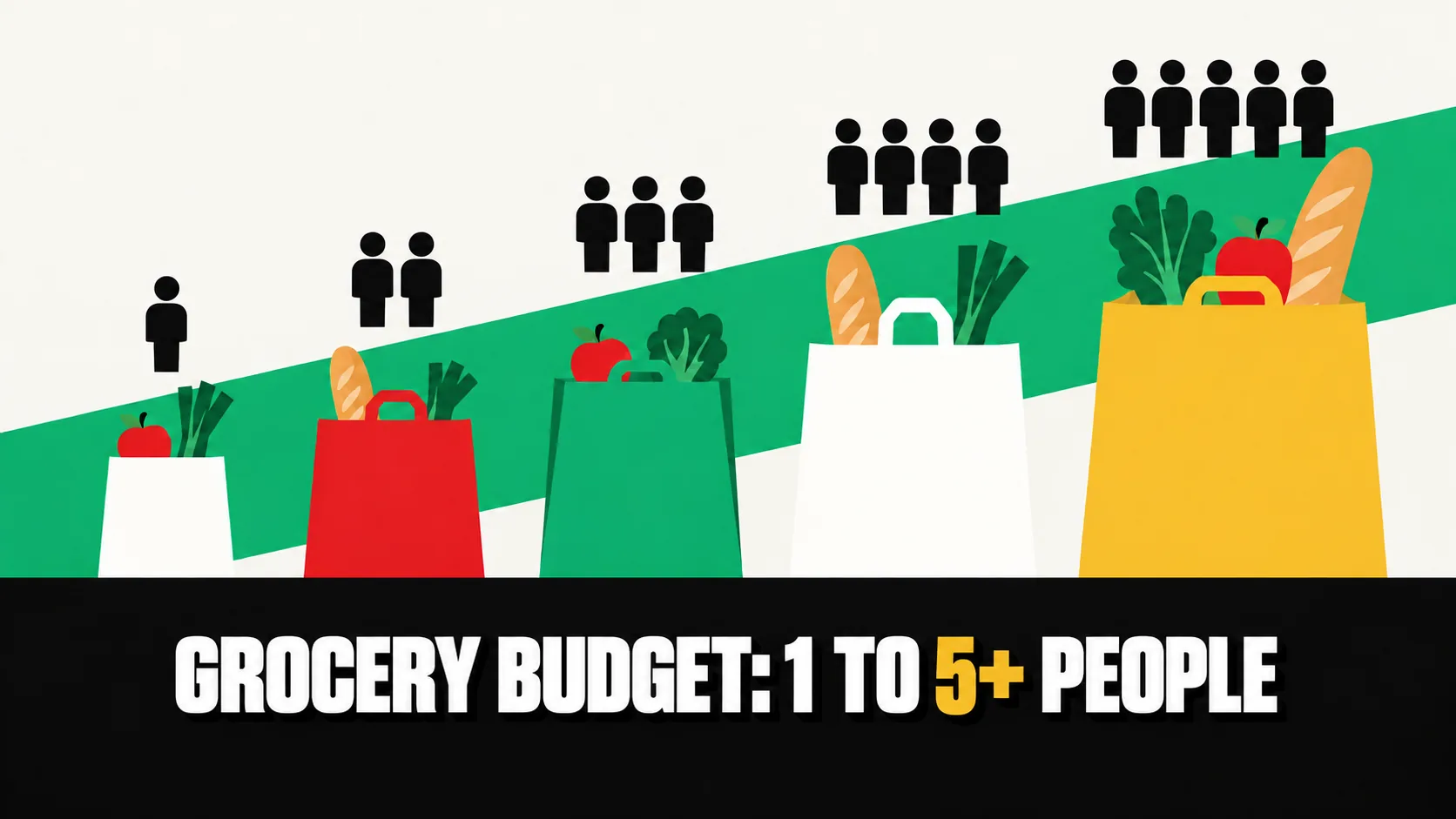
A Swiss household spends about CHF 638 a month on groceries, meaning food and non-alcoholic drinks consumed at home. That is the 2023 figure for all households, equal to 6.2% of gross household income (Federal Statistical Office, FSO). For planning, Budgetberatung Schweiz, the Swiss umbrella association of budget counselling services, gives guideline values of CHF 370 to 1'250 a month, depending on household type and net income.
Updated October 2026. Sources: Federal Statistical Office (FSO), Household Budget Survey, 2023 results (press release of 17 November 2025) and tables T20.02.01.00.13, T20.02.01.00.43 and T20.02.01.00.02 for 2018-2019 and 2020-2021; Budgetberatung Schweiz, budget examples 2025/2026 (in German). All viewed on 9 October 2026.
Key numbers
- A Swiss household spends on average about CHF 638 a month on food and non-alcoholic drinks consumed at home, with 2.07 people per household (FSO, 2023).
- A person under 65 living alone spends on average about CHF 337 a month on food and non-alcoholic drinks (FSO, 2018-2019).
- A couple with two children spends on average about CHF 955 a month on food and non-alcoholic drinks (FSO, 2018-2019).
- The guideline for a couple with two children is CHF 850 to 1'100 a month for food and non-alcoholic drinks, depending on net income (Budgetberatung Schweiz, 2025/2026).
How much do households spend on groceries a month, by number of people?
| Household | People | FSO average 2018-2019 | FSO average 2020-2021 (Covid years) | Guideline 2025/26 (Budgetberatung Schweiz) |
|---|---|---|---|---|
| Single person under 65 | 1 | CHF 337 | CHF 387 | CHF 370–500 |
| Couple under 65, no children | 2 | CHF 642 | CHF 716 | CHF 550–700 |
| Couple with 1 child | 3 | CHF 794 | CHF 846 | CHF 700–850 |
| Couple with 2 children | 4 | CHF 955 | CHF 1'000 | CHF 850–1'100 |
| Couple with 3 or more children | 5.2 on average | CHF 1'102 | CHF 1'166 | CHF 1'000–1'250 (3 children) |
| Single parent | 2.6–2.7 on average | CHF 622 | CHF 648 | CHF 500–650 (1 child), CHF 700–850 (2 children) |
Food and non-alcoholic drinks consumed at home, in Swiss francs (CHF) per household per month, rounded (FSO tables T20.02.01.00.13 and T20.02.01.00.43). Neither source publishes separate figures for six or more people.
Compare the table with your own figure: Rappn adds up your grocery receipts by month and by category.
Find your own grocery figure in Rappn, freeFree, no subscription · iOS & Android
Your spending
Why do the FSO average and the guideline differ?
Because they answer two different questions. The FSO measures what the households in its sample actually spent, high-income households included; Budgetberatung Schweiz tells you how much to plan for and, for the lowest incomes, uses the social-assistance subsistence minimum as a reference point. An average is not a target, and a guideline is not a ceiling.
- Income. In the budget examples, someone living alone plans CHF 370 for food on a net income of CHF 2'500 a month, and CHF 500 on CHF 5'000 to 7'000. A family with two children plans CHF 850 on CHF 5'000 net and CHF 1'100 on CHF 10'000.
- The Covid years. In 2020-2021 couples with children spent CHF 968 a month on groceries, up from CHF 923 in 2018-2019, and CHF 553 on restaurants and accommodation, down from CHF 764 (FSO).
- Age. For the FSO, “children” can be adults, as long as the youngest is under 25. People living alone aged 65 or over spent CHF 403 a month, against 337 under 65 (2018-2019).
- Region. In 2018-2019 a household spent on average CHF 559 a month in Ticino, CHF 620 in the Lake Geneva region and CHF 641 in Central Switzerland (FSO); the guidelines ignore regional differences. The guide to grocery spending by region covers all seven major regions, per person too.
What does a grocery budget cover, and what does it leave out?
A grocery budget is the amount a household plans each month for food and non-alcoholic drinks consumed at home: the item the FSO measures and the guidelines cover. Three related costs are counted separately:
- Alcoholic drinks and tobacco: on average CHF 92 a month per household (FSO 2023).
- Restaurants and accommodation: CHF 558 a month (FSO 2023); the budget examples also leave restaurant meals, guests and work lunches outside the grocery line.
- Cleaning products, personal care, waste disposal: Budgetberatung Schweiz lists them as a separate line of household extras, CHF 40 to 100 a month for someone living alone and CHF 140 to 160 for a family with two children.
If your grocery budget includes these items, add the household extras to the figure in the table. A card statement only shows the total for each shop: bread, washing powder and wine paid together can only be told apart on the receipt.
How much do groceries cost per person in a bigger household?
| Household | People on average (2018-2019 / 2020-2021) | Per person, 2018-2019 | Per person, 2020-2021 (Covid years) |
|---|---|---|---|
| Single person under 65 | 1 | CHF 337 | CHF 387 |
| Couple under 65 | 2 | CHF 321 | CHF 358 |
| Couple with 1 child | 3 | CHF 265 | CHF 282 |
| Couple with 2 children | 4 | CHF 239 | CHF 250 |
| Couple with 3 or more children | 5.25 / 5.24 | CHF 210 | CHF 223 |
| Single parent | 2.68 / 2.57 | CHF 232 | CHF 252 |
Our own calculation, in CHF per person per month: average household spending divided by the average number of people in the same period (FSO). For 2023: CHF 637.76 divided by 2.066 people, about CHF 309 per person. Do not scale that figure up, though: CHF 309 times four people is CHF 1'236, far more than the CHF 955 a couple with two children actually spent (2018-2019).
How do you work out your grocery budget in 4 steps?
Four steps, from the guideline to the week:
- Pick the guideline. Find the row for your household type: on a modest net income use the lower end of the range, on a higher income move towards the top.
- Adjust it to your household. Add CHF 50 to 100 a month for each child aged 12 or over (Budgetberatung Schweiz). For each child beyond the third, the association suggests extrapolating the same step as between its two-child and three-child examples; for the food line that is CHF 100 to 150 a month at the same income (our own calculation).
- Compare it with your real spending. For one or two months, add up all your grocery receipts, leaving out alcohol, cleaning products and personal care: that is your starting figure, more reliable than any average.
- Break it down by week. A month has 4.33 weeks on average (52 divided by 12): on CHF 850 to 1'100 a month, a family with two children has about CHF 196 to 254 a week.
How do you find your own figure instead of an average?
By adding up your receipts. The table shows what households like yours spend; your receipts show what you spend, and on what. You can take the first step today: keep every grocery receipt for a month, or photograph it as soon as you have paid. Rappn, a free Swiss app (iOS and Android) that compares the current promotions of seven Swiss retailers and turns receipts into a spending overview, does the adding up for you. You photograph a receipt, upload it from your gallery or enter a purchase by hand. The app sorts your purchases into categories and shows your spending by month, next to your own monthly average. You can export receipts as PDF or CSV. Rappn covers only groceries: for rent, health insurance and taxes you need a household budget template or the free tools of Budgetberatung Schweiz.
The free Rappn app can also import receipts from the loyalty programmes of three big Swiss supermarkets, up to 12 months back, and you add other receipts by photo; it then shows your spending by category and by month. You need a Rappn account and must be an adult; the programmes’ terms still apply and the operator can restrict the link (how linking works).
Which guide fits your household?
- Grocery budget for one person (living alone)
- Grocery budget for couples (2 people)
- Grocery budget for a family of three (a couple with one child)
- Grocery budget for a family of four (a couple with two children)
- Grocery budget for a large family (five people or more)
- Grocery budget for a single-parent family (one parent with children)
Updated: .
Why Rappn?
Rappn is an independent grocery price comparison app in Switzerland, with no commercial agreements with any retailer. Our comparisons are truly independent.
- 100% free: no subscription, no hidden costs
- Neutral: no commercial agreements with Migros, Coop, Aldi, Lidl, Denner, Aligro, or Otto’s
- Updated daily, as soon as the chains publish their deals
- The chains’ deals in one place: search, filter, compare, no subscription
- Meal planner in the Kitchen tab: plan the week, send the ingredients to your list

Ready to save on groceries?
Install Rappn and compare for yourself this week. No account required.Scan the code, install Rappn and compare current offers. No account needed.



Frequently Asked Questions
Why is the official average different from the recommended grocery budget?
Because they measure different things: the Federal Statistical Office (FSO) records what households in its sample actually spent, high-income households included, while Budgetberatung Schweiz, the budget counselling association, says how much to plan for, depending on net income, and for the lowest incomes uses the subsistence minimum as a reference point. A couple with two children spent CHF 955 a month on average (FSO 2018-2019); the 2025/26 guideline is CHF 850 to 1'100.
How much should I add to the grocery budget for a teenager?
Budgetberatung Schweiz recommends raising the food and drinks line by CHF 50 to 100 a month for each child aged 12 or over (budget examples 2025/26). For a family with two children, one of them 13, the range of CHF 850 to 1'100 thus becomes about CHF 900 to 1'200.
Does a grocery budget include cleaning products and toiletries?
No. The FSO average (CHF 638 a month in 2023) and the guidelines cover only food and non-alcoholic drinks consumed at home. Budgetberatung Schweiz puts cleaning products, personal care and waste disposal in a separate line of household extras: CHF 40 to 100 a month for a single person, CHF 140 to 160 for a family with two children.
Can I work out my grocery budget by multiplying the per-person figure?
No. In 2023 average spending on food and non-alcoholic drinks at home was about CHF 309 per person a month (CHF 637.76 divided by 2.066 people, our calculation from FSO data); times four that makes CHF 1'236, while a couple with two children actually spent CHF 955 (FSO 2018-2019). Spending per person falls as the household grows, so start from the figure for your household type.
Which figure should I use for my budget: the average or the guideline?
To plan, use the Budgetberatung Schweiz guideline for your household type and net income; the FSO average tells you where you stand compared with similar households. After one or two months, replace both with your real spending, added up from your receipts.
How do I find out how much I really spend on groceries?
By adding up your grocery receipts for at least a month. In the free Rappn app you photograph your receipts, upload them from your gallery or enter purchases by hand, and you see your spending by category and by month, next to your own monthly average, so you can compare it with the averages and guidelines for your household type.