
How much do households in Switzerland spend on groceries per week?
A household in Switzerland spends on average about CHF 147 a week on food and non-alcoholic drinks consumed at home, or about CHF 71 per person (our calculation: CHF 638 a month in the 2023 Household Budget Survey of the Federal Statistical Office ÷ 4.33 weeks, and ÷ 2.07 people for the per-person figure).
Rappn compares the current promotions of 7 Swiss retailers, updated daily: free, no subscription.
Plan your weekly shop in Rappn, free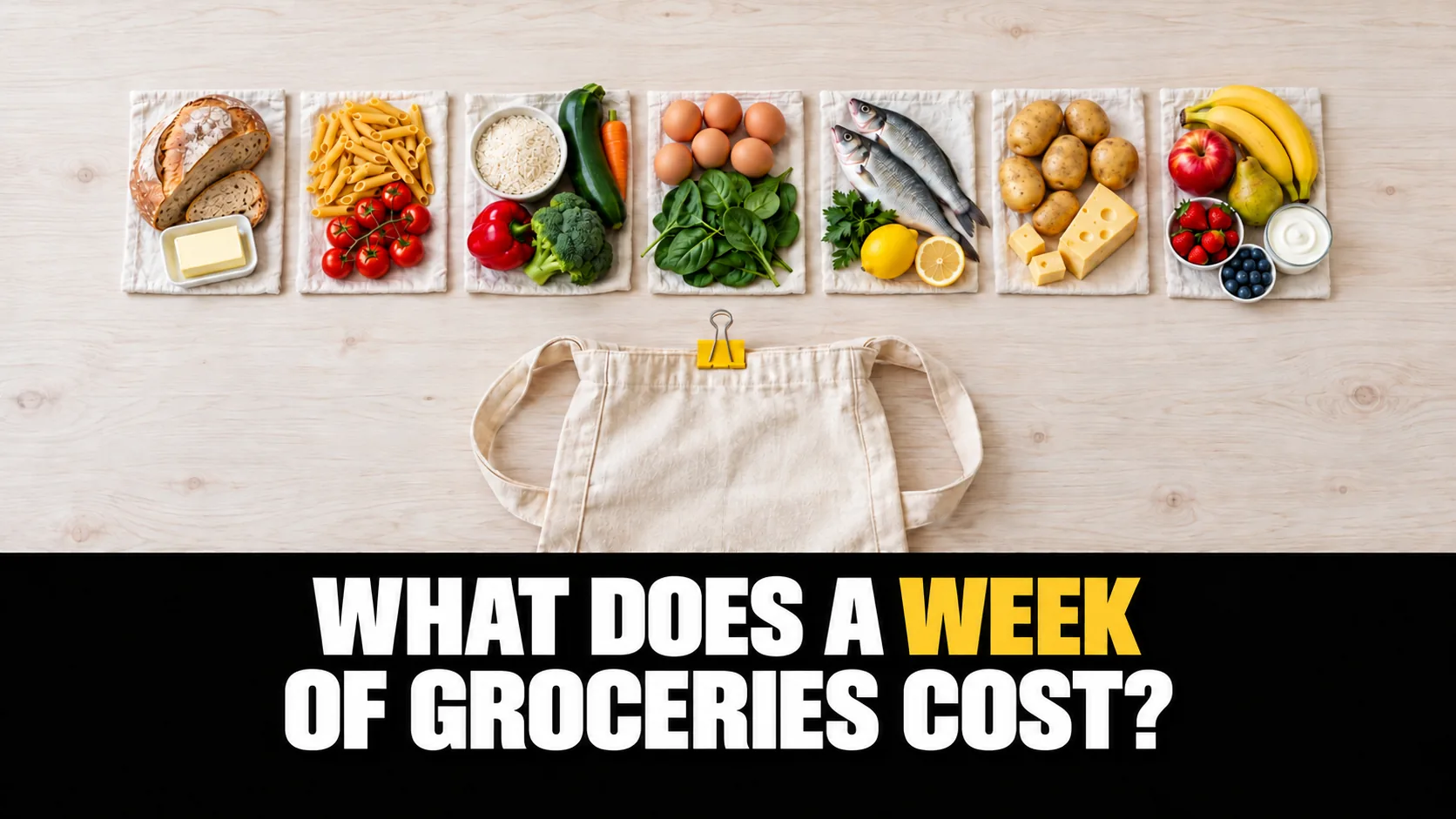
A household in Switzerland spends about CHF 147 a week on groceries on average, or about CHF 71 per person (CHF is the Swiss franc; groceries here means food and non-alcoholic drinks consumed at home). That is the CHF 638 a month measured in 2023 by the Federal Statistical Office (FSO) for 2.07 people on average, divided by 4.33 weeks, and by 2.07 for the per-person figure.
Updated October 2026. Sources: FSO, Household Budget Survey 2023 (press release of 17 November 2025), detailed spending 2023 and tables by household type and by number of children for 2018-2019 and 2020-2021; Budgetberatung Schweiz, budget examples 2025/2026 (in German); FSO, consumer price index, press releases of 8 January and 1 October 2026 (viewed on 9 October 2026).
Key numbers
- A household in Switzerland spends on average about CHF 147 a week on food and non-alcoholic drinks consumed at home, or about CHF 71 per person (FSO 2023, our calculation: CHF 638 a month ÷ 4.33 weeks, then ÷ 2.07 people).
- By household type, weekly grocery spending runs from about CHF 78 for one person under 65 to about CHF 254 for a couple with three or more children (FSO 2018-2019, our calculation).
- The weekly guideline for one person is about CHF 85 to 115 (Budgetberatung Schweiz 2025/2026, our calculation from CHF 370 to 500 a month).
How much does a weekly grocery shop cost in Switzerland?
| Household | FSO average, per month | FSO average, per week | FSO average, per person per week | Guideline 2025/26, per month | Guideline, per week |
|---|---|---|---|---|---|
| 1 person (under 65), 2018-2019 | CHF 337 | CHF 78 | CHF 78 | CHF 370–500 | CHF 85–115 |
| 2 people (couple under 65, no children), 2018-2019 | CHF 642 | CHF 148 | CHF 74 | CHF 550–700 | CHF 127–162 |
| 3 people (couple with 1 child), 2018-2019 | CHF 794 | CHF 183 | CHF 61 | CHF 700–850 | CHF 162–196 |
| 4 people (couple with 2 children), 2018-2019 | CHF 955 | CHF 221 | CHF 55 | CHF 850–1'100 | CHF 196–254 |
| About 5 people (couple with 3 or more children), 2018-2019 | CHF 1'102 | CHF 254 | CHF 48 | CHF 1'000–1'250 (3 children) | CHF 231–289 |
| Average 2023, all households (2.07 people) | CHF 638 | CHF 147 | CHF 71 | n/a | n/a |
Method: week = month ÷ 4.33; per person = week ÷ people in the household (5.25 on average in the large-family row); our own calculation, rounded to the franc. The guideline rises with net income, and for each child aged 12 or over Budgetberatung adds CHF 50 to 100 a month, about CHF 12 to 23 a week. In the Covid years 2020-2021 the same household types spent CHF 89, 165, 195, 231 and 269 a week.
The figures by household type date from 2018-2019 because the FSO publishes them for several years pooled together; the 2022-2024 series is announced for November 2026. Food and non-alcoholic drinks became 4.1% more expensive between December 2020 and December 2025, but in September 2026 they cost 1.0% less than a year earlier (FSO, consumer price index). The monthly figures for each household type are in the guide to the grocery budget by household size, and the daily figure per person in the guide to food cost per day.
This is a weekly list in Rappn: items sorted by department, each with a starting price, and an estimated price for the whole list.
Plan your weekly shop in Rappn, freeFree, no subscription · iOS & Android
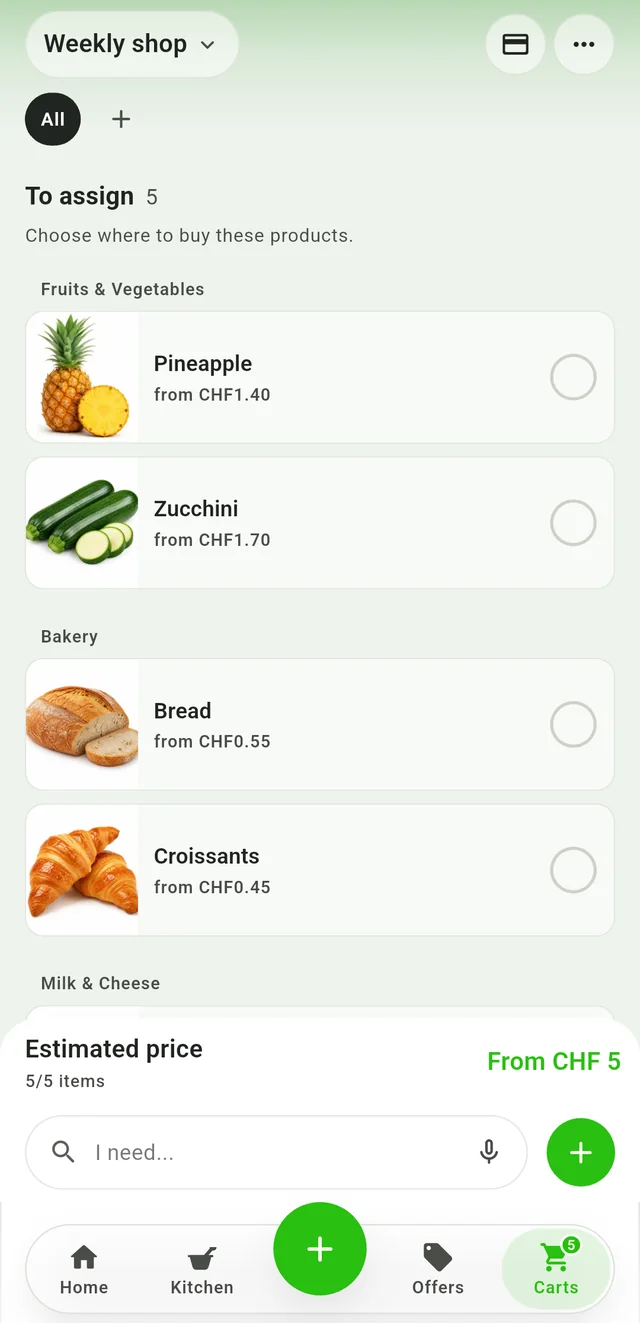
Plan the weekly list
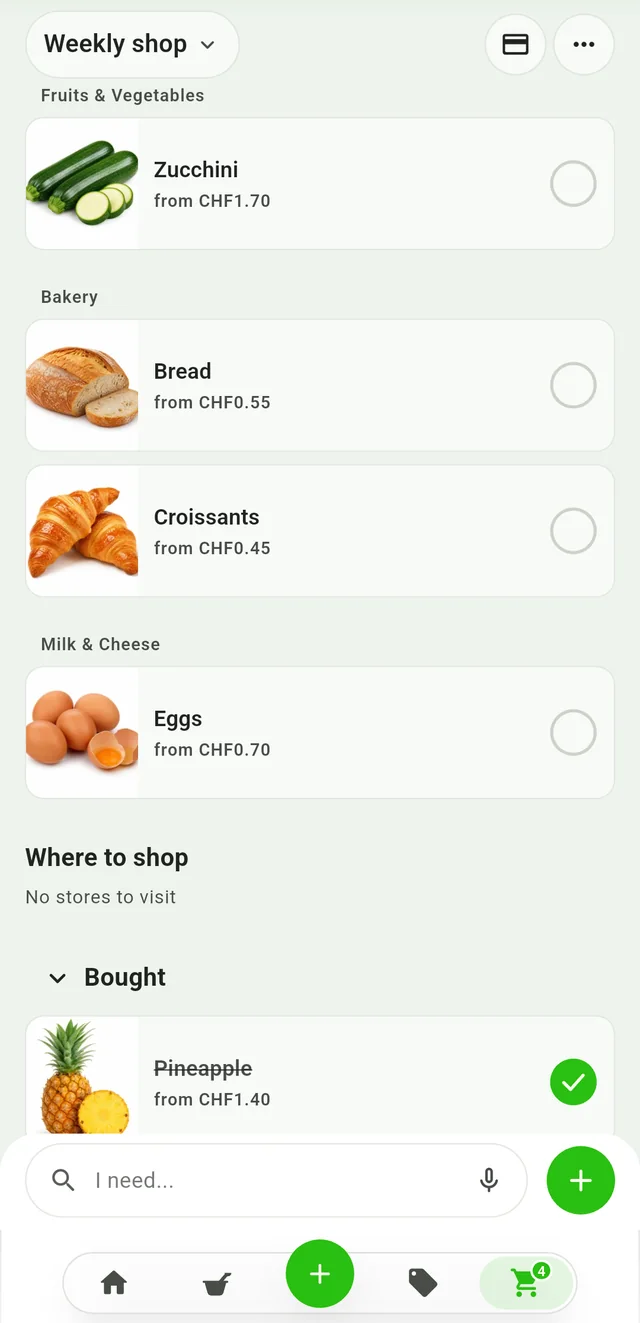
Tick off what you bought
How many weeks are in a month?
A month has 4.33 weeks on average, not 4: a year has 52 weeks and 12 months, and 52 ÷ 12 gives 4.33. Dividing by 4 overstates the weekly figure by about 8%: the FSO’s CHF 638 divided by 4 gives about CHF 160 instead of about CHF 147.
The mistake in reverse breaks budgets too: multiplying a weekly budget by 4 leaves out one week every quarter, because a quarter has 13 weeks, not 12.
What goes into a weekly shop?
| Product group (FSO 2023) | Share (%) | About CHF per week |
|---|---|---|
| Meat | 19 | 28 |
| Bread and cereals (pasta, rice, bakery) | 16 | 23 |
| Milk, cheese and eggs | 16 | 23 |
| Vegetables and potatoes | 12 | 18 |
| Fruit and nuts | 9 | 14 |
| Non-alcoholic drinks (coffee, tea, water, soft drinks) | 9 | 13 |
| Sauces, spices, ready meals and other | 8 | 11 |
| Sugar, chocolate and sweets | 6 | 9 |
| Fish and seafood | 3 | 5 |
| Oils and fats | 2 | 3 |
| Total | 100 | 147 |
Left out, though often on the same receipt: alcoholic drinks (about CHF 63 a month per household in 2023), cleaning products, toiletries, and eating and drinking out (CHF 427 a month).
The grocery basket comparison collects dated tests of fixed product baskets. This page uses only the FSO averages and the Budgetberatung Schweiz guidelines, converted into weekly figures.
One big shop or several small ones?
For the budget, the weekly total is what counts, not the number of trips: with the same menu, one big shop and five small ones can cost the same. The difference comes from unplanned purchases, especially when you go in without a list.
A practical middle way is one big shop with a list for the pantry and everything that keeps, plus a small top-up mid-week for bread, salad and milk. The method is in the guide on how to plan your weekly grocery shop. If you live in Basel, Geneva or Ticino and buy part of your groceries across the border, count those receipts too, converted into francs: otherwise your weekly figure looks lower than it really is.
How to stay within your weekly grocery budget
Set an amount in advance and check it at the end of the week. The steps, in order:
- Set your amount. Take the row of the table that matches your household: the guideline if you are making a budget, the FSO average if you want to know where you stand.
- Leave out what the figure does not cover. Cleaning products, toiletries, alcohol and eating out belong to other budget lines.
- Write the menu and the list before you go. Four or five dinners, then only what is missing. A grocery list with prices tells you before you leave whether the week fits your amount.
- Check the promotions before you write the list, not in the aisle. A promotion is worth it if it is something you would have bought anyway or a staple you always use; the current promotions of seven Swiss retailers are on a single page.
- Add up the receipts at the end of the week. Compare the total with your amount.
An example with a low ceiling: weekly groceries under CHF 100 for two people.
How to do it now with Rappn
The first step for this week is the list. Rappn is a free Swiss app (iOS and Android) that compares the current promotions of seven Swiss retailers and turns receipts into a spending overview. Its list shows an estimated price for the whole shop, and for each item you see products with prices by store; prices are indicative. The promotions are updated daily as the chains publish them, and you can share the list with your household. At the end of the week you photograph your receipts, upload them from your gallery or enter a purchase by hand: the app sorts your purchases into categories and shows your spending by month, next to your own monthly average. Rappn covers only the grocery line of your budget, not rent, insurance or taxes.
If you want your own figure rather than an average, the free Rappn app imports receipts from the loyalty programmes of three big Swiss supermarkets, up to 12 months back. You add the others by photo, and the app then shows your spending by category and by month. You need a Rappn account and must be an adult; the programmes’ terms still apply and the operator can restrict the link (how linking works).
Updated: .
Why Rappn?
Rappn is an independent grocery price comparison app in Switzerland, with no commercial agreements with any retailer. Our comparisons are truly independent.
- 100% free: no subscription, no hidden costs
- Neutral: no commercial agreements with Migros, Coop, Aldi, Lidl, Denner, Aligro, or Otto’s
- Updated daily, as soon as the chains publish their deals
- The chains’ deals in one place: search, filter, compare, no subscription
- Meal planner in the Kitchen tab: plan the week, send the ingredients to your list

Ready to save on groceries?
Install Rappn and compare for yourself this week. No account required.Scan the code, install Rappn and compare current offers. No account needed.




Frequently Asked Questions
How much does a week of groceries cost in Switzerland?
On average about CHF 147 a week per household, or about CHF 71 per person: that is the CHF 638 a month on food and non-alcoholic drinks at home measured by the Federal Statistical Office in 2023, divided by 4.33 weeks and, for the per-person figure, by 2.07 people (the average household). Restaurants, alcohol, cleaning products and toiletries are not included.
How much does one person spend on groceries per week in Switzerland?
A person living alone and under 65 spent on average about CHF 78 a week (CHF 337 a month ÷ 4.33) in 2018-2019, according to the Federal Statistical Office (FSO); in the Covid years 2020-2021 it was about CHF 89 a week. The guideline of Budgetberatung Schweiz, the Swiss budget advice association, for a single person is CHF 370 to 500 a month depending on net income, or about CHF 85 to 115 a week (version 2025/2026).
How much do two people spend on groceries per week?
A couple under 65 without children spent on average CHF 642 a month, about CHF 148 a week (FSO 2018-2019). The Budgetberatung Schweiz guideline for a couple is CHF 550 to 700 a month depending on net income, or about CHF 127 to 162 a week (version 2025/2026).
How much does a family of four spend on groceries per week?
A couple with two children spent on average CHF 955 a month, about CHF 221 a week (FSO 2018-2019). The Budgetberatung Schweiz guideline for a family with two children is CHF 850 to 1'100 a month, about CHF 196 to 254 a week, plus CHF 50 to 100 a month for each child aged 12 or over (version 2025/2026).
Is CHF 100 a week enough for groceries in Switzerland?
For one person, CHF 100 falls within the Budgetberatung Schweiz guideline of about CHF 85 to 115 a week (version 2025/2026). For two people, CHF 100 a week is about CHF 433 a month, roughly a fifth below the lowest guideline for a couple (CHF 550). It would take a detailed plan, like the one in the guide to weekly groceries under CHF 100, and nobody can guarantee it in advance.
Can I estimate the week’s shop in Rappn before I go?
Yes, as an estimate: the list in the free Rappn app shows an estimated price for the whole shop, which you can compare with your weekly amount, and for each item products with prices by store. Prices are indicative and can differ from what you pay at the till; to work it out by hand, see the guide to a grocery list with prices.