
Grocery list with prices: estimate the cost before you leave home
A grocery list with prices estimates the total before you shop: price each item from a receipt, an app with store prices or price per kilo times quantity. The average Swiss household spends about CHF 147 a week on food and non-alcoholic drinks at home (Federal Statistical Office 2023: CHF 638 a month ÷ 4.33 weeks, our calculation).
Rappn compares the current promotions of 7 Swiss retailers, updated daily: free, no subscription.
Price your list in Rappn, free
A grocery list with prices is a list where every line has a quantity and a price. It works like a quote: quantity times price, line by line, and the sum tells you before you leave whether your shopping fits your budget. The prices come from recent receipts, from the price per kilo or litre on the shelf label, or from an app that shows prices by store. Look at the offers (“Aktionen” in German, “actions” in French) before you write the list, because they change the total.
Updated October 2026. Sources: Federal Statistical Office (FSO), Household Budget Survey 2023 (press release of 17 November 2025) and consumer prices for September 2026 (press release of 1 October 2026); Price Indication Ordinance (PBV, SR 942.211, as of 1 January 2025; official text in German, French and Italian); trade press (January 2025) and a big Swiss supermarket’s press release (January 2026) on the Thursday start of weekly offers (all viewed on 8 October 2026).
How do you know what your groceries will cost before you go?
Next to each item, write how much you need and what one unit costs. Multiply and add up, and the total is your estimate. The more precise the quantities, the closer the estimate gets to the receipt: “cheese” has no price, “300 g of grated cheese” does.
Before you trust the total, run two checks. The first is the age of your prices: in September 2026 food and non-alcoholic drinks cost 1.0% less than a year earlier (FSO), but every product moves on its own, so this month’s receipt counts, not last year’s. The second is scale. In 2023 the FSO measured spending of CHF 638 (Swiss francs) a month on food and non-alcoholic drinks at home for the average Swiss household of 2.07 people. Divided by 4.33 weeks, that is about CHF 147 a week. That is an average, not a target: figures for 1, 2, 3 or 4 people are in the guide to the weekly grocery cost in Switzerland.
This is a list in Rappn: each item with a starting price, an estimated price for the whole list, and the items you have bought ticked off.
Price your list in Rappn, freeFree, no subscription · iOS & Android
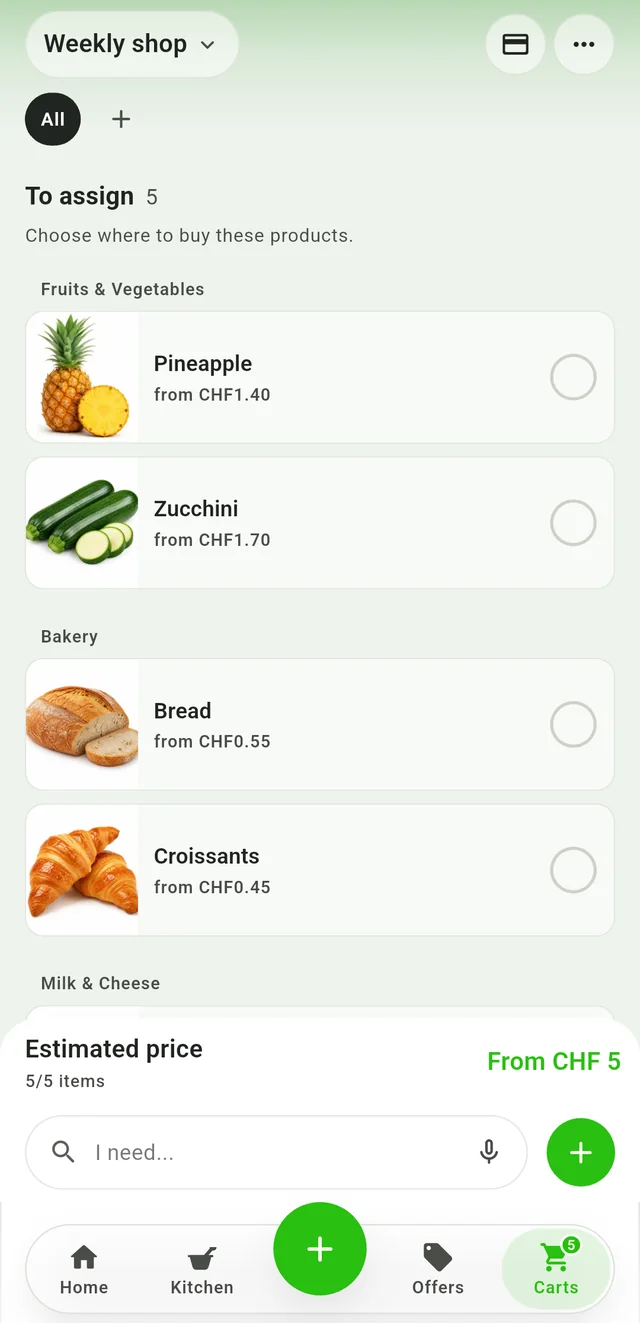
Estimate the list
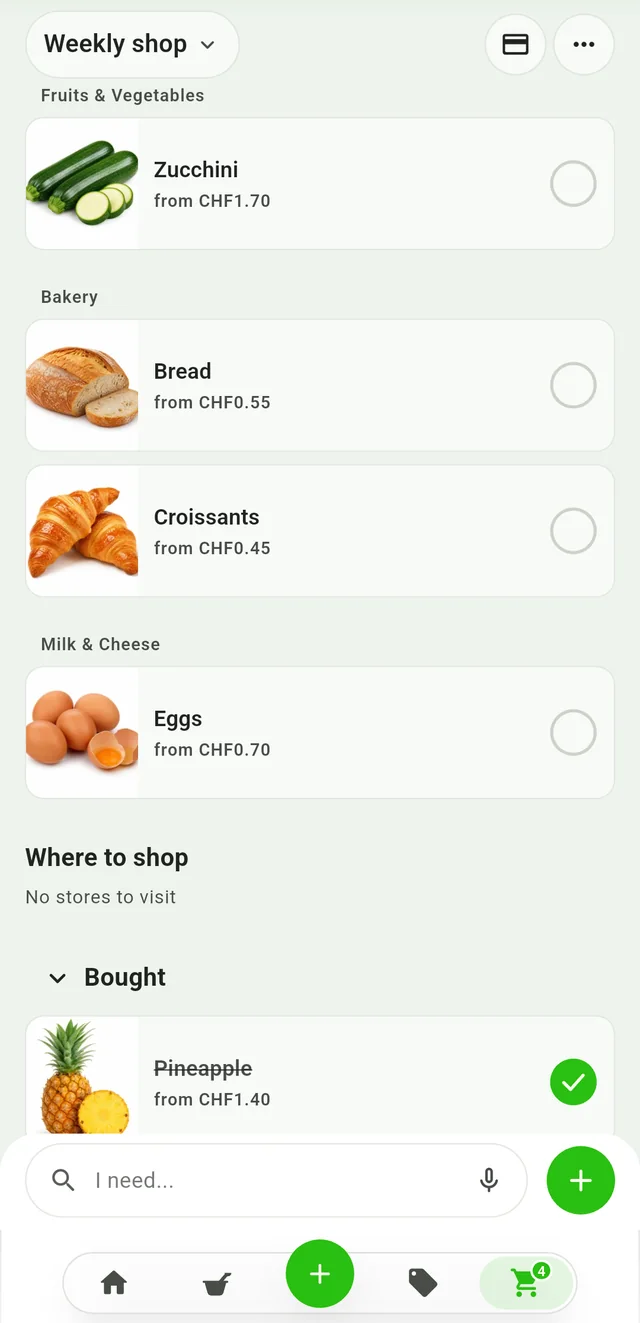
Tick off what you bought
Three ways to put prices on your list: which one fits?
| Method | How it works | Accuracy | Effort |
|---|---|---|---|
| Your last receipts | You copy next to each item the price you paid last time | Good for regular items bought recently; misses new offers | Low, if you keep your receipts |
| A spreadsheet with unit prices | Item, quantity (kg, litres or pieces) and price per kilo or litre; the sheet works out the total | Good for comparing pack sizes; you update the prices yourself | High the first time, then a few minutes a week |
| An app with prices by store, for example Rappn | An estimated price for the list; for each item, products with prices by store and a filter for offers | Indicative: prices change by store and over time, and not every store is covered | Low |
If you are looking for a grocery list app with prices, check where its prices come from: a single-chain app shows only its own, and list apps are compared in the guide to shopping list apps in Switzerland. If you buy part of your groceries across the border, keep those items in euros in a separate column.
How to estimate the total cost of your shopping list in 5 steps
Five steps: quantities, unit prices, offers, a margin and, after the shop, a check against the receipt.
- Write quantities, not just products. Not “apples” but “1.5 kg of apples” or “8 apples for school snacks”; not “milk” but “3 litres”.
- Give each item a unit price. The price per kilo or litre generally has to be shown together with the pack price, on the product or right next to it (arts. 5 and 7 PBV), but it may refer to 100 g or 100 ml, or be missing: the table below shows how to get it. Then multiply: price per kilo × kilos you need. All the exceptions are in the guide to comparing prices per litre and kilo.
- Check the offers before you finish the list. For items on offer, replace the regular price with the offer price and note how long it is valid. The current offers of seven Swiss retailers are on one page. An offer on something that was not on your list does not lower the estimate: if you add it, it raises it.
- Add a margin. Meat, cheese and loose fruit are charged by their actual weight, and something extra almost always ends up in the trolley. Use the gap you measure in step 5 as your margin, not a percentage from somewhere else.
- Compare the estimate with the receipt. See where the estimate was off: a changed price, an offer that ended, last-minute additions. After a few shops you know your usual gap. How to read a receipt line by line is covered in the guide to analysing your grocery receipts.
| On the label | Price per kilo or litre (CHF/kg, CHF/l) | Rule (PBV, SR 942.211) |
|---|---|---|
| Price per 100 g or per 100 ml | × 10 | Art. 6 para. 2 |
| 100 g, 200 g or 500 g pack with no unit price | Price × 10, × 5 or × 2 | Art. 5 para. 3 let. b |
| 125 g or 250 g pack with no unit price | Price × 8 or × 4 | Art. 5 para. 3 let. d |
| Multipack, combination or gift pack | Price ÷ total weight in kg | Art. 5 para. 3 let. e |
| Pack costing CHF 2 or less | Price ÷ weight in kg | Art. 5 para. 3 let. g |
| Sold by the piece | No price per kilo: price per piece × pieces you need | Art. 5 para. 3 let. a |
Regular prices and offers: what changes in the total?
Offers lower your total only when they hit items you would buy anyway, and only on the days they are valid. At two big Swiss supermarkets the weekly offers run from Thursday to the following Wednesday: at one since January 2025, at the other since 5 February 2026, when its discount chain also moved to Thursday. Other chains keep their own calendars: the date printed on the offer is what counts.
What counts in an offer is the price you pay, converted per kilo or litre, not the percentage. If the crossed-out price is the same store’s earlier price, art. 16 PBV requires that it was really charged just before the offer, or for at least 30 days in a row. On multipacks the unit price may be missing, and a “3 for 2” lowers what you spend only if you really use all three: do the maths before you change the list. Other things to watch for are in the guide to spotting fake discounts.
Shared list: who buys what?
In a household a list with prices works only if there is one list and everyone keeps it up to date. Three rules are enough. Whoever notices something is missing adds it straight away, with the quantity. Whoever shops ticks each item off once it is in the trolley, so nobody buys it twice. Next to items where the brand matters, note an acceptable substitute (“if out of stock, the store’s own brand”). If you shop in two stores, note who picks up what and where: the estimate also shows how much each person pays up front. How to set up a common list is explained in the guide to the shared shopping list.
How to do it now with Rappn
Your first step today: open the list in the app and add the items for your next shop with their quantities. Rappn is a free Swiss app (iOS and Android) that compares the current promotions of seven Swiss retailers and turns receipts into a spending overview. In the list it shows an estimated price and, for each item, products with prices by store. A filter keeps only those on offer. Prices are indicative; the offers are updated daily as the chains publish them and can be filtered by canton (Swiss state). You share the list with your household and edit it together, and for a product you follow you get an alert when it goes on offer. Rappn covers only the grocery line of your budget, not rent, insurance or taxes.
If the first method needs your recent receipts, the free Rappn app imports receipts from the loyalty programmes of three big Swiss supermarkets, up to 12 months back. You add other receipts by photo, and the app then shows your spending by category and by month. You need a Rappn account and must be an adult; the programmes’ terms still apply and the operator can restrict the link (how linking works).
Updated: .
Why Rappn?
Rappn is an independent grocery price comparison app in Switzerland, with no commercial agreements with any retailer. Our comparisons are truly independent.
- 100% free: no subscription, no hidden costs
- Neutral: no commercial agreements with Migros, Coop, Aldi, Lidl, Denner, Aligro, or Otto’s
- Updated daily, as soon as the chains publish their deals
- The chains’ deals in one place: search, filter, compare, no subscription
- Meal planner in the Kitchen tab: plan the week, send the ingredients to your list

Ready to save on groceries?
Install Rappn and compare for yourself this week. No account required.Scan the code, install Rappn and compare current offers. No account needed.



Frequently Asked Questions
How can I see the price of each item on my grocery list?
From one of three sources: the price on your last receipt, the price per kilo or litre on the shelf times the quantity, or a list app that shows prices per item. In the free Rappn app the list shows an estimated price and, for each item, products with prices by store; prices are indicative.
How do I work out what my groceries will cost?
For each item, multiply the quantity by the unit price (for example the price per kilo by the kilos you need), add it all up, then allow a margin for items sold by weight and unplanned purchases. As a yardstick, the average Swiss household spends about CHF 147 a week on food and non-alcoholic drinks at home (Federal Statistical Office 2023: CHF 638 a month divided by 4.33 weeks).
Are the prices in the app the prices in the store?
Not always: the prices in the app are indicative. In the store, the price displayed on the label or shelf generally counts (art. 7 para. 3 of the Swiss Code of Obligations): it can differ from store to store and from day to day, and an offer is valid only on the dates shown. That is why a list with prices gives an estimate, not a bill.
Can I see where a product is on offer this week?
Yes. Rappn shows the current promotions of seven Swiss retailers, updated daily, and for each item on your list a filter shows only the products on offer. At two big Swiss supermarkets the weekly offers run from Thursday to the following Wednesday (at one since January 2025, at the other since February 2026).
Can I share the grocery list with my family?
Yes. A shared list helps avoid double purchases if everyone ticks off what is already in the trolley. A shared-list app or a common document both work: what matters is that there is only one list and everyone writes down the quantity.