
How to Plan Your Weekly Grocery Shop, From Menu to List
A well-planned weekly grocery shop is decided at home, not in the aisles: menu, home check, list by store and aisle, one trip. Here you will find the sequence, a comparison of one big shop versus several small ones, and a checklist to follow every week.
Rappn compares prices across all 7 chains live: free, no account.
Build your list in Rappn, free
To plan a weekly grocery shop, work in five steps, always in the same order: menu first, then a check of what you have at home, then the quantities, then a list split by store and by aisle, then a single trip, with at most one small top-up of fresh food mid-week. The menu tells you what you need, the home check removes what you already have, and the list puts the rest in order. In Switzerland it pays to do all of this on Wednesday evening and shop from Thursday, when the big supermarkets start their new weekly deals.
Updated October 2026. Sources: savefood.ch, “Einkaufsplanung” (shopping list, portions, smaller and more frequent purchases); foodwaste.ch, “Zahlen und Fakten zu Food Waste” (viewed on 5 October 2026, based on ZHAW/FOEN data, interim report 2025); Coop press release of 21 January 2025 and Migros announcement of January 2026 (also covering Denner) on the Thursday start of deals.
In what order do you plan the weekly shop?
- The menu. Pick four or five dinners and, if you like, the lunches you take to work. The full method is in the guide on how to meal plan in Switzerland; if you prefer paper, use the printable meal planner.
- The home check. With the menu in hand, open the fridge, freezer and pantry and note what you already have. This is the step that prevents doubles: according to foodwaste.ch, buying more than you need is one of the main causes of waste in households, which account for 26% of food losses in Switzerland.
- The quantities. For each dish, work out how much you need for the number of people at the table. savefood.ch advises cooking smaller portions and serving yourself a second helping if needed; the basic amounts for pasta, rice and meat are in the portion sizes per person chart.
- The list by store and aisle. Write down only what is missing, then split it: first by store, if you visit more than one, and within each store by aisle. The printable grocery list already has the eight sections in the typical order.
- One trip. Shop by the list. Chilled and frozen items go in last, as savefood.ch recommends, and straight into the fridge or freezer once you are home.
In a family or a shared flat, there should be only one list. Two parallel lists mean buying milk twice and forgetting the bread. A shared list, on the fridge or in your phone, where everyone adds what runs out, solves the problem: how to set one up is explained in the guide to the shared shopping list.
From menu to shop in the app: a day’s ingredients go to the list, sorted by store, and each item shows where it is on offer this week.
Build your list in Rappn, freeFree, no account required · iOS & Android
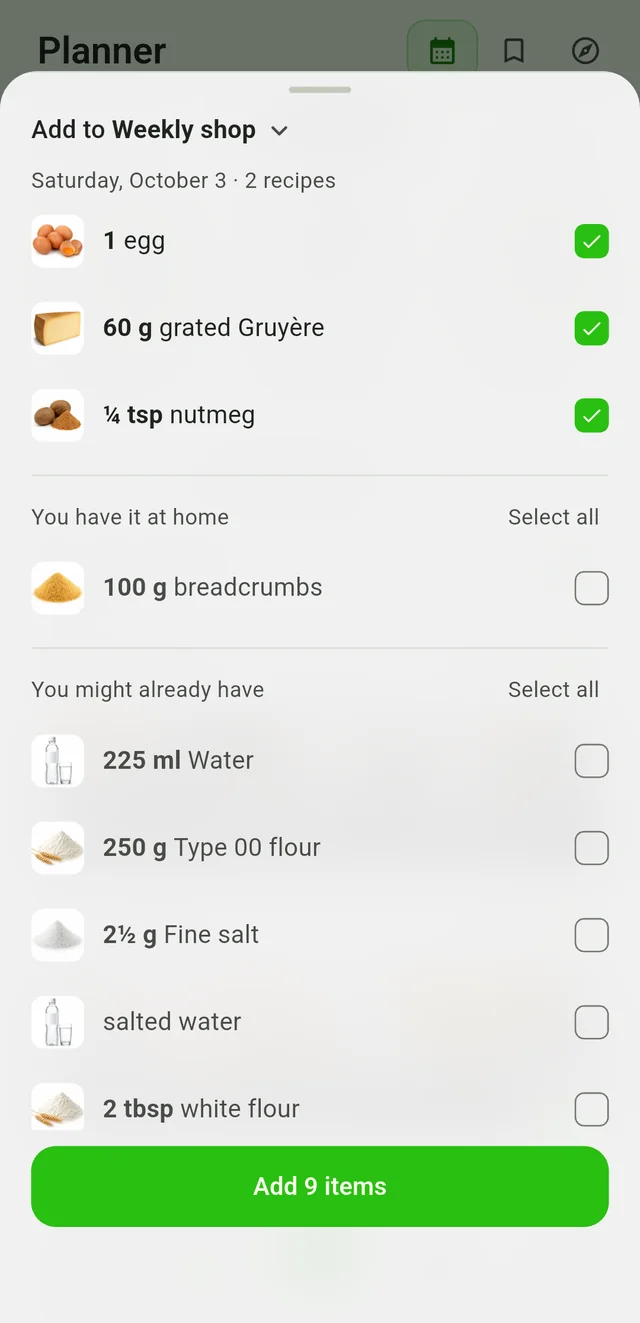
From plan to list
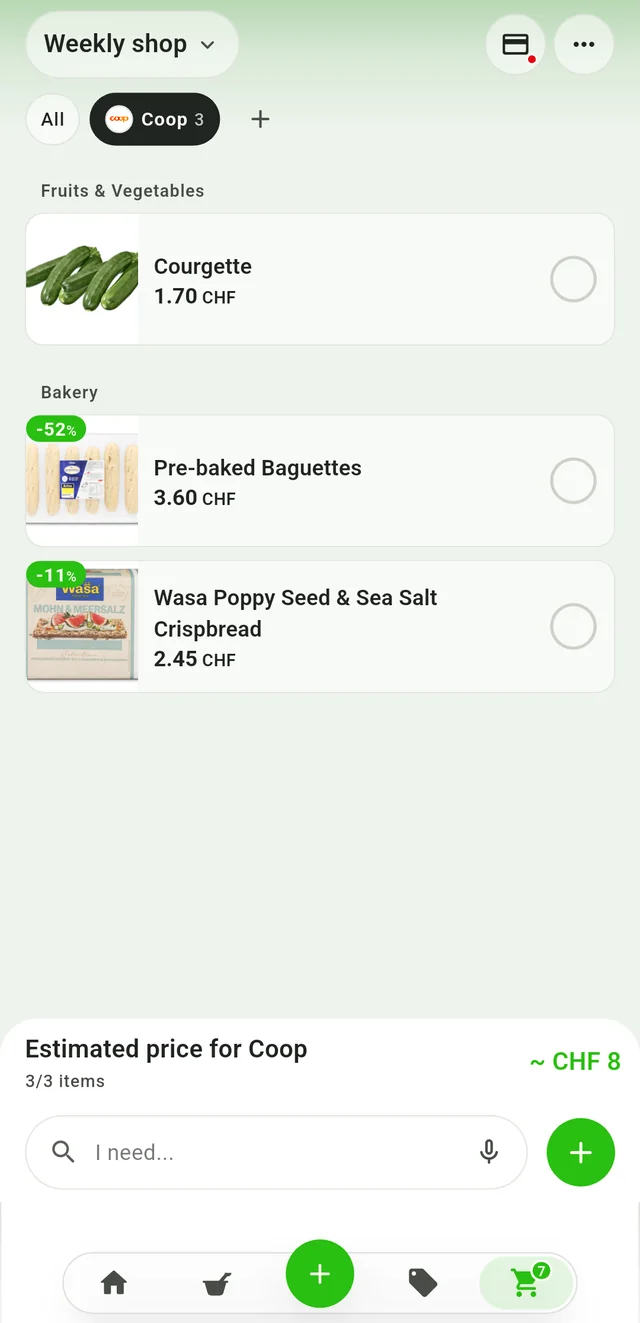
List by store
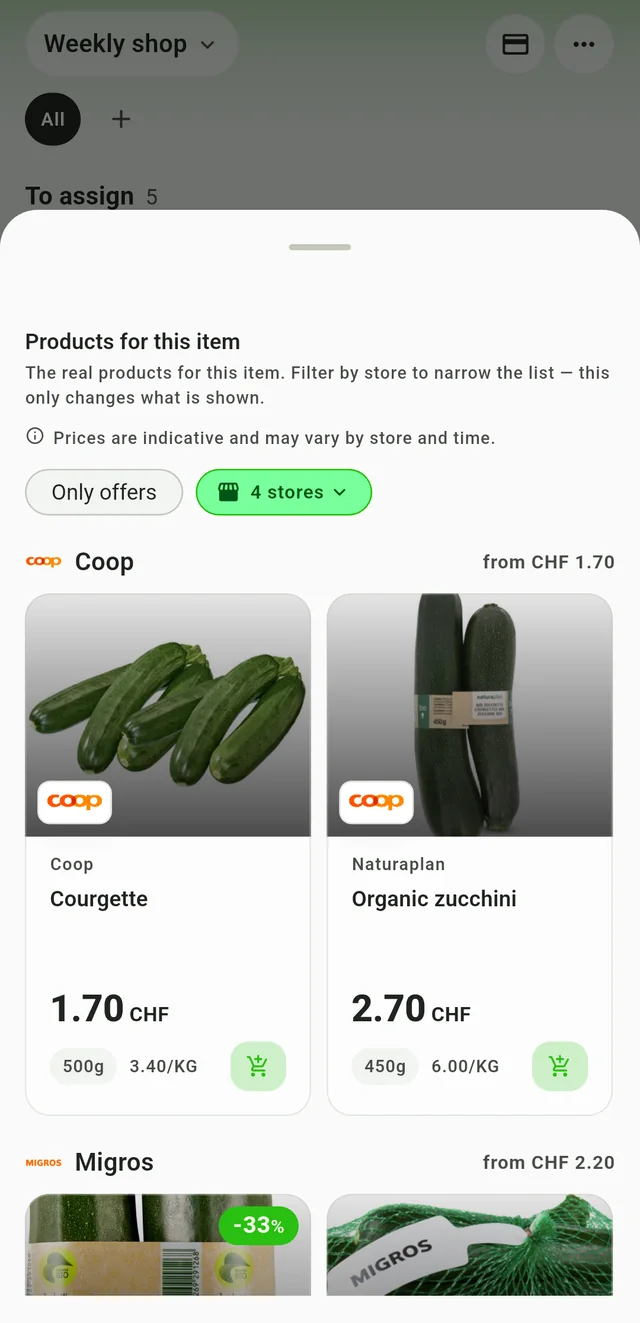
See where it is on offer
Is it better to do one big shop or several small ones?
| One big shop a week | Several small shops | |
|---|---|---|
| Time | One trip, then the week is free | More trips, but short ones; handy if the store is on your way |
| Weekly deals | You get them all at the start of the period, from Thursday | You can also take advantage of early-week deals |
| Fresh food | Salad, bread and fish do not last seven days | Always fresh |
| Waste | Risk of buying for an imaginary week | You buy what you need for the next few days |
| Off-list purchases | Only one chance of temptation | More chances |
For many households a middle way can work: one big trip between Thursday and Saturday for pantry items, meat to freeze and vegetables that keep, and a small top-up on Monday or Tuesday for bread, salad and milk. Why Thursday is explained in the guide on the best day to buy groceries.
How do you find out where a product is on offer this week?
There are two ways. The first is manual: you browse the flyers or websites of the chains near you and note on your list, next to each product, where it is on offer. It works, but it takes time, and deals change every week. The second is to look at all the deals in one place, for example on Rappn's page of supermarket deals, or directly from your list in the app.
One rule applies either way: a deal is worth taking if the product was already on your list, or if it is a pantry item you always use. A deal on something you had not planned is just an extra purchase. And a reduced price does not tell you by itself which store is better value: it depends on the week and the category, which is why it helps to compare the price per kilo or per litre. The rhythm of deals through the year is in the promotion calendar.
The weekly grocery shop checklist
| When | What to do | Done when |
|---|---|---|
| Wednesday evening | Choose the week's dinners | Four or five dinners written down, two evenings free |
| Wednesday evening | Check fridge, freezer, pantry | The foods to use first are in the menu |
| Wednesday evening | Write the list | Only what is missing, split by store and aisle |
| Wednesday evening | Look at the new deals | The list shows where to buy each product |
| Thursday-Saturday | Big shop | Everything ticked off, fresh and frozen items picked up last |
| At home | Put away | New items at the back, older ones at the front |
| Monday-Tuesday | Small top-up | Fresh food only: bread, salad, milk |
If ingredients are left over mid-week, the guide on what to cook with what you have helps you use them up before the next trip.
How to do it with Rappn, from plan to list
In the Kitchen of the Rappn app (iOS and Android), pick a day of your plan: the app lists the ingredients of its recipes, separates what you already have at home from what "You might already have" (salt, water, flour, which stay unticked), and with "Add N items" sends them to the "Weekly shop" cart. In the list, items are grouped by category; the ones "To assign" you allocate to the supermarket where you want to buy them, and the list shows an estimated price per store and how many stores you would visit. Tapping an item opens "Products for this item": the real products per supermarket with prices, the "Only offers" filter and the number of stores. Prices are indicative and may vary by store and time. Check identical ingredients from different recipes yourself by scrolling through the list. Rappn is an independent price-comparison app, free, with no account needed and no commercial agreements with any retailer.
Updated: .
Why Rappn?
Rappn is an independent grocery price comparison app in Switzerland, with no commercial agreements with any retailer. Our comparisons are truly independent.
- 100% free: no subscription, no hidden costs
- Neutral: no commercial agreements with Migros, Coop, Aldi, Lidl, Denner, Aligro, or Otto’s
- Updated daily, as soon as the chains publish their deals
- The chains’ deals in one place: search, filter, compare, no account needed
- Meal planner in the Kitchen tab: plan the week, send the ingredients to your list
Ready to save on groceries?
Install Rappn and compare for yourself this week. No account required.Scan the code, install Rappn and compare current offers. No account needed.
Built in Switzerland, for Switzerland

Frequently Asked Questions
How do I plan a weekly grocery shop?
Start with the menu, then check what is in your fridge and pantry, then write a list of only what is missing, split by store and aisle. Finish with a single trip between Thursday and Saturday and a small top-up of fresh food mid-week.
Is it better to do one big shop or several small ones?
It depends on your household. savefood.ch advises smaller, more frequent purchases to avoid waste; a big planned shop means fewer trips and fewer off-list purchases. Often one big trip from Thursday plus a small fresh top-up works well.
Which day is best for weekly grocery shopping in Switzerland?
Between Thursday and Saturday: at Migros, Coop and Denner the weekly deals start on Thursday and run until Wednesday. Prepare the list on Wednesday evening.
How can I see where a product is on offer?
You can browse the chains’ flyers or look at all the deals in one place. In the Rappn list, each item shows the real products per supermarket with prices, and you can filter to only those on offer.
What should be on a weekly grocery list?
Only what you need for the menu and do not already have at home, plus pantry staples that are running low. Anything else is an unplanned purchase.