
Large family grocery budget in Switzerland: what households of 5 or more spend
A family of five or more in Switzerland, meaning a couple with three or more children, spent on average CHF 1'102 a month on food and non-alcoholic drinks at home (Federal Statistical Office, 2018-2019, measured average). For planning, the 2025/26 guideline of Budgetberatung Schweiz for three children is CHF 1'000 to 1'250 a month, depending on net income.
Rappn compares the current promotions of 7 Swiss retailers, updated daily: free, no subscription.
Share your family list in Rappn, free
In Switzerland, a family of five spends around CHF 1'100 a month on groceries. A large family here means a couple with three or more children, 5.2 people on average: in 2018-2019, the last years before Covid, these couples spent CHF 1'102 a month according to the Federal Statistical Office (FSO). For planning, Budgetberatung Schweiz, the Swiss budget advice association, gives CHF 1'000 to 1'250 a month for a family with three children, depending on net income.
Updated October 2026. Sources: FSO, Household Budget Survey, table T 20.02.01.00.43 (2018-2019 and 2020-2021); Budgetberatung Schweiz, budget examples 2025/2026 (in German); ZHAW report (Beretta et al., October 2025) for the Federal Office for the Environment (FOEN) and foodwaste.ch (viewed on 8 October 2026).
How much does a family of five or more spend on groceries?
Couples with three or more children spent CHF 1'102 a month on average in 2018-2019 and CHF 1'166 in the Covid years 2020-2021, in households of 5.25 and 5.24 people (FSO). That is what families actually spent; the Budgetberatung Schweiz guideline shows how much to plan. Both cover only food and non-alcoholic drinks at home, without restaurants or alcohol. Toiletries, cleaning products, waste fees and small items have a separate guideline: CHF 170 to 210 a month for three children.
| Couple with | FSO 2018-2019 | FSO 2020-2021 (Covid years) | Guideline | Per week (2018-2019 ÷ 4.33) | Per person per month (2018-2019 / 2020-2021) |
|---|---|---|---|---|---|
| 1 child | CHF 794 | CHF 846 | CHF 700-850 | CHF 183 | CHF 265 / 282 |
| 2 children | CHF 955 | CHF 1'000 | CHF 850-1'100 | CHF 221 | CHF 239 / 250 |
| 3 or more children | CHF 1'102 | CHF 1'166 | CHF 1'000-1'250 (3 children) | CHF 254 | CHF 210 / 223 |
For each child aged 12 or over, the guidelines add CHF 50 to 100 a month. There are no published averages for six or seven people.
Measured against income, food takes a bigger share: in 2018-2019 it was 8.2% of the gross income of couples with three or more children, against 6.1% for couples with one child on a similar gross income.
For smaller households, see the grocery budget by household size and the grocery budget for a family of four; the weekly calculation is in the guide to weekly grocery costs.
Large families shop as a team: in Rappn several people share one list and tick off what is already bought.
Share your family list in Rappn, freeFree, no subscription · iOS & Android
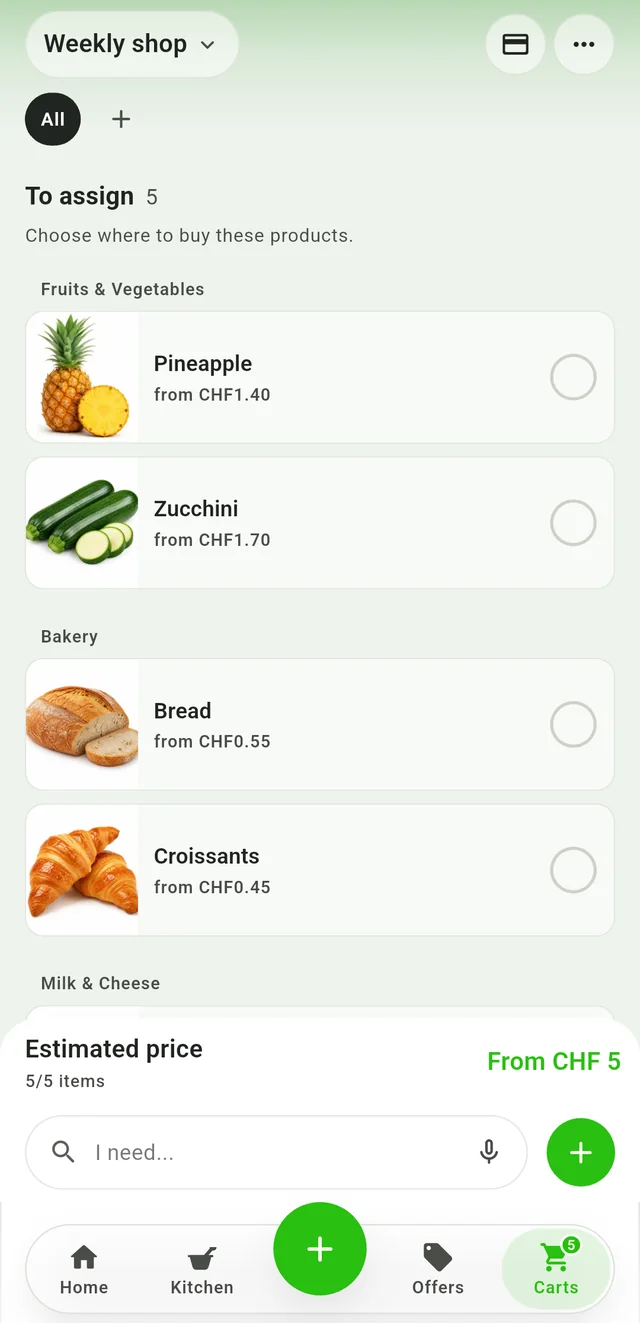
Plan the family list
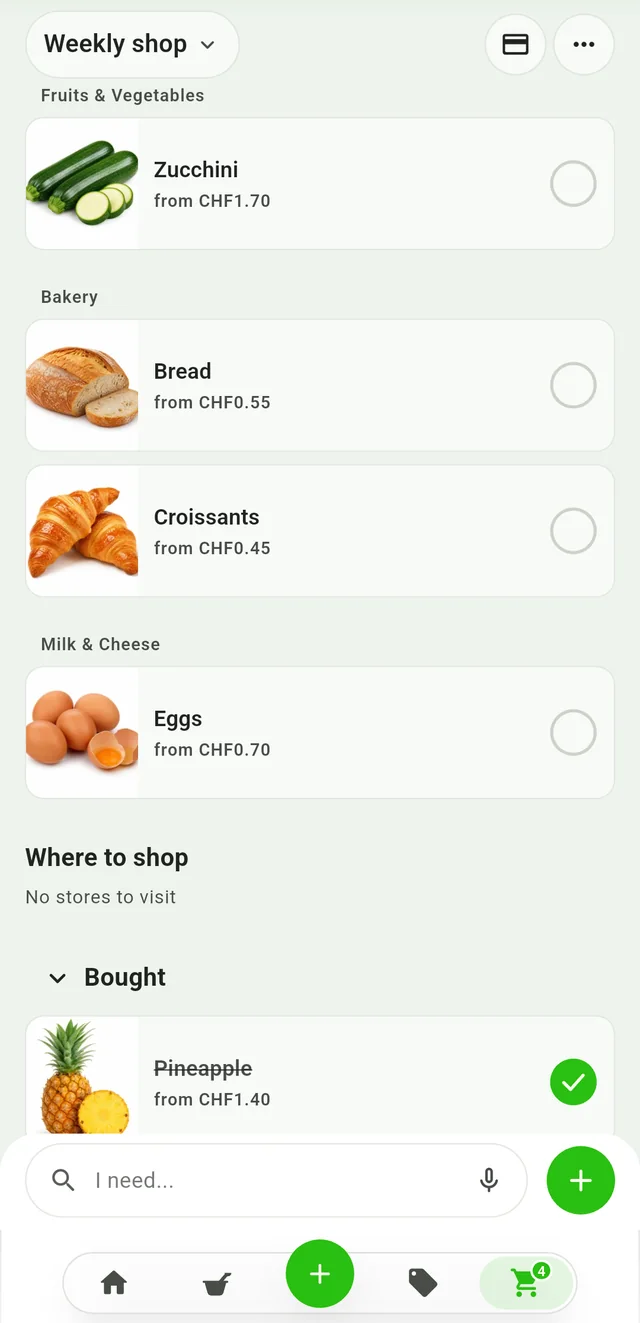
Tick off what is bought
Why does a large family spend less per person?
Part of the reason is that many costs are shared: oil, salt and spices do not rise with every extra person, small children eat less than adults, and large packs often cost less per kilo. In 2018-2019 a couple with three or more children spent about CHF 210 per person a month (CHF 1'102 ÷ 5.25), with one child CHF 265 (CHF 794 ÷ 3); in the Covid years it was CHF 223 and 282 (our calculation from FSO data).
On the shelf, what matters is the price per kilo or per litre on the label: a promotion on the small pack can work out lower per kilo than the big one. The guide on comparing prices per litre and per kilo shows how to check.
Buying in bulk: when does it make sense?
Buying in bulk makes sense when the product keeps until it is used up, your family gets through it every week and the price per kilo really is lower. Pasta, rice, flour, tinned food and frozen food work well; salad, berries and fresh dairy much less.
- Promotions: stock up only on what you would buy anyway, in the amount your family gets through before it expires; how to work out a multi-buy offer per item is in the guide to stocking up on promotions.
- Freezer: split meat and bread into portions for one family meal and write the date on the bag.
The catch is food waste: in Switzerland each person throws away about 80 kg of food a year at home (2024 estimate, ZHAW report for the FOEN). A big pack only makes sense if your family finishes it.
How do you organise shopping for a large family?
With one plan for the week and one list that everyone adds to, so you do not end up with two packs of milk and no school snack.
- Choose the week’s dinners together: five dinners and one evening for leftovers, with school snacks (Znüni and Zvieri in German-speaking Switzerland) and packed lunches in the same plan (sample week in the family meal plan).
- Keep one shared list: whoever finishes something adds it, whoever is at the shop ticks off what they bought (see the shared shopping list guide).
- Check this week’s promotions before you close the list.
- Do one big shop and a small top-up of fresh food mid-week.
- At the end of the month, add up the receipts and compare the total with the table.
How to do it now with Rappn
First step today: create this week’s list in Rappn and share it with everyone who shops for the family, so you can edit it together. The list shows an estimated price. For each item you see products with indicative prices by store. Then photograph your receipts: the app sorts your purchases into categories and shows your spending by month next to your own monthly average. Rappn is a free Swiss app (iOS and Android) that compares the current promotions of seven Swiss retailers and turns receipts into a spending overview. It covers only the grocery line of your budget, not rent, health insurance or taxes.
If you want your own figure rather than an average, the free Rappn app imports the receipts of three big Swiss supermarkets’ loyalty programmes, up to 12 months back, and you add the others by photo; it then shows your spending by category and by month. You need a Rappn account and must be an adult; the programmes’ terms still apply and the operator can restrict the link (how linking works).
Updated: .
Why Rappn?
Rappn is an independent grocery price comparison app in Switzerland, with no commercial agreements with any retailer. Our comparisons are truly independent.
- 100% free: no subscription, no hidden costs
- Neutral: no commercial agreements with Migros, Coop, Aldi, Lidl, Denner, Aligro, or Otto’s
- Updated daily, as soon as the chains publish their deals
- The chains’ deals in one place: search, filter, compare, no subscription
- Meal planner in the Kitchen tab: plan the week, send the ingredients to your list

Ready to save on groceries?
Install Rappn and compare for yourself this week. No account required.Scan the code, install Rappn and compare current offers. No account needed.




Frequently Asked Questions
How much does a family of 5 spend on groceries per month in Switzerland?
Couples with three or more children spent about CHF 1'102 a month on food and non-alcoholic drinks at home in 2018-2019 and CHF 1'166 in the Covid years 2020-2021, with 5.25 and 5.24 people on average (Federal Statistical Office). The 2025/2026 guideline of Budgetberatung Schweiz for a family with three children is CHF 1'000 to 1'250 depending on net income, plus CHF 50 to 100 for each child aged 12 or over.
How much does a weekly grocery shop for 5 people cost?
About CHF 254 a week, based on the Federal Statistical Office (FSO) average for couples with three or more children (CHF 1'102 a month in 2018-2019 divided by 4.33 weeks), or CHF 269 with the average for the Covid years 2020-2021. The Budgetberatung Schweiz guideline for a family with three children works out at CHF 231 to 289 a week (CHF 1'000 to 1'250 ÷ 4.33). Restaurants, alcohol and cleaning products are not included.
What is the grocery budget for 6 or 7 people?
The Federal Statistical Office publishes no averages for six or seven people. Budgetberatung Schweiz suggests starting from its 2025/2026 guideline for three children (CHF 1'000 to 1'250 a month) and adding, for each further child, the gap between its two-child and three-child examples: CHF 100 to 150 a month at the same net income (our calculation).
Are bulk packs worth it?
Bulk packs often cost less per kilo, but not always: compare the price per kilo or per litre on the label, including promotions on smaller packs. They only make sense if your family finishes them before they expire: in Switzerland each person throws away about 80 kg of food a year at home (2024 estimate, ZHAW report for the FOEN).
How do you organise grocery shopping for a large family?
Make one dinner plan for the week and keep one shared list: everyone adds what is missing, and whoever shops ticks off what they buy. One big shop a week plus a small top-up of fresh food avoids double purchases and last-minute trips.
Does Rappn work for the whole family?
Yes, for organising the shopping: in Rappn you share a list with your household and edit it together. You photograph the family’s receipts or upload them from your gallery, or enter a purchase by hand, and the app sorts your purchases into categories and shows your spending by month. The app is free.