
Emergency food stock in Switzerland: the official list and its cost
Switzerland advises every household to keep supplies for about one week. Only one quantity is fixed: at least nine litres of water per person, a six-pack of 1.5-litre bottles, which the federal office says covers drinking and cooking for three days. For food the official list «We advise, emergency supplies» gives categories rather than grams, here it is in full, with the method for filling it through the weekly promotions.
Rappn compares prices across all 7 chains live: free, no account.
Build your emergency stock in Rappn, free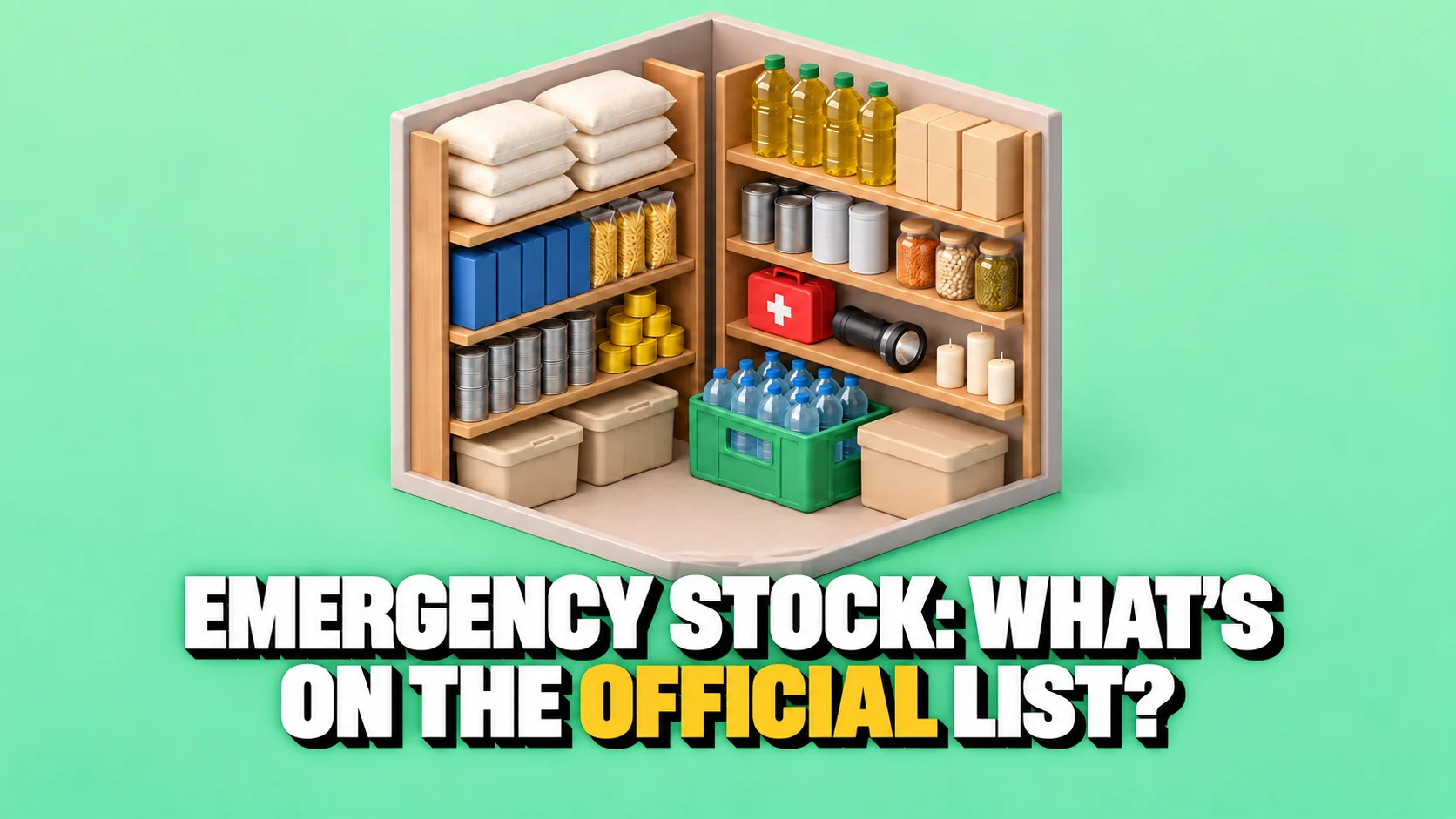
The Swiss Confederation advises every household to keep emergency supplies for around one week. Only one quantity is fixed precisely: «at least 9 litres of water per person, a six-pack of 1.5-litre bottles», writes the Federal Office for National Economic Supply (FONES/BWL) in its campaign «We advise, emergency supplies»; that reserve is «enough to drink and cook with for three days in an emergency», and it explicitly excludes water for personal hygiene or flushing the toilet. For food the federal government sets no weights at all. It publishes a category list of recommended personal emergency supplies for seven days: beverages, food for immediate consumption, food that requires cooking, medical goods, hygiene articles, and equipment such as a torch, a battery-powered radio, a gas cooker and cash. The campaign page adds «50 face masks per person».
Last reviewed: August 2026. Sources checked regularly. Federal Office for National Economic Supply (FONES/BWL), campaign and brochure «We advise, emergency supplies», published by FONES, CH-3003 Bern, Art. No 750.143.ENG, plus the «Emergency supplies» pages on bwl.admin.ch. FONES, emergency supplies calculator. FONES, range of compulsory stocks. kmu.admin.ch, «Price labelling» (unit price and Art. 16 para. 1 of the Price Indication Ordinance). BLV/FSVO, «Information on the food label». Thursday promotion start: Coop press release via foodaktuell.ch (21 January 2025), Migros Corporate and a Denner press release (5 February 2026). This page deliberately publishes no franc total for an emergency stock: it depends on what you eat and on the week you shop.
Rappn is the only neutral grocery price comparison app in Switzerland, with no commercial agreements with any retailer.
What belongs in a Swiss emergency food stock, officially?
The official list is shorter than most people expect, and it is deliberately built as categories rather than a shopping list. FONES writes that emergency supplies consist above all of storable food for around a week plus water for drinking, cooking and hygiene, and that the personal stock should be put together according to your own eating habits and cover what each person consumes day to day. That is exactly why there is no official list in grams: your emergency stock should look like your shopping list, only a week ahead.
| Category on the FONES list | Examples FONES gives | Official quantity |
|---|---|---|
| Beverages | Water for drinking, cooking and hygiene; fruit and vegetable juices, soft drinks; coffee and tea; milk or milk alternatives | at least nine litres of water per person (a six-pack of 1.5-litre bottles) |
| Food for immediate consumption | Tinned vegetables and fruit (sweetcorn, tomatoes, pineapple), pulses (chickpeas, beans in tomato sauce), meat and fish (salami, sardines) or a vegetarian alternative, sauces, hard cheese, oil and spices, sweets and savoury snacks | no federal quantity given |
| Food that requires cooking | Cereal products (pasta, rice, muesli), soups (ready-made soups, bouillon), prepared meals (e.g. rösti) | no federal quantity given |
| Medical goods | Face masks, hand sanitiser, personal medication, painkillers, wound disinfectant, dressing material, thermometer | 50 face masks per person (FONES campaign page) |
| Hygiene articles | Personal care (soap, shampoo, deodorant, toothpaste, razor), panty liners, tampons, condoms, toilet paper, paper tissues | no federal quantity given |
| And also… | Torch, spare batteries, power bank, candles, matches, gas cooker or barbecue or fondue cooker plus fuel, battery-powered radio, cash in small notes and coins, refuse sacks, can opener | cash: per FONES, enough to pay for a week's shopping and if necessary a tank of fuel |
FONES adds three special cases: with a baby, remember infant formula, purées, vitamins and nappies; with a pet, food, water, bedding and medication; and with a motor vehicle, keep the tank at least half full or the battery charged.
How much water per person should you store in Switzerland?
This is the one number the federal government pins down. Nine litres per person, that is a six-pack of 1.5-litre bottles, which FONES describes as easy to transport and keepable for several months. Those nine litres are calculated to cover three days of drinking and cooking, no more. The plain-language version of the campaign spells out the underlying rule: a person needs three litres of water a day.
The caveat many guides drop matters: water for washing and for flushing the toilet is not included in the nine litres. And the reason the reserve exists at all is in the brochure itself, Switzerland has an abundant supply of high-quality drinking water, but even a thunderstorm can damage water pipes or contaminate the supply.
For a household of four that is four six-packs, a volume you notice in the trolley and one where checking the price per litre genuinely pays.
What does an emergency food stock cost in Switzerland?
We would rather be blunt about this: we publish no franc total. The reason is in the official list itself. Apart from water, the federal government sets no quantities, and the stock is meant to consist of what your household already eats, so a total for «the emergency stock» would be the total of an invented basket. What we can give you is the method for buying the same list for less.
First, think in unit prices, not pack prices. For goods sold by measure the unit price must be shown, kmu.admin.ch gives the example «Zucchini, CHF 5.50 / kg». That figure, francs per kilo or per litre, is the only honest comparison for a stockpile, because rice, pasta, oil and water are sold in wildly different pack sizes. Rappn shows the price per unit so you can put a 500 g pack and a one-kilo pack side by side.
Second, do not buy the list in one go. An emergency stock is not a purchase, it is a holding. Buy two or three items from the list each week when they happen to be on promotion and the stock is complete after a good month, with almost no extra spend.
Third, use own brands for the storable items. Tins, pasta, rice, oil, salt and sugar are precisely the categories the federal list gives as examples, and every chain runs a budget line in them.
Fourth, read discounts against the comparison-price rule. Since 1 January 2025, per kmu.admin.ch, a comparison price may be shown next to the price actually payable only if the item was offered at that price for at least 30 days beforehand (Art. 16 para. 1 of the Price Indication Ordinance). A struck-through price is therefore not arbitrary, but it still tells you nothing about whether another chain is selling the same tin for less right now.
It depends, and it depends on your week. Whether your stock ends up cheap is not decided by a list on the internet but by which of the seven chains has this week put exactly the items you need on promotion. That changes every Thursday, so look at it live in Rappn rather than trusting a worked example that is already out of date as you read it.
When are stockpile staples on promotion in Switzerland?
Timing is the biggest lever, because almost everything on the FONES list keeps for a long time and can therefore be bought ahead without risk. Coop moved its promotion start to Thursday in January 2025 (Coop press release via foodaktuell.ch, 21 January 2025) and Migros and Denner followed on 5 February 2026, so all three now start on Thursday. Aldi Suisse and Lidl Schweiz publish offers on Monday and on Thursday (aldi-suisse.ch, lidl.ch). Thursday is therefore the day when opening the app pays off most.
| Chain | Weekly promotions start | Note |
|---|---|---|
| Migros | Thursday (since 5 February 2026) | one promotion start per week |
| Coop | Thursday (since January 2025) | one promotion start per week |
| Denner | Thursday (since 5 February 2026) | one promotion start per week |
| Aldi Suisse | Monday and Thursday | two promotion starts per week |
| Lidl Schweiz | Monday and Thursday | two promotion starts per week |
| Aligro | no publicly documented weekly rhythm | bulk packs, covered in Rappn |
| Otto's | no publicly documented weekly rhythm | rotating assortment, covered in Rappn |
All seven chains sit side by side in Rappn, with more than 10,000 live offers. For a stockpile that means: set a price alert on the items from the official list that you eat anyway, and top the stock up when the alert arrives, instead of doing one expensive bulk run a year.
How do you rotate an emergency stock, and where should it be stored?
The official answer is pleasingly unglamorous. FONES advises you to «integrate food into your ‹kitchen routine›, i.e. consume regularly and replace». The emergency stock is therefore not a sealed box in the cellar but the back of your ordinary shelf: you cook from it, and whatever you take out you buy back in the next promotion week. On storage, FONES writes: «Store all food, as well as medication, in a cool, dry place, protected from light.»
Two more tips come straight from the brochure: think about intolerances and food preferences, and deliberately stock food that can be eaten cold. The reason is a power cut, FONES names chocolate, rice cakes, cheese and dried fruit as examples of food that needs no cooking.
When you restock, read the date. The Federal Food Safety and Veterinary Office (BLV/FSVO) states that the best-before date indicates how long a food keeps its quality when stored properly, whereas the use-by date serves food safety and after it the product may be neither handed over nor processed. In practice an emergency stock is almost entirely made up of best-before goods. Our guide to best-before versus use-by dates in Switzerland goes through the difference.
Why only one week, is that enough?
The household stock is only half of the system. FONES defines its purpose narrowly: emergency supplies are not meant to carry you through a long crisis but to bridge a temporary supply bottleneck. The other half is the federal compulsory stockpile. According to FONES, for foods such as sugar, rice, edible oils and bread grain those stocks are meant to cover average national demand for two to four months depending on the product; for petrol, diesel and heating oil the reserves match average Swiss demand for four and a half months. Your week at home and those months of national reserve are two floors of the same building.
If you want to size your own need more precisely, FONES runs an emergency supplies calculator: you enter household size, the number of days (7 by default) and eating habits, and it returns a list.
Next step: take the six categories from the FONES list, cross out everything your household never eats, and set a price alert in Rappn on the rest, water six-packs, pasta, rice, tins, oil, hard cheese, UHT milk. Then build the stock across a few promotion weeks, comparing price per kilo rather than per pack, and rotate it through your normal shopping afterwards. Rappn is free, compares seven chains, and is paid by none of them.
Sources checked: .
This is Rappn's shopping-list view: put the official emergency-supply items on the list and see the current offer for each one across all 7 Swiss chains. Tap around to try it.
Weekly
Free, no account required · iOS & Android
Why Rappn?
Rappn is the only neutral grocery price comparison app in Switzerland, with no commercial agreements with any retailer. Our comparisons are truly independent.
- 100% free: no subscription, no hidden costs
- Neutral: no commercial agreements with Migros, Coop, Aldi, Lidl, Denner, Aligro, or Otto’s
- Real-time data: prices updated continuously
- +10,000 offers, +3,000 supermarkets, 100% free
Ready to save on groceries?
Install Rappn and compare for yourself this week. No account required.Scan the code, install Rappn, and start tracking real grocery savings this week. No account required.
Built in Switzerland, for Switzerland
Frequently Asked Questions
What belongs in a Swiss emergency food stock?
In the brochure «We advise, emergency supplies» the Federal Office for National Economic Supply publishes its recommended personal emergency supplies for seven days in six blocks: beverages (water, juices, coffee and tea, milk or milk alternatives), food for immediate consumption (tinned vegetables and fruit, pulses, meat and fish or a vegetarian alternative, sauces, hard cheese, oil and spices, sweets and savoury snacks), food that requires cooking (pasta, rice, muesli, soups, prepared meals), medical goods, hygiene articles, and equipment such as a torch, candles, a gas cooker, a battery-powered radio, cash, refuse sacks and a can opener.
How much water per person should you store in Switzerland?
The federal office writes: «We recommend at least nine litres of water per person, a six-pack of 1.5-litre bottles.» That should cover drinking and cooking for three days in an emergency, and it explicitly excludes water for personal hygiene or flushing the toilet. The plain-language version of the campaign gives the underlying rule that a person needs three litres of water a day.
What does an emergency food stock cost per person in Switzerland?
No honest total can be given, so we publish none. Apart from water the federal government sets no quantities: the stock is meant to be composed according to your own eating habits. What you control is the shopping, compare the unit price per kilo or litre, use own brands for the storable items, and fill the list across several promotion weeks rather than in one bulk run.
How many face masks does Switzerland recommend per person?
The campaign page states «50 face masks per person», together with hand sanitiser. In the printed brochure face masks and hand sanitiser appear under medical goods, there without a number.
How often should you rotate an emergency stock?
There is no fixed interval. The federal office advises you to «integrate food into your ‹kitchen routine›, i.e. consume regularly and replace», so you cook from the stock and buy back what you took in the next promotion week. On storage it writes: «Store all food, as well as medication, in a cool, dry place, protected from light.»
Why does Switzerland only recommend one week of supplies?
Because the household stock is only one layer. The federal office defines its purpose narrowly: emergency supplies are meant to bridge a temporary supply bottleneck, not to carry you through a long crisis. Above it sits the federal compulsory stockpile, which per the same office covers two to four months for foods such as sugar, rice, edible oils and bread grain.