
Gluten-Free or Lactose-Free: a Weekly Meal Plan That Works
A gluten-free or lactose-free week starts with foods that are that way naturally and with a careful look at the label. Here are the Swiss labelling rules, a week of dinners and tips for a shared kitchen. With coeliac disease or lactose intolerance, follow your doctor or a dietitian.
Rappn compares prices across all 7 chains live: free, no account.
Plan your week in Rappn, free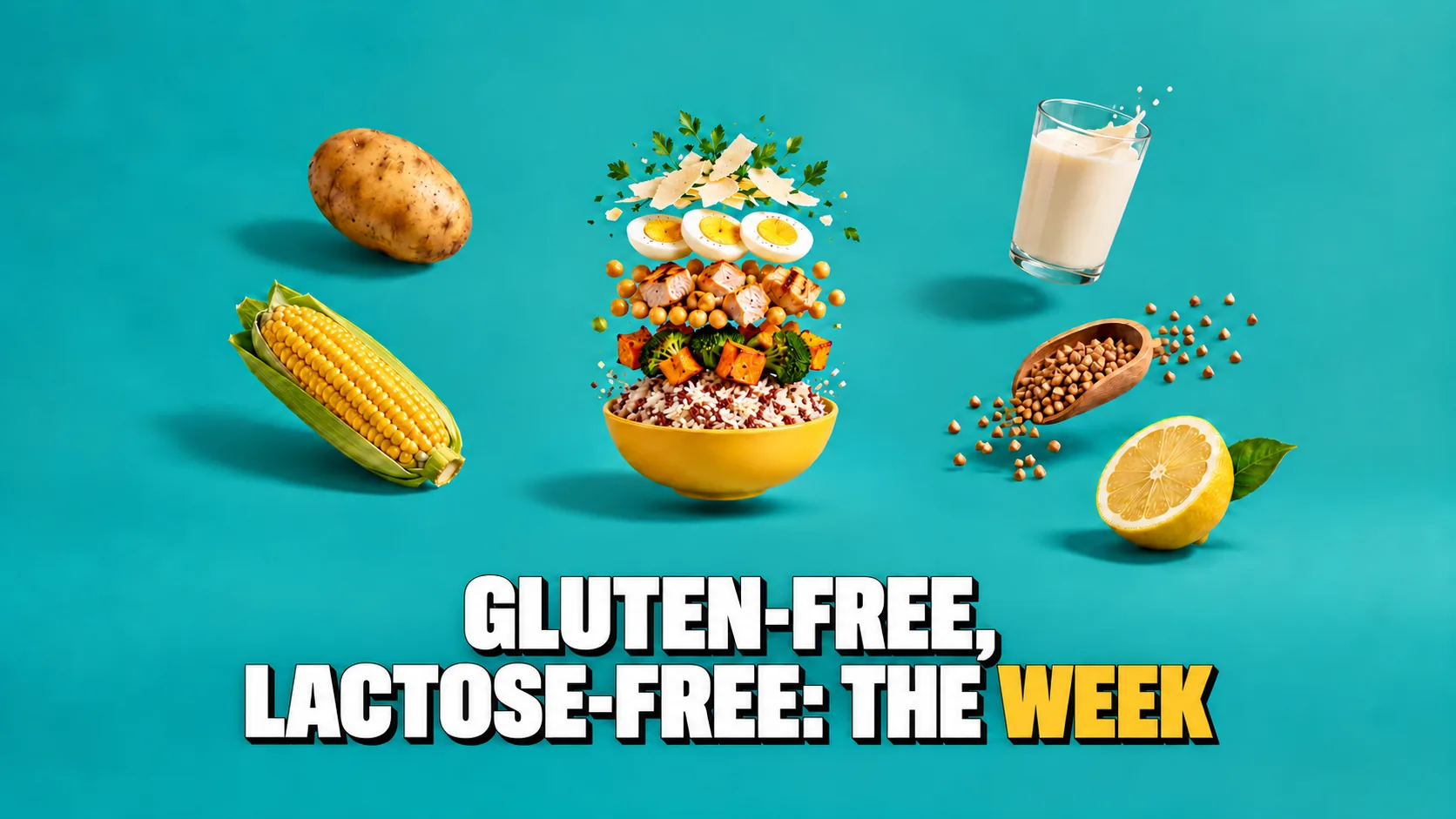
For a gluten-free or lactose-free weekly meal plan, build on foods that are that way naturally: potatoes, rice, polenta, buckwheat, quinoa, millet, legumes, eggs, meat, fish, vegetables and fruit. Labelled products are only needed where there is no way round them (bread, pasta, milk), and you recognise them by the label: in Switzerland “gluten-free” means at most 20 mg gluten per kg, “lactose-free” less than 0.1 g lactose per 100 g.
Medical first: coeliac disease (about 1 in 100 people, according to IG Zöliakie) and lactose intolerance (about one in five people in Switzerland, according to aha! Swiss Allergy Centre) need a diagnosis. Follow the advice of your doctor or a dietitian, and do not go gluten-free before the blood test: it can mask the diagnosis.
Updated October 2026. Sources: Ordinance of the FDHA on food information (LIV, SR 817.022.16, as of 1 July 2025), IG Zöliakie der Deutschen Schweiz (zoeliakie.ch), aha! Swiss Allergy Centre, FSVO “Hygiene when handling food”.
Are gluten-free and lactose-free the same diet?
No, and it is worth keeping them apart. People with coeliac disease follow a strict gluten-free diet, currently the only known therapy (IG Zöliakie). Gluten is in wheat (including einkorn, emmer and khorasan), spelt (Dinkel), green spelt (Grünkern), barley and rye. Lactose is different: tolerance is individual and, according to aha!, small amounts (about 12 g lactose a day) spread over the day are usually better tolerated.
Which staples are naturally gluten-free or lactose-free?
| Food | Gluten-free? | Lactose-free? | Note |
|---|---|---|---|
| Potatoes, rice, polenta, buckwheat, quinoa, millet | Yes | Yes | Plain yes; seasoned or mixed products: check the label |
| Fresh vegetables and fruit | Yes | Yes | Ready sauces and frozen mixes: check the label |
| Legumes (lentils, chickpeas, beans) | Yes | Yes | Tinned or ready-seasoned: check the label |
| Eggs, fresh meat and fish | Yes | Yes | Breaded, marinated, sausages: check the label |
| Plain tofu | Yes | Yes | Marinated or flavoured: check the label |
| Bread and pasta from wheat, rye, barley | No | Depends | For gluten, versions labelled “gluten-free” exist |
| Spelt (Dinkel), green spelt (Grünkern) | No | Yes | Contain gluten even if they seem “more natural” |
| Oats | Only if labelled | Yes | Introduce only with a dietitian, in very small amounts |
| Soy sauce | Often no | Yes | Often contains wheat: check the label |
| Milk, quark, fresh cheese | Yes | No | Versions labelled “lactose-free” exist |
| Yoghurt | Yes | Check the label | Lactose-free versions exist too |
| Mature hard cheese | Yes | Almost | Naturally almost lactose-free, according to aha! |
| Butter | Yes | Little lactose | Tolerance is individual |
The screens show the recipe categories, where you filter by diet style (gluten-free and lactose-free among them), and the alert for products you buy regularly.
Plan your week in Rappn, freeFree, no account required · iOS & Android
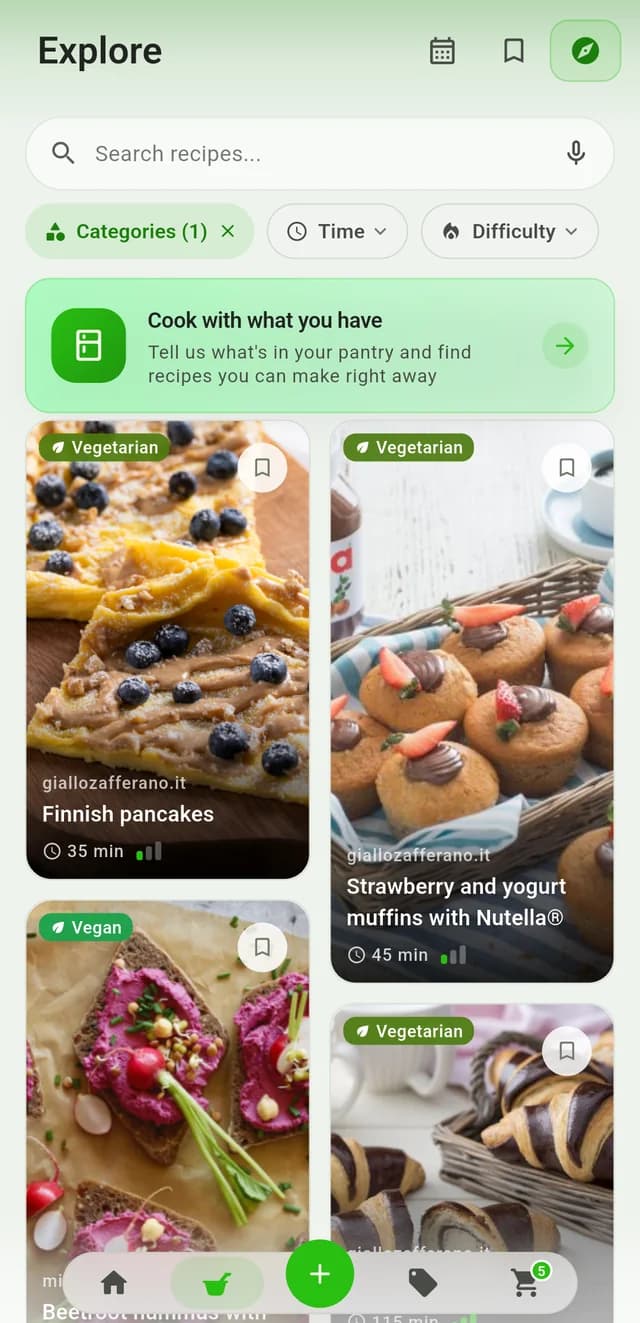
Filter by diet style
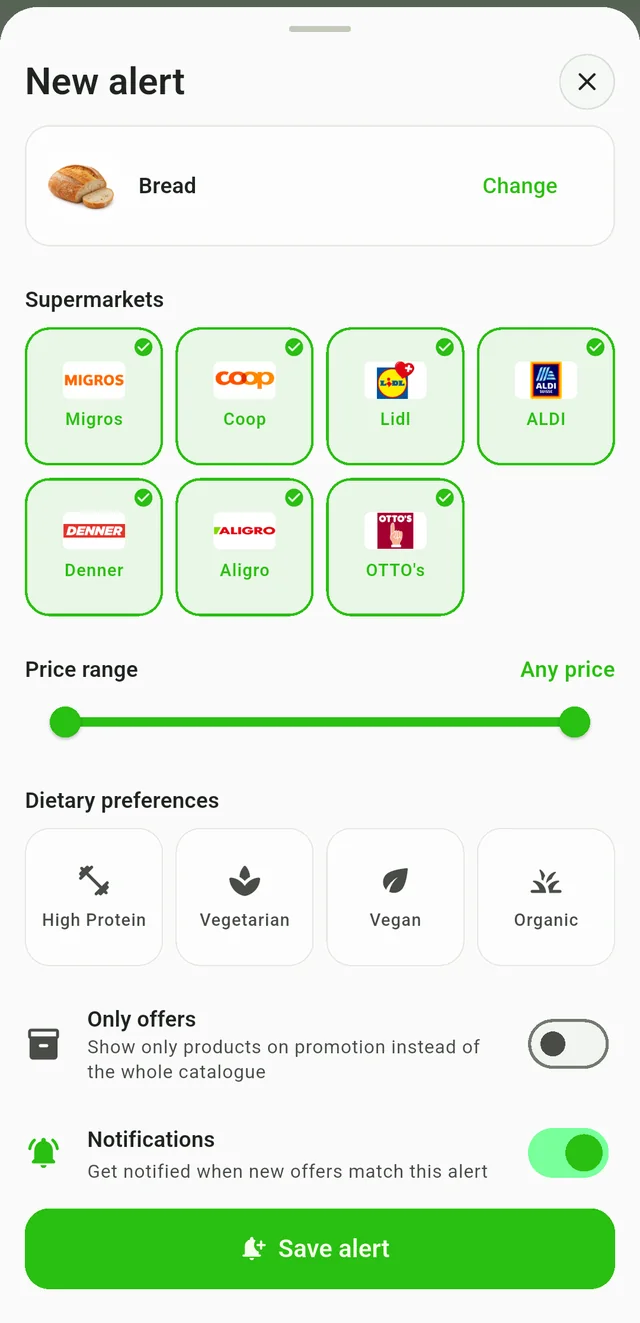
Set a product alert
What does the label say in Switzerland?
The LIV (as of 1 July 2025) sets the limits. Art. 41: “gluten-free” allows at most 20 mg gluten per kg at the time of sale, “very low gluten content” at most 100 mg/kg. Art. 42: “lactose-free” means less than 0.1 g lactose per 100 g or 100 ml of the ready-to-eat product, “low lactose” (laktosearm) at least half the lactose of the normal product and at most 2 g per 100 g dry matter.
Allergens, including cereals containing gluten and milk, must be highlighted in the ingredient list.
What does a week of dinners look like?
| Day | Dinner | Suits | Check or swap |
|---|---|---|---|
| Monday | Risotto with seasonal vegetables | GF + LF | Stock: check the label; mature hard cheese instead of butter |
| Tuesday | Polenta with lentil or meat ragù | GF + LF | Do not thicken the ragù with wheat flour |
| Wednesday | Rösti with a fried egg and salad | GF + LF | Ready-made rösti: check the label; fry in oil |
| Thursday | Rice bowl with tofu and vegetables | GF + LF | Soy sauce labelled “gluten-free” |
| Friday | Potato and vegetable gratin | GF + LF | Cream labelled “lactose-free” |
| Saturday | Lentil dal with rice | GF + LF | Spice mixes: check the label |
| Sunday | Oven-baked fish with potatoes and vegetables | GF + LF | No breadcrumbs; oil instead of butter |
For the overall balance of portions, see the guide on a meal plan following the Swiss food pyramid, for rushed evenings the quick weeknight dinners, for the base stock the pantry staples list. And to build the whole week, see how to meal plan in Switzerland.
How do you avoid cross-contamination in a shared kitchen?
The FSVO sums up kitchen hygiene in four rules: wash, heat, separate, chill. These are rules against germs, not against gluten, but the principle of “separate” applies here too. The tips below are common practice, not a standard: with coeliac disease, ask your dietitian how to set up the kitchen.
- Your own toaster and board for gluten-free bread, or toaster bags.
- Clean surfaces before you start, washed dishes, no sponge that touched normal bread.
- Gluten-free pasta in fresh water, never in water that cooked normal pasta.
- Gluten-free products on the top shelf, so no crumbs fall on them.
- Separate butter and spreads: a knife that went into normal bread and then into the butter leaves crumbs behind.
What do the special products cost?
It depends on the product and the week. The prices are in the dedicated guides: gluten-free prices and lactose-free prices. For ideas at the stove, see the recipes.
How does Rappn help?
In Rappn's Kitchen, under “Explore”, the “Categories” filter has six diet styles, including gluten-free and lactose-free. The tags on recipes are a starting point, not a medical guarantee: always check the product label. With “New alert” you choose Supermarkets, Price range, Dietary preferences, “Only offers” and Notifications. On screen the preferences are High Protein, Vegetarian, Vegan and Organic: for gluten and lactose, the label remains the reference.
Updated: .
Why Rappn?
Rappn is an independent grocery price comparison app in Switzerland, with no commercial agreements with any retailer. Our comparisons are truly independent.
- 100% free: no subscription, no hidden costs
- Neutral: no commercial agreements with Migros, Coop, Aldi, Lidl, Denner, Aligro, or Otto’s
- Updated daily, as soon as the chains publish their deals
- The chains’ deals in one place: search, filter, compare, no account needed
- Meal planner in the Kitchen tab: plan the week, send the ingredients to your list
Ready to save on groceries?
Install Rappn and compare for yourself this week. No account required.Scan the code, install Rappn and compare current offers. No account needed.
Built in Switzerland, for Switzerland
Frequently Asked Questions
Can I cook gluten-free and lactose-free at the same time?
Yes, with natural bases such as potatoes, rice, polenta, legumes, eggs, fish, meat, vegetables and fruit. They are two different needs though: gluten must be excluded completely with coeliac disease, lactose tolerance is individual. Ask your doctor or a dietitian.
Does hard cheese contain lactose?
According to aha! Swiss Allergy Centre, mature hard cheese is naturally almost lactose-free. Tolerance still differs from person to person.
Are oats gluten-free?
Only if the product is labelled “gluten-free” and the contamination stays at or below 20 mg/kg. With coeliac disease, according to IG Zöliakie, oats are introduced in very small amounts with a dietitian.
What does “gluten-free” on a label mean in Switzerland?
At most 20 mg gluten per kg at the time of sale (LIV, Art. 41). “Very low gluten content” allows up to 100 mg/kg.
Should I go gluten-free before a coeliac test?
No. According to IG Zöliakie, do not start a gluten-free diet before the blood test, because it can mask the diagnosis.
How do I avoid gluten in a shared kitchen?
Use a separate toaster and board, clean surfaces, fresh water for gluten-free pasta and separate butter. Store gluten-free products on the top shelf.