
Pantry Staples List: What to Always Have at Home
A well-stocked pantry saves dinner when the fridge is empty. See what to keep, how long it lasts and how to rotate it without waste.
Rappn compares prices across all 7 chains live: free, no account.
Manage your pantry in Rappn, free
A working pantry is 20 to 30 shelf-stable basics that you actually cook with every week and replace as you use them. It is not the federal emergency stock: that has fixed amounts and a fixed purpose, while the pantry lets you cook on ordinary days even when you have not been shopping.
Updated October 2026. Sources: foodwaste.ch (“Check die Haltbarkeit”), FONES/BWL (“We advise - emergency supplies”), FSVO/BLV and SSN/SGE (Swiss nutrition recommendations 2024).
What belongs in a pantry staples list?
| Item | Why | Typical shelf life | Buy on promotion? |
|---|---|---|---|
| Dry goods | |||
| Pasta | Base of many quick dinners | At least 360 days past the best-before date if kept dark, dry and sealed (foodwaste.ch) | Yes |
| Rice | Side dish and one-pot base | At least 360 days past the best-before date if stored correctly (foodwaste.ch) | Yes |
| Polenta | Ticino classic, easy to prepare | Printed on the pack (best-before) | Yes, if you use it |
| Flour | Bread, dough, béchamel | Best-before date on the pack, then a look, smell and taste check (foodwaste.ch method) | Yes, the white one |
| Rolled oats | Breakfast, baking | Printed on the pack (best-before) | Yes |
| Lentils and chickpeas (dry or canned) | Plant protein, soups, salads | Printed on the pack (best-before) | Yes |
| Cans and jars | |||
| Passata and chopped tomatoes | Sauces, soups, stews | Printed on the pack (best-before) | Yes |
| Canned tuna | Ready protein for salads and pasta | Printed on the pack (best-before) | Yes |
| Beans and sweetcorn | Sides, salads, soups | Printed on the pack (best-before) | Yes |
| Oils, vinegar and condiments | |||
| Olive oil and rapeseed oil | Cooking and dressing | Printed on the pack (best-before) | Only a size you will finish |
| Vinegar | Salads, marinades | Best-before date on the pack, then a look, smell and taste check (foodwaste.ch method) | Yes |
| Salt and spices | Basic flavour | Best-before date on the pack, then a look, smell and taste check (foodwaste.ch method) | Small amounts |
| Stock cubes, mustard | Quick broths and sauces | Printed on the pack (best-before) | Yes |
| Breakfast and baking | |||
| Sugar, honey | Sweetening, baking | Best-before date on the pack, then a look, smell and taste check (foodwaste.ch method) | Yes |
| Coffee, tea | Breakfast and breaks | Best-before date on the pack, then a look, smell and taste check (foodwaste.ch method) | Yes |
| Baking powder | Simple cakes | Printed on the pack (best-before) | No, one sachet is enough |
| Freezer | |||
| Frozen vegetables, peas, spinach | Vegetables always at hand | freezing guide | Yes |
| Bread in slices or portions | Stops leftover bread going to waste | See the freezing guide | Yes |
| Fresh items that keep | |||
| Onions, garlic, potatoes | Base of countless recipes | Cool and dark, check weekly | Only the amount you use |
| Eggs | Quick protein | Printed on the pack (best-before) | No |
| Hard cheese | Gratins, seasoning, snacks | Printed on the pack (best-before) | Yes, in a piece |
| UHT milk | Backup when the fresh milk runs out | Printed on the pack (best-before) | Yes |
For amounts you can start from the FSVO/SSN 2024 recommendations: 45 to 75 g of dry pasta, rice or polenta per portion, 60 g of raw pulses, and 2 tablespoons of vegetable oil a day, at least 1 tablespoon of it rapeseed oil.
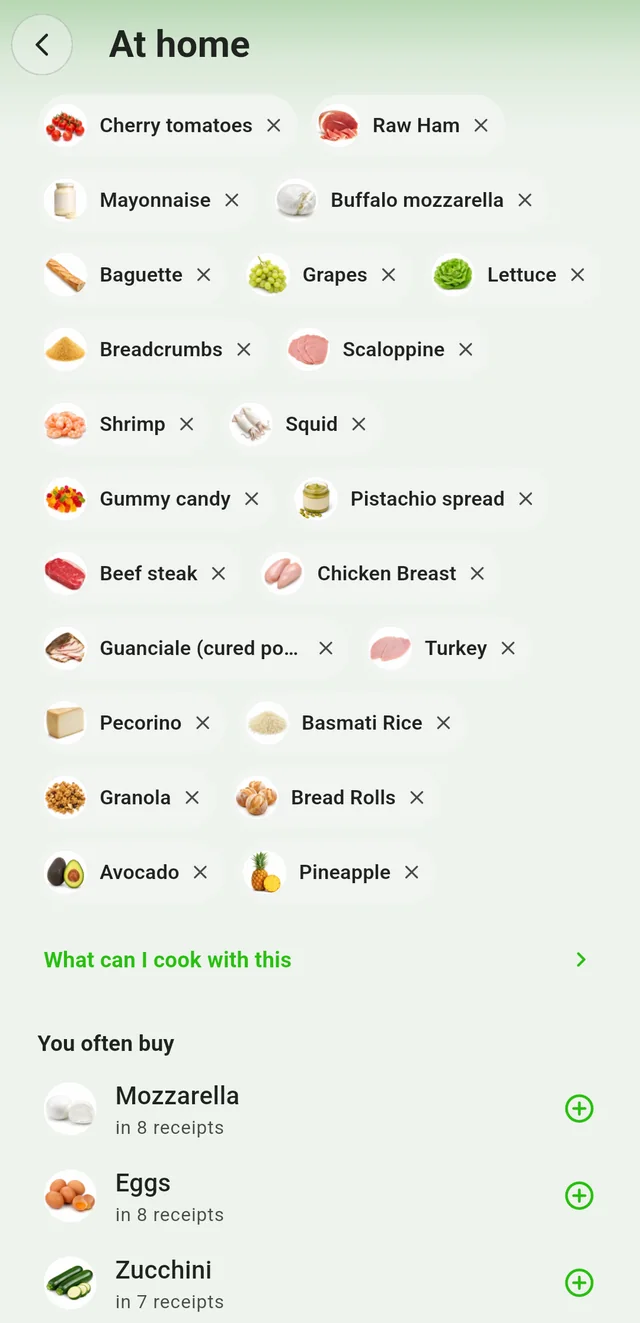
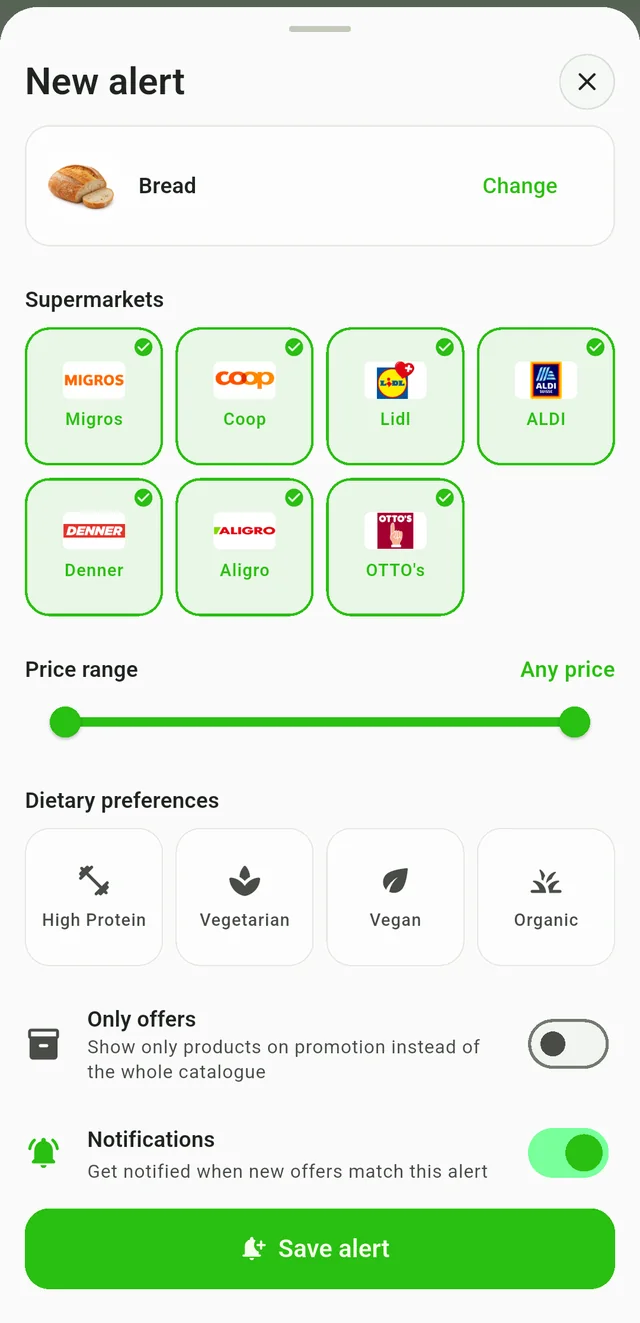
Keep track of what is at home and get notified when a staple goes on offer.
Manage your pantry in Rappn, freeFree, no account required · iOS & Android
Track what’s at home
Set an alert
Best-before or use-by date: what is the difference?
The best-before date says how long the producer guarantees quality, not safety. The use-by date applies to highly perishable food: after it, the product may be neither handed over nor processed (FSVO). In a pantry you will mostly find best-before dates. More in our guide to best-before and use-by dates in Switzerland.
Pantry or emergency stock: what is the difference?
The FONES (Federal Office for National Economic Supply) campaign “We advise - emergency supplies” recommends at least 9 litres of water per person and a personal stock for 7 days, stored cool, dry and dark and built into everyday cooking: consume regularly and replace. The pantry partly overlaps but is meant for daily use. Costs and the list for a real emergency are in emergency food stock in Switzerland.
What should you not stockpile?
- Fresh products: fruit, leafy greens, fresh meat and dairy are bought to fit the week’s meal plan.
- Oils and nuts: they can go rancid, so buy small sizes and check the smell.
- Wholemeal flour: it keeps for less time than white flour, the duration is printed on the pack.
- Spices: they stay safe but lose aroma. Only stock up on those you use often.
How do you rotate the pantry (first in, first out)?
- After shopping, put new items at the back and older ones at the front.
- Once a month check the best-before dates and move whatever expires first to the front.
- Plan a meal around items that expire soon: ideas are in use-up-leftovers recipes.
- Write down what ran out and buy back only the amount you will use within a few weeks.
Promotions only help for what you rotate. The logic is in stockpiling on promotions.
How does Rappn help with your pantry?
Under “At home” in Rappn’s Kitchen you note the ingredients you have, and “What can I cook with this” suggests recipes for them, with more ideas in what to cook with what I have. Under “You often buy” you see products from your receipts. For things you use every week you can set up an alert: choose the supermarkets and the price range, switch on “Only offers” and notifications. Recipes go onto your list as described in recipes to shopping list, and it all starts with your weekly meal plan.
Updated: .
Why Rappn?
Rappn is an independent grocery price comparison app in Switzerland, with no commercial agreements with any retailer. Our comparisons are truly independent.
- 100% free: no subscription, no hidden costs
- Neutral: no commercial agreements with Migros, Coop, Aldi, Lidl, Denner, Aligro, or Otto’s
- Updated daily, as soon as the chains publish their deals
- The chains’ deals in one place: search, filter, compare, no account needed
- Meal planner in the Kitchen tab: plan the week, send the ingredients to your list
Ready to save on groceries?
Install Rappn and compare for yourself this week. No account required.Scan the code, install Rappn and compare current offers. No account needed.
Built in Switzerland, for Switzerland

Frequently Asked Questions
What should be in a pantry?
Pasta, rice, flour, pulses, canned tomatoes, oil, salt, sugar and some frozen items: about 20 to 30 products you actually use. The full list is in the table above.
How long does pasta last after the best-before date?
According to foodwaste.ch, dry pasta kept dark, dry and sealed can be enjoyed safely for at least 360 days past the best-before date. Check for pests or mould before cooking.
What is the difference between a pantry and an emergency stock?
The pantry is for everyday cooking; the FONES emergency stock calls for at least 9 litres of water per person and supplies for 7 days. Both should be rotated and built into everyday cooking.
What is the difference between best-before and use-by?
Best-before is about quality, use-by is about safety: after it the product must no longer be used. In a pantry you will mostly find best-before dates.
Is it worth stocking up when something is on promotion?
Only for products you use regularly and that keep well. A promotion on something you do not use turns into food waste.