
Why does the same item not cost the same in every shop in Switzerland?
Because the store format, the operator, the sales channel and the day of the week decide more than the logo on the front. The Swiss price indication ordinance governs how a price must be displayed, not that it has to be equal across branches. The publicly measured case inside a single chain comes from Saldo (reported by blick.ch on 7 March 2024) and ended in November 2024. What applies in your shop today, you can see live in Rappn.
Rappn compares the current promotions of 7 Swiss retailers, updated daily: free, no subscription.
Check the offers near youThe current offers from the seven chains, searchable and filterable by product, category, price and canton, with the unit price next to the pack price.
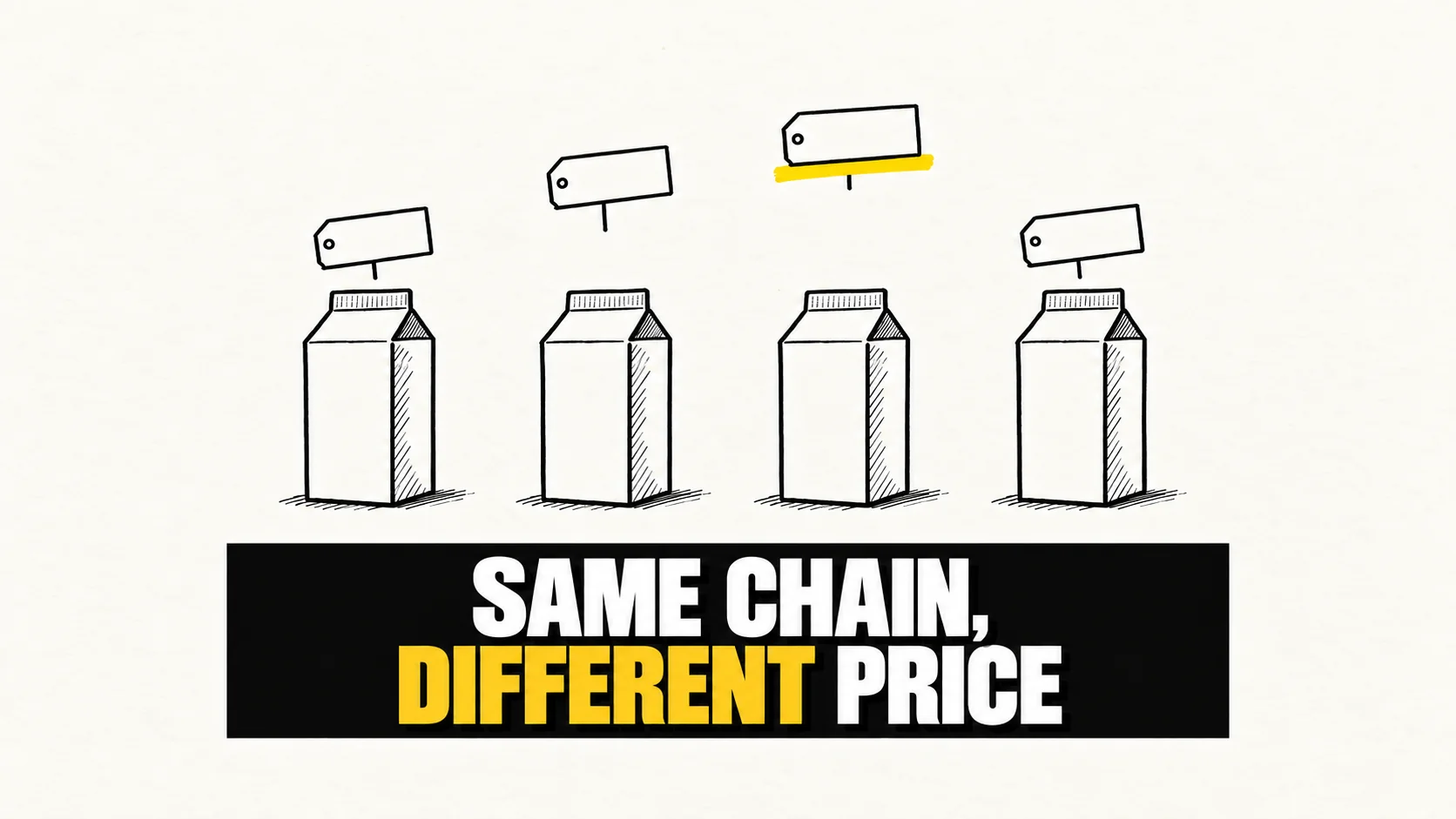
Yes, it happens, and most of the time the chain is not the reason: the individual shop is. An item with the same barcode can carry three different prices in a neighbourhood supermarket, a petrol station shop and a village store, even though the same logo hangs over all three. The Swiss price indication ordinance governs how a price must be displayed, not that it has to be identical in every outlet. This guide sorts the six causes, shows the case that was publicly measured in Switzerland, and says what is still true in September 2026.
Last updated: September 2026. Sources: the price indication ordinance PBV (SR 942.211), summarised on kmu.admin.ch; the Saldo consumer magazine price comparison of Migros branches, reported by blick.ch (7 March 2024) and infosperber.ch (23 March 2024); 20 Minuten (17 November 2024); RTS (18 March 2026); migrolino-ag.ch; volg.ch (2025 figures). This guide deliberately quotes no shelf prices: they change every Thursday.
Rappn is an independent grocery price comparison app in Switzerland, with no commercial agreements with any retailer.
Does a chain have to charge the same price in every branch?
No. The price indication ordinance (PBV, SR 942.211 of 11 December 1978) governs the display, not the level. The federal summary on kmu.admin.ch puts it this way: the price actually to be paid by the consumer must be indicated in Swiss francs, including public levies such as VAT, copyright remuneration and any surcharge that is not freely chosen. For measurable goods whose retail price depends on the quantity sold, the unit price per litre or kilo must be shown as well. Breaches can be punished with a fine of up to CHF 20’000.
What the ordinance does not say matters just as much: it contains no duty to charge the same amount in two outlets of the same chain. The price must be accurate, complete and legible. How high it is depends on who runs the shop and with what costs. The price on the shelf in your shop is therefore the only figure that matters for your groceries, not a Swiss average.
That the display itself is a source of error was shown again in 2026. According to RTS of 18 March 2026, SECO concluded that Migros was in breach of the ordinance on multi-buy labels where the struck-through single-unit price was nearly illegible next to the large promotional price, while Coop sat at the limit of what is permitted. Migros replied that it designs its labels so that promotions stand out clearly; Coop called one contested case a human error with no intent to mislead.
The phone shows which of the seven chains have the same product on offer this week, filterable down to your canton, and Rappn is free.
Check the offers near youFree, no subscription · iOS & Android
"milk"
Welcome
Cause 1: the store format weighs more than the logo
A large supermarket, a station shop, a petrol station shop, a village store and a cash and carry have completely different cost structures: rent per square metre, opening hours, staff per franc of turnover, delivery frequency, size of the range. An outlet that opens on Sundays and late in the evening carries costs that a neighbourhood shop closing at 7 pm does not. The gap you see at the till is usually exactly that cost gap, and not a property of the brand.
Aligro shows the same logic from the other end: the cash and carry format sells in large pack sizes and is open to everyone without a membership card, so its prices only compare with a supermarket shelf through the unit price per kilo or litre.
Cause 2: whoever runs the till is not always the chain
Many outlets carrying a familiar logo do not belong to the group at all: they are run by independent operators. migrolino’s own franchise material states it plainly: the franchisee is legally independent and acts for their own account (migrolino-ag.ch, September 2026). The same source lists more than 360 locations under the migrolino, mio and gooods brands, run by franchise partners or together with the strategic partners Migrol, Shell, SOCAR and Piccadilly.
| Outlet | Who runs it | What follows for the shelf price | Source and date |
|---|---|---|---|
| Coop supermarket | Coop itself | Coop states nationwide uniform prices for identical products | infosperber.ch, 23 March 2024 |
| Migros supermarket | the regional cooperatives | The selective price differentiation between branches was given up in November 2024 | 20 Minuten, 17 November 2024 |
| migrolino and mio shop at a station or petrol station | more than 360 locations, run by franchise partners or together with Migrol, Shell, SOCAR and Piccadilly | The franchisee is legally independent and acts for their own account | migrolino-ag.ch, September 2026 |
| Volg village store and TopShop | 2025: 593 Volg shops, 193 outlets of independent retailers, 121 AGROLA TopShops | Independent retailers run their own shops and are only supplied by Volg | volg.ch, 2025 figures |
Cause 3: the location, and the case that was publicly measured
| What was measured | Result | Source and date |
|---|---|---|
| Greenstar apples, 1 kg, Zurich Kreuzplatz | CHF 5.60 | Saldo, reported by blick.ch, 7 March 2024 |
| Greenstar apples, 1 kg, Zurich Stadelhofen, 500 metres away | CHF 5.20 | Saldo, reported by blick.ch, 7 March 2024 |
| Average markup on loose goods, city of Zurich | 7.5 percent | Saldo, reported by 20 Minuten, 17 November 2024 |
| Highest markup measured, city of Zurich | up to 11 percent | Saldo, reported by blick.ch, 7 March 2024 |
| Average markup, Basel | about 10 percent | Saldo, reported by 20 Minuten, 17 November 2024 |
| Additional Migros Zurich revenue from the practice, 2023 | about CHF 2.64 million, roughly 0.1 percent of supermarket turnover | Saldo, reported by blick.ch and infosperber.ch, March 2024 |
The second half of the story is the one that rarely travels: the practice ended. On 17 November 2024, 20 Minuten reported that Migros was giving up, as part of its new national pricing strategy, the price differentiation it had applied selectively, alongside price cuts on more than 1’000 products. The same source notes that not every region benefits equally, because the cuts start from different levels. In late October 2024 Migros had already announced on its corporate site that it was bringing fruit and vegetable prices down to discounter level and extending the programme to more than 1’000 items in 2025.
For comparison, on 23 March 2024 infosperber.ch quoted Coop as maintaining nationwide uniform prices for identical products. Two chains, two models, and both have moved since: no rule of thumb from 2024 tells you what is on the shelf today on your corner.
Cause 4: region and canton, and what the cooperatives have to do with it
At Migros the regional layer is built into the organisation: retail runs through regional cooperatives that manage their own territory, carry regional ranges and publish their own editions of the weekly flyer. How that split works is set out in the guide on the Migros regional cooperatives. For the price question the short version is enough: an item promoted in one region need not appear in the neighbouring region’s flyer at all.
The canton itself does not make the price. VAT is federal, not cantonal. What varies from canton to canton are the framing conditions: shop opening laws, rents, population density, the number of competing shops nearby. How much of that actually reaches the weekly basket is covered in the guide on where groceries are cheapest by canton.
Cause 5: online and in store are two channels
A chain’s online shop is a channel of its own, with its own range, its own pack sizes and, crucially, delivery or click and collect charges on top of the value of the goods. A basket you build online and the same basket in the store therefore rarely add up to the same amount, even when not a single item is labelled differently. What is genuinely worth comparing between the two channels is covered in the guide on online versus in store grocery prices.
Cause 6: sometimes a different price only means a different day
A large share of the differences people notice is not about place at all, it is about timing. Migros, Coop and Denner start their weekly promotions on Thursday, Coop since the week of 21 January 2025, Migros and Denner since 5 February 2026. Aldi Suisse and Lidl Schweiz publish new offers twice a week, on Monday and on Thursday. Walk into the same shop on a Wednesday and then on a Friday, and you will see the same item at two prices without the chain having differentiated anything between two branches.
Then there is the comparison price on the label. Since 1 January 2025, according to kmu.admin.ch, a comparison price may only be shown next to the price actually to be paid if the item was offered at that price for at least 30 days beforehand (Art. 16 para. 1 PBV). The struck-through price is therefore a regulated statement about the past, not evidence about the shop down the road. Because prices move every Thursday, Rappn shows the promotions that are currently valid rather than a snapshot, filtered by chain and by canton. How the promotion calendar works overall is explained in the guide on how Swiss Aktionen work.
How to check the price in the shop you actually use
The honest answer to whether something costs the same everywhere is: it depends, and it depends on the format, the operator, the channel and the day of the week, in that order. The group level is the weakest of the four. In practice: do not compare chains against chains, compare the item you want to buy across the chains, in your canton, on the day you shop, and always on the unit price per kilo or litre rather than on the pack price.
That is exactly what Rappn is built for. The app compares the current offers from Migros, Coop, Aldi Suisse, Lidl Schweiz, Denner, Aligro and Otto’s, shows the unit price next to the pack price, filters by canton and lets you set a price alert. Rappn is free, works without an account and is available in four languages. Look up the item you care about and see it for your own region, instead of trusting a rule of thumb.
Updated: .
Why Rappn?
Rappn is an independent grocery price comparison app in Switzerland, with no commercial agreements with any retailer. Our comparisons are truly independent.
- 100% free: no subscription, no hidden costs
- Neutral: no commercial agreements with Migros, Coop, Aldi, Lidl, Denner, Aligro, or Otto’s
- Updated daily, as soon as the chains publish their deals
- The chains’ deals in one place: search, filter, compare, no subscription
- Meal planner in the Kitchen tab: plan the week, send the ingredients to your list

Ready to save on groceries?
Install Rappn and compare for yourself this week. No account required.Scan the code, install Rappn and compare current offers. No account needed.




Frequently Asked Questions
Are a chain's prices the same in every branch?
Not necessarily, and the ordinance does not require it. According to the federal summary on kmu.admin.ch, the price indication ordinance (SR 942.211) only requires the price actually to be paid to be shown in Swiss francs, including VAT and any surcharge that is not freely chosen, plus the unit price for measurable goods. Whether two outlets of the same chain charge the same amount is the chain's decision, not the law's. On 23 March 2024 infosperber.ch quoted Coop as maintaining nationwide uniform prices for identical products.
Why is the petrol station shop dearer than the supermarket of the same brand?
Often because it is a different company. migrolino's own franchise material states that the franchisee is legally independent and acts on their own responsibility and for their own account (migrolino-ag.ch, September 2026). On top of that come the cost drivers of the format: rent at high-traffic locations, long opening hours including Sundays, a small sales floor and more frequent deliveries. This guide deliberately puts no percentage on the surcharge, because no public, dated measurement of it was found.
Did Migros really charge more in expensive neighbourhoods?
It was a documented case, and it is over. A Saldo price comparison reported by blick.ch on 7 March 2024 found an average markup on loose goods of 7.5 percent in the city of Zurich and about 10 percent in Basel, with peaks up to 11 percent; Greenstar apples cost CHF 5.60 per kilo at Zurich Kreuzplatz and CHF 5.20 at Stadelhofen 500 metres away. On 17 November 2024, 20 Minuten reported that Migros was giving up this differentiation as part of its new national pricing strategy.
Does the canton set the price?
Not directly. VAT is set at federal level, not cantonal. What varies between cantons are the framing conditions: shop opening laws, rents, population density and the number of competing shops nearby. Added to that is the regional layer of the Migros cooperatives, with their own ranges and their own flyer editions. How the cantons actually rank is covered in the guide on where groceries are cheapest in Switzerland.
Why does the same item have two prices between Wednesday and Friday?
Because the promotion start falls in between. Migros, Coop and Denner launch their weekly promotions on Thursday, Coop since the week of 21 January 2025, Migros and Denner since 5 February 2026. Aldi Suisse and Lidl Schweiz add a wave on Monday. The gap is then not a branch difference at all, it is a calendar difference. Which prices apply right now you can see live in Rappn, filtered by chain and canton.
What does the struck-through price on the label actually mean?
Something about the past, not about the shop down the road. According to kmu.admin.ch, since 1 January 2025 a comparison price may only appear next to the price actually to be paid if the item was offered at that price for at least 30 days beforehand (Art. 16 para. 1 PBV). That the label itself can mislead was shown by the SECO finding on multi-buy promotions reported by RTS on 18 March 2026. Breaches of the ordinance can be punished with a fine of up to CHF 20’000.