
What Does a Low-Carb Grocery Budget Cost in Switzerland, and Where Are the Price Traps?
Low carb is expensive in Switzerland because you delete the cheapest calories in the basket: a kilo of potatoes averages CHF 2.92, a kilo of minced beef CHF 22.15 (BFS, January 2026). Meat is also the most inflated Swiss food category, with a price level of 207.7 against EU-27 = 100 (Eurostat, 2024). What lowers the basket is not switching chains but the cut, the variety and the promotion week.
Rappn compares the current promotions of 7 Swiss retailers, updated daily: free, no subscription.
Check the price in Rappn, free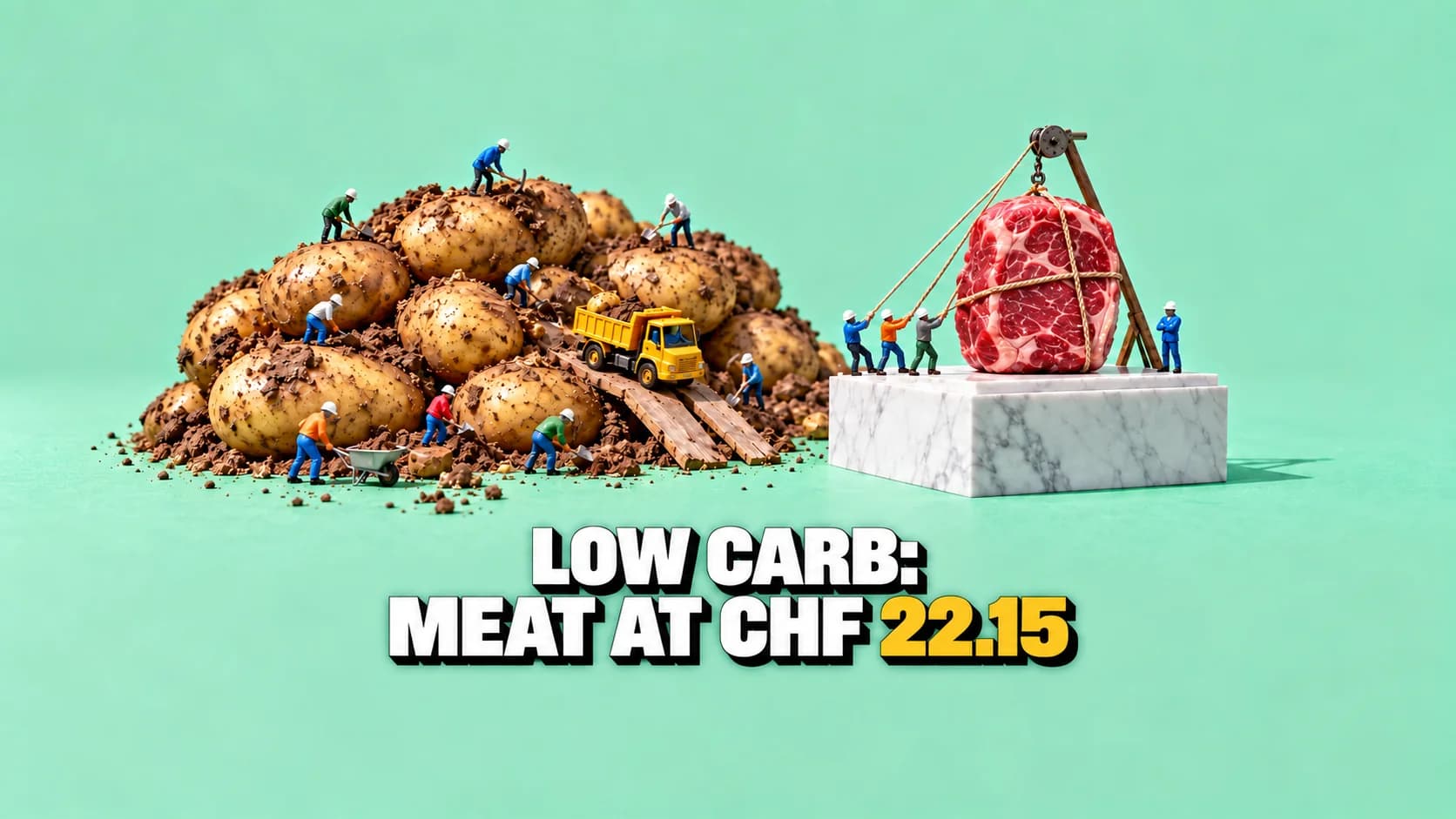
A low-carb basket is expensive in Switzerland not because low-carb products are expensive, but because you delete the cheapest calories in the country. A kilo of potatoes costs CHF 2.92 on the Swiss average, a kilo of minced beef CHF 22.15, both January 2026 average prices from the Federal Statistical Office, a factor of roughly 7.6 when you swap a side dish for protein. This page prices the building blocks of a low-carb basket with official figures, shows the three price traps, and names the lever that actually works: not the chain, but the cut, the variety and the week.
Sources checked regularly. Average prices: Federal Statistical Office (BFS), "LIK, Durchschnittspreise ausgewählter Produkte", monthly values January 2026. International price-level comparison: Eurostat, dataset prc_ppp_ind, price level indices with EU-27 = 100, year 2024. Vegetable and budget-flour prices for 2024: Agrarbericht 2025, Federal Office for Agriculture. Vegetable reference prices for direct marketing: Swiss Farmers' Union, valid from 29.06.2026. Promotion cycle: press release "Migros-Aktionen starten neu am Donnerstag" (corporate.migros.ch, 26.01.2026) and foodaktuell (26.01.2026). Basket comparisons: RTS "A Bon Entendeur" (18.04.2024) and bonus.ch (03.09.2025). Protein bread: familleSuisse. Dietary recommendations: Federal Food Safety and Veterinary Office (BLV). Last checked: July 2026.
Rappn is an independent grocery price comparison app in Switzerland, with no commercial agreements with any retailer.
Why does low carb cost more in Switzerland than abroad?
| Price level index 2024 (EU-27 = 100) | Switzerland | Germany | France | Italy | Austria |
|---|---|---|---|---|---|
| Meat | 207.7 | 112.3 | 131.7 | 105.2 | 120.1 |
| Bread and cereals | 163.0 | 105.7 | 112.5 | 108.5 | 120.0 |
| Milk, cheese and eggs | 147.2 | 97.1 | 96.0 | 105.0 | 102.8 |
| Fruit, vegetables, potatoes | 137.0 | 103.0 | 119.2 | 103.3 | 103.1 |
| Food overall | 161.1 | 102.9 | 111.5 | 104.0 | 110.9 |
Two honest readings follow. First: a low-carb basket built on eggs, quark, cheese and vegetables sits closer to European price levels than one built on meat. The composition matters more than the label. Second, against our own thesis: bread and cereals in Switzerland sit at 163.0, slightly above the food average. So "you are cutting the cheap calories" holds in Swiss francs, not in a comparison with Europe.
These are live offers in Rappn: search a low-carb staple like chicken and see which chains have it on offer this week, then build the basket around that offer instead of a fixed list. Type a product to try it.
Check the price in Rappn, freeFree, no subscription · iOS & Android
"chicken"
Offers
What do the building blocks of a low-carb basket cost?
| Building block | Quantity | Price | Converted | Source |
|---|---|---|---|---|
| Swiss eggs, barn | 6 pcs | CHF 2.56 | approx. 43 centimes per egg | BFS, January 2026 |
| Imported eggs | 6 pcs | CHF 2.12 | approx. 35 centimes per egg | BFS, January 2026 |
| Minced beef | 1 kg | CHF 22.15 | CHF 22.15 per kg | BFS, January 2026 |
| Pork stewing meat | 1 kg | CHF 16.89 | CHF 16.89 per kg | BFS, January 2026 |
| Pork chops | 1 kg | CHF 20.88 | CHF 20.88 per kg | BFS, January 2026 |
| Entrecôte | 1 kg | CHF 74.58 | CHF 74.58 per kg | BFS, January 2026 |
| Tilsit cheese | 100 g | CHF 1.63 | CHF 16.30 per kg | BFS, January 2026 |
| Emmental | 100 g | CHF 1.82 | CHF 18.20 per kg | BFS, January 2026 |
| Gruyère | 100 g | CHF 2.02 | CHF 20.20 per kg | BFS, January 2026 |
| Plain yoghurt | 180 g | CHF 0.81 | CHF 4.50 per kg | BFS, January 2026 |
| Full cream | 2.5 dl | CHF 2.52 | approx. CHF 10.10 per litre | BFS, January 2026 |
| Butter (cooking butter) | 250 g | CHF 3.88 | CHF 15.52 per kg | BFS, January 2026 |
| Carrots, conventional | 1 kg | CHF 1.94 | CHF 1.94 per kg | Agrarbericht 2025, year 2024 |
| Carrots, organic | 1 kg | CHF 3.22 | CHF 3.22 per kg | Agrarbericht 2025, year 2024 |
| Broccoli | 1 kg | CHF 6.00–7.00 | direct-marketing reference price | Swiss Farmers' Union, from 29.06.2026 |
| Cucumbers | 1 kg | CHF 6.10–6.70 | direct-marketing reference price | Swiss Farmers' Union, from 29.06.2026 |
| Courgettes, small | 1 kg | CHF 5.50–6.20 | direct-marketing reference price | Swiss Farmers' Union, from 29.06.2026 |
| Potatoes (the side dish you drop) | 1 kg | CHF 2.92 | CHF 2.92 per kg | BFS, January 2026 |
| Flour, budget line (the side dish you drop) | 1 kg | CHF 1.01 | CHF 1.01 per kg | Agrarbericht 2025, year 2024 |
The three price traps in a low-carb basket
1. The cut matters more than the store. Inside the meat category alone, entrecôte at CHF 74.58 per kilo and pork stewing meat at CHF 16.89 per kilo are a factor of 4.4 apart, both BFS January 2026 averages, both meat. No change of retailer ever recovers a factor of 4.4. Cheese shows the same pattern on a smaller scale: Tilsit CHF 16.30, Emmental CHF 18.20, Gruyère CHF 20.20 per kilo. And six Swiss barn eggs cost CHF 2.56 against CHF 2.12 for six imported ones, that is 44 centimes, or roughly 17 percent less for the imported ones, an origin decision rather than a store decision. More detail on the cheapest meat in Switzerland, milk and cheese prices and egg prices in Switzerland.
2. "Low carb" on the packaging is a brand premium, not a store difference. On 12 August 2025 bonus.ch priced 20 standard-range branded products online at Aldi, Coop, Lidl and Migros, excluding promotions, and found prices almost identical: differences of mostly a single centime, with 30 centimes, or 4.5 percent, as the largest gap on any one product (published 03.09.2025). No low-carb item was in that sample; the logic carries over to any branded product several chains stock alike: when "low carb", "keto" or "protein" is on the pack, switching chains is in all likelihood the weakest lever, the stronger question is whether you need the product at all. Take protein bread: according to familleSuisse, the various protein breads contain 11 to 18.6 grams of fat per 100 grams, roughly eight times the fat of an ordinary Ruchbrot, the standard Swiss medium-dark wheat loaf, and twice that of a butter braid, and they are sold in bakeries as well as at Migros and Aldi. Eggs, plain yoghurt and cheese are the same categories without the brand premium.
3. The organic and the variety premium on vegetables. Vegetables drive the volume in a low-carb basket, and this is where the spread is widest. For 2024, Agrarbericht 2025 lists carrots at CHF 1.94 per kilo and organic carrots at CHF 3.22 (plus 66 percent), celeriac at CHF 2.80 against CHF 5.34 organic (plus 91 percent), and onions at CHF 2.24 against CHF 5.37 (plus 140 percent). On top of that comes the variety premium: in the Swiss Farmers' Union direct-marketing reference prices valid from 29.06.2026, carrots cost CHF 2.10 to 2.50 per kilo, broccoli CHF 6.00 to 7.00, cauliflower CHF 5.75 to 8.25, cucumbers CHF 6.10 to 6.70, small courgettes CHF 5.50 to 6.20 and beefsteak tomatoes CHF 5.60 to 6.20. That marks out the cheap lane clearly, and it is a narrow one: root vegetables. Brassicas explicitly do not belong to it, broccoli and cauliflower, at CHF 5.75 to 8.25, sit on the same level as cucumbers, courgettes and tomatoes. Per kilo, root vegetables cost roughly a third of brassica, fruiting and salad vegetables. Current shelf prices are covered in the guide to fruit and vegetable prices in Switzerland.
Where does switching store actually pay?
| Part of the basket | How big is the difference? | Evidence | What it means for you |
|---|---|---|---|
| Whole staples basket | 30 products: Lidl CHF 162.05, Aldi CHF 166.59, Coop CHF 167.82, Migros CHF 170.37, Denner CHF 181.67 | RTS "A Bon Entendeur", April 2024 | Roughly 12 percent across the whole basket, the store counts, but it is not the biggest lever |
| Standard-range branded products | 20 branded products at Aldi, Coop, Lidl, Migros: near-identical, mostly one centime apart, at most 30 centimes or 4.5 percent | bonus.ch, priced 12.08.2025, published 03.09.2025 | On branded goods, switching chains saves almost nothing; the product choice decides |
| Fresh meat and the fresh counter | In the RTS test the ranking turned on a single line: cheap minced steaks were missing at Denner on the shopping day, and the company pointed out that such products are regularly stocked | RTS "A Bon Entendeur", April 2024 | For fresh goods the day decides, not the chain's reputation, check first |
| Private label instead of brands | Follows from combining both comparisons: identical branded prices but different basket totals | bonus.ch 03.09.2025 and RTS 18.04.2024 | The biggest plannable lever in a low-carb basket |
| This week's promotions | Migros and Denner have started on Thursday since 5 February 2026; Denner's weekend deal now runs four days instead of two | corporate.migros.ch and foodaktuell, 26.01.2026 | Your planning window is Wednesday evening to Thursday |
Chicken, cheese, eggs, quark: what is actually discounted this week.
Rappn puts the promotions of seven chains in one place, filtered to your canton, with product search, a shopping list and price alerts, so you build the basket around this week's real prices instead of last month's list.
Which promotions move a low-carb basket?
The categories that dominate a low-carb basket are typically promotion-heavy: meat, cheese, dairy and fresh vegetables. And the calendar has moved. The press release of 26 January 2026 states that from 5 February 2026 Migros promotions start on Thursday and run until the Wednesday of the following week, with the Migros magazine and its promotion supplement now delivered on Wednesday. Denner moved its promotion start to Thursday at the same time, and its weekend deal now runs four days instead of two (foodaktuell, 26.01.2026). Coop had switched roughly a year earlier. In practice: the best moment to plan a low-carb shop is Wednesday evening to Thursday, not Sunday. How the cycle spreads across the year is covered in the Swiss promotion calendar, and how to tell a real discount from an apparent one in the guide to spotting fake discounts.
And is low carb a good idea at all?
That is not a price question and Rappn does not answer it: whether a low-carbohydrate diet suits you is individual and belongs between you and a qualified professional. For orientation, here is what the official Swiss recommendation says. The BLV recommends adults eat five portions of vegetables and fruit a day, three of them vegetables and two fruit, three daily portions of grain products and potatoes with at least half wholegrain, meat including poultry a maximum of two to three times a week, and legumes at least once a week, with the explicit note that the quantities can be adjusted individually. Cutting grain products departs from that orientation. That is a personal decision rather than an arithmetic problem, and it does not change the price arithmetic above.
Verdict: it depends, but what it depends on is measurable
No chain is permanently the cheapest for a low-carb basket, and nobody can credibly guarantee you a weekly price: the basket rests on three things and all three move. The cut and the variety, where meat alone spans a factor of 4.4 and vegetables roughly a factor of 3. Private label instead of branded, because branded prices are near-identical across chains. And this week's promotion, which has started on Thursday since 5 February 2026. So the cheapest route is always the same: look at the current offers on meat, cheese, eggs and vegetables first, then build the basket around them. If protein is also on your mind, see high-protein grocery shopping; for the plant-based part, tofu and meat-substitute prices. And if your budget is a harder limit than your carbohydrates, the best private labels move more than any diet label.
Updated: .
Why Rappn?
Rappn is an independent grocery price comparison app in Switzerland, with no commercial agreements with any retailer. Our comparisons are truly independent.
- 100% free: no subscription, no hidden costs
- Neutral: no commercial agreements with Migros, Coop, Aldi, Lidl, Denner, Aligro, or Otto’s
- Updated daily, as soon as the chains publish their deals
- The chains’ deals in one place: search, filter, compare, no subscription
- Meal planner in the Kitchen tab: plan the week, send the ingredients to your list

Ready to save on groceries?
Install Rappn and compare for yourself this week. No account required.Scan the code, install Rappn and compare current offers. No account needed.




Frequently Asked Questions
What does low-carb grocery shopping cost in Switzerland?
There is no credible flat figure, because the price depends on the cut, the variety and the promotion week. As building blocks: minced beef CHF 22.15 per kilo, pork stewing meat CHF 16.89, Emmental CHF 18.20, six Swiss barn eggs CHF 2.56, plain yoghurt CHF 4.50 per kilo (all BFS average prices, January 2026), carrots CHF 1.94 per kilo (Agrarbericht 2025, year 2024). Do the arithmetic and the pattern is clear: meat along with brassica and salad vegetables drive the bill, while eggs, dairy and root vegetables hold it down.
Is low carb more expensive than a normal weekly shop?
In Swiss francs, usually yes, because the cheapest calories drop out: a kilo of potatoes averages CHF 2.92 and a kilo of budget flour CHF 1.01 (Agrarbericht 2025, year 2024), while a kilo of minced beef is CHF 22.15 (BFS, January 2026). On top of that, meat is the most inflated food category in Switzerland: a price level index of 207.7 against EU-27 = 100 in 2024 (Eurostat). How big the premium turns out to be depends on the composition, not the label.
Where is low-carb shopping cheapest: Migros, Coop, Aldi, Lidl or Denner?
No chain is permanently the cheapest, and for a low-carb basket the store is not the biggest lever. In the RTS basket test of April 2024 the same 30 staple products cost CHF 162.05 at Lidl, CHF 166.59 at Aldi, CHF 167.82 at Coop, CHF 170.37 at Migros and CHF 181.67 at Denner, roughly a 12 percent spread. For branded products, bonus.ch (03.09.2025) found prices near-identical across Aldi, Coop, Lidl and Migros. Comparing this week’s promotions on meat, cheese and vegetables is the more useful move.
Are products labelled "low carb" worth the money?
On price, they are the worst place in the basket to try to save: bonus.ch priced 20 standard-range branded products across Aldi, Coop, Lidl and Migros and found mostly a single centime of difference, with 30 centimes or 4.5 percent as the largest gap (priced 12.08.2025), so on branded goods switching chains achieves almost nothing. And a specialty product is not automatically what you expect: according to familleSuisse, protein breads contain 11 to 18.6 grams of fat per 100 grams, roughly eight times as much as an ordinary Swiss Ruchbrot. Whether such a product suits you is best clarified with a qualified professional.
Which vegetables are cheapest for low carb?
Root vegetables, by a wide margin. In the Swiss Farmers’ Union direct-marketing reference prices valid from 29.06.2026, carrots cost CHF 2.10 to 2.50 per kilo, while broccoli runs CHF 6.00 to 7.00, cauliflower CHF 5.75 to 8.25, cucumbers CHF 6.10 to 6.70 and small courgettes CHF 5.50 to 6.20. So brassicas are not automatically cheap. Add the organic premium: for 2024, Agrarbericht 2025 lists carrots at CHF 1.94 per kilo and organic carrots at CHF 3.22. Per kilo, brassica, fruiting and salad vegetables are a multiple of root vegetables.
When are meat and cheese on promotion in Switzerland?
The cycle shifted in 2026. According to the press release of 26 January 2026, Migros promotions start from 5 February 2026 on Thursdays and run until Wednesday; Denner moved to Thursday at the same time, with a weekend deal running four days instead of two (foodaktuell, 26.01.2026). Coop had switched roughly a year earlier. That makes Wednesday evening to Thursday the best planning moment for a low-carb shop.